💥Join UPSC 2027,2028 Mentorship (July Batch) + XFactor Notes & Microthemes PDF

GS Paper: GS3-08.Issues related to direct and indirect farm subsidies and MSP; PDS

  • NFSA Draft Amendment on Antyodaya Anna Yojana (AAY)

    Why in News?

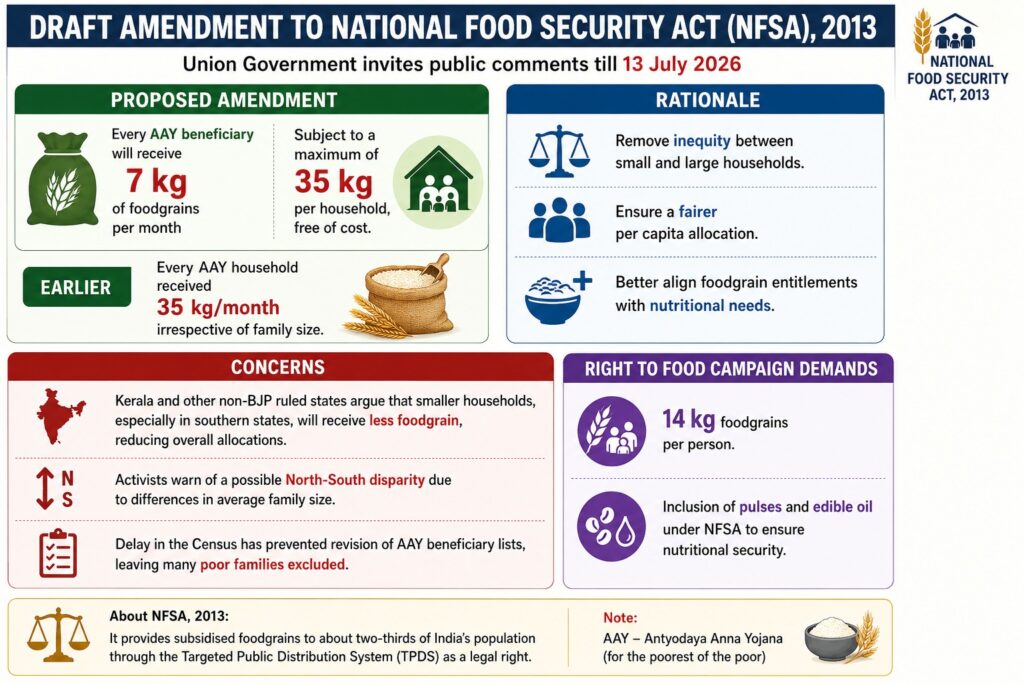
    The Union Government has released a draft amendment to the National Food Security Act (NFSA), 2013, inviting public comments until 13 July 2026.

    Proposed Amendment

    • Every AAY beneficiary will receive 7 kg of foodgrains per month, subject to a maximum of 35 kg per household, free of cost.
    • Earlier: Every AAY household received 35 kg/month, irrespective of family size.

    Rationale

    • Remove inequity between small and large households.
    • Ensure a fairer per capita allocation.
    • Better align foodgrain entitlements with nutritional needs.

    Concerns

    • Kerala and other non-BJP ruled states argue that smaller households, especially in southern states, will receive less foodgrain, reducing overall allocations.
    • Activists warn of a possible North-South disparity due to differences in average family size.
    • Delay in the Census has prevented revision of AAY beneficiary lists, leaving many poor families excluded.
    • Right to Food Campaign demands:
      • 14 kg foodgrains per person.
      • Inclusion of pulses and edible oil under NFSA to ensure nutritional security.

    [2018] With reference to the provisions made under the National Food Security Act, 2013, consider the following statements:

    1. The families coming under the category of ‘below poverty line (BPL)’ only are eligible to receive subsidised food grains.

    2. The eldest woman in a household, of age 18 years or above, shall be the head of the household for the purpose of issuance of a ration card.

    3. Pregnant women and lactating mothers are entitled to a ‘take‑home ration’ of 1600 calories per day during pregnancy and for six months thereafter.

    Which of the statements given above is/are correct?

    A 1 and 2

    B 2 only

    C 1 and 3

    D 3 only
  • Assess the role of National Horticulture Mission (NHM) in boosting the production, productivity and income of horticulture farms. How far has it succeeded in increasing the income of farmers?

    The NHM was a centrally sponsored scheme launched in 2005-06 to promote the holistic development of the horticulture sector through area-based, regionally differentiated strategies.

    Key Pillars of NHM

    Cluster based approach

    Supply of quality planting material through nurseries and tissue culture units.

    Improving production and productivity through area expansion and rejuvenation.

    Promoting and spreading modern technologies.

    Focussing on training and skill development.

    Infrastructure for post-harvest management and marketing.

    Role of NHM in boosting

    Production

    Horticulture production increased from 280.70 MT (2013-14) to 367.72 MT (2024-25) (Fruits: 114.51 MT, Vegetables: 219.67 MT)

    Fruit production increased by ~30%, and vegetable production increased by ~22%.

    Establishment of nurseries and tissue culture units ensured healthy, disease-free plants.

    Area-focused interventions increased scale and concentration of production.

    Crop diversification – Promotion of high-value and short-duration crops.

    Boost in Productivity

    The productivity has risen from 12.10 MT per hectare in 2019 to 12.56 MT per hectare in 2024

    Distribution of high-yielding and disease-resistant varieties increased output per unit area.

    Technology dissemination – Promotion of drip irrigation, mulching, protected cultivation (polyhouse, net house).

    Farmers trained in scientific cultivation, pest control and nutrient management – improved efficiency.

    Reduced crop loss through improved plant health and management practices.

    Boost in Farmer Income

    Horticulture now contributes about 33% to Agriculture Gross Value Added (GVA) in Agriculture.

    High-value crops – Fruits, spices and flowers generate more income per hectare than cereals.

    Multiple cropping cycles of Vegetables and floriculture ensure regular cash flow.

    Post-harvest infrastructureCold storage, pack houses, grading and processing units reduce wastage and increase price realisation.

    Export potential

    Employment generation – Jobs in nurseries, processing, transport and storage supplement household income.

    Challenges

    Uneven regional performance – Benefits concentrated in better-developed states/regions

    Low Exports – India ranks 14th in vegetables and 23rd in fruits, and its share in the global horticultural market is a mere 1%.

    Input issues –

    less than 5% of Indian soils have sufficient nitrogen

    Only 55% area irrigated.

    Seed replacement rate is 35-45% (over 90% in USA)

    Inadequate cold-chain and logistics – Around 15-20% of the fruits and vegetables in India are wasted

    Climate vulnerability – Sensitive to droughts, floods, heat waves, pests. Eg- Locust Attack

    Sanitary and Phytosanitary (SPS) barriers – Eg- rejection of consignments by EU due to pesticide residue detection.

    Way Forward

    Agro-ecological approach – District-Level Climate-Contingent Crop Planning Cells

    Rural Agri-Logistics Nodes under Gati Shakti Framework to develop cold chains, aggregation centers

    Strengthening FPOs to enhance collective bargaining and direct market access for farmers. Eg- Sahyadri FPO in Maharashtra – increased incomes by 30%

    Raising R&D Investment to 1% of GDP

    Legal Reforms – Simplify land leasing laws, Adopt model contract farming Act

    Budget 2025-26 emphasised Agriculture as the ‘first engine’ for India’s development journey. Horticulture can be the key pillar of this journey.

    Farm Subsidy and Minimum Support Prices

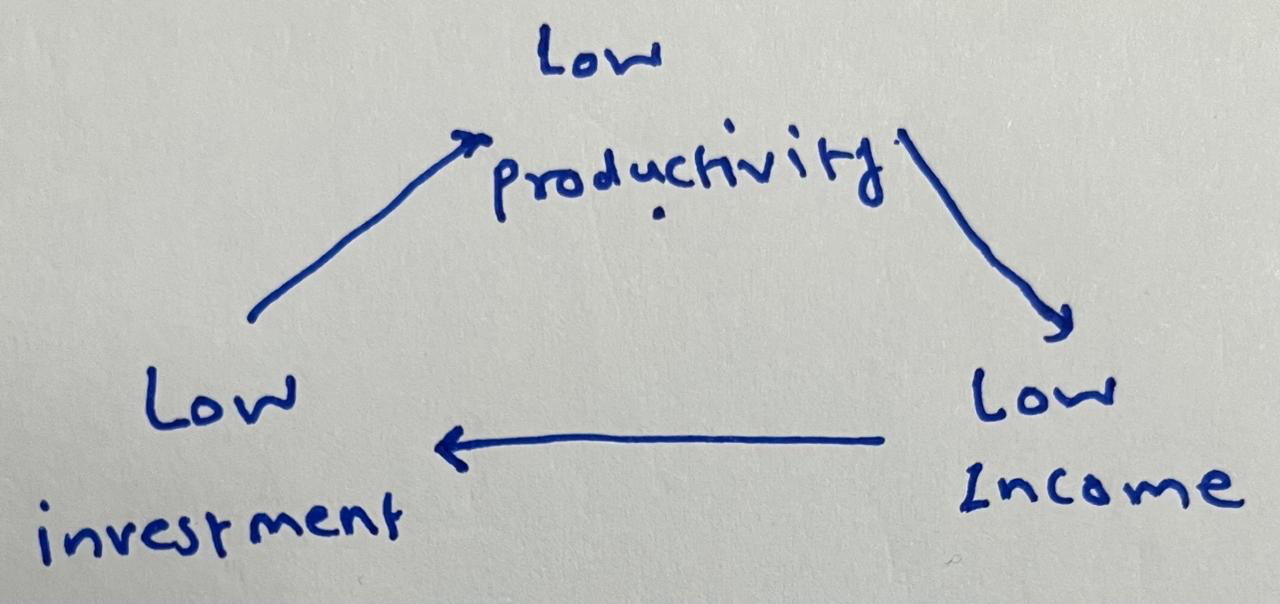
  • What do you mean by Minimum Support Price (MSP)? How will MSP rescue the farmers from the low-income trap?

    MSP is the government-declared assured floor price at which the government procures specific agricultural crops from farmers, through agencies like FCI, NAFED and state procurement bodies.

    Announced before the sowing season based on recommendations of the Commission for Agricultural Costs and Prices (CACP)

    Intended to cover the cost of production + reasonable margin (50% over A2+FL cost)

    Notified for 23 crops (22 mandated crops andFRP for sugarcane)

    Role of MSP in rescuing farmers from the Low-Income Trap

    Predictability – Assured pricing helps farmers plan crop investments, buy better inputs and adopt new technologies.

    Crop diversification through higher MSPs for nutri-cereals and oilseeds. Eg- higher MSP hikes for millets in recent years

    Improved creditworthiness of farmers due to MSP-backed income – Reduce dependence on moneylenders.

    Enhances Food Security through the Public Distribution System (PDS)

    Strengthens Rural Economy – higher rural demandmultiplier effect on rural economy

    Benchmark for private buyers: If traders offer prices below MSP, farmers can opt to sell to government agencies instead.

    Limitations of MSP

    Effective mainly for wheat and rice in states like Punjab, Haryana, MP, UP

    MSP growth has not kept pace with rising production costs. (CRISIL Report)

    Limited Reach – only 6% farmers benefitted (Shanta Kumar committee)

    94% of the total agri and allied sector output is outside MSP support.

    Limited storage capacity has resulted in huge piling of stocks in FCI warehouses.

    Way Forward

    Shift towards Regenerative Agriculture Incentives – Eg- DBT for farmers adopting soil-friendly inputs, micro-irrigation, and low-carbon practices

    Price Deficiency Payment (MP’s Bhavantar Bhugtan Yojana)

    MSP 2.0 based on 3 D’s – Decentralisation, Diversification and Digital Procurement.

    MSP can act as a meaningful income stabiliser only when it is complemented by efficient procurement, strong market linkages, and inclusive access

  • What are the reformative steps taken by the Government to make food grain distribution system more effective?

    India’s Public Distribution System is the world’s largest food transfer programme and India’s most far-reaching social safety net, accounting for around 50% of the overall social assistance budget.

    Objectives of PDS

    Food security

    Stabilise foodgrain prices

    Prevent hunger and malnutrition

    Safety net during emergencies

    Reformative Steps to Strengthen India’s Food-Grain Distribution System

    National Food Security Act, 2013 – Expanded the PDS coverage to 67% of population

    End-to-End Digitalisation of PDS

    All 20.4 Cr household ration cards digitised

    Aadhaar seedingover 47 million bogus ration cards removed (2013-21).

    Implementation of Warehouse Inventory Network and Governing System (WINGS) application to automate tagging of mills

    5.33 lakh e-PoS devices installed in all Fair Price Shops.

    One Nation One Ration Card (ONORC) – Ensures nationwide portability of PDS benefits.

    Doorstep Delivery of Foodgrains in Punjab, Haryana, Delhi etc.

    Strengthening Storage & Supply Chain

    GPS-based tracking of trucks. Eg- Chhatisgarh

    Expansion of warehouses under PEG Scheme (Private Entrepreneurs Guarantee).

    Direct Benefit Transfer (DBT) in Chandigarh, Puducherry, Dadra & Nagar Haveli.

    Decentralised Procurement in states like Punjab, Haryana, MP, Chhattisgarh, Telangana.

    Nutritional Improvements in PDS

    Introduction of fortified rice under NFSA, ICDS and PM-POSHAN.

    Some states (Tamil Nadu, Odisha) supply pulses, millets, oil and eggs through PDS.

    However, despite these steps there are few challenges

    As per study by Crisil using a ‘thali index’, up to 50% of rural and 20% of urban Indians cannot afford two balanced meals a day

    Even with PDS support, food deprivation remained 40% in rural and 10% in urban areas

    Weak supply chain management – Storage Losses due to poor warehousing and handling. Eg- 40% of the food wasted (1.5 lakh crore or 1% of the GDP)

    Open ended procurement leads to overflowing of FCI godowns

    Diversion – Eg- 28% of allocated foodgrains fail to reach beneficiaries as per HCES 2022-23.

    Inclusion and exclusion errors due to faulty beneficiary identification.

    Corruption and ghost beneficiaries – Over 47 million bogus ration cards cancelled between 2013-2021

    Corruption at Fair Price Shops (FPS) – Issues of under-weighing, overcharging etc

    Fiscal Burden – Food subsidy budget @ 2.1 lakh cr in 2025-26

    Way Forward

    Shanta Kumar Committee Recommendations on Revamping of PDS

    Direct Procurement by States

    Private Sector Involvement in procurement, storage, and distribution

    Diversify the food basket – Include millets, pulses, edible oil and iodised salt for nutritional security.

    Strengthen grievance redressal – Set up toll-free helplines, social audits and citizen charters at FPS level.

    Community monitoring – Involve self-help groups, local bodies and civil society in supervision.

    Universal PDS similar to Tamil Nadu’s model.

    Optimise buffer stock norms to reduce food grain wastage.

    The PDS remains a vital tool for India’s food security and realise SDG 1,2,3,and 12