Why in the News?
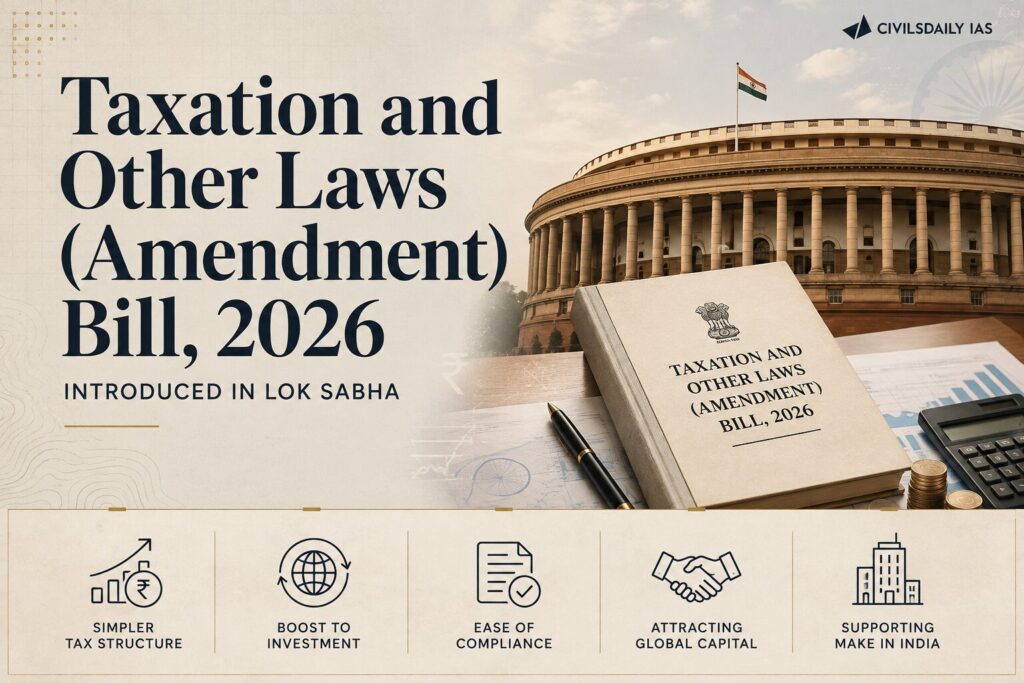
The Finance Minister introduced the Taxation and Other Laws (Amendment) Bill, 2026 in the Lok Sabha to amend tax and payment laws, improve tax certainty, attract foreign investment, and support the Make in India initiative.
Key Highlights
- Amends the Payment and Settlement Systems Act, 2007, Income-tax Act, 2025, and Finance Act, 2026.
- Replaces the Income-tax (Amendment) Ordinance, 2026 with a permanent law.
- Simplifies tax exemptions for foreign companies using Indian data centres.
- Allows leased data centres to avail tax benefits.
- Facilitates relocation of foreign fund managers to India without creating a taxable business presence.
- Restores dividend tax exemption for REITs and InvITs under the new tax regime.
Other Legislative Business
- Discussion on Demands for Excess Grants (FY 2022-23).
- Introduction of the Appropriation (No. 3) Bill, 2026 to regularise excess government expenditure.
- Statements on implementation of Parliamentary Standing Committee recommendations.
- Consideration of the Bankers’ Books Evidence Bill, 2026 to modernise evidence laws for digital banking.
Appropriation Bill
- Authorises the government to withdraw money from the Consolidated Fund of India to meet approved expenditure.
- Required under Article 114 of the Constitution.
Demands for Excess Grants
- Presented when actual government expenditure exceeds the amount approved by Parliament.
- Examined by the Public Accounts Committee (PAC) before parliamentary approval.
- Constitutional Basis: Article 115.
Bankers’ Books Evidence Bill, 2026
- Seeks to modernise legal provisions governing bank records by recognizing digital banking and electronic records.