Why in the News?
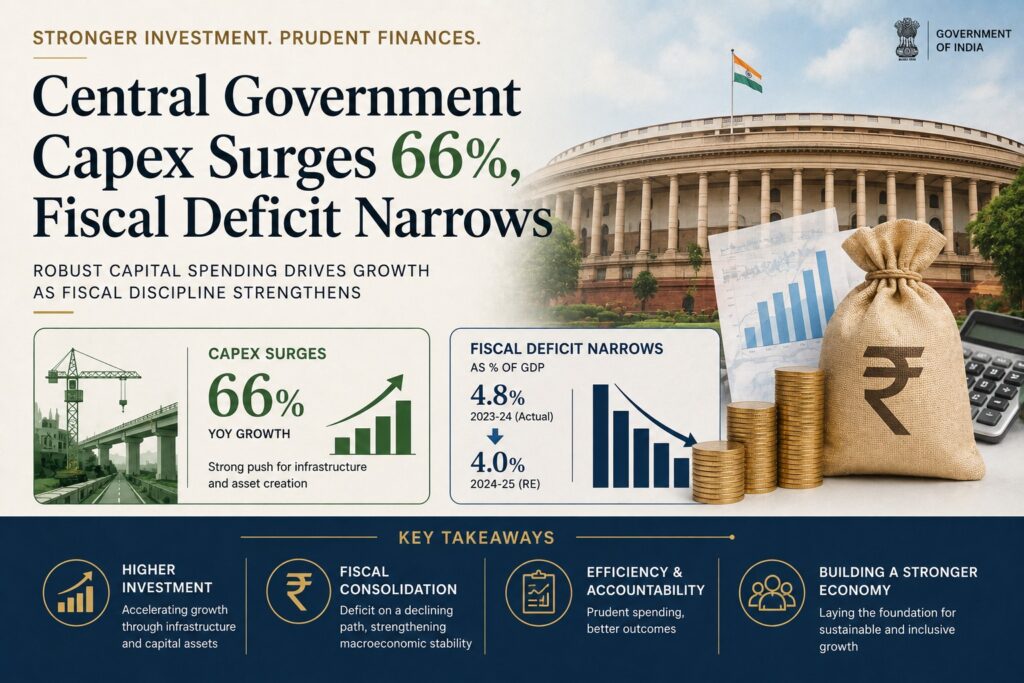
The Central Government’s capital expenditure (capex) increased by 66% to ₹89,255 crore in June 2026, while the fiscal deficit narrowed by 46% to ₹1.45 lakh crore, reflecting strong public investment despite revenue pressures.
Key Highlights
- Capex: Up 66% YoY to ₹89,255 crore.
- FY 2026-27 Capex Target: ₹12.22 lakh crore; 28% achieved in the first quarter.
- Fiscal Deficit: Reduced by 46% in June.
- Direct Taxes: Corporate tax up 20% and income tax up 7% (Apr-Jun).
- Customs Duty: Increased 36%, supported by higher duties on gold and silver.
Why is the Fiscal Position Under Pressure?
- Urea subsidy increased 68% to ₹53,034 crore.
- Excise collections declined 22% due to fuel duty cuts.
- Weak GST growth affected overall revenue.
- Higher global crude oil prices may increase future expenditure.
Significance
- Higher capex boosts infrastructure, employment and long-term economic growth.
- Lower fiscal deficit improves macroeconomic stability.
- Strong direct tax collections indicate resilient formal economic activity.
Challenges
- Rising subsidy burden.
- Declining fuel excise revenue.
- Volatile global oil prices.
- Sustaining fiscal consolidation while maintaining capital investment.
Capital Expenditure (Capex)
- Spending that creates long-term productive assets, such as roads, railways, ports and power infrastructure.
- Promotes economic growth by increasing productive capacity.
Revenue Expenditure
- Spending on salaries, pensions, subsidies, interest payments and day-to-day government operations.
- Does not create permanent assets.
Fiscal Deficit
- Fiscal Deficit = Total Expenditure − (Revenue Receipts + Non-Debt Capital Receipts)
- Indicates the government’s borrowing requirement during a financial year.
- Primary Deficit: Fiscal deficit minus interest payments.
- Revenue Deficit: Revenue expenditure exceeds revenue receipts.
“[2025] A country’s fiscal deficit stands at ₹50,000 crores. It is receiving ₹10,000 crores through non-debt creating capital receipts. The country’s interest liabilities are ₹1,500 crores. What is the gross primary deficit?
(a) ₹48,500 crores
(b) ₹51,500 crores
(c) ₹58,500 crores
(d) None of the above.
