💥Join UPSC 2027,2028 Mentorship (July Batch) + XFactor Notes & Microthemes PDF

GS Paper: Indian Economy

  • GST revenues surpass ₹1.44 lakh crore

    India recorded its second-highest monthly gross GST revenues in June at ₹1,44,616 crore, 56% more than a year earlier when the second COVID wave had hit economic activity.

    What is GST?

    • GST is an indirect tax that has replaced many indirect taxes in India such as excise duty, VAT, services tax, etc.
    • The Goods and Service Tax Act was passed in Parliament on 29th March 2017 and came into effect on 1st July 2017. It is a single domestic indirect tax law for the entire country.
    • It is a comprehensive, multi-stage, destination-based tax that is levied on every value addition.
    • Under the GST regime, the tax is levied at every point of sale. In the case of intra-state sales, Central GST and State GST are charged. All the inter-state sales are chargeable to the Integrated GST.

    Answer this PYQ in the comment box:

    Q.All revenues received by the Union. Government by way of taxes and other receipts for the conduct of Government business are credited to the (CSP 2015):

    (a) Contingency Fund of India

    (b) Public Account

    (c) Consolidated Fund of India

    (d) Deposits and Advances Fund


    [wpdiscuz-feedback id=”jkgx8spg2w” question=”Please leave a feedback on this” opened=”1″]Post your answers here.[/wpdiscuz-feedback]

    What are the components of GST?

    There are three taxes applicable under this system:

    1. CGST: It is the tax collected by the Central Government on an intra-state sale (e.g., a transaction happening within Maharashtra)
    2. SGST: It is the tax collected by the state government on an intra-state sale (e.g., a transaction happening within Maharashtra)
    3. IGST: It is a tax collected by the Central Government for an inter-state sale (e.g., Maharashtra to Tamil Nadu)

    Advantages Of GST

    • GST has mainly removed the cascading effect on the sale of goods and services.
    • Removal of the cascading effect has impacted the cost of goods.
    • Since the GST regime eliminates the tax on tax, the cost of goods decreases.
    • Also, GST is mainly technologically driven.
    • All the activities like registration, return filing, application for refund and response to notice needs to be done online on the GST portal, which accelerates the processes.

    Issues with GST

    • High operational cost
    • GST has given rise to complexity for many business owners across the nation.
    • GST has received criticism for being called a ‘Disability Tax’ as it now taxes articles such as braille paper, wheelchairs, hearing aid etc.
    • Petrol is not under GST, which goes against the ideals of the unification of commodities.

    Take a look at the share of GST in government earnings for the previous fiscal:

    UPSC can ask about the majority component of the Revenue Receipts of the govt. See how Corporate tax is nearing the GST revenues.

    Do you think it will surpass GST revenue when the economy is fully recovered?


    UPSC 2023 countdown has begun! Get your personal guidance plan now! (Click here)
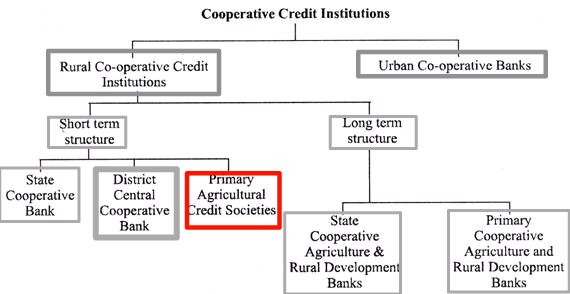
  • What are Primary Agricultural Credit Society (PACS)?

    The Cabinet Committee on Economic Affairs (CCEA) has approved a proposal to digitise around 63,000 primary agricultural credit societies (PACS).

    What are the Primary Agricultural Credit Societies (PACS)?

    • PACS is a basic unit and smallest co-operative credit institutions in India.
    • In 1904 the first Primary Agricultural Credit Society (PACS) was established.
    • It works on the grassroots level (gram panchayat and village level).
    • PACS is the final link between the ultimate borrowers, i.e., rural people, on the one hand, and the higher agencies, i.e., Central cooperative bank, state cooperative bank, and Reserve Bank of India, on the other.

    Who regulates PACS?

    • PACS are registered under the Co-operative Societies Act and also regulated by the RBI.
    • They are governed by the “Banking regulation Act-1949” and Banking Laws (Co-operative societies) Act 1965.

    Various objectives of PACS

    1. To raise capital for the purpose of making loans and supporting members’ essential activities.
    2. To collect deposits from members with the goal of improving their savings habit.
    3. To supply agricultural inputs and services to members at reasonable prices,
    4. To arrange for the supply and development of improved breeds of livestock for members.
    5. To make all necessary arrangements for improving irrigation on land owned by members.
    6. To encourage various income-generating activities through supply of necessary inputs and services.

    Functions of PACS

    • As registered cooperative societies, PACS have been providing credit and other services to their members.
    • PACS typically offer the following services to their members:
    1. Input facilities in the form of a monetary or in-kind component
    2. Agriculture implements for hire
    3. Storage space

    Who can form PACS?

    • A primary agricultural credit society can be formed by a group of ten or more people from a village. The society’s management is overseen by an elected body.
    • The membership fee is low enough that even the poorest agriculturist can join.
    • Members of the society have unlimited liability, which means that each member assumes full responsibility for the society’s entire loss in the event of its failure.

    What capitalizes PACS?

    • The primary credit societies’ working capital is derived from their own funds, deposits, borrowings, and other sources.
    • Share capital, membership fees, and reserve funds are all part of the company’s own funds.
    • Deposits are made by both members and non-members.
    • Borrowings are primarily made from central cooperative banks.

    Why need digitization?

    • PACS account for 41 % (3.01 Cr. farmers) of the KCC loans given by all entities in the country and 95 % of these KCC loans (2.95 Cr. farmers) through PACS are to the small and marginal farmers.
    • The other two tiers viz. State Cooperative Banks (StCBs) and District Central Cooperative Banks (DCCBs) have already been automated by the NABARD and brought on Common Banking Software (CBS).
    • Majority of PACS have so far been not computerized and still functioning manually resulting in inefficiency and trust deficit.

    Significance of digitization

    • Computerization of PACS will increase their transparency, reliability and efficiency, and will also facilitate the accounting of multipurpose PACS.
    • Along with this, it will also help PACS to become a nodal centre for providing services such as direct benefit transfer (DBT), Interest subvention scheme (ISS), crop insurance scheme (PMFBY), and inputs like fertilizers and seeds.

    Try this PYQ from CSP 1999:

    Q.The farmers are provided credit from a number of sources for their short and long term needs. The main sources of credit to the farmers include-

    (a) the Primary Agricultural Cooperative Societies, commercial banks, RRBs and private money lenders

    (b) the NABARD, RBI, commercial banks and private money lenders

    (c) the District Central Cooperative Banks (DCCB), the lead banks, IRDP and JRY

    (d) the Large Scale Multi-purpose Adivasis Programme, DCCB, IFFCO and commercial banks


    [wpdiscuz-feedback id=”l5v0qluiul” question=”Please leave a feedback on this” opened=”1″]Post your answers here.[/wpdiscuz-feedback]


    UPSC 2023 countdown has begun! Get your personal guidance plan now! (Click here)
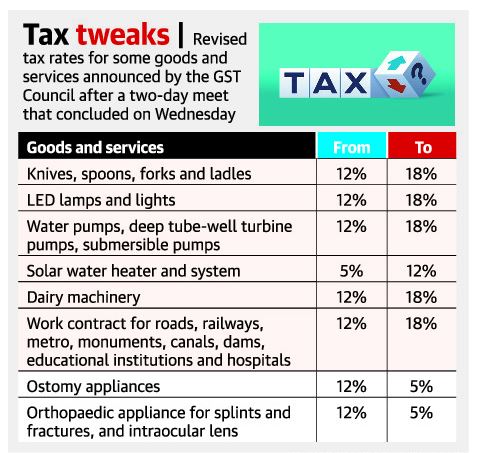
  • Govt. hikes GST for household items

    The Goods and Services Tax (GST) Council has decided to hike and lower GST on certain commodities.

    What is the news?

    • From July 18, tax hikes will kick in for over two dozen goods and services, ranging from unbranded food items, curd and buttermilk to low-cost hotels, cheques and maps.
    • Tax rates will be lowered for about half-a-dozen goods and services, including ropeways and truck rentals where fuel costs are included.
    • It scrapped GST for items imported by private vendors for use by defence forces.

    What is GST?

    • GST launched in India on 1 July 2017 is a comprehensive indirect tax for the entire country.
    • It is charged at the time of supply and depends on the destination of consumption.
    • For instance, if a good is manufactured in state A but consumed in state B, then the revenue generated through GST collection is credited to the state of consumption (state B) and not to the state of production (state A).
    • GST, being a consumption-based tax, resulted in loss of revenue for manufacturing-heavy states.

    What are GST Slabs?

    • In India, almost 500+ services and over 1300 products fall under the 4 major GST slabs.
    • There are five broad tax rates of zero, 5%, 12%, 18% and 28%, plus a cess levied over and above the 28% on some ‘sin’ goods.
    • The GST Council periodically revises the items under each slab rate to adjust them according to industry demands and market trends.
    • The updated structure ensures that the essential items fall under lower tax brackets, while luxury products and services entail higher GST rates.
    • The 28% rate is levied on demerit goods such as tobacco products, automobiles, and aerated drinks, along with an additional GST compensation cess.

    Why rationalize GST slabs?

    • From businesses’ viewpoint, there are just too many tax rate slabs, compounded by aberrations in the duty structure through their supply chains with some inputs are taxed more than the final product.
    • These are far too many rates and do not necessarily constitute a Good and Simple Tax.
    • Multiple rate changes since the introduction of the GST regime in July 2017 have brought the effective GST rate to 11.6% from the original revenue-neutral rate of 15.5%.
    • Merging the 12% and 18% GST rates into any tax rate lower than 18% may result in revenue loss.

    Haven’t GST revenues been hitting new records?

    • Yes, they have – GST revenues have scaled fresh highs in three of the first four months of 2022, going past ₹1.67 lakh crore in April.
    • But there is another key factor — the runaway pace of inflation.
    • Wholesale price inflation, which captures producers’ costs, has been over 10% for over a year and peaked at 15.1% in April.
    • Inflation faced by consumers on the ground has spiked to a near-eight year high of 7.8% in April.
    • The rise in prices was the single most important factor for higher tax inflows along with higher imports.


    UPSC 2023 countdown has begun! Get your personal guidance plan now! (Click here)
  • Downturn in tech startup ecosystem

    Context

    The startup ecosystem which has been in overdrive for the past few years — propelled by a combination of factors, but largely, by the era of cheap money — is now showing signs of weakness.

    Factors that helped fuel the tech startups

    • With the combination of accelerated financial inclusion (bank accounts), ease of identification (Aadhaar) and connectivity (mobile phones) it was said that it is ultimately a bet on the Indian consumer, and the economy, not on government regulations/policies.
    • Low-interest rates: In the era of cheap money and negative real interest rates, uncomfortable questions over the true market size and profitability were swept under the rug.
    • Growth fuelled by cash burn: High cash burn rates were the norm as both startups and investors sought growth by subsidising the customer.

    What is going wrong?

    • Lack of profitability: Among the startups that have gone public in recent times, Paytm’s losses stood at Rs 2,396 crore in 2021-22, while for Zomato and PB Fintech (PolicyBazaar) losses were Rs 1,222 crore and Rs 832 crore respectively.
    • Drying-up of investment: Sure, investors will continue to pour money.
    • Some early age start-ups will continue to be funded, as will some of the more mature ones.
    • But investors are likely to be more circumspect in their dealings.
    • Impact on valuation: There are also reports of startups in diverse markets, ranging from Ola to OYO, planning to raise funds at lower valuations.
    • Among those who have gone public in recent times, most are trading much below their listing price.
    • Tighter financial conditions, a re-rating of the market, will impact both fundraising efforts and valuations.

    Lack of discretionary spending capacity

    • Many numbers were given as indicators of the size of the market or TAM (the total addressable market).
    • Smartphone users: One such number thrown around is the smartphone users in the country — some have pegged this at 500 million.
    • UPI transactions: The transactions routed through the UPI platform — in May there were almost six billion transactions worth Rs 10 trillion.
    • Bank account holders: We have the near universality of bank accounts.
    • But in reality, for most of these startups, the market or even the potential market is just a fraction of this.
    • There aren’t that many consumers with significant discretionary spending capacity, and those with the capacity aren’t increasing their spending as these companies would hope.
    • No increase in spending: What is equally worrying is the complete absence of any increase in spending by even these consumers who would have the capacity to spend more.
    • While more consumers are on-board digital payment platforms — Paytm has about 70 million monthly transacting users — these numbers suggest that when it comes to consumers with considerable discretionary spending, the size of the market shrivels considerably.

    Conclusion

    Tech startups are about to witness a tough time ahead. Some startups will survive this period. Many may not. And changes in the dynamics of private markets will also have a bearing on public markets.

    UPSC 2023 countdown has begun! Get your personal guidance plan now! (Click here)

  • online marketplace

    Context

    The proliferation of a wide range of e-commerce platforms has created convenience and increased consumer choice. However, these platforms also have given rise to several concerns as well.

    What is e-commerce ?

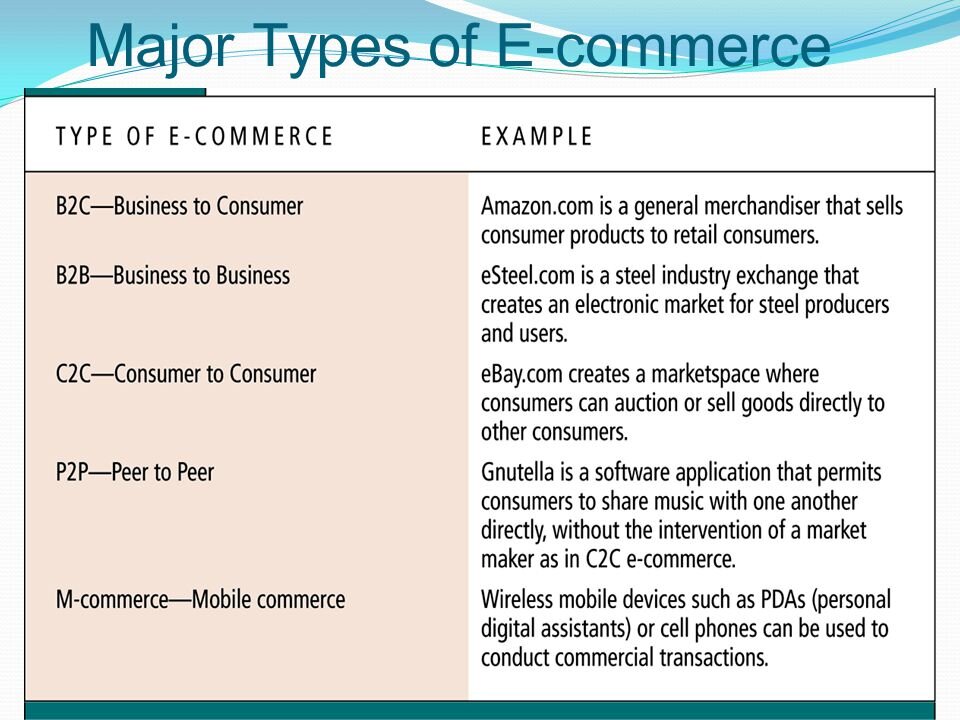
    • Electronic commerce or e-commerce is a business model that lets firms and individuals buy and sell things over the Internet.
    • Propelled by rising smartphone penetration, the launch of 4G networks and increasing consumer wealth, the Indian e-commerce market is expected to grow to US$ 200 billion by 2026 from US$ 38.5 billion in 2017.
    • India’s e-commerce revenue is expected to jump from US$ 39 billion in 2017 to US$ 120 billion in 2020, growing at an annual rate of 51%, the highest in the world.
    • The Indian e-commerce industry has been on an upward growth trajectory and is expected to surpass the US to become the second-largest e-commerce market in the world by 2034.

    Advantages of e-Commerce

    • The process of e-commerce enables sellers to come closer to customers that lead to increased productivity and perfect competition. The customer can also choose between different sellers and buy the most relevant products as per requirements, preferences, and budget. Moreover, customers now have access to virtual stores 24/7.
    • e-Commerce also leads to significant transaction cost reduction for consumers.
    • e-commerce has emerged as one of the fast-growing trade channels available for the cross-border trade of goods and services.
    • It provides a wider reach and reception across the global market,with minimum investments. It enables sellers to sell to a global audience and also customers to make a global choice. Geographical boundaries and challenges are eradicated/drastically reduced.
    • Through direct interaction with final customers, this e-commerce process cuts the product distribution chain to a significant extent. A direct and transparent channel between the producer or service provider and the final customer is made. This way products and services that are created to cater to the individual preferences of the target audience.
    • Customers can easily locate products since e-commerce can be one store set up for all the customers’ business needs
    • Ease of doing business: It makes starting, managing business easy and simple.
    • The growth in the e-commerce sector can boost employment, increase revenues from export, increase tax collection by ex-chequers, and provide better products and services to customers in the long-term.

    Issues created by the e-commerce sites

    • Predatory pricing: These companies resort to predatory pricing to acquire customers even as they suffer persistent financial losses.
    • SEBI is rightly revisiting the valuation norms of such companies looking to list on the stock exchange.
    • Exclusionary practice: They take away choice from suppliers and consumers.
    • This, in the long run, can be viewed as an exclusionary practice that eliminates other players from the market. 
    • Lack of level playing field: While neutrality is the fundamental basis of a marketplace and a level playing field is in the fitness of things, claims of outfits such as Flipkart or Amazon to be a marketplace for a wide variety of sellers can be questioned.
    • A few select sellers, who are generally affiliated with the platform, reap the benefits of greater visibility and better terms of trade — reduced commissions and platform-funded discounts.
    • Undue advantage to associated companies: The associate companies are prominent sellers on their platform.
    • It is alleged that undue advantage is given while recommending or listing these products.
    • Cartelisation: Online travel aggregators are often accused of cartelisation.
    • Information asymmetry: The aggregators gather shopping habits, consumer preferences, and other personal data.
    • The platforms are accused of using this data to create and improve their own products and services, taking away business from other sellers on their platform.
    • They capitalise on this data and information about other brands to launch competing products on their marketplace.
    • This information asymmetry is exploited by the aggregators to devour organisations they promise to support.
    • Problems in dispute resolution mechanism: Another issue often noticed is the lack of a fair and transparent dispute resolution mechanism for sellers on these platforms.
    • Delayed payments, unreasonable charges, and hidden fees are common occurrences.
    • Unreasonable and one-sided contracts allow travel aggregators to have a disparity clause (in the rates) which allows them to offer rooms at a much cheaper rate but bars the hotels from doing so.

    Impact of the e-commerce

    • The online aggregator platforms have also damaged large segments of small and medium businesses through their dominant position and the malpractices this position allows them to indulge in.
    • The ultimate loss bearer is the consumer who will have a reduced bargaining position.

    Way forward

    • Comprehensive rules: It is time that a set of comprehensive rules and regulations is put together.
    • These regulations need to be inclusive, should eliminate the conflicts of interest inherent in current market practices, and prevent any anti-competitive practices.
    • Model agreement: A model agreement that is fair and allows a level playing field between the aggregators and their business partners should be implemented.
    • Learning from EU act: There is a lot to learn from the Digital Markets Act of the EU that seeks to address unfair practices by these gatekeepers.
    • Need for dispute resolution mechanism: Strong and quick grievance redressal and dispute resolution mechanisms should be established.
    • Punitive penalties: The rules should allow for punitive penalties for unfair practices.
    • Fair competition rules: Market dominance and subsequent invoking of fair competition rules should be triggered at the level of micro-markets and for product segments.

    Conclusion

    The nature of our success in dealing with this change will lie in the ways in which we deal with the concerns of all players.


  • What is Small Savings Scheme?

    Economists expect the Centre to raise the interest rates paid on small savings schemes for the July to September 2022 quarter.

    Small Savings Scheme

    • Small Savings Schemes are a set of savings instruments managed by the central government with an aim to encourage citizens to save regularly irrespective of their age.
    • They are popular as they provide returns higher than bank fixed deposits, sovereign guarantee and tax benefits.

    How is it managed?

    • Since 2016, the Finance Ministry has been reviewing the interest rates on small savings schemes on a quarterly basis.
    • All deposits received under various schemes are pooled in the National Small Savings Fund.
    • The money in the fund is used by the Centre to finance its fiscal deficit.

    What are the different saving schemes?

    The schemes can be grouped under three heads –

    1. Post office deposits
    2. Savings certificates and
    3. Social security schemes

    (1) Post Office Deposits

    • Under this we have the savings deposit, recurring deposit and time deposits with 1, 2, 3 and 5 year maturities and the monthly income account.
    • The savings account currently pays an interest of 4% per annum and can be opened individually or jointly with an initial investment of Rs 500.
    • The recurring deposit that pays 5.8% a year compounded quarterly matures after 60 months from the date of opening.
    • It allows investors to save on a monthly basis with a minimum deposit of Rs 100 per month.
    • Investments under the 5-year time deposit up to Rs 1.5 lakh further qualifies for benefit under section 80C of Income Tax Act.

    (2) Savings Certificates

    • Under this, we have the National Savings Certificate and the Kisan Vikas Patra.
    • The National Savings Certificate pays interest at a rate of 6.8% per annum upon maturity after 5 years. The interest that is earned is reinvested into the scheme every year automatically.
    • The NSC also qualifies for tax saving under Section 80C of the income tax act.
    • The Kisan Vikas Patra, which is open to everyone, doubles your one-time investment at the end of 124 months signifying a return of 6.9% compounded annually.
    • The minimum investment amount is Rs 1000 while there is no upper limit.

    (3) Social security schemes

    • In the third head of social security schemes, there is Public Provident Fund, Sukanya Samriddhi Account and Senior Citizens Savings Scheme.

    a. Public Provident Fund

    • The Public Provident Fund is a popular saving option for long term goals like retirement.
    • It pays 7.1% a year and qualifies for tax benefit under Section 80C of the Income Tax Act.
    • Upon maturity of the account after 15 years, it can be extended indefinitely in blocks of 5 years.
    • The accumulated amount and interest earned are exempt from tax at the time of withdrawal.

    b. Sukanya Samriddhi Account

    • The Sukanya Samriddhi Account was launched in 2015 under the Beti Bachao Beti Padhao campaign exclusively for a girl child.
    • The account can be opened in the name of a girl child below the age of 10 years.
    • The scheme guarantees a return of 7.6% per annum and is eligible for tax benefit under Section 80C of the Income Tax Act.
    • The tenure of the deposit is 21 years from the date of opening of the account and a maximum of Rs 1.5 lakh can be invested in a year.

    c. Senior Citizen Savings Account

    • And finally, the 5-year ​​Senior Citizen Savings Account can be opened by anyone who is over 60 years to age.
    • It carries an interest of 7.4% per annum payable quarterly and qualifies for Section 80C tax benefit.
    • These time-tested and safe modes of investments don’t offer quick returns, but are safer when compared to market-linked schemes.


    UPSC 2023 countdown has begun! Get your personal guidance plan now! (Click here)

  • What does our Current Account Deficit (CAD) show?

    The data for the country’s current account balance for the fourth quarter of FY 2021-22 shows a decrease in the deficit to 1.5% of gross domestic product (GDP) from 2.6% of GDP in Q3 FY 2021-22.

    What is Current Account Deficit (CAD)?

    • A current account is a key component of balance of payments, which is the account of transactions or exchanges made between entities in a country and the rest of the world.
    • This includes a nation’s net trade in products and services, its net earnings on cross border investments including interest and dividends, and its net transfer payments such as remittances and foreign aid.
    • A CAD arises when the value of goods and services imported exceeds the value of exports, while the trade balance refers to the net balance of export and import of goods or merchandise trade.

    Components of Current Account

    Current Account Deficit (CAD) =

    Trade Deficit + Net Income + Net Transfers

    (1) Trade Deficit

    • Trade Deficit = Imports – Exports
    • A Country is said to have a trade deficit when it imports more goods and services than it exports.
    • Trade deficit is an economic measure of a negative balance of trade in which a country’s imports exceeds its exports.
    • A trade deficit represents an outflow of domestic currency to foreign markets.

    (2) Net Income

    • Net Income = Income Earned by MNCs from their investments in India.
    • When foreign investment income exceeds the savings of the country’s residents, then the country has net income deficit.
    • This foreign investment can help a country’s economy grow. But if foreign investors worry they won’t get a return in a reasonable amount of time, they will cut off funding.
    • Net income is measured by the following things:
    1. Payments made to foreigners in the form of dividends of domestic stocks.
    2. Interest payments on bonds.
    3. Wages paid to foreigners working in the country.

    (3) Net Transfers

    • In Net Transfers, foreign residents send back money to their home countries. It also includes government grants to foreigners.
    • It Includes Remittances, Gifts, Donation etc

    How does Current Account Transaction takes place?

    • While understanding the Current Account Deficit in detail, it is important to understand what the current account transactions are.
    • Current account transactions are transactions that require foreign currency.
    • Following transactions with from which component these transactions belong to :
    1. Component 1 : Payments connection with Foreign trade – Import & Export
    2. Component 2 : Interest on loans to other countries and Net income from investments in other countries
    3. Component 3 : Remittances for living expenses of parents, spouse and children residing abroad, and Expenses in connection with Foreign travel, Education and Medical care of parents, spouse and children

    What has been the recent trend?

    • In Q4 FY 2021-22, CAD improved to 1.5% of GDP or $13.4 billion from 2.6% of GDP in Q3 FY 2021-22 ($22.2 billion).
    • The difference between the value of goods imported and exported fell to $54.48 million in Q4FY 2021-22 from $59.75 million in Q3 FY2021-22.
    • However, based on robust performance by computer and business services, net service receipts rose both sequentially and on a year-on-year basis.
    • Remittances by Indians abroad also rose.

    What are the reasons for the current account deficit?

    • Intensifying geopolitical tensions and supply chain disruptions leading to crude oil and commodity prices soaring globally have been exerting upward pressure on the import bill.
    • A rise in prices of coal, natural gas, fertilizers, and edible oils have added to the pressure on trade deficit.
    • However, with global demand picking up, merchandise exports have also been rising.

    How will a large CAD affect the economy?

    • A large CAD will result in demand for foreign currency rising, thus leading to depreciation of the home currency.
    • Nations balance CAD by attracting capital inflows and running a surplus in capital accounts through increased foreign direct investments (FDI).
    • However, worsening CAD will put pressure on inflow under the capital account.
    • Nevertheless, if an increase in the import bill is because of imports for technological upgradation it would help in long-term development.

    Should a widening CAD worry policymakers?

    • Data shows the trade deficit widened to $24.29 billion in May 2022 from $6.53 billion a year ago.
    • Merchandise exports in May 2022 rose by 20.55% over May 2021, while merchandise imports rose by 62.83%.
    • However, if increasing imports is accompanied by an expansion in industrial production, it is a sign of economic development.
    • Immediately after the covid-19 lockdown, after a long time, the country experienced a current account surplus.


    UPSC 2023 countdown has begun! Get your personal guidance plan now! (Click here)

  • What is GST Compensation Cess?

    The Centre has extended the time for levy of GST compensation cess by almost four years till March 31, 2026.

    What is the news?

    • The Goods and Services Tax (Period of Levy and Collection of Cess) Rules were notified in 2022 by the Finance Ministry.
    • The levy of cess was to end on June 30 but the GST Council, chaired by Union Finance Minister decided to extend it till 2026.

    What is GST?

    • GST, being a consumption-based tax, would result in loss of revenue for manufacturing-heavy states.
    • GST launched in India on 1 July 2017 is a comprehensive indirect tax for the entire country.
    • It is charged at the time of supply and depends on the destination of consumption.
    • For instance, if a good is manufactured in state A but consumed in state B, then the revenue generated through GST collection is credited to the state of consumption (state B) and not to the state of production (state A).

    Compensation Cess under GST regime

    • Due to the consumption-based nature of GST, manufacturing states like Gujarat, Haryana, Karnataka, Maharashtra and Tamil Nadu feared a revenue loss.
    • Thus, GST Compensation Cess or GST Cess was introduced by the government to compensate for the possible revenue losses suffered by such manufacturing states.
    • However, under existing rules, this compensation cess will be levied only for the first 5 years of the GST regime – from July 1st, 2017 to July 1st, 2022.
    • Compensation cess is levied on five products considered to be ‘sin’ or luxury as mentioned in the GST (Compensation to States) Act, 2017 and includes items such as- Pan Masala, Tobacco, and Automobiles etc.

    Alternatives to prevent losses

    • The input tax credit can help a producer by partially reducing GST liability by only paying the difference between the tax already paid on the raw materials of a particular good and that on the final product.
    • In other words, the taxes paid on purchase (input tax) can be subtracted from the taxes paid on the final product (output tax) to reduce the final GST liability.

    Distributing GST compensation

    • The compensation cess payable to states is calculated based on the methodology specified in the GST (Compensation to States) Act, 2017.
    • The compensation fund so collected is released to the states every 2 months.
    • Any unused money from the compensation fund at the end of the transition period shall be distributed between the states and the centre as per any applicable formula.

    Significance of GST compensation

    • States no longer possess taxation rights after most taxes, barring those on petroleum, alcohol, and stamp duty were subsumed under GST.
    • GST accounts for almost 42% of states’ own tax revenues, and tax revenues account for around 60% of states’ total revenues.
    • Finances of over a dozen states are under severe strain, resulting in delays in salary payments and sharp cuts in capital expenditure outlay amid the pandemic-induced lockdowns and the need to spend on healthcare.


    Try this question from CSP 2018:

    Q.Consider the following items:

    1. Cereal grains hulled
    2. Chicken eggs cooked
    3. Fish processed and canned
    4. Newspapers containing advertising material

    Which of the above items is/are exempt under GST (Goods and Services Tax)?

    (a) 1 only

    (b) 2 and 3 only

    (c) 1, 2 and 4 only

    (d) 1, 2, 3 and 4


    [wpdiscuz-feedback id=”0fc3cnkef0″ question=”Please leave a feedback on this” opened=”1″]Post your answers here.[/wpdiscuz-feedback]


    UPSC 2023 countdown has begun! Get your personal guidance plan now! (Click here)

  • Need for transparency in RBI’s policy making

    Context

    Modern inflation targeting central banks are often bound by explicit statutory mandates. Critics have argued that the RBI ignored its statutory inflation targeting duty.

    Why transparency and predictability of the central bank is important?

    • Prior to the 1990s, central banks preferred secrecy.
    • Surprising market: The common wisdom was that the efficacy of monetary policy depended on taking markets by surprise.
    • This belief started changing gradually with the adoption of inflation targeting.
    • Influencing the inflation expectations: Targeting inflation required central banks to influence households’ and firms’ decisions.
    • Thus emerged the need for central banks to be transparent and predictable.

    Independence with accountability of the Central bank

    • There was growing international recognition that central banks as monetary authorities should enjoy a relatively higher degree of independence from governments.
    •  In a democratic polity, this could only be expected in exchange for increased accountability.
    • As a result, regulatory governance gradually emerged as a relevant consideration for independent central banks over the last three decades.

    Regulatory governance at the RBI

    • The regulatory governance discourse in India came into the focus with the report of the Financial Sector Legislative Reforms Commission in 2013.
    •  Like a state, regulators usually enjoy significant legislative, executive and judicial powers and should be subject to appropriate accountability mechanisms.
    • These should include internal separation of powers; a well-structured regulation making process overseen by the board, through public consultation and cost-benefit analysis; duty to explain its actions to regulated entities and public at large; regular reporting requirements; and judicial review.
    • Based on these recommendations, the Ministry of Finance released a handbook in 2013 for voluntary adoption of these enhanced governance standards by all financial sector regulators.
    • These developments turned the spotlight on the RBI’s regulatory governance.

    Reasons for the criticism of the RBI

    • Targeting exchange rate: The central bank appears to have ventured into uncharted legal territory by possibly targeting the exchange rate instead of inflation.
    • Regulatory governance issues: Separately, critics have also highlighted broader regulatory governance challenges at the RBI.
    • For instance, its alleged use of informal nudges to restrict a foreign player’s access to the Indian payment ecosystem goes against an adverse Supreme Court ruling.
    • Such criticisms underline an urgent need to improve the credibility of the central bank’s rule of law quotient.
    • Least responsive in legislative function:  A 2019 research paper found the central bank’s legislative functions to be the least responsive in comparison to three other regulators – SEBI, TRAI and AERA.
    • RBI’ss consultation papers usually presented only one solution and did not offer merits and demerits of multiple possible solutions.

    Implications of weak regulatory governance: Judicial scrutiny

    • Weak regulatory governance resulted in weak regulations, inviting judicial scrutiny.
    • Changes in master circular: In 2019, the Supreme Court effectively rewrote RBI’s master circular on wilful defaulters to provide additional procedural safeguards to borrowers.
    •  Striking down of crypto ban: In 2020, the court struck down an RBI circular that sought to ban its regulated entities from dealing or settling in virtual currencies.
    • The court found that the RBI had neither adduced any cogent evidence of the likely harm, nor had it considered any less intrusive alternative before issuing the circular.

    RRA 2.0 suggestions for the RBI

    • The recent report of the Regulations Review Authority 2.0 (RRA) offers useful suggestions to improve the central bank’s regulation-making process.
    • The RBI had set up the Review Authority 2.0 (RRA) in April 2021 to streamline its regulations.
    • Skill improvement in regulatory drafting: RRA has advocated for skill development in regulatory drafting inside the RBI.
    • Public consultation: To improve regulatory governance at the RBI, RRA suggested that its regulatory instructions should be issued only after public consultation, except if they are urgent or time sensitive.
    • They must contain a brief statement of objects and reasons clearly explaining the rationale behind their issuance.
    •  Although much softer than the FSRLC standards, RRA nevertheless signal a progressive step forward.

    Conclusion

    The RBI should heed these recommendations. It should ideally hardcode the suggested principles into a secondary legislation that is binding on itself. That would be the best way to signal that the central bank takes regulatory governance and rule of law seriously.

    UPSC 2023 countdown has begun! Get your personal guidance plan now! (Click here)

  • The tricky restructuring of global supply chains

    Context

    After the go-go 1990s and 2000s the pace of economic integration stalled in the 2010s, as firms grappled with the aftershocks of a financial crisis, a populist revolt against open borders and President Donald Trump’s trade war.

    Background of globalisation

    • After the Berlin Wall fell in 1989, main theme of globalisation was efficiency.
    • Companies located production where costs were lowest, while investors deployed capital where returns were highest.
    • Governments aspired to treat firms equally, regardless of their nationality, and to strike trade deals with democracies and autocracies alike.
    • Low prices: All this kept prices low for consumers and helped lift 1bn people out of extreme poverty as the emerging world, including China, industrialised.


    Recent worries with globalisation

    • Volatile capital flows destabilised financial markets. Many blue-collar workers in rich countries lost out.
    • Recently, two other worries have loomed large.
    • Cost in case of disruption is high: First, some lean supply chains are not as good value as they appear: mostly they keep costs low, but when they break, the bill can be crippling.
    • Covid-19 was a shock, but wars, extreme weather or another virus could easily disrupt supply chains in the next decade.
    • Dependencies on autocracies have increased: The second problem is that the single-minded pursuit of cost advantage has led to a dependency on autocracies that abuse human rights and use trade as a means of coercion.
    • Hopes that economic integration would lead to reform—what the Germans call “change through trade”—have been dashed: autocracies account for a third of world gdp.

    The fragile state of the international trade and beginning of new phase in globalisation

    • The pandemic and war in Ukraine have triggered a once-in-a-generation reimagining of global capitalism in boardrooms and governments.
    • Supply chain resilience: The supply chains are being transformed, from the $9trn in inventories, stockpiled as insurance against shortages and inflation, to the fight for workers as global firms shift from China into Vietnam.
    • Preferring security over efficiency: This new kind of globalisation is about security, not efficiency: it prioritises doing business with people you can rely on, in countries your government is friendly with.
    • One indication that companies are shifting from efficiency to resilience is the vast build-up in precautionary inventories: for the biggest 3,000 firms globally these have risen from 6% to 9% of world gdp since 2016.
    • Many firms are adopting dual sourcing and longer-term contracts.
    • Investment pattern is inverted: The pattern of multinational investment has been inverted: 69% is from local subsidiaries reinvesting locally, rather than parent firms sending capital across borders.
    • Strategic autonomy: The industries under most pressure are already reinventing their business models, encouraged by governments that from Europe to India are keen on “strategic autonomy”.
    • Moving towards vertical integration: The car industry is copying Elon Musk’s Tesla by moving towards vertical integration, in which you control everything from nickel mining to chip design.
    • Long-term supply deals: In energy, the West is seeking long-term supply deals from allies rather than relying on spot markets dominated by rivals.

    Challenges

    • Protectionism: The danger is that a reasonable pursuit of security will morph into rampant protectionism, jobs schemes and hundreds of billions of dollars of industrial subsidies.
    • Long-run inefficiencies: The long-run inefficiency from indiscriminately replicating supply chains would be enormous.
    • Were you to duplicate a quarter of all multinational activity, the extra annual operating and financial costs involved could exceed 2% of world gdp.

    Way forward

    • Restraint: Because of the above challenges, restraint is crucial.
    • Diversification: Governments and firms must remember that resilience comes from diversification, not concentration at home.
    • Diversify in the areas controlled by autocracies: The choke-points autocracies control amount to only about a tenth of global trade, based on their exports of goods in which they have a leading market share of over 10% and for which it is hard to find substitutes.
    • The answer is to require firms to diversify their suppliers in these areas, and let the market adapt. 

    Conclusion

    Will today’s governments be up to the task? Myopia and insularity abound. But if you are a consumer of global goods and ideas—that is to say, a citizen of the world—you should hope globalisation’s next phase involves the maximum possible degree of openness.

    UPSC 2023 countdown has begun! Get your personal guidance plan now! (Click here)