💥Join UPSC 2027,2028 Mentorship (July Batch) + XFactor Notes & Microthemes PDF

GS Paper: Indian Economy

  • What is Transition Tax Credit?

    Taxpayers who had missed out on getting the benefit of transitional tax credits during India’s switchover to the Goods and Services Tax (GST) regime five years ago, will now get a fresh window to avail them.

    What is Transitional Tax Credit?

    • A tax credit is a component of a company’s tax payment that can be applied to offset a subsequent tax obligation.
    • When India moved to the GST regime in 2017, companies had to transition the credit sitting on their books.
    • So, the closing balance in the old tax regime would become the opening credit balance under GST.
    • When India moved from the old indirect tax regime to GST, a one-time transition of credit was allowed.
    • That is, companies could set off part of the taxes paid during the old tax regime against future GST liabilities.
    • Many companies claimed that they had simply forgotten to claim the transitional credit.

    Why in news?

    • The Supreme Court has directed the revenue authorities to facilitate such credits.
    • The move is likely to benefit hundreds of GST assessees who had hitherto not been able to avail such credits.
    • They will be given two-month window to claim during September and October.


    UPSC 2023 countdown has begun! Get your personal guidance plan now! (Click here)

  • The cost of misrepresenting inflation

    Context

    Globally, inflation is now the prime concern of governments, even as there is a speculation that a recession may not be far behind.

    Is inflation in India driven by the global factors?

    • The Governor of the Reserve Bank of India (RBI) has been reported as saying that there was a “need to recognise global factors in inflation”.
    • However, the current inflation in India is, even largely, due to global factors is wrong, and harmful.
    • While the price of edible oils and the world price of crude may have risen following the Ukraine war, the impact of this development on overall inflation in India, measured by the rise in the consumer price index, would depend upon their share in the consumption basket of households, which is relatively low.
    • For the commodity groups ‘fuel and light’ and ‘fats and oils’, chosen as proxies for the price of imported fuel and edible oils, respectively, inflation has actually been lower in the first five months of 2022 than in the last five months of 2021.
    • On the other hand, for the commodity group ‘food and beverages’, it was exactly the reverse, i.e., inflation has been much higher in the more recent period.
    • Contribution of domestic factors: The estimated direct contribution of this group to the current inflation dwarfs that of all other groups, establishing conclusively that the inflation is driven by domestic factors.

    Inadequacy of monetary policy to address the food-price driven inflation

    • Issues with the monetary policy: Starting in May, the repo rate has been raised.
    • Raising the interest rate in an attempt to control inflation, implicitly assumes that it reflects economy-wide excess demand.
    • Such a diagnosis of the current inflation is belied by the fact that the price of food is rising faster than that of other goods i.e., its relative price has risen.
    • So, the excess demand is in the market for foodstuff, and it is this that needs to be eliminated.
    • The inadequacy of monetary policy to address food-price-driven inflation has been flagged by economists internationally.
    • at the World Economic Forum’s annual meet held at Davos, Switzerland in June, Nobel Laureate Joseph Stiglitz observed that raising interest rates is not going to solve the problem of inflation. It is not going to create more food.
    • Jerome Powell is reported stating that even though the Fed’s resolve to fight inflation is unconditional, “a big part of inflation won’t be affected by our tools”.
    • This is an acknowledgement that there is only so much a central bank can do when battling inflation driven by the rise in energy and food prices.

    Way forward

    • Need for supply side interventions:  To hold on to the view that inflation in India is due to excess aggregate demand curable by raising interest rates ensures that attention is not paid to the necessary supply-side interventions.

    Conclusion

    India is suffering from undercurrent of a food price inflation, which, by exacerbating poverty, stands in the way of a more rapid expansion of the economy.

    UPSC 2023 countdown has begun! Get your personal guidance plan now! (Click here)

  • Why there is no reason to panic over the rupee

    Context

    Rupee hits the all-time low of 80 against US dollar recently. The enormity of the challenges can be gauged by these numbers: Since the beginning of war, foreign exchange reserves have declined by $51-billion, total portfolio outflows have been $23 billion, and the current account deficit is now certain to breach $100 billion.

    Is depreciation of rupee sign of weak domestic fundamentals?

    • In case of strong domestic fundamentals: In an ideal world, if domestic economic fundamentals are strong, the depreciation of the rupee should be accompanied by an appreciation of the Dollar Index (DXY) along similar lines.
    • In case of weak fundamentals: Between January 2008 and February 2012 and October 2012 and May 2014, on a cumulative basis, the rupee had lost a whopping 48.7 per cent against the USD, even as the DXY had appreciated by a modest 5.2 per cent.
    • This indicates that much of the decline in rupee value then was purely because of weak domestic macro fundamentals.
    • Current scenario:  The rupee has depreciated by a modest 5.6 per cent since the Russian invasion of Ukraine, though the DXY has appreciated by 11.3 per cent.
    •  Thus, the recent decline in the rupee has been more because of the strengthening of the dollar and not because of weak fundamentals at home.

    Reasons for the dominance of dollar

    • In principle, Bretton Woods ensured that the dollar would be a “trust” currency.
    • The US sits at the centre of an international financial system where its assets have been in high demand.
    • For instance, frantically growing Asian economies whose penchant for US government securities have also made them susceptible to sudden changes in expectations and economic sentiments sweeping the globe.
    • The recent disturbances in the global supply chain and volatile commodity prices have only made the job more difficult.

    What explains the recent strengthening of dollar

    • High interest rates in the US: The recent gains in the dollar have come along expectations of aggressive monetary policy by the US Fed compared to other major jurisdictions, particularly, the Eurozone and Japan.
    • Markets expect the Fed to continue on its path of interest rate normalisation with multiple rate hikes.
    • Low interest rates in the Eurozone: The European Central Bank (ECB) appears behind the curve, its communication with markets is as uncertain as the political and climatic hot winds criss-crossing the Eurozone.
    • Low interest rates in Japan: The Bank of Japan has taken a completely divergent path, continuing its accommodative monetary policy despite the hammering of the yen.
    • This has augured well for the dollar, obscuring the question of how the Fed failed to anticipate the surge in inflation.

    Measures by the RBI and the government

    • As currencies reel under the weight of an unrelenting dollar, questions on the rupee’s performance and future are a natural corollary, more so in the wake of hitting the psychological mark of Rs 80/dollar.
    • In 2013, when the rupee was in a free fall, stability was finally restored but it came at a cost — a debt buildup of $34.5 FCNR(B).
    • This time, the RBI and government have taken a long-term view of bolstering dollar inflows, which is perfectly justified.
    • The RBI, in close tandem with the government, has been supportive of the rupee, and is also now embarking on an unprecedented journey to internationalise the currency. 

    Conclusion

    A direct casualty of the Ukraine war is that the Indian rupee has now depreciated by 5.6 per cent against the dollar. In terms of relative performance, however, the rupee has done quite well compared to most of its counterparts.


    Back2Basics: US Dollar Index

    • The U.S. dollar index (USDX) is a measure of the value of the U.S. dollar relative to a basket of foreign currencies.
    • The USDX was established by the U.S. Federal Reserve in 1973 after the dissolution of the Bretton Woods Agreement.
    • It is now maintained by ICE Data Indices, a subsidiary of the Intercontinental Exchange (ICE).
    • The six currencies included in the USDX are often referred to as America’s most significant trading partners, but the index has only been updated once: in 1999 when the euro replaced the German mark, French franc, Italian lira, Dutch guilder, and Belgian franc.
    • Consequently, the index does not accurately reflect present-day U.S. trade.

    Bretton Woods Agreement and Systems

    • The Bretton Woods Agreement was negotiated in July 1944 by delegates from 44 countries at the United Nations Monetary and Financial Conference held in Bretton Woods, New Hampshire.
    • Thus, the name “Bretton Woods Agreement.
    • Under the Bretton Woods System, gold was the basis for the U.S. dollar and other currencies were pegged to the U.S. dollar’s value.
    • The Bretton Woods System effectively came to an end in the early 1970s when President Richard M. Nixon announced that the U.S. would no longer exchange gold for U.S. currency.

    FCNR(B)

    • An FCNR ( Foreign Currency Non-resident) account is a type of term deposit that NRIs can hold in India in a foreign currency.
    • FCNR (A) was introduced in 1975 to encourage NRI deposits.
    • The Reserve Bank of India (RBI) guaranteed the exchange rate prevalent at the time of a deposit to eliminate risk to depositors.
    • In 1993, the apex bank introduced FCNR (B), without exchange rate guarantee, to replace FCNR (A).
  • What Rs 80 to a dollar means

    The Indian rupee breached the psychologically significant exchange rate level of 80 to a US dollar in early trade.

    Free fall of Indian Rupee

    • Since the war in Ukraine began, and crude oil prices started going up, the rupee has steadily lost value against the dollar.
    • There are growing concerns about how a weaker rupee affects the broader economy.
    • Certainly it presents challenges to policymakers, especially since India is already grappling with high inflation and weak growth.

    What is the rupee exchange rate?

    • The rupee’s exchange rate vis-à-vis the dollar is essentially the number of rupees one needs to buy $1.
    • This is an important metric to buy not just US goods but also other goods and services (say crude oil) trade in which happens in US dollars.

    Benefits of Rupees fall

    • Broadly speaking, when the rupee depreciates, importing goods and service becomes costlier.
    • But if one is trying to export goods and services to other countries, especially to the US, India’s products become more competitive.
    • Depreciation makes these products cheaper for foreign buyers.

    How bad is it for the rupee?

    • If the rupee depreciates at a rate faster than the long-term average, it goes above the dotted line, and vice versa.
    • In the last couple of years, the rupee has been more resilient than the long-term trend.
    • The current fall has brought about a correction.

    Rupee’s exchange rate against the dollar

    • Another thing to note is that, at least as of now, the rupee is still more resilient (against the dollar) than it was in some of the previous crises such as the Global Financial Crisis of 2008 and the Taper Tantrum of 2013.
    • Moreover, the US dollar is just one of the currencies Indians need to trade.
    • If one looks at a whole basket of currencies, then data suggests the rupee has become stronger (or appreciated against that basket).
    • In other words, while the US dollar has become stronger against all other major currencies including the rupee, the rupee, in turn, has become stronger than many other currencies such as the euro.

    Is it a cause of worry?

    • It is important to remember that it is more of a story of the dollar strengthening than the rupee weakening.
    • This suggests that as things stand, India is still not facing an external crisis.
    • Take for instance the issue of external debt.
    • Long-term data shows that India is in a relatively comfortable position.

    Can we be comfortable with this free-fall?

    • While India is fine as of now, trends suggest things are getting worse.
    • For instance, forex reserves have fallen by over $50 billion between September 2021 and now.
    • In these 10 months, the rupee’s exchange rate with the dollar has fallen 8.7%, from 73.6 to 80. For context, historically the rupee depreciates by about 3% to 3.5% in a year.
    • What’s worse, many experts expect the rupee to weaken further in the coming 3-4 months and fall to as low as 82 to a dollar.

    Why are the rupee-dollar exchange rate and forex reserves falling?

    • To understand movements on these variables, one must understand India’s Balance of Payment (BoP)
    • The BoP is essentially a ledger of all monetary transactions between Indians and foreigners. Here it is shown in US dollar terms.
    • If a transaction leads to dollars coming into India, it is shown with a positive sign; if a transaction means dollars leaving India, it is shown with a minus sign.

    How did BoP come to the picture?

    • The BoP has two broad subheads (also called “accounts”) — current and capital — to slot different types of transactions.
    • The current account is further divided into the trade account (for export and import of goods) and the invisibles account (for export and import of services).
    • So if an Indian buys an American car, dollars will flow out of BoP, and it will be accounted for in the trade account within the current account.
    • If an American invests in Indian stock markets, dollars will come into the BoP table and it will be accounted for under FPI within the capital account.
    • The important thing about the BoP is that it always “balances”.

    India’s vulnerability on the external debt front

    • In 2021-22, India had a trade deficit of $189.5 billion.
    • That is, the country imported more goods (such as crude oil) than it exported, and the net effect was negative.
    • At the end of the year, the BoP was at a surplus of $47.5 billion — that is, the net effect of all transactions on current and capital accounts was that $47.5 billion came into India.

    What may happen ahead?

    Now, two things can happen from here:

    (1) Huge BoP surplus would lead to the rupee appreciating

    • This will bring about a change in people’s buying and investing preferences.
    • For instance, India’s exports will become costlier and import cheaper. Over time, the trade deficit will alter (will reduce or turn into a surplus) to “balance” the BoP.

    (2) RBI swoops in and removes all the surplus dollars

    • RBI purchases dollars to increase its forex reserves.
    • In 2021-22, for instance, India’s forex reserves went up by $47.5 billion.
    • The RBI keeps monitoring the BoP every week and keeps intervening in such a manner which ensures that the rupee’s exchange rate does not fluctuate too much.

    What will be the effect on the economy?

    • Since a large proportion of India’s imports are dollar-denominated, these imports will get costlier.
    • A good example is the crude oil import bill.
    • Costlier imports, in turn, will widen the trade deficit as well as the current account deficit, which, in turn, will put pressure on the exchange rate.
    • On the exports front, however, it is less straightforward.
    • For one, in bilateral trade, the rupee has become stronger than many currencies.

    Should policymakers prevent the fall?

    • It is neither wise nor possible for the RBI to prevent the rupee from falling indefinitely.
    • Defending the rupee will simply result in India exhausting its forex reserves over time because global investors have much bigger financial clout.
    • Most analysts believe that the better strategy is to let the rupee depreciate and act as a natural shock absorber to the adverse terms of trade.

    What should policymakers do?

    • The RBI (which is in charge of monetary policy) should focus on containing inflation, as it is legally mandated to do.
    • The government (which is in charge of the fiscal policy) should contain its borrowings.
    • Higher borrowings (fiscal deficit) by the government eat up domestic savings and force the rest of the economic agents to borrow from abroad.
    • Policymakers (both in the government and the RBI) have to choose what their priority is: containing inflation or being hung up on exchange rate and forex levels.
    • If they choose to contain inflation (that is, by raising interest rates) then it will require sacrificing economic growth. So be prepared for that.

    Conclusion

    • We can conclude that the rupee’s exchange rate and forex reserves levels are two sides of the same coin.

    Back2Basics: Taper Tantrum

    • After the 2007-2009 global financial crisis and recession, the US Federal Reserve started a bond-buying program (known as quantitative easing) to infuse liquidity.
    • With these funds, the investors started investing in global bonds and stocks. 
    • In 2013, the US Federal Reserve decided to reduce (taper) its quantum of a bond-buying program which led to a sudden sell-off in global bonds and stocks. 
    • As a result, many emerging market economies, that received large capital inflows, suffered currency depreciation and outflows of capital.
    • This was called globally a ‘taper tantrum‘.


    UPSC 2023 countdown has begun! Get your personal guidance plan now! (Click here)

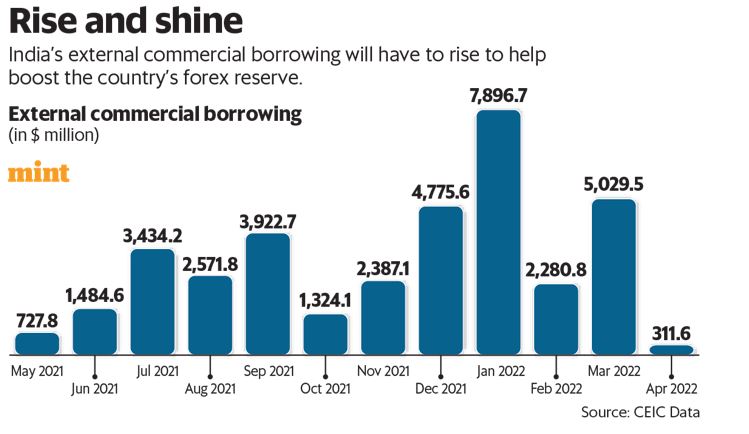
  • What are External Commercial Borrowings (ECBs)?

    The Reserve Bank of India has relaxed norms for companies raising external commercial borrowings (ECBs), as part of a set of measures to stem the slide in the rupee.

    What are ECBs taken by Indian companies?

    • ECBs are commercial loans that eligible resident entities can raise from outside India, i.e. from a recognized non-resident entity.
    • ECBs can be buyer’s credit, supplier’s credit, foreign currency convertible bonds, foreign currency exchangeable bonds, loans etc.
    • ECBs can be raised via the automatic route where cases are examined by the Authorized Category Dealer, or the approval route where borrowers are mandated to forward their request to RBI through their authorized dealers.
    • Borrowers must follow norms on minimum maturity period, maximum all-in-cost ceiling, end-uses etc.

    What is the relaxation offered by the RBI?

    • RBI earlier had raised borrowing limit under the automatic route from $750 million or its equivalent per financial year to $1.5 bn up till up to 31 December, 2022.

    Why such move?

    • The objective was to increase the supply of foreign exchange reserves.
    • This in turn would thereby prevent the fast depreciation of the rupee witnessed over the last few months.

    What clarity do foreign lenders want from RBI?

    • Lenders want to know whether the investment grade needs to be rated by domestic or international agencies.
    • If it is only by global agencies, it would limit the number of potential borrowers.
    • This is because companies which might be rated high domestically might not necessarily have made the investment grade when rated by international agencies.

    Why do Indian firms go for ECBs?

    • Low cost: ECBs give companies the benefit of borrowing abroad at lower interest rates.
    • Long term repayment: They are also an avenue to borrow a large volume of funds for a relatively long period of time.
    • Surpassing exchange fluctuation: Also, borrowing in foreign currencies enables companies to pay for their machinery import etc., thereby nullifying the impact of varying exchange rate.
    • Long term profitability: ECBs can help diversify the investor base and funds available at lower cost, helping improve profitability of companies.
    • Better credit ratings: ECB interest rates are also a function of their ratings in the international market.

    What are the risks for firms raising ECBs?

    • Though companies get attracted to ECBs due to lower interest rates, the comfort level of the borrower depends on how stable the rate of exchange is.
    • Depreciation of the rupee will raise debt servicing burden as compared to what has been worked out at the time of availing of the ECB facility.
    • Thus, the companies might need to incur hedging costs (amount equal to the aggregate costs, fees, and expenses) to cover the exchange rate risk.


    UPSC 2023 countdown has begun! Get your personal guidance plan now! (Click here)

  • Key terminologies in news: Yield Inversion, Soft-Landing and Reverse Currency Wars

    This article provides a quick summary of what has been happening in the global economy. These are few key terms that one is likely to hear repeatedly in the coming days and weeks:

    1. Yield Inversion
    2. Soft-landing and
    3. Reverse Currency War

    Here’s a quick look at what they mean and why they are significant at present.

    (1) Bond Yield Inversion

    What is Bond Yeild?

    • Bonds are essentially an instrument through which governments (and also corporations) raise money from people.
    • Typically government bond yields are a good way to understand the risk-free interest rate in that economy.
    • This 2019 piece provides an introduction to government bonds and explains how yields are calculated.

    What is Yield Curve?

    • The yield curve is the graphical representation of yields from bonds (with an equal credit rating) over different time horizons.
    • In other words, if one was to take the US government bonds of different tenures and plot them according to the yields they provide, one would get the yield curve.

    The chart below provides a sense of the different types of yield curves one could have.

    How to see this?

    • Under normal circumstances, any economy would have an upward sloping yield curve.
    • That is to say, as one lends for a longer duration — or as one buys bonds of longer tenure — one gets higher yields. This makes sense.
    • If one is parting with money for a longer duration, the return should be higher.
    • Moreover, a longer tenure also implies that there is a greater risk of failure.
    • An inversion of the yield curve essentially suggests that investors expect future growth to be weak.

    Inversion of bond yield

    • However, there are times when this bond yield curve becomes inverted.
    • For instance, bonds with a tenure of 2 years end up paying out higher yields (returns/ interest rate) than bonds with a 10 year tenure.
    • Such an inversion of the yield curve essentially suggests that investors expect future growth to be weak.

    Here’s how to make sense of this?

    • When investors feel buoyant about the economy they pull the money out from long-term bonds and put it in short-term riskier assets such as stock markets.
    • In the bond market, the prices of long-term bonds fall, and their yield (effective interest rate) rises.
    • This happens because bond prices and bond yields are inversely related.
    • However, when investors suspect that the economy is heading for trouble, they pull out money from short-term risky assets (such as stock markets) and put them in long-term bonds.
    • This causes the prices of the long-term bonds to rise and their yields to fall.

    Why use inversion curve?

    • Over the years, inversion of the bond yield curve has become a strong predictor of recessions. Of course, for it to be taken seriously, such an inversion has to last for several months.
    • Over the past few weeks, such inversion is happening repeatedly in the US, suggesting to many that a recession is in the offing.
    • In the current instance, the US Fed (their central bank) has been raising short-term interest rates, which further bumps up the short-end of the yield curve while dampening economic activity.

    (2)  Soft-Landing

    • The process of monetary tightening that the US is currently unveiling involves not just reducing the money supply but also increasing the cost of money (that is, the interest rate).
    • US is doing this to contain soaring inflation.
    • Ideally, the US Fed or any central bank doing this would like to bring about monetary tightening in such a manner that slows down the economy but doesn’t lead to a recession.
    • When a central bank is successful in slowing down the economy without bringing about a recession, it is called a soft-landing — that is, no one gets hurt.
    • But when the actions of the central bank bring about a recession, it is called hard-landing.

    (3) Reverse Currency War

    • A flip side of the US Fed’s action of aggressively raising interest rates is that more and more investors are rushing to invest money in the US.
    • This, in turn, has made the dollar become stronger than all the other currencies. That’s because the dollar is more in demand than yen, euro, yuan etc.
    • On the face of it, this should make all other countries happier because a relative weakness of their local currency against the dollar makes their exports more competitive.
    • For instance, a Chinese or an Indian exporter gets a massive boost.
    • In fact, in the past the US has often accused other countries of manipulating their currency (and keeping its weaker against the dollar) just to enjoy a trade surplus against the US.
    • This used to be called the currency war.

    What explains this reverse currency war unfolding at the moment?

    • The important thing to understand is that a stronger dollar has had a key benefit — importing cheaper crude oil.
    • A currency which is losing value to the dollar, on the other hand, finds that it is getting costlier to import crude oil and other commodities that are often traded in dollars.
    • But raising the interest rate is not without its own risks.
    • Just like in the US, higher interest rates will decrease the chances of a soft-landing for any other economy.


    UPSC 2023 countdown has begun! Get your personal guidance plan now! (Click here)

  • GST Slab Changes

    Customers will have to pay a 5% Goods and Services Tax (GST) on pre-packed, labelled food items such as atta, paneer and curd, besides hospital rooms with rents above ₹5,000.

    What is GST?

    • GST launched in India on 1 July 2017 is a comprehensive indirect tax for the entire country.
    • It is charged at the time of supply and depends on the destination of consumption.
    • For instance, if a good is manufactured in state A but consumed in state B, then the revenue generated through GST collection is credited to the state of consumption (state B) and not to the state of production (state A).
    • GST, being a consumption-based tax, resulted in loss of revenue for manufacturing-heavy states.

    What are GST Slabs?

    • In India, almost 500+ services and over 1300 products fall under the 4 major GST slabs.
    • There are five broad tax rates of zero, 5%, 12%, 18% and 28%, plus a cess levied over and above the 28% on some ‘sin’ goods.
    • The GST Council periodically revises the items under each slab rate to adjust them according to industry demands and market trends.
    • The updated structure ensures that the essential items fall under lower tax brackets, while luxury products and services entail higher GST rates.
    • The 28% rate is levied on demerit goods such as tobacco products, automobiles, and aerated drinks, along with an additional GST compensation cess.

    Why rationalize GST slabs?

    • From businesses’ viewpoint, there are just too many tax rate slabs, compounded by aberrations in the duty structure through their supply chains with some inputs taxed more than the final product.
    • These are far too many rates and do not necessarily constitute a Good and Simple Tax.
    • Multiple rate changes since the introduction of the GST regime in July 2017 have brought the effective GST rate to 11.6% from the original revenue-neutral rate of 15.5%.
    • Merging the 12% and 18% GST rates into any tax rate lower than 18% may result in revenue loss.


    UPSC 2023 countdown has begun! Get your personal guidance plan now! (Click here)

  • Public Capex Plan key to long-term growth: FM

    Finance Minister said India’s long-term growth prospects were embedded in public capital expenditure programs.

    What is the news?

    • FM has raised capital expenditure (capex) by 35.4% for the financial year 2022-23 to ₹7.5 lakh crore to continue the public investment-led recovery of the pandemic-battered economy.
    • The capex last year was ₹5.5 lakh crore.

    What is Capital Expenditure (Capex)?

    • The government’s expenditure is categorized into two:
    1. The one which results in asset development or acquisition known as CAPEX,
    2. Another is utilized to cover operating costs and obligations but does not result in asset creation known as Revenue expenditure.
    • Capex is defined the as money spent on the acquisition of assets such as land, buildings, machinery, and equipment, as well as stock investments.

    What attributes to capex?

    • The portion of government payments that goes toward the construction of assets such as schools, colleges, hospitals, roads, bridges, dams, railway lines, airports, and seaports amounts to capex.
    • The acquisition of new weaponry and weapon systems, such as missiles, tanks, fighter planes, and submarines, necessitates a significant financial outlay.
    • The defense sector receives over a third of the central government’s capital spending, primarily for armament acquisitions.
    • Despite the fact that defense spending is classified as a capital expenditure, it does not result in the development of infrastructure to support economic growth.
    • Also includes investments that will produce earnings or dividends in the future.

    Significance of Capex

    • Economic recovery: This action is crucial in light of the economic slowdown induced by the Covid-19 epidemic, as well as a dip in the employment ratio.
    • Value creation: Capital asset formation provides future cash flows for the economy and contributes to value creation.
    • Multiplier Effect: Capex is expected to have a Multiplier Effect (a change in rupee value of output with respect to a change in rupee value of expenditure).
    • Increased employment: Capital spending creates jobs and improves labor productivity as a result of the multiplier effect.
    • Macroeconomic Stabilizer: Capital Expenditure serves as a macroeconomic stabilizer and is an excellent instrument for countercyclical fiscal policy.


    UPSC 2023 countdown has begun! Get your personal guidance plan now! (Click here)
  • India & FTA

    Context

    In recent months, India has signed trade agreements with Australia and UAE. n the last week of June, New Delhi began talks for a similar agreement with the EU.

    How FTA with EU could help India

    • India’s successful sectors like textiles, pharmaceuticals and leather could benefit from these deliberations, which would also be keenly watched by representatives of the services and renewable energy sectors.
    • A successful free trade agreement (FTA) with the EU could help India to expand its footfall in markets such as Poland, Portugal, Greece, the Czech Republic and Romania, where the country’s exports registered double-digit annual growth rates in the last decade.

    So, what are the factors India need to consider while signing FTA

    1] Impact of tariff on domestic industry:

    • It has been observed that when India is an importer, the preferential tariffs that accrue as a result of trade agreements are significantly lower than the rates charged from countries given Most Favoured Nation (MFN) status by India.
    • But when the partner country is the importer, preferential tariffs on Indian goods, in most cases, are closer to the MFN tariffs.
    • As a result, Indian exporters do not get the same returns as their counterparts in the partner countries.
    • India’s trade with South Korea is a case in point.
    • Before entering into a trade agreement care should, therefore, be taken to ensure that the domestic industry is not made to compete on unequal terms with the partner countries.

    2] Adherence to the rules of origin

    • The India-UAE Comprehensive Economic Partnership Agreement sets a good example.
    • It includes a strong clause on the rules of origin.
    • Forty per cent value addition or substantial processing of up to 40 per cent in the exporting country is required to qualify for lower tariffs.
    • Rules of origin have been a bone of contention in most Indian trade agreements.
    • (CAROTAR, 2020): In 2020, the country notified the Customs (Administration of Rules of Origin under Trade Agreements) Rules (CAROTAR, 2020), which require a basic level of due diligence from the importer.

    3] Including the offset clauses

    • “Offset clauses” — where the exporter is obliged to undertake activities that directly benefit the importing country’s economy — should be built into trade agreements, especially for technology intensive sectors.

    4] Emergency action plan

    •  In February 2020, the US made India ineligible for claims under GSP, America’s oldest preferential trade scheme.
    • The US Trade Representative’s Office deemed India as a developed country and suspended beneficial treatment under the GSP.
    • A contingency plan should be in place to tackle such situations.

    5] Inclusion of sunset clause

    • India should also take a cue from the US-Mexico-Canada Agreement, to incorporate a “sunset” clause in trade agreements.
    • The pact between the three North American nations provides for periodic reviews and the agreement is slated to end automatically in 16 years unless the countries renegotiate it.

    6] Parity between services and merchandise

    • India should negotiate for parity between services and merchandise.
    • Low trade in services: India’s trade in services is low, and its overall score in the OECD’s Services Trade Restrictiveness Index (STRI) exceeds the world average.
    • It is especially high in legal and accounting services due to the licencing requirements in both these segments.
    • Expansion in banking and financial services: There is also significant room for expansion of trade in the banking and financial services industry.

    Conclusion

    A well-crafted trade agreement could help India enhance its share in global trade and help attain the government’s target of making the country a $5-trillion economy.

    UPSC 2023 countdown has begun! Get your personal guidance plan now! (Click here)


    Back2Basics: CAROTAR Rules

    • Importers will have to do their due diligence to ensure that imported goods meet the prescribed ‘rules of origin’ provisions.
    • This is the essential availing concessional rate of customs duty under free trade agreements (FTAs).
    • A list of minimum information, which the importer is required to possess, has also been provided in the rules along with general guidance.
    • Also, an importer would now have to enter certain origin related information in the Bill of Entry, as available in the Certificate of Origin.

    Why need CAROTAR?

    • CAROTAR 2020 supplements the existing operational certification procedures prescribed under different trade agreements.
    • India has inked FTAs with several countries, including Japan, South Korea and ASEAN members.
    • Under such agreements, two trading partners significantly reduce or eliminate import/customs duties on the maximum number of goods traded between them.
    • The new rules will assist customs authorities in the smooth clearance of legitimate imports under FTAs.
  • Bank frauds

    Context

    The biggest banking scam in India has come to the forefront; in this case, DHFL has hoodwinked a consortium of banks driven by the Union Bank of India to the tune of ₹35,000 crore through financial misrepresentation.

    How scams affect economy

    • The banking system of any country is the backbone of its economy.
    • Excessive losses to banks affect every person in the country because the amounts deposited in banks belong to the citizens of the country.
    • The NPAs that banks incur are mainly due to bad loans and scams.
    • The data by the RBI also show that one of the fundamental problems in the way of the development of banking in India is on account of rising bank scams and the costs consequently forced on the framework.
    • Strangely, as in a Global Banking Fraud survey (KPMG), the issue is not just for India alone; it is a worldwide issue.

    Reasons for scams

    •  Frauds in the banking industry can be grouped under four classifications: ‘Management’, ‘Outsider’, ‘Insider’ and ‘Insider and Outsider’ (jointly).
    • Operational failures: All scams, whether interior or outside, are results of operational failures.
    • Limited asset monitoring: Research by Deloitte has shown that limited asset monitoring after disbursement (38%) was the foremost reason behind stressed assets and insufficient due diligence before disbursement (21%) was among the major factors for these NPAs.
    • Poor bank corporate governance: A study by the Indian Institute of Management Bangalore has shown that poor bank corporate governance is the cause behind rising bank scams and NPAs.

    The problems of high NPA

    • In a Financial Stability Report released by the RBI in December 2021, there is a projection of the gross NPAs of banks rising from 6.9% in September 2021 to 8.1% of total assets by September 2022 (under a baseline scenario) and to 9.5% under a severe stress scenario.
    • A high NPA also reduces the net interest margin of banks besides increasing their operating cost; these banks meet this cost by increasing the convenience fee from their small customers on a day-to-day basis.

    Suggestions

    • Banks have to exercise due diligence and caution while offering funds.
    • Regulation and control of CAs: The regulation and the control of chartered accountants is a very important step to reduce non-performing assets of banks.
    • Banks should be cautious while lending to Indian companies that have taken huge loans abroad.
    • Tightening audit system: There is also an urgent need to tighten the internal and external audit systems of banks.
    • Fast rotation of employees: The fast rotation of employees of a bank’s loan department is very important.
    • Public sector banks should set up an internal rating agency for rigorous evaluation of large projects before sanctioning loans.
    • Effective MIS: Further, there is a need to implement an effective Management Information System (MIS) to monitor early warning signals about business projects.
    • CIBIL score of the borrower: The CIBIL score of the borrower (formerly the Credit Information Bureau (India) Limited) should be evaluated by the bank concerned and RBI officials.
    • Use of AI: Financial fraud can be reduced to a great extent by the use of artificial intelligence (AI) to monitor financial transactions.
    • Improve loan recovery process: Rather than having to continuously write off the bad loans of large corporates, India has to improve its loan recovery processes and establish an early warning system in the post-disbursement phase.
    • Risk assessment: Banks need to carry out fraud risk assessments every quarter.
    • Only establishment of National Asset Reconstruction Company Ltd. (NARCL) or the ‘bad bank’ is not a real solution.
    • These measures can help only after a loan is bad but not the process of a loan going bad.

    Conclusion

    While the Government of India and the RBI have taken several measures to try and resolve the issue of scams in the banking industry, the fact is that there is still a long way to go.

    UPSC 2023 countdown has begun! Get your personal guidance plan now! (Click here)