The Union Minister for Culture and Tourism has provided information about the Zonal Cultural Centres (ZCCs) in Lok Sabha.
AboutZonal Cultural Centres (ZCCs):
About
• Set up by the Ministry of Culture to promote and preserve cultural heritage.
• Established in 1985, with operations beginning in 1986-87.
• Seven ZCCs located in Patiala, Nagpur, Udaipur, Prayagraj, Kolkata, Dimapur, and Thanjavur.
Aims and Objectives
• Preserving and promoting regional folk, tribal, and traditional arts.
• Enhancing and celebrating India’s cultural diversity.
• Encouraging folk & tribal arts and promoting cultural education.
• Involving youth in creative cultural programs.
• Strengthening linkages between different regions of India to showcase their contribution to Indian culture.
Implementation and Structural Mandate
• Government allocated Rs. 10 crore to each ZCC during the 7th and 10th Plans.
• Free land provided by state governments for ZCC headquarters.
• Organizes Rashtriya Sanskriti Mahotsav (RSM) and regional festivals to promote cultural engagement.
• 42 regional festivals organized annually, 14 RSMs since 2015.
Significance
• Strengthens cultural unity across India and preserves regional cultures.
• Providesplatforms for youth to engage in cultural activities.
• Promotes national integration through events bringing together artists from different regions.
• Contributes to economic development through tourism and employment.
PYQ:
[2013] Which of the following bodies is/are not mentioned in the Indian Constitution?
1. National Development Council
2. Planning Commission
3. Zonal Councils
Select the correct answer using the codes given below:
On November 25, the Portuguese conquered Goa, establishing first territorial possession in India by any colonists.
This marked the beginning of Portugal’s 400-year colonial rule in the region, which ended only in 1961, making them the last colonial power to leave India.
Why the Portuguese came to Goa?
Vasco da Gama’s voyage in 1498 revealed the thriving trade networks in the Indian Ocean.
The Portuguese aimed to capitalize on the wealth from the Indian Ocean trade routes.
Rivalry with Muslim-controlled trade routes prompted the Portuguese to establish a military presence in the region.
In 1505, the Portuguese State of India was formally established, six years after Vasco da Gama’s arrival.
Francisco de Almeida, the first Viceroy, set up the first base in Fort Manuel (now part of Kochi).
The Portuguese controlled the Island of Bom Bahia (later Bombay) until it was ceded to England in 1661.
How Alfonso de Albuquerque conquered Goa?
Albuquerque (Viceroy, 1509-1515) understood that Goa was essential for controlling the maritime trade routes in the East.
The decision to attack Goa was influenced by Timmayya, a debated figure, either a Malabari pirate or an aristocrat with links to the Vijayanagara Empire.
Albuquerque’s first attack on Goa (February-March 1510) was largely successful due to the unpopularity of Sultan Yusuf Adil Shah’s rule among Goa’s Hindu population.
Many locals supported the Portuguese against the Sultan’s rule.
After being stranded on the Mandovi River during the monsoon season, Albuquerque received reinforcements from Portugal.
In November 1510, with reinforcements, Albuquerque launched a successful attack and retook Goa.
Who Was Timmayya?
Timmayya, a key figure in the conquest of Goa, is described in various sources as a pirate from Malabar.
However, other historians argue that he was of noble birth and held a prestigious position in the Vijayanagara Empire.
According to historians, Timmayya was actually a high-ranking admiral in the Vijayanagara navy.
Though the Portuguese regarded him as a corsair or pirate, he was in fact executing orders from the Vijayanagara Empire, attacking Portuguese and rival merchant ships on his empire’s behalf.
While some historians argue that Timmayya’s counsel was pivotal in the timing of the attack on Goa, others suggest that Albuquerque may have already planned the assault, with Timmayya’s advice simply solidifying the decision.
Why did Timmayya want Goa conquered?
The rulers of the Vijayanagara Empire had long eyed Goa after it was lost to the Sultan of Bijapur.
Timmayya’s personal motivations were likely shaped by the empire’s strategic interest in regaining control of the region, as Goa was seen as a valuable territory in both military and economic terms.
PYQ:
[2021] Consider the following statements:
1. It was during the reign of Iltutmish that Chengiz Khan reached the Indus in pursuit of the fugitive Khwarezm prince.
2. It was during the reign of Muhammad-bin-Tughluq that Taimur occupied Multan and crossed the Indus.
3. It was during the reign of Deva Raya II of Vijayanagara Empire that Vasco da Gama reached the coast of Kerala.
Which of the statements given above is/are correct?
The #AbKoiBahanaNahi national campaign was launched in New Delhi to empower women and end gender-based violence.
About the#AbKoiBahanaNahi Campaign:
About
• Launched By:
– Ministries of Women and Child Development
– Ministries of Rural Development
– Support from UN Women
Aims and Objectives
• End Gender-Based Violence: Create awareness and urgency to end violence against women and girls across India.
• Dignity and Equality: Promote women’s dignity by empowering them to report violence and fight for their rights.
• Gender Equality in Economy: Ensure full, equal participation of women in all sectors for building a developed India (Viksit Bharat).
Implementation and Structural Mandate
• National Call to Action: urging all stakeholders—citizens, NGOs, and government agencies—to actively work towards ending gender-based violence.
• Alignment with Global Campaigns: The campaign aligns with the UN’s #NoExcuse global initiative, which calls for accountability and action against rising violence.
• Supportive Interventions: Government measures to reduce women’s drudgery, ensure financial inclusion, bridge the gender digital divide, and provide safe spaces for women.
Significance
• Empowerment for Dignity: The campaign empowers women to fight for their dignity, free from societal constraints.
• Women’s Role in National Development: Reinforces that achieving gender equality is crucial for India’s development by 2047.
• Support to Women’s Rights: Promotes a holistic approach to women’s rights, ensuring gender-sensitive laws, healthcare, education, and economic opportunities.
PYQ:
[2010] Two of the schemes launched by the Government of India for Women’s development are Swadhar and Swayam Siddha. As regards the difference between them, consider the following statements:
1. Swayam Siddha is meant for those in difficult circumstances such as women survivors of natural disasters or terrorism, women prisoners released from jails, mentally challenged women etc., whereas Swadhar is meant for holistic empowerment of women through Self Help Groups.
2. Swayam Siddha is implemented through Local Self-Government bodies or reputed Voluntary Organizations whereas Swadhar is implemented through the ICDS units set up in the states.
Which of the statements given above is/are correct?
November 24 is commemorated as the Shaheedi Divas of Guru Tegh Bahadur, the 9th guru of the Sikhs, who was executed on the orders of Aurangzeb in 1675.
Guru Tegh Bahadur: Everything you need to know
Details
Who wasGuru Tegh Bahadur?
Born on April 1, 1621 in Amritsar, Punjab to Guru Hargobind (6th Sikh Guru), Mata Nanaki
Death: November 11, 1675, executed by Mughal Emperor Aurangzeb
Became 9th Guru (1665 to 1675)
Promoted the idea of Nirbhau (fearless) and Nirvair (without enmity) and emphasized the oneness of God.
Referred to as ‘Hind Ki Chadar’ (Shield of India).
What was his historical contribution?
Guru stood up for the Hindu Kashmiri Pandits, defending their right to practice their religion against Mughal Emperor Aurangzeb’s oppressive policies.
Refused to convert to Islam despite facing torture and persecution, ultimately leading to his execution.
Advocated for the principle of one God, rejecting idol worship and preaching about the unity of all religions.
Emphasized meditation, self-discipline, moral living, and serving others. He urged Sikhs to remain spiritually committed while defending the rights of the innocent.
His hymns are compiled in the Guru Granth Sahib, with 115 hymns attributed to him.
Many Gurdwaras are dedicated to him, including Gurdwara Sis Ganj Sahib in Delhi, built on the site where he was executed.
Guru Gobind Singh, the 10th Sikh Guru, was born to Guru Tegh Bahadur in 1666.
PYQ:
[2013] Consider the following Bhakti Saints:
Dadu Dayal
Guru Nanak
Tyagaraja
Who among the above was/were preaching when the Lodi dynasty fell and Babur took over?
PM recently highlighted Lothal’s importance in India’s maritime history as the site of the world’s first dockyard, now home to the National Maritime Heritage Complex under Ministry of Ports, Shipping and Waterways.
About Lothal’s Maritime Heritage Complex:
Facts about Lothal
Dockyard Evidence: Recent IITGn study confirms existence of a dockyard (222 x 37 meters).
River Shift: Sabarmati River’s old course closer to Lothal during Harappan period, now 20 km away.
Trade Route: Linked Ahmedabad, Lothal, Nal Sarovar, Little Rann, and Dholavira.
Satellite Imagery: Revealed ancient channels of Sabarmati River, confirming Lothal’s strategic location.
Trade Connections: Traders might have used the Gulf of Khambhat, collecting materials from Ratanpura and transporting them to Mesopotamia.
Historical Significance
Built around: 2200 BC as a major trade center for beads, gems, and ornaments.
Lothal means “mound of the dead” in Gujarati similar to Mohenjodaro.
Discovered by S.R. Rao, excavated from 1955 to 1960.
World’s earliest known dock; connected to the ancient Sabarmati River.
Nominated as UNESCO World Heritage Site in 2014; only port-town of the Indus Valley Civilization.
Features of the Present Complex
Location: Bhal region, Gujarat, India.
Objective: Showcase India’s 5,000-year-old maritime history, focusing on the first dockyard at Lothal.
Developed by: Ministry of Ports, Shipping, and Waterways.
Components: Exhibition halls, maritime park, amphitheater, and educational spaces.
PYQ:
[2021] Which one of the following ancient towns is well-known for its elaborate system of water harvesting and management by building a series of dams and channelling water into connected reservoirs?
Q) What are the continued challenges for Women in India against time and space? (UPSC CSE 2019)
Mentor’s Comment: UPSC Mains have always been focused on Minority Section of the Society –esp. Women and children. Some recent micro themes have been asked like – Mental Healthcare challenges faced by Women in India (Mains 2023).
In major cities like Mumbai, Delhi, and Chennai, HIV seroprevalence rates among ‘female sex workers’ have been reported between 50% to 90%.
This alarming statistic places these women at a significantly higher risk (30 times more likely to contract HIV) compared to other women of reproductive age. Secondly, the mental health of sex workers is severely compromised due to the stigma associated with their profession.
Today’s editorial discusses the systemic barriers that prevent sex workers from accessing mental health care. This content can be used on a case-by-case basis depending upon the demand of the questions related to ‘Women Issues’ and the ‘Healthcare’ sector in India.
_
Let’s learn!
Why in the News?
The recent initiatives aimed at addressing HIV prevention among sex workers have highlighted gaps in mental health support, prompting calls for more integrated healthcare approaches that consider both physical and mental health needs.
Furthermore, with cultural representations of “Heeramandi,” there is a drawing attention to the resilience and agency of sex workers while also acknowledging their struggles.
What are the Mental Health challenges faced by sex workers?
• Common Disorders: Many sex workers suffer from high rates of depression and anxiety, with studies showing that up to 47% may experience depression. Due to exposure to violence and trauma, around 21% report symptoms of Post-Traumatic Stress Disorder (PTSD). • Violence and Stigma: Sex workers often face physical, emotional, and sexual violence from clients and others, leading to chronic stress and mental health issues. Societal stigma creates feelings of shame and isolation, making it hard for them to seek help. • Economic Pressures: Many enter sex work due to financial need, which adds ongoing stress and anxiety about their situation. To cope with stress and trauma, some may turn to drugs or alcohol, which can worsen their mental health. • Barriers to Care: Discrimination in healthcare settings and fear of judgment prevent many sex workers from getting the mental health care they need.
Why is access to mental health services limited for sex workers?
Stigma and Discrimination: Many sex workers avoid seeking help due to fear of being judged by healthcare providers. Past experiences of discrimination can lead to distrust in the healthcare system.
Legal Barriers: In many areas, sex work is illegal, making workers afraid to seek help due to potential legal consequences. Many migrant sex workers do not have valid IDs, which can prevent them from accessing services.
Economic Constraints: Many sex workers struggle financially, making it hard to afford mental health care.
Limited Availability of Services: Few mental health services are designed specifically for sex workers, who may feel that existing options don’t meet their needs. Many sex workers are unaware of available mental health resources.
Cultural and Language Barriers: Migrant sex workers may face language barriers that complicate communication with healthcare providers.
What comprehensive strategies can be implemented?
Creating Safe Spaces: Create specialized, free, and confidential mental health services for sex workers, staffed by trained professionals who understand their unique challenges.
Community-Based Support: Establish peer support groups and outreach programs to connect sex workers with resources and foster a sense of community.
Education and Empowerment: Provide workshops on mental health awareness and coping strategies, along with skill development programs to create alternative job opportunities.
Advocacy for Rights and Stigma Reduction: Work towards decriminalizing sex work and advocate for policies that protect sex workers’ rights, while also launching public awareness campaigns to combat stigma.
Researchers have identified unique salt chimneys on the Dead Sea floor.
Key facts about the Dead Sea:
Details
Location
• Located between Jordan and Israel, with the eastern shore in Jordan and the western shore in Israel.
• The southern half of the western shore belongs to Israel, and the northern half is in the West Bank.• Divided by Al-Lisan peninsula into two basins: the northern basin is deep (400 m), and the southern basin is shallow (< 3 m).
Geographical Features
• 430.5 meters below sea level, the Earth’s lowest land-based feature.
• Length: 50 km, Width: 15 km at its widest point.
• Surrounded by the Judaea hills (west) and Transjordanian plateaus (east).
Salinity and Density
• Salinity: 34.2%, almost ten times saltier than ordinary seawater, making it the fourth saltiest water body in the world.
• Density: 1.240 kg/L, which allows people to float easily.
Inlets and Outlets
• Main inlet: Jordan River.
• No outlet, water loss occurs primarily through evaporation.
• High salinity and harsh climate result in no life except for algae and microorganisms.
About the Salt Chimneys
Salt chimneys are tall, chimney-like structures made of crystallized salt, recently discovered on the Dead Sea floor.
They are found by researchers from the Helmholtz Centre for Environmental Research (UFZ) during an underwater survey.
These chimneys range from 1 to over 7m in height.
Formation Process:
Groundwater from surrounding aquifers flows through old salt deposits around the Dead Sea basin, dissolving halite (salt) and carrying it as brine.
Despite being saline, the brine is less dense than the Dead Sea water due to its high salinity, causing it to rise as a plume from the lake bed.
When this brine contacts the colder Dead Sea water, it rapidly crystallizes, forming chimney structures that can grow several centimeters in height each day.
Potential Role in Sinkhole Forecasting
Thousands of sinkholes have appeared near the Dead Sea in recent decades; understanding chimney formation may aid in preventing future collapses in vulnerable areas.
Researchers have linked the formation of salt chimneys to underground cavities, which are often the precursors to sinkholes.
The location of these chimneys may help predict areas at high risk for sinkhole formation, offering a way to monitor and mitigate potential hazards.
Police found dead bodies floating in the Barak River (inflicted due to Manipur Violence).
About the Barak River:
Details
Geographical Location
• Originates from Japvo mountain in Manipur hills at 3,015 m altitude.
• Flows south, forming the border between Assam and Manipur up to Jirimat.
• Flows for 524 km in India, and then enters Bangladesh as Surma and Kushiyara, later becoming Meghna River.• The river is navigable in parts, with National Waterway 6 (121 km).
Physical Features
• Length: 564 km in total, with 524 km in India.
• Drainage area in India: 41,157 sq. km (1.38% of India’s total area).
• Tributaries: Jiri, Dhaleswari, Singla, Longai, Sonai, and Katakhal.
Flora and Fauna/Important Sites
• Fauna: Home to over 2,000 species of fish and rare creatures like the Siamese crocodile, susu dolphin, smooth-coated otter, and black mugger crocodile.
• Flora: Includes Varzea forest, Los llamjao, tidal forests (mangroves), Pats (flat-topped table mountains), and large tropical swamps.
• Wetlands support farming and biodiversity.
• Hydropower projects: Tipaimukh Dam, Tista Champamati, Dhansiri Barrages.
• Affected by flooding and soil erosion, especially during monsoon.
PYQ:
[2014] Consider the following rivers:
1. Barak
2. Lohit
3. Subansiri
Which of the above flows/flow through Arunachal Pradesh?
Since 2021, November 15th is celebrated as Janjatiya Gaurav Divas to honor the contributions of tribal communities in India’s freedom struggle.
This day commemorates the birth anniversary of the legendary SriBirsa Munda.
Who was Birsa Munda?
Born on November 15, 1875, in the Chotanagpur region (now Jharkhand), during a period of significant changes for the Munda community.
He spent his early years traveling with his parents; received primary education under Jaipal Nag.
He was influenced by the Sardari agitation, a peaceful movement against British rule, Birsa emerged as a leader advocating tribal rights.
Causes of the Rebellion:
British policies like the Permanent Settlement Act (1793) disrupted traditional land systems, leading to displacement and exploitation of tribal communities.
The Mundas’ khuntkatti land rights system was eroded by jagirdars and thikadars, resulting in land alienation.
Increased migration of non-tribals under British rule led to exploitation through high-interest money lending and forced labor.
Missionary-led education raised awareness among tribals, creating social divides but also sparking movements for tribal rights.
Historical Background:
Birsa started the Birsait faith to counter Christian missionary conversions among tribals. It became a challenge to British conversion efforts.
Members of the Munda and Oraon communities joined the Birsait sect.
The Mundas honored him as Dharati Aaba (Father of the Earth).
The Ulgulan Movement: Also known as the Munda Rebellion, led by Birsa Munda in 1899-1900.
Concentrated in the Munda belt of Khunti, Tamar, Sarwada, and Bandgaon.
The goal was to establish Munda Raj (self-rule) and independence, known as Ulgulan or the “Great Tumult.”
The rebellion was ultimately suppressed by British forces, leading to Birsa Munda’s capture and death.
Birsa Munda’s mobilization left a lasting impact, prompting government reforms like the repeal of the Begar system and enactment of the Tenancy Act (1903).
The movement was violently suppressed, and Birsa Munda died in jail on June 9, 1900.
Significance:
Janjatiya Gaurav Divas is significant in preserving the legacy of tribal resistance leaders and advocating for tribal rights.
It promotes a more inclusive society that values the contributions of all communities in India’s historical and cultural fabric.
PYQ:
[2020] With reference to the history of India, “Ulgulan” or the Great Tumult is the description of which of the following events?
Q) Public health system has limitations in providing universal health coverage. Do you think that private sector can help in bridging the gap? What other viable alternatives do you suggest? (UPSC CSE 2015)
Q) The increase in life expectancy in the country has led to newer health challenges in the community. What are those challenges and what steps need to be taken to meet them? (UPSC CSE 2022)
India’s Public Health System needs to focus on preventing and controlling non-communicable diseases like hypertension, diabetes, cardiovascular diseases, stroke, and cancer. These diseases affect people of all income levels, but the poor and old aged population is the most vulnerable.
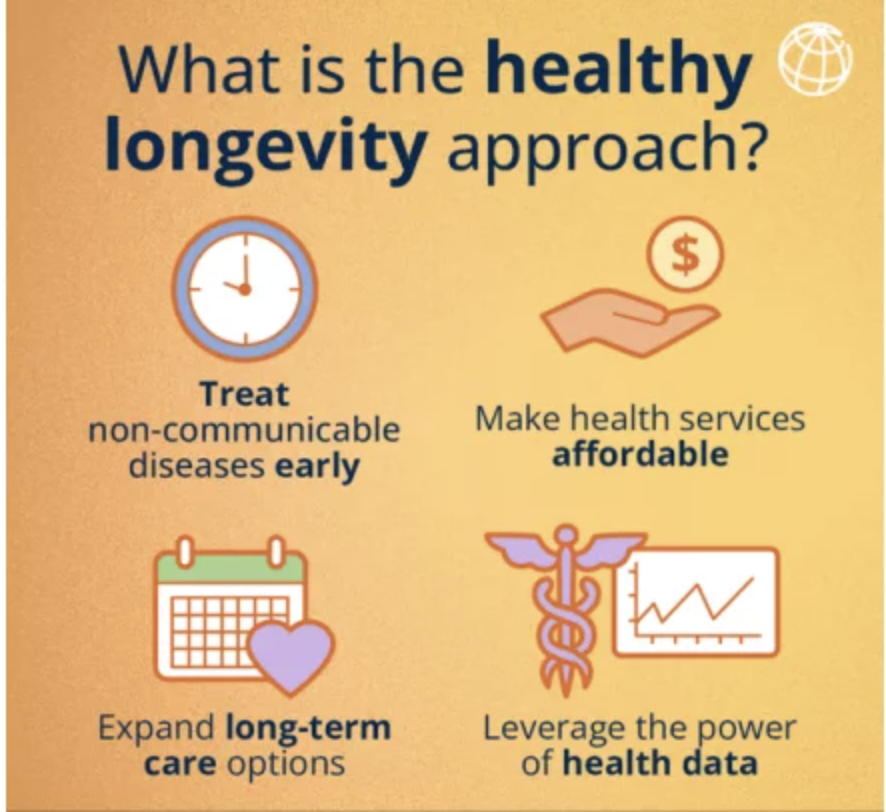
In this scenario, Health Longevity is an evidence-based approach to help countries define prioritized, costed interventions and policy changes to save and extend people’s lives. According to World Bank, investing in healthy longevity could save 150 million lives in low- and middle- income countries.
Today’s editorial emphasizes the issues related to the health sector in India especially with respect to Non-communicable diseases.
_
Let’s learn!
Why in the News?
The World Bank publishes an important and forward-thinking report on a key issue affecting people’s well-being. The report is Unlocking the Power of Healthy Longevity: Demographic Change, Non-communicable Diseases, and Human Capital, released in Washington D.C. in September 2024.
Key Findings of the Report:
● Aging and NCD Burden: Global aging is accelerating, with non-communicable diseases (NCDs) causing over 70% of deaths, especially in low- and middle-income countries. ● Potential Life Savings: Investing in healthy longevity could save 150 million lives and significantly improve productivity and economic growth by 2050. ● Life-Course Health Investments: Addressing health from maternal to elderly care, with a focus on NCD prevention, is essential for promoting healthier aging populations. ● Gender and Social Equity: Women, who often bear caregiving responsibilities and live longer with NCDs, require targeted health and social protections to ensure equity in aging.
Issues related to the Elderly Population in India:
Size of Elderly Population: India has the second-largest elderly population in the world, with approximately 140 million people aged 60 years and above.
Growth Rate: The elderly population is growing at a rate nearly three times higher than India’s overall population growth, indicating a significant demographic shift.
Aging Population Challenge: This rapidly aging population places considerable pressure on health services, social systems, and the economy.
What are the Disease Concerns in India?
Rise in Non-Communicable Diseases (NCDs): India is witnessing an increasing burden of NCDs, including heart disease, diabetes, cancer, and chronic respiratory diseases, which are now the leading causes of death.
Health Risks for the Elderly: As the elderly population grows, the prevalence of age-related diseases and NCDs is expected to surge, straining healthcare systems.
Impact on Public Health: The health challenges are compounded by the underdeveloped infrastructure for treating chronic diseases, particularly in rural areas.
Issues related to Hospital Expenses in India:
Rising Healthcare Costs: Medical expenses for elderly care, especially for chronic diseases and long-term care, are escalating. Private hospitals often charge exorbitantly, making healthcare unaffordable for many elderly individuals.
Inaccessibility of Healthcare: The elderly often face challenges in accessing healthcare facilities due to geographic and economic barriers, leading to delays in diagnosis and treatment.
Catastrophic Health Expenditure: Many elderly people, particularly in lower-income segments, face catastrophic health expenses that can push them into poverty. Even with government schemes, the out-of-pocket expenses remain high.
Steps taken by the Indian Government:
● National Programme for Health Care of the Elderly (NPHCE): This program aims to provide comprehensive healthcare services specifically tailored for older adults. ● National Social Assistance Programme (NSAP): Aimed at providing financial assistance to the elderly who are below the poverty line. ● Maintenance and Welfare of Senior Citizens Act, 2007: This act mandates maintenance and welfare provisions for senior citizens. ● Atal Vayo Abhyuday Yojana (AVYAY): A scheme focused on promoting the welfare of senior citizens through various support services. ● Elderline: A national helpline established to assist elderly individuals in accessing information and services related to their needs
Efficacy of Social Security Schemes:
Limited Coverage: India’s social security schemes, including pensions and health insurance, often do not adequately cover the elderly, especially those in lower income brackets or rural areas.
For example: Public health schemes like Ayushman Bharat aim to provide health insurance to underprivileged populations, but the coverage and access remain limited for the elderly.
Vulnerable Groups: The elderly in India, particularly those without formal employment or savings, remain highly vulnerable to financial distress from healthcare expenses and lack sufficient social security support.
Way forward:
Enhance and Expand Social Security Coverage: Strengthen existing social security schemes like Ayushman Bharat to ensure comprehensive health insurance and pension coverage for elderly populations, particularly in rural and low-income areas. This can help alleviate financial strain from healthcare costs.
Invest in Geriatric Healthcare Infrastructure: Improve healthcare facilities and services for the elderly, focusing on chronic disease management and accessible healthcare, especially in rural areas. This includes training healthcare workers in geriatric care and increasing the availability of affordable long-term care options.