💥Mains Ready By December. Smash Mains & Smash PYQ Admissions Open

GS Paper: GS2

  • India AI: Governance Guidelines

    Introduction

    Artificial Intelligence has evolved from an assistive tool to an autonomous decision-maker, influencing governance, economy, security, and social life. Recognizing both its potential and perils, the Government of India, through MeitY’s drafting committee (July 2025), released the India AI Governance Guidelines.It is  rooted in the vision of “AI for All”. The framework aims to foster inclusive growth, innovation, and ethical use of AI, ensuring that India’s AI journey is safe, transparent, and globally credible.

    Why in the News

    For the first time, India has articulated a unified, principle-based framework on AI governance, a techno-legal and institutional roadmap aligning AI with constitutional values and national priorities. It promotes voluntary frameworks over strict regulation marking a shift from restraint to responsible innovation.

    What are the Core Principles Guiding India’s AI Governance?

    1. Seven Sutras: Trust, People First, Innovation over Restraint, Fairness & Equity, Accountability, Understandable by Design, Safety, Resilience & Sustainability. These are adapted from the RBI’s FREE-AI Committee report and designed to be sector-neutral and technology-agnostic.
    2. Trust as Foundation: Builds confidence in AI systems by ensuring transparency, safety, and ethical use.
    3. People First: Emphasizes human oversight and empowerment, preventing machine dominance.
    4. Innovation over Restraint: Encourages experimentation with accountability, not prohibition.
    5. Fairness & Equity: Prevents algorithmic discrimination and digital exclusion.

    How Does the Framework Promote AI Development and Infrastructure?

    1. Compute Expansion: Over 38,000 GPUs made available to startups and researchers at subsidized rates.
    2. AIKosh Data Platform: Houses 1,500 datasets and 217 models from 20 sectors, ensuring data accessibility with privacy.
    3. Digital Public Infrastructure (DPI): Combines Aadhaar, UPI, and Bhashini for scalable, low-cost AI deployment.
    4. MSME Enablement: AI-linked loans via SIDBI & Mudra, tax rebates for certified AI adoption, and starter packs for sectors like textiles and logistics.

    How Does India Address Risk and Regulation in AI?

    1. Balanced Regulation: No separate AI law yet existing laws (IT Act, DPDP Act, Copyright Act, etc.) govern AI harms.
    2. Key Risk Areas: Deepfakes, data poisoning, discrimination, loss of control, national security threats.
    3. India-specific Risk Framework: Classifies harms empirically and promotes voluntary, proportionate compliance.
    4. Content Authentication: Suggests watermarking and provenance tools aligned with global C2PA standards.

    How Will Institutions Enforce AI Safety and Accountability?

    1. AI Governance Group (AIGG): Apex inter-ministerial body chaired by the Principal Scientific Adviser, coordinating AI policy across ministries.
    2. Technology & Policy Expert Committee (TPEC): Offers domain expertise on law, data, security, and governance.
    3. AI Safety Institute (AISI): Anchors technical safety, risk research, and international collaborations like the Global Network of AI Safety Institutes.
    4. Accountability Measures:
      • Graded Liability System based on role and risk.
      • Transparency Reports, Grievance Redressal Systems, Peer Monitoring, and Self-certifications for compliance.

    What is India’s Global and Long-term Vision for AI Governance?

    1. Foresight & Diplomacy: Positions India as a voice of the Global South in AI governance debates (G20, UN, OECD).
    2. AI Incident Reporting System: Centralised database tracking AI harms for national security and regulatory learning.
    3. Techno-Legal Architecture: Concepts like DEPA for AI Training embed consent and privacy by design.
    4. Action Plan:
      • Short-term: Build institutions and awareness.
      • Medium-term: Develop standards, risk frameworks, and legal clarity.
      • Long-term: Evolve global leadership and adaptive legal frameworks.

    Conclusion

    India’s AI Governance Guidelines represent a paradigm shift from regulation to enablement, balancing innovation with public trust. By rooting governance in human values, institutional cooperation, and digital infrastructure, India positions itself as a responsible AI power, one that prioritizes inclusivity, transparency, and resilience. The framework sets a precedent for the Global South, reflecting India’s vision of “AI for All, AI for Good”.

    PYQ Relevance

    [UPSC 2023] e-governance, as a critical tool of governance, has ushered in effectiveness, transparency and accountability in governments. What inadequacies hamper the enhancement of these features?

    Linkage: The AI Governance Guidelines integrate e-governance and AI to improve transparency, accountability, and citizen-centricity. This addresses the same governance challenges this question targets.
  • What constitutes Contempt of Court in India

    Introduction

    Recent remarks made against the Chief Justice of India and the Supreme Court have sparked nationwide debate on whether such statements amount to contempt of court. This incident is significant as it goes beyond personal criticism, it questions the authority of India’s top court and raises issues regarding the balance between free speech and judicial independence. The spread of such remarks through social media amplifies their impact, prompting discussions about protecting the dignity of the judiciary while upholding democratic accountability.

    Understanding the Concept of Contempt

    1. Constitutional Reference: The term ‘contempt of court’ appears in Article 19(2) as a valid ground for imposing reasonable restrictions on freedom of speech and expression.
    2. Lack of Procedural Guidelines: The Constitution does not specify how contempt proceedings should be initiated; these are governed by statutory provisions.
    3. Courts of Record: Under Articles 129 and 215, the Supreme Court and High Courts are designated as Courts of Record, implying their judgments serve as precedents and they possess the power to punish for contempt.

    Types of Contempt and Their Legal Basis

    1. Governing Law: The Contempt of Courts Act, 1971 provides the legal framework for contempt proceedings.
    2. Classification: Section 2(a) of the Act divides contempt into civil and criminal.
      • Civil Contempt: Wilful disobedience of any court judgment, decree, direction, or undertaking.
      • Criminal Contempt: Publication or act that:
        • Scandalizes or lowers the authority of any court.
        • Prejudices or interferes with judicial proceedings.
        • Obstructs the administration of justice.

    How Contempt Differs from Mere Disobedience

    1. Broader Implication: Contempt extends beyond disobedience. It encompasses disruption of justice delivery and diminishing public faith in the judiciary.
    2. Objective: Ensures that the judicial process remains uninfluenced and the authority of courts remains intact.
    3. Public Order Impact: Any act that weakens confidence in the justice system indirectly threatens the rule of law.

    Freedom of Criticism vs Judicial Dignity

    1. Legitimate Criticism: The law recognizes that fair criticism of judicial decisions is not contempt.
    2. Boundary of Legality: Criticism crosses into contempt when it transgresses limits of fairness, becomes malicious, or undermines the authority of the court.
    3. Balance Required: Maintaining equilibrium between transparency and respect for institutions is vital to constitutional morality.

    Significance of Recent Controversy

    1. Erosion of Judicial Authority: Remarks against the Chief Justice are not just personal; they symbolically attack the institution itself.
    2. Amplification via Social Media: Online circulation transforms isolated opinions into mass narratives, posing greater risks to judicial credibility.
    3. Trigger for Debate: Highlights the need for clear boundaries between criticism, activism, and contempt, particularly in digital public discourse.

    Conclusion

    Contempt of court serves as a constitutional safeguard for maintaining judicial integrity and authority. However, in a democracy, constructive criticism is vital for institutional reform. The challenge lies in ensuring that such criticism remains responsible, reasoned, and respectful. As public discourse migrates online, India’s legal system must re-examine the contours of contempt to preserve both judicial dignity and freedom of speech, two essential pillars of constitutional morality.

    PYQ Relevance

    [UPSC 2019] Do you think that the Constitution of India does not accept the principle of strict separation of powers rather it is based on the principle of checks and balances? Explain.

    Linkage: This topic is important for both Prelims and Mains. While direct questions can be asked in both, in the mains examination it can be well integrated into various judicial topics. Like in this 2019 question, contempt jurisdiction is part of this checks-and-balances system. Judicial contempt powers are mechanisms for internal checks within the democratic structure.

  • Mayor in India

    Why in the News?

    Zohran Mamdani of Indian-origin has been elected as the mayor of New York City.

    Mayor in India:

    • Overview: The Mayor serves as the head of a Municipal Corporation, responsible for urban governance, civic infrastructure, and local service delivery in large cities.
    • Basis: Institutionalised under the 74th Constitutional Amendment Act, 1992, which gave constitutional status to Urban Local Bodies (ULBs) and transferred 18 functional subjects to them.
    • Administrative Framework: Municipal corporations function under state municipal laws, operating under the supervision of state urban development departments.
    • Historical Context: The first municipal corporation was created in Madras (1688), followed by Bombay and Calcutta (1762) under British rule.
    • Evolution of the office: The idea of an elected municipal President was first introduced through Lord Mayo’s Resolution (1870). The present form of local self-government was shaped by Lord Ripon’s Resolution (1882), earning him the title “Father of Local Self-Government in India.”
    • Election and Tenure:
      • Direct Election: Citizens directly elect the Mayor in cities like Bhopal, Indore, and Jaipur.
      • Indirect Election: Elected councillors choose the Mayor in cities like Mumbai, Delhi, and Bengaluru.
      • Tenure: Varies from 1 to 5 years, depending on state-specific legislation.
    • Powers and Functions:
      • Ceremonial Role: Acts as the first citizen of the city, representing it in official and public functions.
      • Presiding Officer: Chairs meetings of the Municipal Corporation and ensures smooth deliberations.
      • Limited Executive Power: Administrative authority lies with the Municipal Commissioner (IAS officer) appointed by the state government.
      • Policy and Representation: Serves as a political leader and civic advocate, voicing urban development concerns.

    How a Mayor in India differ from a Mayor in the U.S.?

    India U.S.
    System Type Parliamentary model under state supervision Executive or presidential city model
    Election Usually indirectly elected by councillors Directly elected by citizens
    Tenure 1–5 years, varies by state Fixed 4-year term, renewable once
    Administrative Power Ceremonial, executive power with Commissioner Full executive control over departments and budget
    Financial Authority Dependent on state approval Autonomous budgetary power (e.g., NYC manages $120+ bn)
    Legislative Role Chairs council meetings Can veto bills and issue executive orders
    Autonomy Subordinate to state Semi-autonomous, independent within city jurisdiction
    Nature of Office Symbolic and representational Powerful executive, city-level head of government


    [UPSC 2024] Consider the following statements:

    1. Powers of the Municipalities are given in Part IX A of the Constitution.

    2. Emergency provisions are given in Part XVIII of the Constitution.

    3. Provisions related to the amendment of the Constitution are given in Part XX of the Constitution.

    Select the answer using the code given below:

    (a) 1 and 2 only (b) 2 and 3 only (c) 1 and 3 only (d) 1, 2 and 3*


  • A nationwide SIR

    Introduction

    India’s Election Commission (ECI) has launched the Special Intensive Revision (SIR 2.0) of electoral rolls to address a persistent issue, duplicate and multiple voter entries across constituencies and states. As the electoral roll forms the foundation of Indian democracy, its accuracy directly determines the legitimacy of elections. The initiative represents a nationwide, paperless, tech-driven approach that seeks to align the voter database with digital verification systems, ensuring that every vote counts once and only once.

    Understanding the SIR and its Objective

    1. Definition: The Special Intensive Revision (SIR), under the Representation of the People (RPA) Act, 1950, aims to ensure the integrity of electoral rolls and prevent duplication and impersonation.
    2. Objective: To update, verify, and purify the voter database by leveraging technology, interlinked databases, and field-level verification.
    3. Legal Basis: Under Section 22 and 23 of the RPA, 1950, corrections, deletions, and transfers of voter entries are authorized to maintain roll accuracy.
    4. Context: This follows recent legal scrutiny and concerns raised after instances of double voting and duplicate EPIC numbers across states.

    Why Duplicate Entries Are a Major Concern

    1. Erosion of Electoral Integrity: Duplicate or multiple entries lead to bogus voting, undermining free and fair elections.
    2. Systemic Weakness: Failures in linking EPIC (Elector Photo Identity Card) data and inter-state coordination have enabled repeated entries.
    3. Case Example: In Prashant Kishor’s case, the same EPIC number was found in two constituencies, revealing system-level flaws.
    4. Administrative Burden: Duplicate entries strain the ECI’s verification apparatus, consuming time, manpower, and digital resources.
    5. Loss of Public Confidence: Recurring discrepancies in electoral lists weaken voter faith in institutional fairness and neutrality.

    How the Electoral Roll is Being Purified

    1. Tech Integration: The Electoral Registration Officers (EROs) use National Voters’ Service Portal (NVSP), AI-driven duplicate detection, and data cross-verification through NIC and CDAC systems.
    2. Field-Level Verification: Enumerators conduct doorstep distribution and validation of forms to identify discrepancies.
    3. Automated Detection: Use of Common Photo Identity Card (EPIC) data and facial/ID match algorithms ensures high accuracy in identifying duplication.
    4. Legal Safeguards: Voters are given an opportunity to rectify records within six months under the law before deletion.
    5. Accountability Mechanism: EROs are held responsible for false deletion or oversight in duplication verification.

    How Technology is Transforming Voter Verification

    1. Digital Synchronization: SIR 2.0 uses centralized databases for unified record-keeping across states.
    2. EPIC-Database Linkage: Integration with Aadhaar and other ID repositories facilitates cross-verification while preventing fraudulent entries.
    3. Machine Learning Models: These identify patterns of duplication and commonalities across datasets.
    4. Paperless Process: Transition from manual to cloud-based verification reduces procedural errors.
    5. Accountability Enhancement: Real-time dashboards enable monitoring of deletions, corrections, and transfers.

    Challenges and Procedural Gaps

    1. Administrative Lapse: Failures stem not from technology but from poor implementation and follow-up by EROs.
    2. Inconsistent Updates: Delay in updating inter-constituency migration data leads to overlapping entries.
    3. Procedural Redundancy: Revisions often become ritualistic exercises without systemic correction mechanisms.
    4. Accountability Deficit: Lack of penal action against negligent officials reduces deterrence.
    5. Digital Divide: Areas with limited connectivity face challenges in real-time digital verification.

    Way Forward

    1. Institutional Accountability: Make EROs answerable for errors through performance audits.
    2. Continuous Roll Updating: Transition from annual revision to dynamic roll management.
    3. Citizen Participation: Introduce crowdsourced error reporting through verified portals.
    4. Data Integration: Extend linkage with Aadhaar, PAN, and DigiLocker for authentication.
    5. Transparency Mechanism: Establish public dashboards for tracking deletion and addition records.
    6. Legal Framework: Consider amending the RPA to provide statutory backing for digital roll management.

    Conclusion

    The Special Intensive Revision (SIR 2.0) symbolizes India’s move towards a digitally verifiable democracy, but its success depends on administrative accountability as much as on technology. Ensuring a clean, accurate, and dynamic electoral roll is not a technical formality, it is a democratic imperative. Only a transparent, error-free voter database can sustain public faith in India’s electoral integrity.

    PYQ Relevance

    [UPSC 2024] Examine the need for electoral reforms as suggested by various committees with particular reference to the “one nation-one election” principle.

    Linkage: It addresses electoral reform as a structural and procedural issue under the Representation of the People Act (RPA, 1950), the same law governing the SIR initiative. It connects with the broader reform drive for efficient, error-free elections.

  • Recalling the landmark Shah Bano Case

    Why in the News?

    The upcoming Bollywood film revisits the historic Shah Bano case (1985), one of India’s most politically charged legal battles.

    Recalling the landmark Shah Bano Case

    Background of the Case:

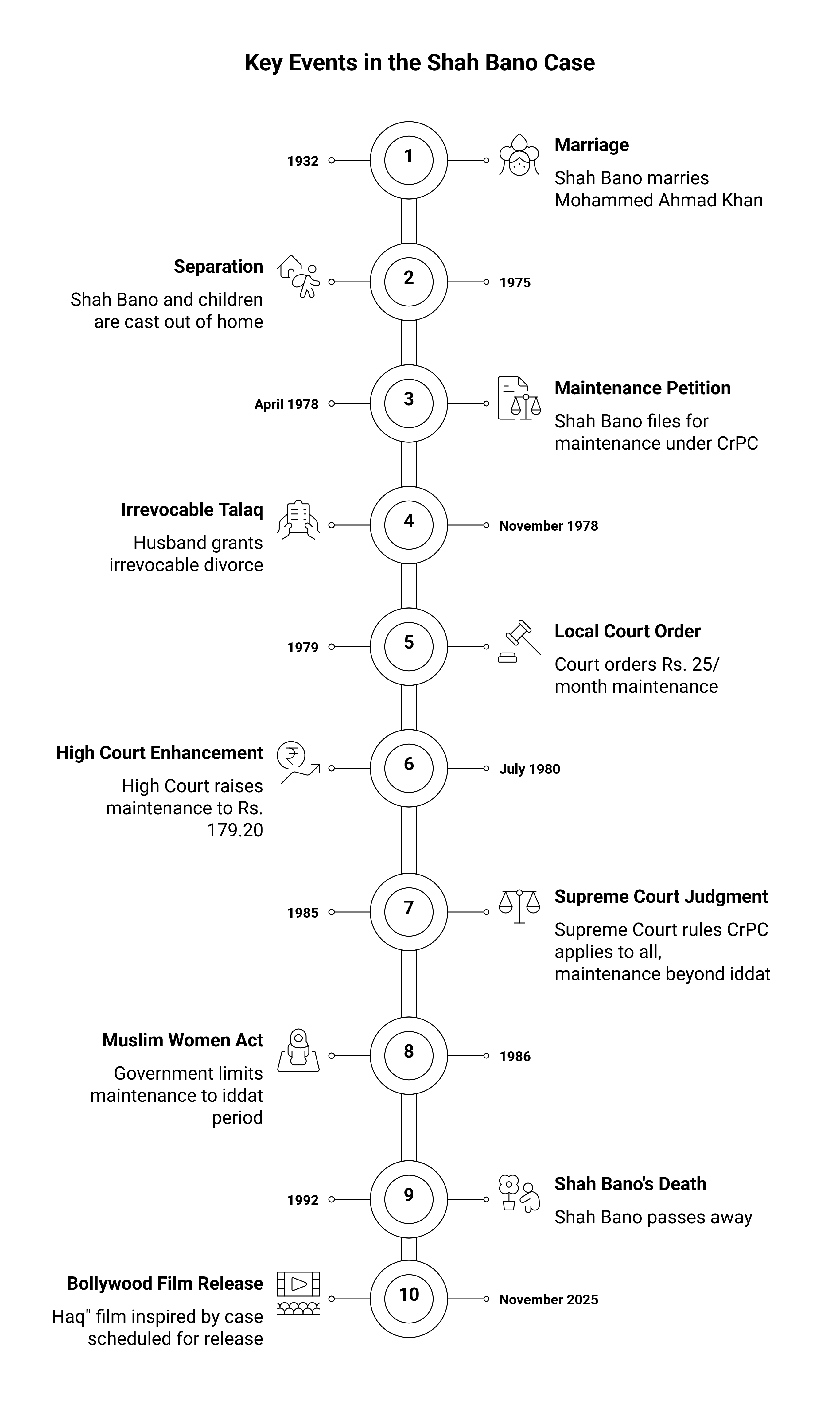
    • Origin: In 1978, Shah Bano Begum, a 62-year-old Muslim woman from Indore, was divorced by her husband, Mohammad Ahmad Khan, a lawyer, via triple talaq after 43 years of marriage.
    • Legal Action: She filed for maintenance under Section 125 of the CrPC (1973), a secular law ensuring financial support for dependents unable to maintain themselves.
    • Husband’s Argument: Claimed that under Muslim personal law, his obligation ended after the iddat period (~3 months) and that payment of mahr (dower) fulfilled his duty.
    • Lower Court Ruling: Ordered payment of ₹25/month; the Madhya Pradesh High Court raised it to ₹179.20. Khan appealed to the Supreme Court, triggering the landmark 1985 judgment.

    Supreme Court Verdict of April 23, 1985:

    • Bench & Ruling: A five-judge Constitution Bench led by CJI Y.V. Chandrachud dismissed the appeal, upholding the High Court’s decision.
    • Secular Applicability: Held that Section 125 CrPC applies to all religions, as its purpose is to prevent destitution, not to regulate personal law.
    • Maintenance Beyond Iddat: Affirmed that a divorced Muslim woman is entitled to maintenance beyond the iddat period if she cannot sustain herself.
    • Religious Harmony: Cited Quranic verses to show consistency between Islamic principles and maintenance under secular law.
    • Uniform Civil Code (UCC): Expressed concern that Article 44 remained a “dead letter,” urging steps toward a common civil code.

    Muslim Women (Protection of Rights on Divorce) Act, 1986:

    • Enactment: Passed after protests from Muslim organisations and AIMPLB, reversing the Shah Bano ruling.
    • Key Provision: Limited husband’s liability to maintenance during iddat, shifting later responsibility to relatives or Waqf Boards.
    • Judicial Interpretation:
      • Danial Latifi v. Union of India (2001) – Upheld the Act but read it progressively, requiring lump-sum payment within iddat for lifetime support.
      • Mohd. Abdul Samad v. State of Telangana (2024) – Reaffirmed that Muslim women may still claim relief under Section 125 CrPC, preserving the choice of remedy.

    Legacy and Significance:

    • Landmark Impact: Became a watershed case in India’s struggle between gender justice and religious identity.
    • Political Consequence: The 1986 Act was seen as appeasement politics, deepening the secularism debates.
    • Reform Catalyst: Revived the UCC discourse, influenced feminist legal reform, and reinforced constitutional morality.
    • Enduring Symbol: Continues to shape discussions on minority rights, women’s empowerment, and judicial activism in India’s plural legal framework.
    [UPSC 2020] Customs and traditions suppress reason, leading to obscurantism. Do you agree?


  • BRICS Pay and the Push to De-dollarize Global Finance

    Why in the News?

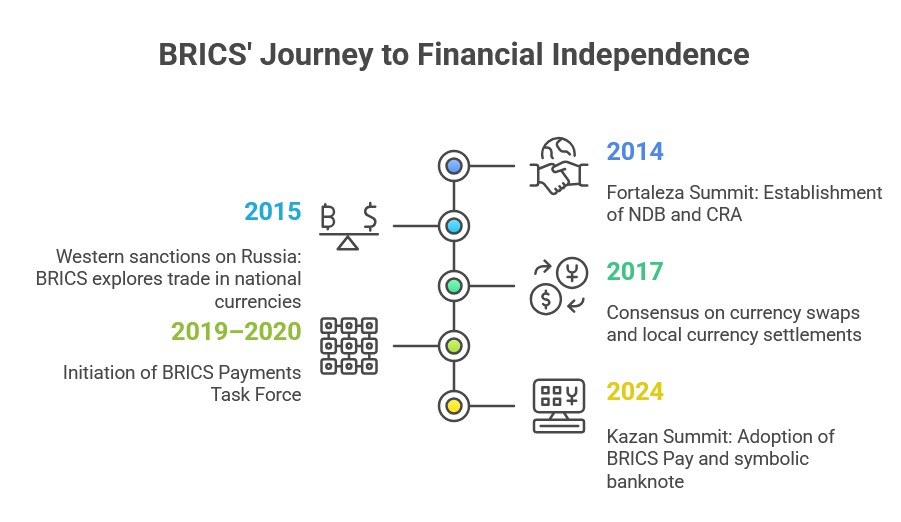
    Since 2014, BRICS nations have worked to cut dependence on the U.S. dollar, launching the New Development Bank (NDB), Contingent Reserve Arrangement (CRA), and now BRICS Pay to promote local currency trade and rival the SWIFT system.

    BRICS Pay and the Push to De-dollarize Global Finance

    About BRICS Pay Initiative:

    • Overview: BRICS Pay is a proposed cross-border digital payment and settlement platform developed by the BRICS nations (Brazil, Russia, India, China, South Africa) to facilitate trade in local currencies and reduce reliance on the U.S. dollar and the SWIFT network.
    • Origins: The idea emerged after the 2014 Fortaleza Summit, where BRICS established its own financial architecture, the New Development Bank (NDB) and the Contingent Reserve Arrangement (CRA).
    • Purpose: To enable direct financial transactions among member nations using local currencies, minimizing the role of Western-controlled financial systems and avoiding U.S.-led sanctions.
    • Development Path:
      • 2017: BRICS agreed to enhance currency cooperation via swaps, local currency settlements, and direct investments.
      • Early 2020s: The BRICS Payments Task Force (BPTF) was created to design interoperable systems.
      • 2024 Kazan Summit: Leaders highlighted strengthening of correspondent banking networks and settlements in local currencies under the BRICS Cross-Border Payments Initiative.
    • Prototype: A demo of BRICS Pay was unveiled in Moscow (October 2024), marking a concrete step toward implementation.
    • Supporting National Systems:
      • India: Unified Payments Interface (UPI)
      • China: Cross-Border Interbank Payment System (CIPS)
      • Russia: System for Transfer of Financial Messages (SPFS)
      • Brazil: Pix instant payment system
    • Strategic Importance: The initiative seeks to establish a self-reliant financial network, bypass SWIFT, and enhance monetary sovereignty among emerging economies.

    Back2Basics: Society for Worldwide Interbank Financial Telecommunication (SWIFT) System

    • Establishment: Founded in 1973 by 239 banks from 15 countries to standardize and secure cross-border financial communications.
    • Headquarters: La Hulpe, Belgium.
    • Nature: A messaging network, not a bank, it does not hold or transfer funds but enables secure interbank communication for financial transactions.
    • Coverage: Connects over 11,000 financial institutions across 200+ countries, making it the largest international payment messaging system.
    • Operation:
      • Assigns each member a Bank Identifier Code (BIC) of 8–11 characters.
      • Standardizes message formats to ensure seamless global financial communication.
      • Facilitates fund transfer instructions, trade settlements, and foreign exchange operations.
    • Governance:
      • Supervised by G10 central banks, the European Central Bank (ECB), and the National Bank of Belgium.
      • Managed by a 25-member board of directors, representing about 3,500 member institutions.
    • Strategic Role:
      • Forms the backbone of global finance, allowing efficient movement of capital.
      • Exclusion from SWIFT acts as a powerful economic sanction tool, isolating nations (e.g., Russia and Iran) from the international financial system.
    • Significance: SWIFT’s dominance reflects Western control over global finance, making it a central target for alternative networks like BRICS Pay, China’s CIPS, and Russia’s SPFS that seek a multipolar monetary order.


    [UPSC 2023] With reference to the Central Bank digital currencies, consider the following statements:

    1. It is possible to make payments in a digital currency without using US dollar or SWIFT system.

    2. A digital currency can be distributed with a condition programmed into it such as time-frame for spending it.

    Which of the statements given above is/are correct?

    Options: (a) 1 only (b) 2 only (c) Both 1 and 2* (d) Neither 1 nor 2


  • What are the challenges with the High Seas Treaty

    Introduction

    The High Seas Treaty, formally known as the Biodiversity Beyond National Jurisdiction (BBNJ) agreement, establishes a legal framework to conserve and sustainably use marine biodiversity in areas outside national control. It covers nearly two-thirds of the ocean’s surface. Adopted under the UN Convention on the Law of the Sea (UNCLOS), 1982, it aims to address threats from climate change, overfishing, and pollution through tools like Marine Protected Areas (MPAs) and Environmental Impact Assessments (EIAs). Ratified by over 60 nations in 2024, it will come into effect in January 2026. This makes it one of the most comprehensive global conservation instruments after the Paris Agreement.

    Why in the News? 

    The High Seas Treaty being ratified by 60+ nations represents a historic step in ocean governance, a domain previously beyond formal protection. For the first time, the international community has agreed on a legally binding mechanism to preserve marine life that exists outside any country’s jurisdiction. This is strikingly different from the earlier regime under UNCLOS, which lacked clear provisions for protecting biodiversity.

    What is the High Seas Treaty About?

    1. Biodiversity Beyond National Jurisdiction (BBNJ): Creates an all-inclusive framework to conserve and manage marine biodiversity beyond national boundaries.
    2. Marine Genetic Resources (MGRs): Recognised as a common heritage of humankind, ensuring equitable benefit-sharing between nations.
    3. Area-Based Management Tools (ABMTs): Establishes Marine Protected Areas (MPAs) to safeguard biodiversity and improve climate resilience and food security.
    4. Environmental Impact Assessments (EIAs): Mandates prior assessment of projects with potential cross-border or cumulative ecological impact.
    5. Capacity Building and Technology Transfer: Facilitates scientific collaboration, especially for developing nations, combining modern science and indigenous knowledge.

    Major Challenges with the High Seas Treaty

    1. Uncertainty over Core Principles
      1. Common Heritage vs. Freedom of High Seas: The “common heritage” principle promotes equitable access and benefit-sharing, while “freedom of the high seas” allows unrestricted navigation and resource use.
      2. Partial Application: The treaty applies the “common heritage” principle only partially, especially for MGRs, reflecting a compromise rather than resolution.
      3. Result: Creates ambiguity in rights and responsibilities of states in exploration, research, and benefit distribution.
    2. Ambiguity in Marine Genetic Resources (MGRs) Governance
      1. Undefined Governance Mechanism: Earlier, no clear framework existed for using or sharing MGRs.
      2. Biopiracy Concerns: Developing nations fear exploitation by developed countries, who could monopolize genetic discoveries and profits.
      3. Equity Gap: The lack of clarity risks excluding Global South nations from scientific and commercial benefits.
    3. Implementation and Enforcement Gaps
      1. Jurisdictional Complexity: The high seas lie beyond national boundaries, making monitoring and enforcement difficult.
      2. Institutional Limitations: While UNCLOS provides a broad legal foundation, there’s no dedicated global enforcement body to ensure compliance.
      3. Dependence on Voluntary Reporting: Could weaken accountability, especially in regulating corporate activities.
    4. Financial and Technological Inequities
      1. Unequal Capabilities: Developing countries lack access to marine technologies for monitoring and sustainable use.
      2. Technology Transfer Gap: The treaty mandates capacity-building, but without specific funding mechanisms, commitments may remain rhetorical.
      3. Risk: Could widen the North-South divide in ocean research and benefit sharing.
    5. Balancing Conservation and Development
      1. Sustainable Use vs. Conservation: Striking a balance between environmental protection and economic opportunities (like deep-sea mining or biotechnology) remains contentious.
      2. Unclear Prioritization: Without clear hierarchy between ecological and developmental objectives, policy conflicts may persist.

    Conclusion

    The High Seas Treaty represents a landmark effort to bring order and justice to the global commons. Yet, the true test lies in resolving philosophical ambiguities and ensuring equitable implementation. Without robust funding, technology sharing, and accountability mechanisms, it risks becoming another well-intentioned but weak global accord. For India, aligning its Blue Economy strategy with the treaty’s framework will be key to ensuring both ecological and economic dividends.

    PYQ Relevance

    [UPSC 2022] Discuss global warming and mention its effects on the global climate. Explain the control measures to bring down the level of greenhouse gases which cause global warming, in the light of the Kyoto Protocol, 1997.

    Linkage: Both Kyoto Protocol and High Seas Treaty are UN-backed frameworks aimed at addressing global commons issues, air and ocean respectively.

  • The vision of Model Youth Gram Sabha

    Introduction

    The Gram Sabha, enshrined in Article 243A of the Constitution (73rd Amendment, 1992), is the cornerstone of India’s Panchayati Raj system. It represents every registered voter in a village and empowers them to deliberate on budgets, plans, and governance priorities. However, despite its revolutionary potential, public participation, especially among youth, has remained minimal.

    The Model Youth Gram Sabha seeks to correct this by introducing structured simulations where students, teachers, and professionals engage in decision-making processes. This move shifts civics from a theoretical subject to a lived democratic experience.

    Why in the News

    For the first time, India is institutionalizing a Model Youth Gram Sabha across 28 States and Union Territories, involving over 600 Jawahar Navodaya Vidyalayas and 2200 Kendriya Vidyalayas. This initiative, launched by the Ministry of Panchayati Raj and the Ministry of Education in collaboration with the Aspirational Bharat Collaborative, brings Panchayati Raj simulations into school and college curricula. It aims to turn civic learning into active democratic participation, bridging the gap between youth education and local governance.

    This development is significant because it transforms village-level democratic institutions into educational tools, helping young citizens internalize governance, decision-making, and accountability, critical for a vibrant democracy.

    The Vision of Model Youth Gram Sabhas

    Why is the Model Youth Gram Sabha significant?

    1. Grassroots Democracy in Action: Embeds participatory governance within the Panchayati Raj structure, empowering youth to experience real governance processes like village budgeting and development planning.
    2. Educational Innovation: Moves beyond classroom civics by integrating simulation-based learning that mirrors Gram Sabha debates, resolutions, and deliberations.
    3. Nationwide Outreach: Involves 600+ Jawahar Navodaya and 2200+ Kendriya Vidyalayas, training 1,238 teachers from 24 states, demonstrating large-scale civic inclusion.

    What are the key features of the initiative?

    1. Collaborative Governance Model: Jointly implemented by the Ministry of Panchayati Raj, Ministry of Education, and the Aspirational Bharat Collaborative.
    2. Curricular Integration: Encourages schools and colleges to embed Gram Sabha simulations into learning modules.
    3. Phased Launch: Phase I covers 28 States/UTs; future expansion includes Zilla Parishads and State-run schools.
    4. Teacher Training: Specialized workshops to train educators in deliberation techniques and Panchayati processes.

    How does it differ from earlier civic education models?

    1. Beyond Theoretical Learning: Unlike Lok Sabha or Vidhan Sabha mock sessions, MYGS is rooted in real Panchayati Raj frameworks, ensuring practical governance exposure.
    2. UN-aligned Civic Pedagogy: Echoes the UN model of participatory learning but contextualized for Indian democracy.
    3. From Classroom to Village: Encourages field-level participation by linking school students with local Panchayats.

    What are the expected outcomes?

    1. Civic Empowerment: Fosters democratic citizenship, making youth aware of rights, duties, and public accountability.
    2. Policy Awareness: Helps future citizens understand budgeting, development priorities, and resolution-making.
    3. Inclusive Governance: Promotes bottom-up participation, especially in rural youth, bridging rural-urban civic divides.
    4. Democratic Habituation: Converts democracy from a concept into a daily lived experience.

    How does it contribute to democratic transformation?

    1. Institutional Strengthening: Empowers future voters to engage meaningfully in Gram Sabha and Panchayat processes.
    2. Critical Skills Development: Trains youth in debate, negotiation, and consensus-building, essential for leadership.
    3. Bridging Cynicism and Participation: Reconnects citizens with governance by reducing alienation from political processes.
    4. Future-ready Governance: Ensures continuity of democratic culture through successive generations.

    Conclusion

    The Model Youth Gram Sabha embodies the next phase of India’s democratic evolution, from representation to participation. By making civic engagement experiential, it nurtures a generation that values governance not as an abstract idea but as a lived responsibility. A future where citizens grow up debating budgets, resolving issues, and fostering transparency at the grassroots will ensure that democracy remains vibrant, inclusive, and self-sustaining.

    PYQ Relevance

    [UPSC 2015] In absence of a well-educated and organized local level government system, Panchayats and Samitis have remained mainly political institutions and not effective instruments of governance. Critically discuss.

    Linkage: This question assesses the effectiveness of Panchayati Raj Institutions and the need for civic capacity to make decentralisation meaningful. It links with how the Model Youth Gram Sabha cultivates governance literacy and participatory skills among youth to strengthen grassroots democracy.

  • India’s exit from the Ayni Airbase in Tajikistan

    Why in the News?

    ​India’s complete pullout from the Ayni Airbase in Tajikistan (in 2022), its sole foreign military post, drew sharp opposition’s criticism.

    India’s exit from the Ayni Airbase in Tajikistan

    About Ayni Airbase:

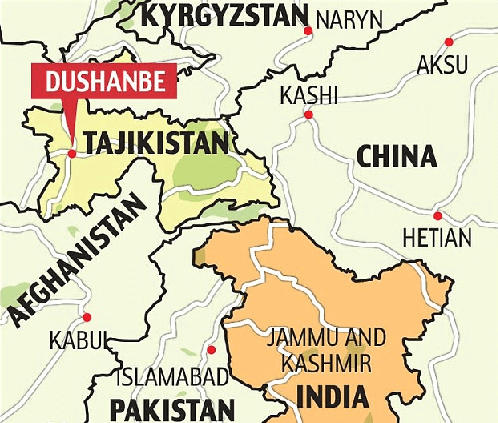
    • Location: Situated 10 km west of Dushanbe, Tajikistan, near the Afghanistan border via the Wakhan Corridor, and about 20 km from Pakistan-occupied Kashmir (PoK).
    • Also known as: Known as Gissar Air Base or Gissar Military Aerodrome; originally a Soviet-era base later modernised by India.
    • Development by India: Upgraded by India in the early 2000s under a bilateral agreement with Tajikistan; India invested ~USD 100 million to extend the runway (3,200 m), build hangars, depots, and control systems.
    • Operational Role: Hosted IAF helicopters and Su-30MKI fighters, with ~200 Indian personnel managing repair and training operations; also supported humanitarian and evacuation missions, notably during the 2021 Taliban takeover.
    • Predecessor: Replaced Farkhor Airbase (1998–2008), India’s earlier base used for supporting the Northern Alliance in Afghanistan.

    Strategic Significance of the Airbase:

    • Forward Presence: Gave India surveillance and strike reach over Afghanistan and Pakistan’s western front.
    • Regional Leverage: Enhanced India’s defence footprint in Central Asia, countering China’s BRI and Russian influence.
    • Operational Hub: Supported the then anti-Taliban Northern Alliance and India’s broader Connect Central Asia Policy (2012).
    • Evacuation & Logistics Node: Enabled rapid crisis evacuation and regional logistical operations.
    • Geopolitical Symbolism: Marked India’s aspiration for a continental strategic presence; its closure reflects shrinking influence west of the Himalayas amid Russia–China consolidation.

    Reasons for India’s Exit:

    • Lease Expiry: The bilateral lease expired in 2022 and was not renewed by Tajikistan.
    • External Pressures: Russia and China discouraged Tajikistan from extending India’s presence.
    • Strategic Shift: Diminished relevance post-Taliban’s return (2021) and collapse of India’s Afghan network.
    • Operational Constraints: High costs, limited autonomy, and dependence on Russian logistics reduced viability.
    • Reorientation: Strategic focus moved toward the Indo-Pacific and maritime partnerships.
    [UPSC 2022] Consider the following countries :

    1. Azerbaijan 2. Kyrgyzstan 3. Tajikistan 4. Turkmenistan 5. Uzbekistan

    Which of the above have borders with Afghanistan?

    Options: (a) 1, 2 and 5 only (b) 1, 2, 3 and 4 only (c) 3, 4 and 5 only* (d) 1, 2, 3, 4 and 5


  • [1st November 2025] The Hindu Op-ed: The case for a board of peace and sustainable security

    PYQ Relevance

    [UPSC 2024] Terrorism has become a significant threat to global peace and security. Evaluate the effectiveness of the United Nations Security Council’s Counter Terrorism Committee (CTC) and its associated bodies in addressing and mitigating this threat at the international level.

    Linkage: The BPSS proposal aligns with the recurring UPSC theme of UN reform and institutional effectiveness. It can serve as an additional point in answers evaluating the effectiveness of the UNSC and its bodies like the CTC.

    Mentor’s Comment

    The United Nations, despite its founding vision to preserve peace, faces a persistent structural crisis, peace agreements fail, transitions stall, and conflicts reignite. In this context, former Foreign Secretary Nirupama Rao’s proposal for a “Board of Peace and Sustainable Security (BPSS)” marks a profound call for institutional reform. This article dissects the argument, structure, and implications of this proposed board through a UPSC-relevant analytical framework.

    Introduction

    The UN Security Council (UNSC), envisioned to prevent conflict and sustain global peace, continues to struggle with institutional paralysis and outdated structures. Across continents, peace efforts collapse because international systems abandon political engagement too early.
    A new institutional vision, a Board of Peace and Sustainable Security (BPSS), is proposed to infuse continuity, coordination, and political strategy into global peace efforts.

    Why in the news?

    As the UN marks its 80th anniversary, its credibility is under intense scrutiny. While conflicts proliferate, peace agreements remain fragile and transitional mechanisms fail. The UNSC’s structural limitations, lack of political continuity, and inability to sustain long-term engagement make reform urgent. The proposed Board of Peace and Sustainable Security aims to fill this vacuum by institutionalising sustained political engagement before, during, and after conflict. This is significant because it represents one of the first major reform ideas that seeks to integrate peacekeeping with political strategy and regional cooperation, without challenging UNSC authority.

    A clearly defined institutional purpose

    1. Institutional void: The UNSC lacks sustained political engagement capacity. The BPSS would institutionalize political accompaniment beyond peace agreements.
    2. Complementary role: It would not replace or challenge the UNSC or Secretary-General but reinforce implementation and coordination.
    3. Mandate: Ensures continuity in peace efforts by reinforcing national and regional ownership of peace processes and reducing relapse into conflict.
    4. Scope: Works on reinforcing national capacities, coordinating peacekeeping with regional organizations, and ensuring peace agreements translate into durable political outcomes.

    Why is reform of the UN system urgent?

    1. Loss of continuity: Peacebuilding institutions within the UN lose momentum due to ad-hoc missions. BPSS seeks to sustain political engagement beyond immediate crises.
    2. Structural inertia: Waiting for comprehensive UNSC reform delays urgent action; thus, pragmatic institutional innovation is required within existing frameworks.
    3. Authority for change: Under Article 22, the UN General Assembly already holds power to create subsidiary bodies like BPSS without requiring Charter amendments.
    4. Reform from within: Instead of replacing the UNSC, BPSS enhances coordination, ensuring peace agreements transition into stable governance systems.

    What will make the Board credible and representative

    1. Rotational membership: Around two dozen member states, elected for fixed terms, representing all regions (Africa, Asia, Europe, Latin America, Caribbean, West Asia).
    2. Avoiding elite capture: The body should represent inclusivity, not hierarchy, ensuring small and middle powers have a say.
    3. Regional linkages: Works with regional hubs (Addis Ababa, Jakarta, Brasilia, New York) to ensure peace processes reflect local ownership.
    4. Consultative participation: Civil society and regional organizations will have a structured role in deliberations, enhancing legitimacy and field coordination.

    How will the BPSS function in practice?

    1. Style of functioning: Not another bureaucratic forum, but a continuing engagement body ensuring follow-through once UN missions end.
    2. Operational continuity: Prevents premature withdrawal of peacekeeping efforts; sustains political engagement through periodic review and coordination.
    3. Integration: Works in coordination with the Secretary-General, Peacebuilding Commission, and UNSC to align peacekeeping with political strategies.
    4. Focus on youth and fragile states: Ensures peace presence remains where political institutions are nascent.
    5. Conflict prevention: Reduces relapse risk by merging early-warning with long-term political strategies and governance support.

    How will the BPSS strengthen sustainable security?

    1. Beyond short-term peacekeeping: Moves from reactive missions to proactive stability frameworks.
    2. Sustainable security concept: Integrates security, governance, and development rather than treating them in silos.
    3. Inclusive approach: Aligns local, regional, and global stakeholders, reflecting the interconnected nature of modern conflicts.
    4. Institutional learning: Retains experience from past missions to inform future interventions.
    5. Principled reform: Sustains political momentum, not episodic intervention, ensuring peace is treated as an ongoing political project.

    Conclusion

    The proposed Board of Peace and Sustainable Security reimagines peace not as an event but as a process requiring sustained political accompaniment. It seeks to anchor peacekeeping within a strategy of governance, development, and institutional resilience. This reform is not just administrative, it represents a return to the original ideals of the UN Charter, adapting them for a multipolar and conflict-prone world. Sustainable peace demands political continuity, inclusivity, and long-term commitment, principles the BPSS embodies.