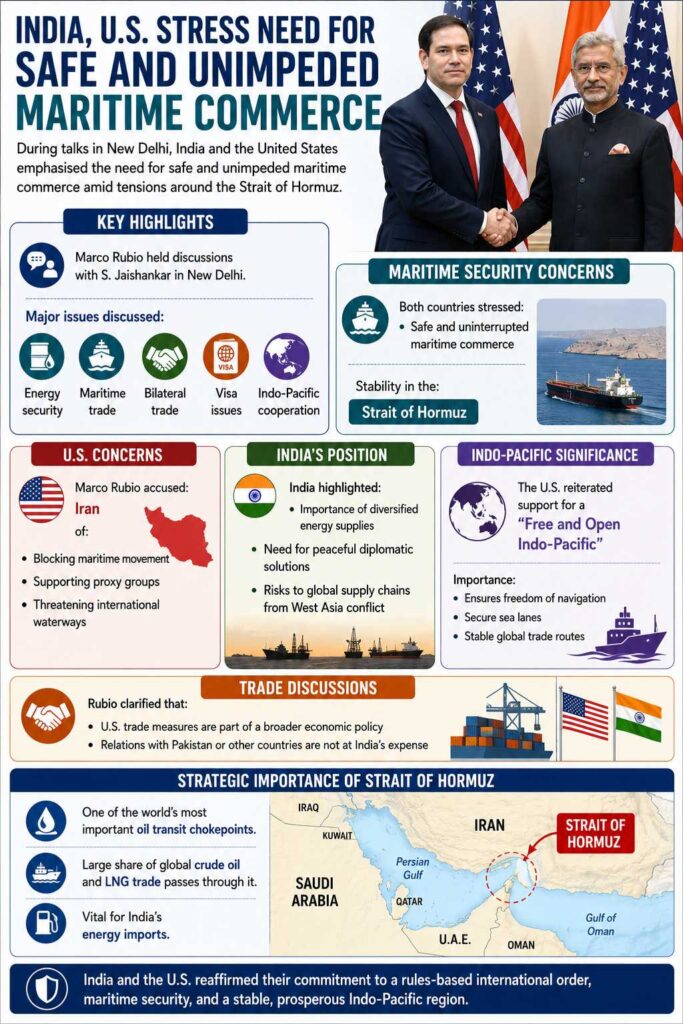
During talks in New Delhi, India and the United States emphasised the need for safe and unimpeded maritime commerce amid tensions around the Strait of Hormuz.
Key Highlights
Marco Rubio held discussions with S. Jaishankar in New Delhi.
Major issues discussed:
Energy security
Maritime trade
Bilateral trade
Visa issues
Indo-Pacific cooperation
Maritime Security Concerns
Both countries stressed:
Safe and uninterrupted maritime commerce
Stability in the: Strait of Hormuz
U.S. Concerns
Marco Rubio accused Iran of:
Blocking maritime movement
Supporting proxy groups
Threatening international waterways
India’s Position
India highlighted:
Importance of diversified energy supplies
Need for peaceful diplomatic solutions
Risks to global supply chains from West Asia conflict
Indo-Pacific Significance
The U.S. reiterated support for: A “Free and Open Indo-Pacific”
Importance
Ensures:
Freedom of navigation
Secure sea lanes
Stable global trade routes
Trade Discussions
U.S. trade measures are part of a broader economic policy
Relations with Pakistan or other countries are not at India’s expense
Strategic Importance of Strait of Hormuz
One of the world’s most important oil transit chokepoints.
Large share of global crude oil and LNG trade passes through it.
Vital for India’s energy imports.
Consider the following statements: Statement-I: Recently, the United States of America (USA) and the European Union (EU) have launched the Trade and Technology Council”. Statement-II: The USA and the EU claim that through this they are trying to bring technological progress and physical productivity under their control. Which one of the following is correct in respect of the above statements?
[A] Both Statement-I and Statement-II are correct and Statement-II is the correct explanation for Statement-I.
[B] Both Statement-I and Statement-II are correct and Statement-II is not the correct explanation for Statement-I.
[C] Statement-l is correct but Statement-II is incorrect.
[D] Statement-I is incorrect but Statement-II is correct.
The recent Ebola outbreak in Uganda has revived concerns over whether repeated animal-to-human spillovers could trigger a future pandemic. The concern is significant because Ebola outbreaks are increasingly occurring in urban areas, unlike earlier outbreaks largely confined to remote forests. However, experts argue that despite rising spillover risks, Ebola still lacks the sustained human-to-human transmission needed for a pandemic.
What is Ebola disease?
Ebola disease, or Ebola virus disease (EVD), is a rare but severe and highly fatal illness caused by a group of viruses in the genus Orthoebolavirus. It is characterized by viral hemorrhagic fever, causing widespread inflammation, internal bleeding, and organ failure.
Transmission & Origins
Animal to Human: It is a zoonotic disease originating in wildlife. Fruit bats are considered the natural host, and the virus can spread to humans via contact with infected animals or consumption of “bushmeat”.
Human to Human: Spread requires direct contact with bodily fluids (blood, saliva, sweat, vomit, feces, urine, etc.) of an infected person. It is not an airborne disease.
Contaminated Objects: It can also be contracted by touching surfaces, needles, or clothing contaminated with these fluids.
Are Climate Change and Ecological Disruptions Increasing Ebola Spillover Risk?
Spillover risk refers to the possibility of a disease-causing pathogen (virus, bacteria, etc.) jumping from animals to humans.
Habitat Disruption: Deforestation, mining, and agricultural expansion increase human interaction with fruit bats, considered natural reservoirs of Ebola, raising spillover chances.
Changing Disease Ecology: Altered rainfall and temperature patterns affect wildlife movement and feeding behaviour, increasing contact between animals and humans.
Human Encroachment: Expansion of settlements into forest ecosystems exposes communities to infected wildlife through hunting, farming, and bushmeat consumption.
Urbanisation Effect: Ecological stress combined with migration increases the possibility of outbreaks emerging closer to densely populated areas.
One Health Imperative: Rising spillover risk strengthens the need for an integrated human-animal-environment health approach for surveillance and prevention.
Why Does Spillover Risk Not Automatically Translate into Pandemic Potential?
Pandemic Requirement: Pandemic-capable viruses require efficient and sustained human-to-human transmission, particularly across large populations and geographies.
Transmission Constraint: Ebola spreads primarily through direct contact with infected bodily fluids, unlike airborne respiratory viruses.
Biological Limitation: Not all viruses possess the evolutionary capacity to adapt for sustained human transmission.
Urban Presence is not equal to Pandemic: Mere entry into urban centres does not ensure global spread unless the pathogen sustains continuous chains of transmission.
Comparative Insight: Respiratory viruses such as COVID-19 spread rapidly due to aerosol transmission, unlike Ebola’s contact-based spread.
How Has Ebola’s Epidemiological Pattern Changed Over Time?
Uganda Outbreak: The current outbreak has renewed attention to changing disease geography and regional vulnerability.
Increased Frequency: WHO has highlighted growing concerns over the frequency and scale of Ebola outbreaks.
Cross-Border Risk: Urbanisation and increased mobility raise possibilities of international exportation of isolated cases, though sustained spread remains unlikely.
What Makes Ebola Different from Pandemic Viruses?
Transmission Mode: Ebola spreads through blood, saliva, sweat, tears, vomit, faeces, breast milk, semen, and contaminated surfaces, requiring close contact.
Incubation Period: Symptoms generally emerge after 2-21 days, allowing surveillance and containment opportunities.
Symptom Visibility: Severe symptoms such as fever, headache, sore throat, vomiting, diarrhoea, bleeding, and organ dysfunction enable faster case identification.
Lack of Airborne Spread: Ebola fundamentally differs from influenza or coronaviruses due to the absence of efficient airborne transmission.
Geographic Containment: Major outbreaks have historically remained regionally concentrated, despite occasional international spread.
How Serious Is the Threat of Repeated Ebola Outbreaks Despite Low Pandemic Risk?
The threat of repeated Ebola outbreaks remains severe and critical, because even though the virus is highly unlikely to trigger a global pandemic, its localized impact completely devastates the regions it strikes.
Health System Fragility: Repeated outbreaks expose weaknesses in infrastructure, surveillance, and healthcare delivery systems, particularly in vulnerable countries.
Economic Burden: Outbreaks strain already fragile economies through healthcare expenditure, movement restrictions, and productivity loss.
Public Health Disruption: Healthcare systems divert resources from routine immunisation and essential services.
Humanitarian Impact: Fear, stigma, and mortality affect social cohesion and trust in institutions.
Can Existing Public Health Systems Handle Repeated Ebola Outbreaks?
Infrastructure Constraint: Countries facing outbreaks often suffer from fragile healthcare infrastructure, low laboratory capacity, and shortages of trained personnel.
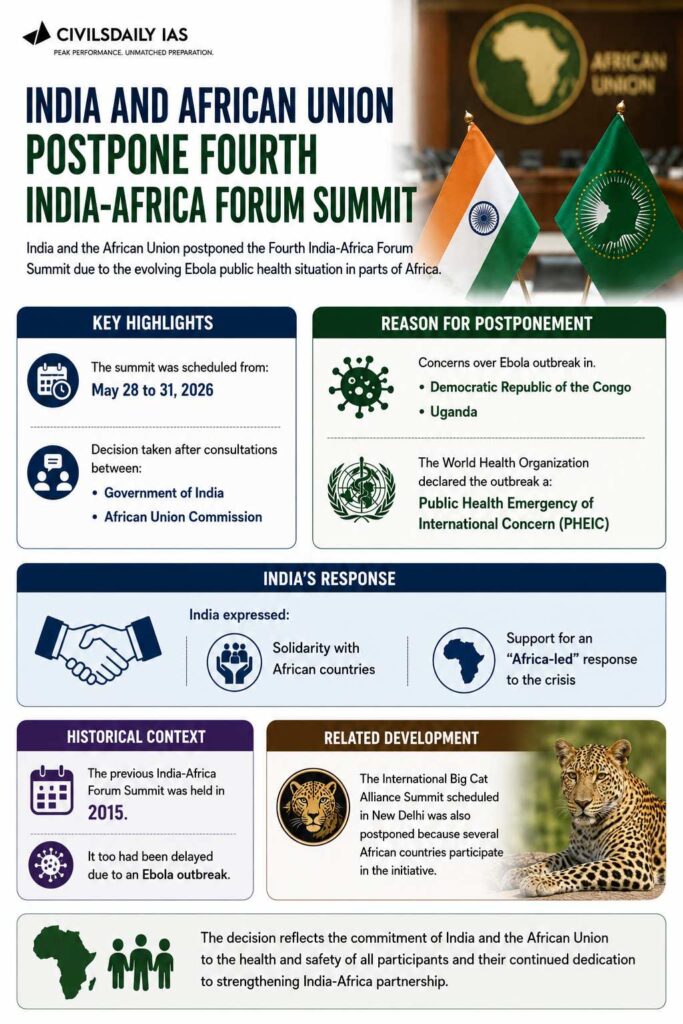
Example: In the May 2026 Bundibugyo virus outbreak affecting the Democratic Republic of the Congo (DRC) and Uganda, inadequate isolation systems and unsafe medical environments immediately caused a severe cluster of infections among the healthcare workers themselves.
In the 2025 Ebola outbreak in Kasai Province, healthcare teams had to track down and manually monitor 572 unique contacts across massive, hard-to-reach rural zones to successfully stop the transmission chain
Preparedness Gap: Pandemic preparedness systems remain uneven across regions.
The global vaccine emergency stockpile sits at a healthy target of 500,000 doses. But because funding drops between crises, roughly 42,000 precious doses simply expired unused on shelves due to sluggish preventive distribution pipelines
Reliance on WHO & International Coordination: Local governments cannot foot the bill or logistics alone, leaving them dependent on global emergency bodies for basic survival.
In May 2026, the WHO had to declare the central African outbreak a Public Health Emergency of International Concern (PHEIC) and use UNICEF’s ultra-cold chain supply network to rush specialized resources to the area within a 7-day window
Community Engagement: Local trust-building improves compliance with containment measures.
How Effective Are Existing Ebola Vaccines and Treatments?
Vaccine Success: Two approved vaccines, Ervebo and Zabdeno/Mvabea, offer strong protection against the Zaire strain.
Strain Limitation: Vaccines currently have limited cross-strain effectiveness, leaving gaps for other Ebola variants.
Bundibugyo Challenge: Vaccines for the Bundibugyo strain remain under development.
Medical Countermeasures: Expanded therapeutic options improve survival prospects during outbreaks.
Research Need: Viral evolution necessitates continued investment in strain-specific vaccines.
Can Artificial Intelligence Improve Ebola Preparedness and Surveillance?
Data Analytics: AI supports rapid analysis of large epidemiological datasets.
Outbreak Prediction: Machine learning models improve early warning systems and hotspot prediction.
Medical Countermeasures: AI accelerates drug discovery and vaccine development.
Surveillance Support: Real-time analytics improve disease tracking and response coordination.
Resource Allocation: Predictive tools facilitate targeted deployment of healthcare resources.
How Important Is Public Trust in Ebola Outbreak Management?
Behavioural Compliance: Trust improves adherence to isolation, contact tracing, and safe burial practices.
Institutional Legitimacy: Effective communication reduces misinformation and panic.
Community Participation: Local cooperation determines outbreak containment success.
Past Lessons: Distrust during previous outbreaks undermined surveillance and treatment efforts.
Conclusion
Repeated Ebola outbreaks underscore that spillover risk and pandemic risk are not synonymous. While urban outbreaks, ecological disruption, and global mobility elevate concern, Ebola’s limited transmission biology constrains sustained worldwide spread. Rising zoonotic threats necessitate stronger surveillance, resilient health infrastructure, vaccine innovation, and trust-based governance to prevent local outbreaks from escalating into larger crises.
PYQ RelevanceIs Spillover Risk the Same as Pandemic Risk?Spillover Risk: Refers to the likelihood of a pathogen jumping from animals to humans, causing isolated infections or local outbreaks. Pandemic Risk: Refers to the ability of a disease to achieve efficient and sustained human-to-human transmission across countries and continents. Ebola Example: Ebola has high spillover risk due to repeated zoonotic transmission from wildlife, but low pandemic risk because it spreads mainly through close bodily contact. COVID-19 Contrast: COVID-19 transformed from a spillover event into a pandemic because of rapid respiratory transmission among humans. Policy Significance: Distinguishing the two helps governments avoid panic while strengthening surveillance, containment, and preparedness systems. What Determines Pandemic Potential? Sustained Transmission: Efficient human-to-human spread.Reproduction Rate (R0): Ability to generate secondary infections. Mutation Capacity: Viral adaptation for new transmission pathways.Global Connectivity: International mobility patterns.Global Examples of Zoonotic Spillovers Nipah Virus (India/Bangladesh): Bat-to-human transmission with limited spread.COVID-19: Example of spillover evolving into pandemic due to respiratory transmission. Avian Influenza (H5N1): High mortality but limited human transmission.Governance Lessons for India Integrated Surveillance: Strengthens disease detection through the Integrated Disease Surveillance Programme (IDSP). One Health Approach: Enhances coordination between human, animal, and environmental health systems. Preparedness Systems: Improves laboratory networks, genomic surveillance, and emergency response capacity.
PYQ Relevance
[UPSC 2020] COVID-19 pandemic has caused unprecedented devastation worldwide. However, technological advancements are being availed readily to win over the crisis. Give an account of how technology was sought to aid management of the pandemic
Linkage: The Ebola outbreak re-opens debate about pandemic preparedness, disease surveillance, vaccines, and outbreak management, similar to the COVID-19 experience. The article also helps in understanding the distinction between spillover risk and pandemic risk in zoonotic diseases like Ebola.
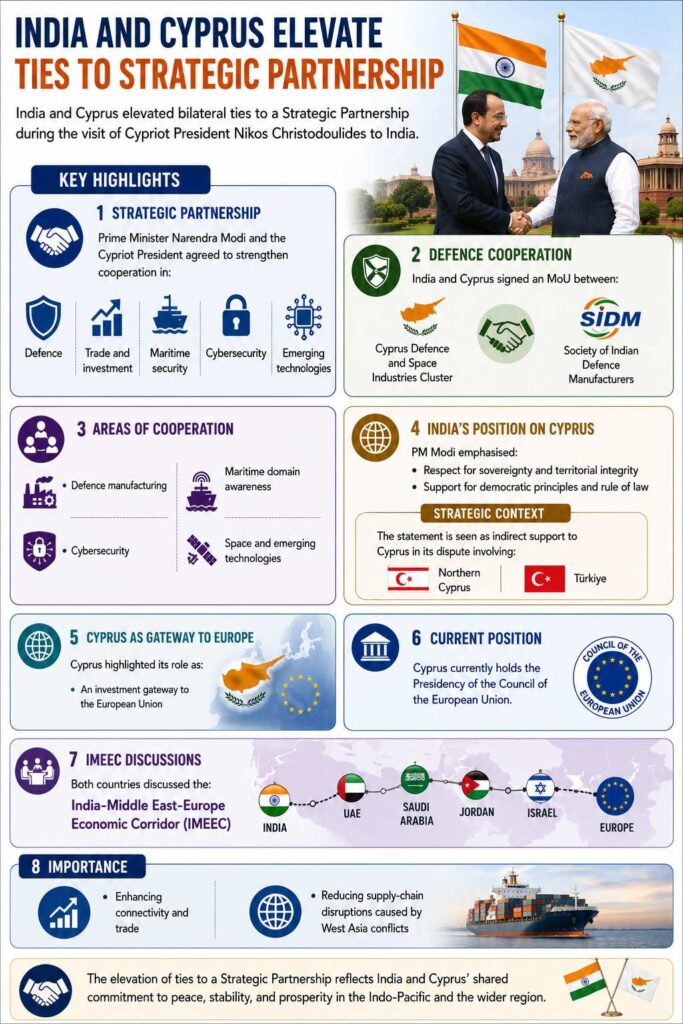
India and Cyprus elevated bilateral ties to a Strategic Partnership during the visit of Cypriot President Nikos Christodoulides to India.
Key Highlights
Strategic Partnership
Prime Minister Narendra Modi and the Cypriot President agreed to strengthen cooperation in:
Defence
Trade and investment
Maritime security
Cybersecurity
Emerging technologies
Defence Cooperation
India and Cyprus signed an MoU between:
Cyprus Defence and Space Industries Cluster
Society of Indian Defence Manufacturers
India’s Position on Cyprus
PM Modi emphasised:
Respect for sovereignty and territorial integrity
Support for democratic principles and rule of law
Strategic Context
The statement is seen as indirect support for Cyprus in its dispute involving Northern Cyprus and Türkiye.
Cyprus as a Gateway to Europe
Cyprus highlighted its role as an investment gateway to the European Union
Current Position: Cyprus currently holds the Presidency of the Council of the European Union.
[2024] Consider the following statements: Statement I: The Sumed pipeline is a strategic route for Persian Gulf oil and Natural gas shipments to Europe. Statement-II: Sumed pipeline connects the Red Sea with the Mediterranean Sea. Which one of the following is correct in respect of the above statements?
[A] Both Statement-I and Statement-II are correct and Statement-II explains Statement-I
[B] Both Statement-I and Statement-II are correct, but Statement-II does not explain Statement-I
[C] Statement-I is correct, but Statement-II is incorrect
[D] Statement-I is incorrect, but Statement-II is correct
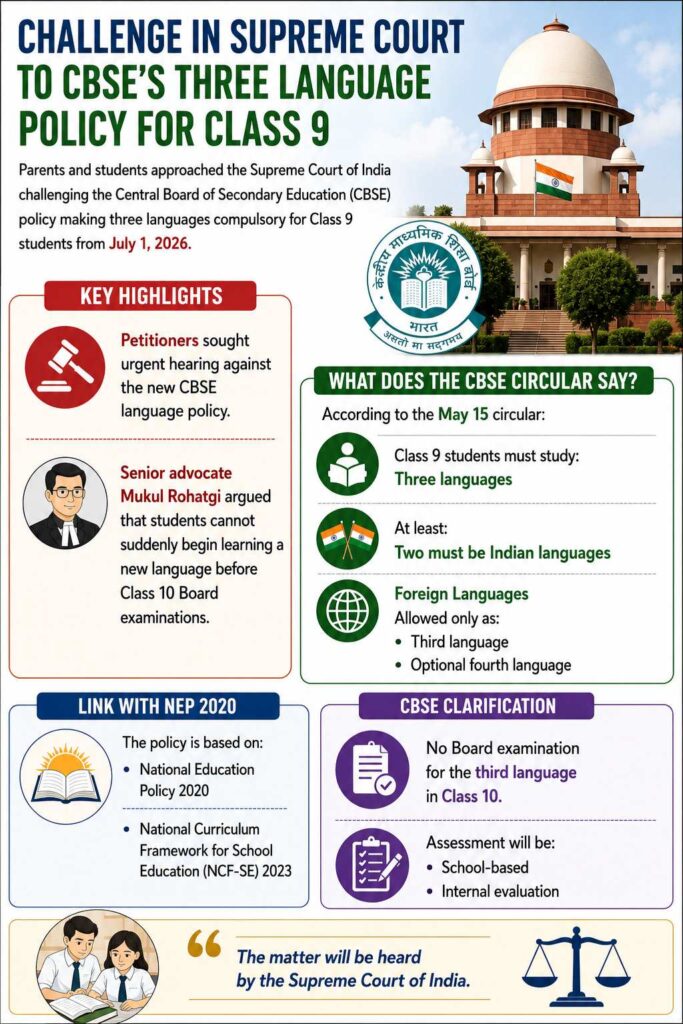
Parents and students approached the Supreme Court of India challenging the Central Board of Secondary Education (CBSE) policy making three languages compulsory for Class 9 students from July 1, 2026.
Key Highlights
Petitioners sought urgent hearing against the new CBSE language policy.
Senior advocate Mukul Rohatgi argued that students cannot suddenly begin learning a new language before Class 10 Board examinations.
What Does the CBSE Circular Say?
According to the May 15 circular:
Class 9 students must study: Three languages
At least: Two must be Indian languages
Foreign Languages
Allowed only as:
Third language
Optional fourth language
Link with NEP 2020
The policy is based on:
National Education Policy 2020
National Curriculum Framework for School Education (NCF-SE) 2023
CBSE Clarification
No Board examination for the third language in Class 10.
Assessment will be:
School-based
Internal evaluation
Concerns Raised
Petitioners argued:
Increased academic burden
Student stress and peer pressure
Difficulty in adapting to a new language at Class 9 stage
Court Response
Chief Justice Surya Kant stated that the matter would be listed before the appropriate Bench next week.
About the Three-Language Formula
Encourages multilingual learning in schools.
Originally recommended in earlier national education policies.
Aims to promote:
Indian languages
National integration
Linguistic diversity
[2012] Which of the following provisions of the Constitution of India have a bearing on Education? 1. Directive Principles of State Policy 2. Rural and Urban Local Bodies 3. Fifth Schedule 4. Sixth Schedule 5. Seventh Schedule Select the correct answer using the codes given below:
PYQ Relevance[UPSC 2024] What changes has the Union Government recently introduced in the domain of Centre-State relations? Suggest measures to be adopted to build the trust between the Centre and the States and for strengthening federalism.Linkage: This PYQ is highly relevant as the Ladakh debate concerns federal balance, democratic representation, and Centre-region relations in a Union Territory framework. The article directly examines tensions between administrative centralisation and political autonomy, making it useful for answers on cooperative and asymmetrical federalism.
Mentor’s Comment
Ladakh’s demand for constitutional representation has intensified after the Union Ministry of Home Affairs reportedly argued that additional districts and administrative decentralisation may be more suitable for Ladakh than a legislature or Sixth Schedule protections. The issue is significant because Ladakh occupies a strategically sensitive frontier bordering China and Pakistan. At the same time, it remains without legislative representation after the abrogation of Article 370 and reorganisation of Jammu & Kashmir in 2019.
Why Is Ladakh’s Demand for Representation a Major Constitutional Question?
Post-2019 Governance Shift: Ladakh became a Union Territory without a legislative assembly after the reorganisation of Jammu & Kashmir in 2019, creating a governance vacuum in political representation.
Constitutional Demand: Local groups have demanded Sixth Schedule protections, statehood, or legislative mechanisms to safeguard land, employment, culture, and local autonomy.
Democratic Deficit: Governance remains concentrated in bureaucratic institutions despite growing aspirations for elected representation.
Strategic Significance: Ladakh shares sensitive borders with China and Pakistan, making political legitimacy and local trust crucial for national security.
Sharp Institutional Contrast: While the Centre advocates administrative decentralisation through districts, local stakeholders seek constitutional and political decentralisation.
Can Administrative Decentralisation Substitute Democratic Representation?
Administrative Accessibility: Creation of five new districts, Nubra, Changthang, Sham, Zanskar and Drass, improves access to local administration in geographically difficult terrain.
Harsh Terrain Constraints: Ladakh spans nearly 59,000 sq km, with mountain barriers, harsh winters, and sparsely distributed settlements requiring local accessibility.
Functional Limitation of Districts: District administrations implement policies but cannot legislate on land rights, employment priorities, education, renewable energy governance, or cultural protection.
Political Accountability Gap: A district magistrate remains accountable upward to administrative superiors, whereas legislatures ensure accountability downward to citizens.
Democratic Agency: Administrative convenience cannot replace political voice in a representative democracy.
Why Is the “Population and Viability” Argument Against Representation in Ladakh Being Questioned?
The debate centres on whether low population, financial dependence, and difficult geography should limit Ladakh’s political representation. A key argument against a legislature is that Ladakh’s sparse population and dependence on the Centre make elected governance impractical. However, this view is contested because India has historically prioritised political inclusion and strategic integration over population size or economic viability, especially in sensitive border regions where representation strengthens trust and stability.
Democratic Equality Principle: India has not historically linked representation exclusively to population size or economic profitability. Several small or fiscally dependent regions have received legislative institutions to strengthen democratic participation.
Northeast Precedent:Nagaland (1963), Mizoram (1987), and Arunachal Pradesh (1987) received statehood despite sparse populations, difficult terrain, and heavy dependence on central transfers, reinforcing political integration in strategic frontier regions.
Strategic Imperative:Frontier populations contribute to national security through territorial presence, local intelligence, and social resilience. Political inclusion strengthens trust in border areas adjoining adversarial neighbours.
Fiscal Federalism Logic:Redistributive federalism under institutions such as the Finance Commission exists precisely because regions possess unequal economic capacities. Fiscal dependence has not been a constitutional ground for limiting political representation.
Governance versus Representation Distinction:Administrative decentralisation through districts may improve service delivery, but districts cannot legislate on land rights, employment safeguards, resource governance, or cultural protections, which require representative institutions.
Normative Constitutional Concern: The larger question is whether strategically vital citizens who bear frontier hardships should remain politically underrepresented despite their central role in safeguarding territorial integrity.
How Does the Northeast Challenge Arguments Against Ladakh’s Representation?
Arunachal Pradesh Example: Despite sparse population and strategic sensitivity near China, Arunachal Pradesh received statehood in 1987, reinforcing political integration.
Mizoram Example: Mizoram became a state in 1987 despite a relatively small population, demonstrating that representation was prioritised over demographic size.
Nagaland Example: Nagaland received statehood in 1963, despite limited population and fiscal dependence.
Security Through Inclusion: India historically integrated border regions through political accommodation rather than purely military or bureaucratic administration.
Belonging-Based Integration: Political participation strengthened trust and national integration in sensitive frontier regions.
Is Fiscal Dependence a Valid Reason to Deny Political Representation?
Redistributive Federalism: India’s fiscal system operates through redistribution via the Finance Commission, recognising unequal developmental capacities.
Example: Northeastern and Himalayan states receive higher per capita transfers due to difficult terrain and limited revenue bases.
Intergovernmental Transfers: Several states depend heavily on central transfers for governance and welfare expenditure.
Regional Disparity Reality: Mountainous terrain, sparse population, and strategic limitations naturally constrain revenue generation in border regions.
Developmental Equity: Fiscal dependence has never been an accepted constitutional basis for limiting democratic rights.
Example: Mizoram and Nagaland received statehood despite limited economic self-sufficiency.
Comparative Illustration: Even large states receive significant fiscal devolution despite differing revenue capacities.
Example: States such as Uttar Pradesh and Bihar receive large transfers due to population and developmental criteria, though for different reasons.
Why Is Land Governance Emerging as the Core of Ladakh’s Anxiety?
Large-Scale Renewable Projects: Proposed renewable energy expansion in the Pang region of Changthang reportedly seeks access to nearly 13 GW of solar and renewable capacity.
Land Transformation Concerns: Approximately 50,000 hectares of land may be impacted, raising questions over ecological sustainability and local consent.
Economic Stakes: Investments nearing ₹50,000 crore and potential annual income of approximately ₹7,000 crore make land governance politically significant.
Representation Deficit: The article argues that decisions on land, royalties, sustainability, and livelihoods require locally accountable institutions.
How Is Ladakh’s Demand About Belonging Rather Than Separatism?
Constitutional Inclusion: The article frames Ladakh’s demand as a desire to belong more fully within India’s constitutional framework.
Political Trust: Greater representation strengthens legitimacy in border areas where citizens bear high strategic burdens.
Frontier Citizenship: Border communities often experience developmental and climatic hardships while contributing significantly to territorial security.
Democratic Principle: India’s strength lies in deepening participation rather than expanding administrative centralisation.
Conclusion
Ladakh’s demand highlights the broader challenge of balancing strategic administration with democratic representation in frontier regions. Administrative decentralisation may improve governance access, but it cannot substitute political voice, accountability, and local participation in decisions concerning land, resources, and identity. India’s experience in border regions suggests that durable integration is strengthened not merely through security and administration, but through constitutional inclusion and representative institutions.
Russian President Vladimir Putin visited China in May 2026 for his first foreign trip after re-election, showing China’s growing importance to Russia. The visit is significant because 32% of Russia’s trade in 2025 was with China, reflecting Moscow’s increasing dependence after Western sanctions. Russia-China ties have expanded from cautious cooperation to deeper links in energy, trade, technology, and defence. For India, this matters because Russia is a key defence partner, while China remains India’s biggest security challenge.
How Have Russia-China Relations Evolved Historically?
Imperial Legacy: Rivalry and Territorial Disputes (17th Century-1917): Russia and China experienced phases of rivalry during the imperial period, including territorial disputes and unequal treaties.
Expansionist Competition: Initial contacts between the Russian and Qing Empires in the 17th century involved competition over Siberia and the Amur River regions.
“Unequal Treaties”: In the 19th century, Russia exploited China’s weakness to annex large tracts of territory, including the regions surrounding the Amur and Ussuri Rivers, through treaties such as the Treaty of Aigun (1858) and the Treaty of Peking (1860).
Historical Distrust: This era established a legacy of mistrust, as these treaties are still viewed in China as part of a “Century of Humiliation”.
Communist Cooperation:
The “Honeymoon Decade”: Following the 1949 communist victory in China, the Soviet Union and China formed a tight ideological alliance, strengthened by the 1950 Sino-Soviet Treaty of Friendship.
Sino-Soviet Split:
Ideological Divergence: Disputes emerged in the late 1950s over interpretations of Marxism-Leninism, Soviet leader Nikita Khrushchev’s “peaceful coexistence” policy, and China’s desire for nuclear ambitions.
Border Conflicts: Relations broke down entirely in the 1960s, leading to border conflicts, notably the 1969 Ussuri River clashes.
“Confrontation Decade”: Through the 1970s and 1980s, the nations maintained a high-tension relationship, with China moving toward rapprochement with the US to counter Soviet power.
Strategic Reconciliation: Relations improved after the Soviet collapse in 1991, especially after Russian President Boris Yeltsin’s 1992 visit to China.
Putin-Xi Consolidation: A “No Limits” Partnership (2022-2026): Russia-China ties deepened significantly after 2022 following the Ukraine war and Western sanctions on Moscow.
Strategic Alignment: Relations deepened significantly following the February 2022 Russian invasion of Ukraine, as Beijing provided an economic lifeline to a sanctioned Moscow.
“No Limits” Friendship: Weeks before the 2022 Ukraine war, Presidents Vladimir Putin and Xi Jinping declared a partnership with “no limits,” uniting against the U.S.-led global hegemony.
Asymmetric Partnership (2026): By 2026, Russia has become increasingly dependent on China, which is now its largest trading partner, purchasing large amounts of oil and supplying high-tech components, despite Western sanctions.
The 2026 Configuration: Current relations (as of May 2026) are described as a “comprehensive strategic partnership of coordination for a new era,” with leaders meeting regularly to sign new cooperation agreements on trade, energy, and technology.
Why Are Russia and China Moving Closer Strategically?
Western Pressure: Shared resistance to US-led sanctions, military alliances, and perceived hegemonic interventions has encouraged coordination.
Economic Complementarity: China provides markets, finance, technology, and industrial capacity, while Russia supplies energy, defence systems, and natural resources.
Political Alignment: Both states support a “multipolar world order” and oppose unilateral dominance in global institutions.
Diplomatic Coordination: Cooperation has increased in multilateral forums such as BRICS, Shanghai Cooperation Organisation (SCO), and the United Nations Security Council (UNSC).
Strategic Necessity: Russia’s post-Ukraine isolation has accelerated dependence on China for trade, investment, and diplomatic legitimacy.
How Deep Is the Russia-China Economic Partnership?
Trade Expansion:China accounted for 32% of Russia’s total trade in 2025, highlighting growing economic dependence.
Energy Cooperation: Russia supplies oil and gas to China through major pipelines, reducing Moscow’s dependence on European markets.
Power of Siberia Pipeline: The 3,000-km pipeline transports natural gas from Eastern Siberia directly to northeastern China’s Heilongjiang province.
Power of Siberia-2 Project: The proposed 2,600-km pipeline through Mongolia could significantly expand Russian gas exports to China.
Technology and Finance: China increasingly supports Russia through alternative payment systems, industrial collaboration, and trade settlements outside the dollar system.
Sanctions Adaptation: Bilateral trade has become a mechanism for reducing Western economic pressure on Russia.
Are Russia and China Moving Towards a Military Alliance?
Strategic Coordination: Joint military exercises, defence consultations, and strategic patrols have expanded, indicating growing military cooperation.
Example:“Vostok” exercises, Joint Sea naval drills in the Sea of Japan, and joint bomber patrols over the East China Sea and Pacific region.
“Better Than Allies” Approach: Russia and China describe their relationship as “not allies, but better than allies”, enabling deep cooperation without a binding defence commitment. This preserves strategic flexibility and prevents subordination of national interests.
Strategic Convergence: Cooperation in missile warning systems, aerospace, cyber capabilities, artificial intelligence, and dual-use technologies reflects increasing security alignment.
Example: Russia assisted China in developing an early-warning missile defence system, while China increasingly supports Russia through microchips and drone components after Western sanctions.
Geopolitical Signalling: Joint military activities are often aimed at strategic messaging rather than interoperability, signalling resistance to Western influence.
Example:Russia-China-Iran trilateral naval exercises in the Gulf of Oman project coordination near critical maritime chokepoints.
Absence of Formal Treaty: Russia and China have avoided a NATO-style mutual defence alliance, indicating limits to military integration despite growing convergence.
Entrapment Concerns: Beijing may avoid direct involvement in Russia-NATO conflict over Ukraine. At the same time, Moscow remains cautious about being drawn into a Taiwan contingency, reducing prospects for a formal alliance.
Asymmetric Dependence: China’s larger economic weight makes it the senior partner, while Russia increasingly depends on Beijing for trade, technology, and diplomatic support, creating structural limits to equal alliance formation.
Assessment: Russia and China are moving toward a strategic or quasi-alliance characterised by deep coordination, but not a formal military alliance, due to fears of entrapment and differing regional priorities.
How Does a Stronger Russia-China Axis Affect India’s Security?
Strategic Dilemma:
The Continental Catch-22: India relies heavily on Russia to maintain its military readiness, yet its primary active threat is China along the 3,488-kilometer Line of Actual Control (LAC).
Continental Security Challenge: Closer Moscow-Beijing ties may weaken Russia’s ability to remain strategically neutral in India-China tensions.
Eroded Diplomatic Buffer: Historically, during India-China border crises (such as the 1962 war or the 2020 Galwan Valley clash), Moscow acted as a quiet mediator or accelerated emergency arms supplies to New Delhi.
The Tri-Continental Encirclement: A tight Russia-China axis, combined with Pakistan’s deep alignment with Beijing, effectively creates a coordinated security ring around India’s northern and western land borders.
Defence Dependence: India continues to depend heavily on Russian-origin defence platforms including missiles, submarines, and fighter systems.
Legacy Systems Lock-In: Over 60% of India’s current military inventory, including the S-400 Triumf air defense missile systems, Sukhoi Su-30MKI fighter jets, T-90 tanks, and INS Chakra nuclear submarine programs, is of Russian origin.
The Spare-Parts Crisis: India cannot instantly replace these platforms. It requires a decades-long supply of Russian spare parts, technical upgrades, and ammunition to maintain basic operational readiness against Pakistan and China.
Reduced Strategic Space: Enclosure in Eurasian Geopolitics
Multilateral Dilution: India uses groupings like BRICS and the Shanghai Cooperation Organisation (SCO) to project power in Eurasia. However, a dominant Russia-China axis turns these forums into anti-Western vehicles, alienating India’s interests.
Losing Central Asia: India views Central Asia as vital for energy security and counter-terrorism. A unified Russia-China front effectively locks India out of the region. This will allow China’s Belt and Road Initiative (BRI) to expand unchecked.
Technology Access: Russia’s increasing technological integration with China may influence defence transfers and strategic cooperation with India.
Joint Technology Leakage: As Russia and China merge their military-industrial complexes in areas like artificial intelligence, hypersonic missiles, and cyber warfare, India faces the acute risk of data spillover.
Diplomatic Balancing: The Aggressive Pivot to the West:
The Western Counterweight: To offset its continental vulnerabilities, India is rapidly intensifying its security architecture with the West, notably through the Quad (US, Japan, Australia) and bilateral defense pacts with France and the US.
Can India Preserve Strategic Autonomy Amid Emerging Geopolitical Blocs?
Multi-Alignment: India increasingly follows a strategy of engaging multiple power centres rather than exclusive alliances.
Strategic Autonomy: Maintains independent foreign policy choices despite closer engagement with Western powers.
Russia Engagement: Sustains defence and energy ties with Moscow despite Western pressure.
China Management: Combines military preparedness, diplomatic engagement, and economic caution.
Indo-Pacific Balancing: Strengthens partnerships through the Quad, maritime cooperation, and supply-chain diversification.
Domestic Capability: Expands defence indigenisation through Atmanirbhar Bharat in Defence to reduce long-term dependence.
Conclusion
The deepening Russia-China partnership reflects a shifting global order shaped by geopolitical rivalry, economic interdependence, and resistance to Western dominance. Although a formal military alliance remains unlikely, growing strategic convergence between Moscow and Beijing could narrow India’s diplomatic and security space. For India, the challenge lies in preserving strategic autonomy through calibrated multi-alignment. Maintaining strong ties with Russia, managing tensions with China, and strengthening partnerships in the Indo-Pacific while accelerating defence indigenisation and economic resilience is the need of the hour for India.
PYQ Relevance
[UPSC 2020] What is the significance of Indo-US defence deals over Indo-Russian defence deals? Discuss with reference to stability in the Indo-Pacific region.
Linkage: The PYQ directly relates to India’s strategic balancing between traditional defence dependence on Russia and emerging partnerships with the US amid geopolitical shifts. The deepening Russia-China partnership increases India’s security concerns, making defence diversification and Indo-Pacific strategy more relevant.
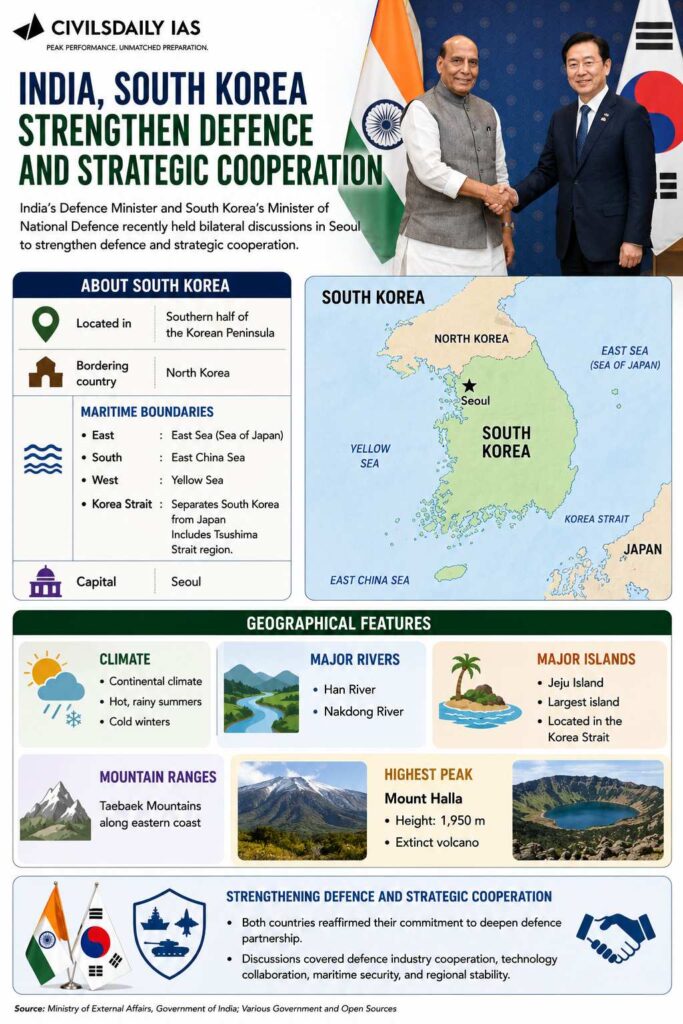
India’s Defence Minister and South Korea’s Minister of National Defence recently held bilateral discussions in Seoul to strengthen defence and strategic cooperation.
About South Korea
Located in the southern half of the Korean Peninsula
Bordering country North Korea
Maritime Boundaries
East: East Sea (Sea of Japan)
South: East China Sea
West: Yellow Sea
Korea Strait
Separates South Korea from Japan
Includes Tsushima Strait region.
Geographical Features
Climate
Continental climate
Hot, rainy summers
Cold winters
Major Rivers
Han River
Nakdong River
Major Islands
Jeju Island
Largest island
Located in the Korea Strait
Mountain Ranges
Taebaek Mountains along eastern coast
Highest Peak
Mount Halla
Height: 1,950 m
Extinct volcano
[2024] Consider the following countries: 1. Italy 2. Japan 3. Nigeria 4. South Korea 5. South Africa Which of the above countries are frequently mentioned in the media for their low birth rates, or ageing population or declining population?
PYQ Relevance[UPSC 2023] e-governance, as a critical tool of governance, has ushered in effectiveness, transparency and accountability in governments. What inadequacies hamper the enhancement of these features? Linkage: This PYQ directly examines the limitations of digital governance, including implementation bottlenecks, accessibility, and administrative capacity. The article on the digital Census similarly highlights concerns of digital illiteracy, enumerator preparedness, omission errors, and data credibility.
Mentor’s Comment
India’s transition to a digital Census in 2027 marks a major institutional shift in governance and data collection. While digitisation can improve efficiency, the credibility of Census outcomes depends on questionnaire design, field testing, enumerator preparedness, and safeguards against exclusion and fraud. Since the 2027 Census will influence delimitation of Lok Sabha and Assembly constituencies, any enumeration error can have significant political and administrative consequences.
How does the inclusion of caste enumeration alter the Census framework?
Historic Shift: Introduces caste-related questions for the first time since Independence, making it a major methodological change.
Political Sensitivity: Bihar and Karnataka caste surveys revealed that many communities may resist official numerical representation, making social acceptance a challenge.
Pre-testing Requirement: Necessitates extensive field testing of definitions and schedules to ensure enumerators and respondents interpret caste categories uniformly.
Administrative Implication: Influences future affirmative action debates, welfare targeting, and political mobilisation.
Why does the Census method matter for political representation?
Delimitation Linkage: Census population figures will be used for the next delimitation of Lok Sabha and State Legislative Assembly constituencies.
Methodological Concern: India follows an extended de facto method, where people are counted at their usual residence during enumeration.
Household Definition: Includes persons who share food from a common kitchen, including paying guests staying throughout the Census period.
Electoral Implication: Variations in enumeration affect the distribution of political representation across States.
Resident Qualification: A six-month residence requirement applies for voter registration, but Census coverage differs from electoral rolls.
How can migration and NRIs distort Census outcomes?
Large Migrant Population: India has around 1.58 crore NRIs, constituting over 1% of India’s population.
Representation Impact: If all NRIs were grouped into one State, they could potentially influence around five Lok Sabha seats in future delimitation.
Regional Disparity: States such as Kerala, Gujarat, Punjab, Telangana, and Tamil Nadu have disproportionately high migrant populations.
Kerala Migration Survey 2023: Estimated nearly 22 lakh people from Kerala living or working abroad, indicating potential undercount risks.
Seat Allocation Risk: Excluding migrant-heavy populations may result in loss of parliamentary representation for affected States.
Possible Administrative Response: Considers collecting information on non-resident family members during enumeration to improve delimitation accuracy.
Can a fully digital Census improve data quality?
Digital Enumeration: Plans complete data collection using mobile electronic devices, mainly smartphones and tablets.
Enumerator Constraints: A large share of enumerators may lack digital familiarity, increasing implementation risks.
Operational Evidence: During Karnataka’s Socio-Economic and Caste Survey, enumerators reportedly faced difficulties operating digital systems.
Hybrid Alternative: Earlier planning for the 2021 Census proposed paper schedules later digitised from home, which could reduce operational disruptions.
Confidentiality Concern: Assistance by family members or students to enumerators may create privacy and accountability issues.
Quality Assurance: Requires mechanisms for detecting data-entry errors and validating responses.
Self-Enumeration: Allows respondents to complete forms through smartphones or computers, increasing convenience but requiring safeguards.
Why are questionnaire design and definitions central to Census credibility?
Conceptual Complexity: Population enumeration questions are more complex than house-listing questions.
Instruction Burden: Earlier Census exercises required extensive explanatory material, including around six printed pages explaining disability categories in the 2011 Census.
Comprehension Challenge: Even seemingly simple questions, such as employment status during the last year, require nuanced understanding.
Enumerator Variation: Over 30 lakh enumerators may interpret definitions inconsistently without standardised training.
Embedded Clarification: Requires simplified wording and in-question explanations, instead of separate instruction manuals.
How can respondent fatigue undermine Census reliability?
Questionnaire Overload: Excessive questions can produce fatigue, incomplete responses, or inaccurate reporting.
Household Burden: The form must be completed for every household member, increasing response complexity.
Intentional Misreporting: Respondents may deliberately provide incorrect information to avoid follow-up questions.
Self-Enumeration Risk: Digital self-reporting increases chances of skipping difficult or sensitive questions.
Which categories of people are most vulnerable to omission?
Domestic Workers: Persons such as servants, helpers, nurses, and unrelated dependents living within households face higher exclusion risks.
Children in Hostels: Children temporarily residing away from home may be missed from household enumeration.
Post-Enumeration Surveys: Previous surveys reported higher omission rates among distant relatives and unrelated household members.
Questionnaire Design Solution: Questions on temporary absence and likelihood of return can reduce omission errors.
Expanded Household Inquiry: Asking about non-relatives sharing meals and accommodation improves coverage.
Can fraudulent enumeration compromise Census credibility?
Manipulation Risk: Possibility of fraudulent enumeration by groups attempting demographic inflation cannot be ruled out.
Historical Example: The 2001 Census cancellation in certain areas remains an institutional warning.
Need for Vigilance: Requires field testing, monitoring systems, and verification mechanisms.
Conclusion
India’s first digital Census in 2027 can strengthen the quality, speed, and usability of demographic data, but technology alone cannot ensure credibility. Accurate enumeration will depend on well-tested questionnaires, trained enumerators, safeguards against exclusion, and robust verification mechanisms. Since Census outcomes will shape delimitation, welfare planning, and governance, India’s priority must be to ensure that digitisation enhances accuracy, inclusiveness, and public trust, rather than merely administrative efficiency.
India’s heat crisis is increasingly becoming a night-time public health emergency, as evidence shows that night temperatures are rising faster than daytime temperatures. This reduces the body’s ability to recover from daytime heat. The concern is significant because mortality sharply increases when night temperatures remain above 28-30°C, while existing heat action plans remain largely focused on daytime heatwaves.
Why Are Rising Night-Time Temperatures Emerging as a Major Public Health Threat?
Physiological Recovery: Cooler nights allow the human body to recover from daytime heat. Persistently warm nights prevent recovery, resulting in prolonged heat exposure and cumulative stress.
Sustained Heat Burden: Continuous exposure transforms heat stress from a daytime phenomenon into a prolonged condition, increasing health risks without adequate relief.
Vulnerable Populations: Low-income groups living in densely packed houses without natural ventilation or cooling systems face disproportionate exposure.
Public Health Blind Spot: Heat action plans largely focus on daytime heatwaves, while night-time thermal stress remains under-recognised.
Extreme Night Heat: Climate Trends data across 200 Indian cities (1986-2018) found that in cities such as Delhi, minimum night temperatures frequently exceeded 32°C and sometimes crossed 35°C. This indicates that nights are increasingly failing to provide thermal relief.
How Are Night-Time Temperatures Rising Faster Than Daytime Temperatures in India?
Urban Heat Retention: Concrete, asphalt, and built surfaces absorb heat during the day and slowly release it at night, preventing cooling.
Urban Heat Island Effect: Dense urban settlements trap heat and restrict airflow, keeping cities warmer after sunset.
Anthropogenic Heat Emissions: Air conditioners, vehicles, industries, and energy use release residual heat into urban environments.
Climate Change: Rising baseline temperatures are increasing both daytime and night-time heat, with warmer nights showing faster escalation in several regions.
What Trends Indicate the Rise of Night-Time Temperatures in India?
Long-Term Trend: A Climate Trends analysis using IMD data found that night-time temperatures increased faster than daytime temperatures between 1986 and 2015.
Temperature Rise: Mean annual temperatures increased by ~0.63°C, while coldest night temperatures increased by ~0.4°C, indicating warming even during recovery periods.
Future Projection: By the 2070s, night temperatures during the warmest day may rise by 4.7°C, alongside a 5.5°C rise in daytime maximum temperatures.
Regional Variation: Metropolitan cities are projected to witness stronger warming due to urbanisation and dense built-up surfaces.
Why Does Urbanisation Intensify Night-Time Heat Exposure?
Urban Heat Island Effect: Urban surfaces such as concrete, roads, bricks, and metal infrastructure absorb heat during the day and radiate it at night, preventing cooling.
Loss of Green Spaces: Reduced vegetation lowers natural cooling and evapotranspiration, increasing retained heat.
Water Body Degradation: Shrinking lakes and wetlands reduce local cooling capacity.
Built Environment: Dense construction blocks airflow and traps heat in residential clusters.
Air Conditioner Heat Emissions: Cooling devices release waste heat outdoors, increasing ambient night-time temperatures in urban neighbourhoods.
What Evidence Links Night-Time Heat with Mortality Risks?
Ahmedabad Case Study: The Indian Institute of Public Health, Gandhinagar analysed mortality data in Ahmedabad and found a strong correlation between night-time heat and all-cause mortality.
Critical Threshold: Mortality rises sharply when maximum night-time temperature exceeds 28°C.
Mortality Spike: If night-time temperature remains below 28°C, all-cause mortality averages around 145 deaths/day. When temperatures rise above 30°C, mortality increases to approximately 265 deaths/day.
Significance: Findings indicate that night temperatures may be as important as daytime heat in determining heat-related deaths.
Why Are Existing Heat Action Plans Inadequate in Addressing Night-Time Heat?
Daytime Bias: Most heat action plans focus on extreme daytime temperature warnings, overlooking night-time risks.
Intermittent Heatwave Focus: Current interventions primarily target short-duration heatwaves rather than persistent elevated temperatures throughout summer.
Housing Deficit: Existing policies inadequately address thermal discomfort in informal settlements and overcrowded housing.
Inclusive Heat Governance: Heat Action Plans must incorporate night-time temperature indicators and vulnerable settlements.
Conclusion
India’s heat crisis can no longer be assessed through daytime temperatures alone. Recognising night-time heat as a major climate-health risk is essential for building effective Heat Action Plans, resilient cities, and equitable protection for vulnerable populations.
PYQ Relevance
[UPSC 2017] “Climate change” is a global problem. How India will be affected by climate change? How Himalayan and coastal states of India will be affected by climate change?
Linkage: The PYQ examines impacts of climate change on ecosystems, economy, disasters, and human systems including health. The article provides a specific case study of climate change impact in India, rising night-time heat causing increased mortality and urban heat stress.