This newscard is an excerpt from an articles which delves into the historical and social context of the Jenu Kuruba community, including their displacement from their traditional lands in the Western Ghats due to conservation efforts.
About Jenu Kuruba
The Jenu Kuruba tribe, numbering around 37,000, resides primarily in the Nilgiris region, bordering Kerala and Karnataka.
Their traditional occupation involves collecting honey in the forest, reflected in their name where ‘Jenu’ means ‘honey’ in Kannada.
In the early 20th century, they lived in forest huts and engaged in cultivation.
Social organization of Jenu Kurubas’
They speak the Jenu Kurumba language, which is related to Kodava or considered a rural dialect of Kannada.
Historically, they engaged in activities like food gathering, collecting minor forest produce, and handling elephants.
They typically reside in small settlements known as Hadi and practice shifting cultivation.
Social organization within the community is semi-nomadic, with decentralized authority led by a head-man (yajamana) and a ritual head or shaman (gudda).
Their rehabilitation
The tribe has fought for their rights to live in reserved forests, most recently in 2020 under the Forest Rights Act.
In 2021, protests continued against the forest department for promoting eco-tourism and safaris, which are deemed illegal under Indian and international laws.
From the 1970s onwards, many Jenu Kurubas have been evicted from their homes due to conservation efforts in tiger reserves like Nagarhole and Bandipur.
Those relocated outside the forest often work as daily wagers, agricultural laborers, or on coffee estates in Kodagu.
PYQ:
[2013] Consider the following pairs :
Tribe: State
1. Limboo Limbu : Sikkim
2. Karbi : Himachal
3. Dongaria Kondh : Odisha
4. Bonda : Tamil Nadu
Which of the above pairs are correctly matched?
(a) 1 and 3 only
(b) 2 and 4 only
(c) 1, 3 and 4 only
(d) 1, 2, 3 and 4
[2014] With reference to ‘Changpa’ community of India, consider the following statement :
1. They live mainly in the State of Uttarakhand.
2. They rear the Pashmina goats that yield a fine wool.
3. They are kept in the category of Scheduled Tribes.
Which of the statements given above is/are correct?
Researchers at the University of Kerala have devised an eco-friendly fuel cell that primarily utilizes air and seawater to generate power.
Magnesium – Copper -Cupric Oxide Fuel Cell
A semiconducting layer of Cupric Oxide grown over Copper substrate was used in a Magnesium- Sodium Chloride based fuel cell.
It breathes air; produces only electricity and heat during its operation and emits pure water.
The prototype, measuring 3 cm × 1.5 cm × 1 cm, delivered a voltage of 0.7 V and a current of 0.35 A for a duration of 10 minutes, showcasing the potential for practical application.
What is a Fuel Cell?
A fuel cell is an electrochemical cell that converts the chemical energy into electricity of a fuel and an oxidizing agent.
It generates electrical energy from fuel through an electrochemical reaction, offering high efficiency and zero emissions.
They are an innovative technology poised to revolutionize electricity generation, often referred to as the “battery of the future“.
Fuel cells provide high efficiency, low emissions, and can be used in various applications.
Note: Any electrochemical cell generates DC (Direct Current) output.
Significance of the Device
This innovative fuel cell technology is anticipated to disrupt the market dominance of Lithium-ion batteries, offering a higher power output.
Unlike conventional batteries, the Magnesium-based fuel cells utilized in this research operate by utilizing saline water as fuel and extracting oxygen from the surrounding air.
PYQ:
2015:
With reference to ‘fuel cells’ in which hydrogen-rich fuel and oxygen are used to generate electricity, consider the following statements :
1. If pure hydrogen is used as a fuel, the fuel cell emits heat and water as by-products.
2. Fuel cells can be used for powering buildings and not for small devices like laptop computers.
3. Fuel cells produce electricity in the form of Alternating Current (AC).
Which of the statements given above is / are correct?
Q) ‘Climate change’ is a global problem. How India will be affected by climate change? How Himalayan and coastal states of India will be affected by climate change? (UPSC CSE 2017)
Q)Describe the major outcomes of the 26th session of the Conference of the Parties (COP) to the United Nations Framework Convention on Climate Change (UNFCCC). What are the commitments made by India in this conference? (UPSC CSE 2021)
Note4Students:
Prelims: NA;
Mains: Social Issues; Women Issues;
Mentor comments: Women are very effective at mobilizing communities during disasters. They are at the frontline in moving forward with recovery. Women further hold key knowledge of most of the Natural Resources and their management. Hence, they can be the key actors in Climate Adaptation and Mitigation.
However, women and girls have less access to climate information, early warnings, agricultural advisory services, mobile phone technology, and financial credit. For example, more women than men died in the Indian Ocean Tsunami in 2004 because they were less likely to know how to swim, and long clothing hampered their movement. Now, we have no time to lose as we are standing at the intersection of inequality and climate change, and our strategies must reflect the urgency of the times.
Let’s learn.
—
Why in the News?
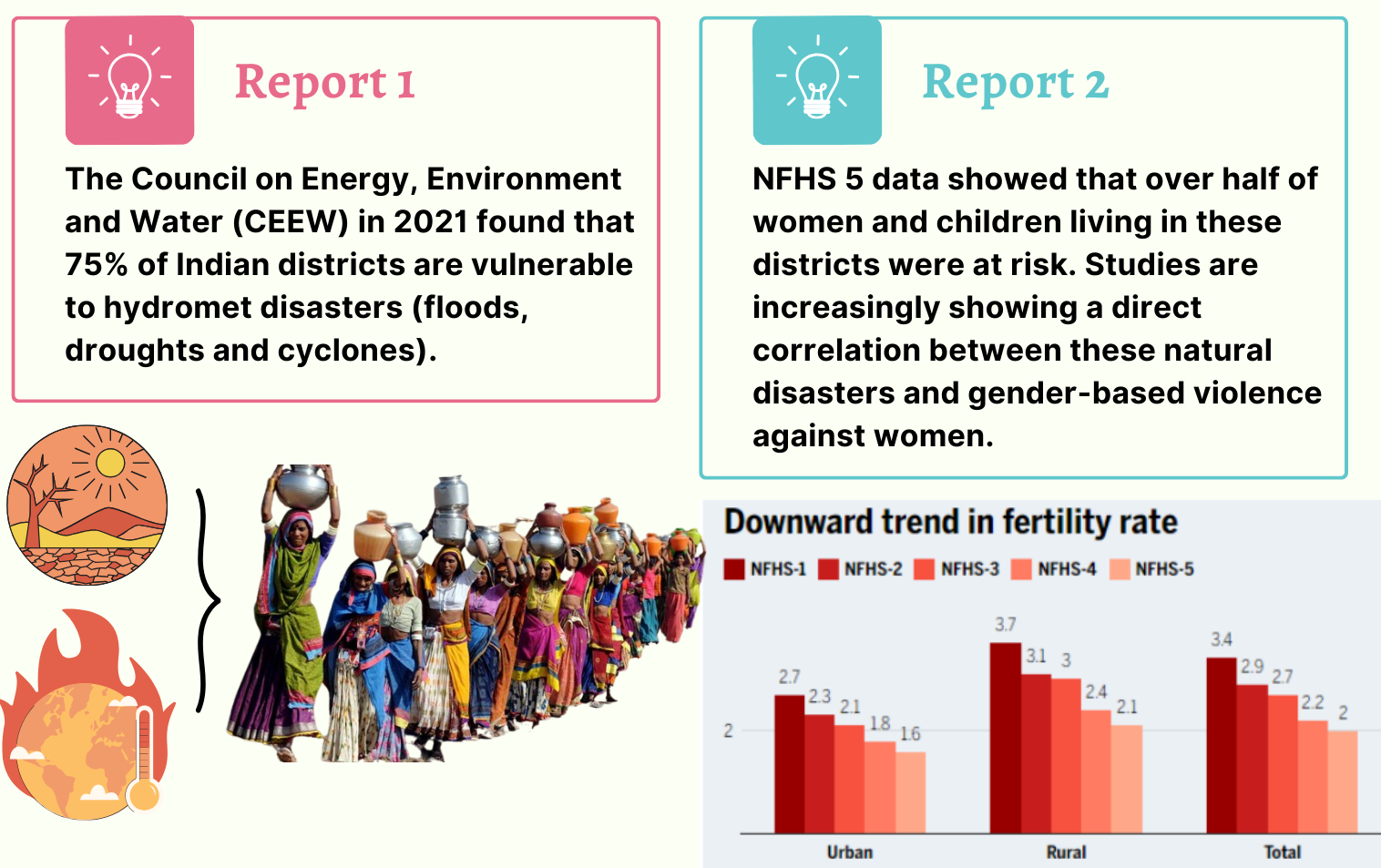
According to the United Nations Development Programme (UNDP), women and children are 14 times more likely than men to die in a disaster.
Tropical countries in the past decade are likely to face unprecedented heatwaves.
The SC has just recently ruled that people have a right to be free from the adverse effects of climate change, and the right to a clean environment is already recognized as a Fundamental Right within the ambit of the ‘Right to Life’.
Why Women are more vulnerable due to Climate Change Impacts?
High Sector-Specific Dependency: Agriculture is the most important livelihood source for women in India, particularly in rural India. Climate-driven crop yield reductions increase poverty.
Men Vs. Women Scenario: Within small and marginal landholding households, while men face social stigma due to unpaid loans (leading to migration, emotional distress, and sometimes even suicide), women experience higher domestic work burdens, worse health, and greater intimate partner violence.
The Scenario in Drought-prone Areas:National Family Health Survey 4 and 5 data showed that women living in drought-prone districts were more underweight, experienced more intimate partner violence, and had a higher prevalence of girl marriages.
Poverty and Insecurity: The increasing food and nutritional insecurity, work burdens and income uncertainties lead not only to poor physical health but also impact their mental health and emotional well-being.
How do the Extreme Climatic Events result in gender-based violence?
Reduced Self-Care: Subsequent changes in water cycle patterns severely impact access to safe drinking water, which increases the drudgery and reduces the time for productive work and self-health care of women and girls.
Maternal Issues: Prolonged heat is particularly dangerous for pregnant women (Chances of Preterm Birth/ Eclampsia), young children, and the elderly.
Cardiovascular disease: Air Pollution affects women’s health, causing respiratory and cardiovascular disease, and also the unborn child, impairing its physical and cognitive growth. One of the most worrying aspects is its impact on the growing brain.
Emerging data from cohort studies in India show that the risk of lung cancer increases by 9% due to PM2.5
Why does Climate Action need Women?
Improve Agri-Productivity: Women increased their agricultural yields by 20% to 30% when provided with the same access to resources as men.
Enhanced Conservation: Tribal and rural women have been at the forefront of environmental conservation.
Empowerment: Giving women and women collectives (Self-help Groups and Farmer Producer Organisations) the knowledge, tools, and access to resources would encourage local solutions to emerge.
Reducing CO2 emissions is crucial:
Creating Cooler Environments: Immediate action is needed to protect vulnerable groups from heatwaves, such as providing cooling spaces and adjusting work schedules.
Planting trees and vegetation can create a cooler and more sustainable environment.
Upgrading Infrastructure: Urban planning can help mitigate heatwave and drought impacts, such as increasing green spaces and using heat-resistant materials.
Improving early warning systems for heatwaves, creating more cooling shelters and green spaces, and promoting awareness campaigns about heatwave risks and safety measures are crucial for preparedness and mitigation.
Water Conservation: Traditional rainwater harvesting and storage systems in India can be revived using geographic information systems and local planning.
Improving water use efficiencies, and reusing treated wastewater can help reduce the strain on freshwater resources.
Technological Interventions: The M.S. Swaminathan Research Foundation in a few districts of Tamil Nadu showed that by using Geographic Information Systems (GIS), Panchayats could improve the groundwater crisis.
It identified vulnerabilities and climate hazards and developed a local plan to improve water access by directing government schemes and resources.
Recently a study by researchers at the L.V. Prasad Eye Institute (LVPEI), Hyderabad, has found that around 70-80% of people who visit an Eye Hospital can benefit from teleconsultations because their problems aren’t serious enough to require attention at a hospital.
Key points as report:
Telemedicine in High-Income Countries: Studies in high-income countries have shown that telemedicine is both patient- and environment-friendly for delivering healthcare services.
Carbon Emissions from the Healthcare Sector: According to the International Comparison of Healthcare Carbon Footprints analysis, India’s healthcare sector emitted 74 million tonnes of carbon dioxide in 2014, around 3% of India’s total emissions of the gas that year.
Carbon Neutrality in Healthcare: The healthcare sector should aim for carbon neutrality to mitigate its environmental impact. Teleophthalmology is cited as an efficient and effective tool to help achieve this goal, as demonstrated by the lead author’s remarks.
The teleophthalmology process:
What are Telemedicine’s Green Gains?
Reduced Carbon Footprint: Teleophthalmology significantly reduces the need for patients, especially those from rural areas, to travel long distances to access healthcare services. This leads to a substantial reduction in carbon dioxide emissions, contributing to environmental sustainability.
Economic Gains: Teleophthalmology results in significant cost savings for both patients and healthcare systems. Patients save money on travel expenses
Easy Accessibility: Teleophthalmology improves access to eye care services, especially for individuals living in remote or rural areas where access to healthcare facilities is limited. It allows patients to receive timely consultations without the need for extensive travel.
Targeted Care Gains: Teleophthalmology is particularly beneficial for patients with minor eye problems like mild refractive errors or regular preventive eye check-ups. It enables healthcare providers to target specific demographics and deliver personalized care more effectively.
Conclusion: The recent study highlights teleophthalmology’s potential in reducing carbon emissions and improving accessibility to eye care, emphasizing its role in achieving carbon neutrality and delivering cost-effective, targeted healthcare services, particularly for minor eye issues.
The Finance Minister proposed the ₹19,500 crore PLI scheme in the Union Budget of 2022-23.
This was to scale domestic manufacturing of the entire solar supply chain — from polysilicon to solar modules.
The government also introduced a steep 40% customs duty on PV modules and 25% on PV cells.
BACK2BASICS
What is the ALMM list?
The Approved List of Models and Manufacturers (ALMM) is a list of models and manufacturers of solar photovoltaic (PV) modules approved by the Ministry of New and Renewable Energy (MNRE) in India.
Objective: The ALMM is used to ensure the quality of solar panels and the manufacturer’s reliability for government projects, government-assisted projects, projects under government schemes and programs, and open access and net-metering projects.
It is being re-implemented to boost domestic solar manufacturing against China’s dominance in the supply value chain of solar PV.
Does India rely on Solar PV imports?
China’s Dominance in Imports: China is the leading supplier of solar cells and modules to India, accounting for a significant portion of India’s imports. As of January 2023-24, China accounted for 53% of India’s solar cell imports and 63% of solar PV module imports.
Manufacturing Capacity Disparity: China holds a dominant position in the manufacturing capacity for various components of solar panels, including polysilicon, wafers, cells, and modules. Rating agency ICRA estimates that China commands over 80% of the manufacturing capacity in these areas.
Government Initiatives:
Notification of ALMM Order: The government initiated efforts to address import dependency in the solar sector by notifying the Approved List of Models and Manufacturers (ALMM) order in January 2019.
Introduction of PLI Scheme: The Finance Ministry proposed the Production Linked Incentive (PLI) scheme worth ₹19,500 crore in the Union Budget of 2022-23. This scheme was designed to incentivize domestic manufacturing across the entire solar supply chain, ranging from polysilicon to solar modules.
Imposition of Customs Duties on PV Modules and Cells: To further incentivize domestic manufacturing and curb imports, the government introduced steep customs duties on photovoltaic (PV) modules and cells. Initially, a 40% customs duty was imposed on PV modules, and a 25% duty was imposed on PV cells.
Why is China a leading exporter?
Cost-Competitive Manufacturing: China is recognized as the most cost-competitive location for manufacturing all components of the solar PV supply chain.
Low Cost of Power: The lower cost of power supplied to the solar PV industry significantly contributes to China’s competitiveness.
Growing Domestic Demand: The significant and rapidly growing domestic demand for solar PV products in China has played a crucial role in driving economies of scale.
Economies of Scale: China’s large-scale production capacity allows manufacturers to benefit from economies of scale.
Continuous Innovation: Chinese government support and the competitive market environment have fostered continuous innovation throughout the solar PV supply chain.
Future scope for Solar Energy in India:
Ambitious Targets: The target of achieving 500 GW of installed capacity from non-fossil fuels by 2030 underscores the significant role solar energy will play in India’s energy mix.
Fastest Growth Rate in Electricity Demand: India accounts for the fastest rate of growth in electricity demand among major economies, according to the International Energy Agency (IEA).
Abundant Solar Potential: India possesses abundant solar resources, with an estimated solar power potential of 748.99 GW.
Conclusion: The ALMM list, PLI scheme, and customs duties aim to boost domestic solar manufacturing in India to counter China’s dominance. With ambitious targets, fast-growing electricity demand, and abundant solar potential, solar energy holds significant promise for India’s energy transition.
Mains question for practice
Q Discuss the initiatives undertaken by the Indian government to promote domestic manufacturing in the solar sector, particularly in light of China’s dominance.
The Indian Space Research Organisation (ISRO) has said its PSLV-C58/XPoSat mission has practically left zero debris in earth’s orbit.
About PSLV Orbital Experimental Module-3 (POEM-3)
Launched on January 1, 2024, POEM-3 utilized the spent PS4 stage of the PSLV-C58 vehicle, which initially launched XPoSat.
It is a three-axis-altitude controlled platform with power generation and tele-command & telemetry capabilities, for supporting Payloads.
The XPoSat mission aimed to leave no debris in space, demonstrating ISRO’s commitment to responsible space practices.
Upon deployment into its orbit at 650 km, POEM-3 was maneuvered to a 350 km circular orbit to minimize orbit decay time after the experiment’s completion.
After completing 400 orbits, POEM-3 re-entered Earth’s atmosphere after 73 days in space.
Significance of this achievement
With the rise in the number of satellites in orbit around the earth, space debris has become a pressing issue.
Space debris in the low earth orbit (LEO) mainly comprises pieces of spacecraft, rockets, and defunct satellites, and the fragments of objects that have deteriorated explosively as a result of anti-satellite missile tests.
This debris often flies around at high speeds of up to 27,000 kilometres per hour.
Due to their sheer volume and momentum, they pose a risk to several space assets.
Threats posed by Space Debris
Space debris also leads to two major risks:
It creates unusable regions of the orbit due to excessive debris, and
Leads to the ‘Kessler syndrome’ – creation of more debris due to cascading collisions resulting from one collision.
Various Initiatives to mitigate the Space Debris Issue
Description
Project NETRA
ISRO initiative for early warning system in space to detect debris and hazards to the Indian satellites.
It can spot, track and catalogue objects as small as 10 cm, up to a range of 3,400 km and equal to a space orbit of around 2,000 km.
Space Debris Mitigation Guidelines
Established in 2002 by the Inter-Agency Space Debris Coordination Committee (IADC) and endorsed by the United Nations in 2007.
Zero Debris Charter by ESA
Adopted by the European Space Agency (ESA) with the goal of achieving zero space debris by 2030.
NASA’s Orbital Debris Program
NASA’s initiative since 1979, focusing on reducing orbital debris creation, tracking existing debris, and exploring debris removal technologies.
Space Force Tracking System
Implemented by the U.S. Space Force to monitor space debris and assess collision risks in low Earth orbit (LEO).
Chinese Debris Removal Initiatives
China’s efforts include deploying spacecraft for debris removal with innovative technologies like solar sails.
Japanese CRD2 Demonstration
Partnership between Japan’s Aerospace Exploration Agency (JAXA) and Astroscale to develop debris removal technologies.
Practice MCQ:
ISRO’s PSLV Orbital Experimental Module-3 (POEM-3) recently re-entered Earth’s Orbit. What is so significant about this re-entry?
(a) It practically left zero debris in earth’s orbit.
(b) It facilitated groundbreaking research on the effects of microgravity on biological organisms.
(c) It paved the way for the development of reusable spacecraft technology, reducing the cost of future space missions.
The Ministry of New & Renewable Energy has unveiled Guidelines for the implementation of an R&D Scheme under the National Green Hydrogen Mission.
The scheme aims to catalyze advancements in the production, storage, transportation, and utilization of green hydrogen, with a focus on affordability, efficiency, safety, and reliability.
Hydrogen Energy: A Backgrounder
Hydrogen is an important source of energy since it has zero carbon content and is a non-polluting source of energy in contrast to hydrocarbons that have net carbon content in the range of 75–85 per cent.
Hydrogen energy is expected to reduce carbon emissions that are set to jump by 1.5 billion tons in 2021.
It has the highest energy content by weight and lowest energy content by volume.
As per International Renewable Energy Agency (IRENA), Hydrogen shall make up 6 per cent of total energy consumption by 2050.
Hydrogen energy is currently at a nascent stage of development, but has considerable potential for aiding the process of energy transition from hydrocarbons to renewable.
About National Green Hydrogen Mission (NGHM)
The National Green Hydrogen Mission was launched in January 2023 to make India a ‘global hub’ for using, producing and exporting green hydrogen.
Earlier, the National Hydrogen Mission was launched on August 15, 2021,with a view to cutting down carbon emissions and increasing the use of renewable sources of energy.
The Ministry of New and Renewable Energy (MNRE) formulates the scheme guidelines for implementation of these missions.
Key features of the NGHM
Power capacity: The mission seeks to promote the development of green hydrogen production capacity of at least 5 MMT per annum with an associated renewable energy capacity addition of about 125 GW in the country by 2030.
Job creation: It envisages an investment of over ₹8 lakh crore and creation of over 6 lakh jobs by 2030.
Reducing energy import bill: It will also result in a cumulative reduction in fossil fuel imports of over ₹1 lakh crore and abatement of nearly 50 MMT of annual greenhouse gas emissions by 2030.
Export promotion: The mission will facilitate demand creation, production, utilisation and export of green hydrogen.
Incentivization: Under the Strategic Interventions for Green Hydrogen Transition Programme (SIGHT), two distinct financial incentive mechanisms targeting domestic manufacturing of electrolysers and production of green hydrogen will be provided under the mission.
Green Hydrogen Hubs: Regions capable of supporting large-scale production and/or utilisation of hydrogen will be identified and developed as Green Hydrogen Hubs.
Types of Hydrogen
Hydrogen extraction methods are classified into three types based on their processes: Grey, Blue, and Green.
Green Hydrogen: Green hydrogen is produced through water electrolysis, utilizing electricity generated from renewable energy sources.
Grey Hydrogen: This type of hydrogen is obtained through coal or lignite gasification (black or brown), or by steam methane reformation (SMR) of natural gas or methane (grey). These processes are typically carbon-intensive.
Blue Hydrogen: Blue hydrogen is derived from natural gas or coal gasification, coupled with carbon capture storage (CCS) or carbon capture use (CCU) technologies to mitigate carbon emissions.
PYQ:
[2010]Hydrogen fuel cell vehicles produce one of the following as “exhaust”:
(a) NH3
(b) CH4
(c) H2O
(d) H2O2
[2023]With reference to green hydrogen, consider the following statements:
1. It can be used directly as a fuel for internal combustion.
2. It can be blended with natural gas and used as fuel for heat or power generation.
3. It can be used in the hydrogen fuel cell to run vehicles.
Titled “Geospatial modelling and mapping of soil erosion in India,” the report marks the first attempt to classify soil erosion on a pan-India basis.
The study categorizes soil erosion into six classifications, ranging from “minor” to “catastrophic,” based on the amount of soil eroded per hectare over a year.
Soil Erosion in India
Soil erosion is the process by which soil is removed or displaced from its original location, often due to the action of wind, water, or human activities.
It is a natural geological process accelerated by various factors such as deforestation, overgrazing, improper agricultural practices, urbanization, and climate change.
Key trends in India
Nearly 30% of the country’s landmass is experiencing “minor” soil erosion.
Critical 3% (approx. 1500 sq km) faces “catastrophic” topsoil loss.
The Brahmaputra Valley in Assam emerged as the most significant hotspot for soil erosion, with close to 300 square kilometers or 31% of its surface soil lost to “catastrophic” erosion.
The lower Himalayan region, extending from Kashmir to Uttarakhand and beyond, and Odisha also face severe erosion challenges, posing threats to biodiversity and environmental stability.
Causes of Soil Erosion
Anthropogenic Causes: Soil erosion in India is primarily caused by human activities including deforestation, overgrazing, improper land use practices, and construction activities.
Natural Causes: The monsoon season, characterized by heavy rainfall, exacerbates soil erosion, especially in regions with steep slopes and poor vegetation cover.
Impact of Soil Erosion
Topsoil, essential for agriculture due to its nutrient-rich composition, is crucial for sustaining crop growth.
Erosion diminishes soil fertility, leading to reduced crop yields and agricultural productivity.
Revised Universal Soil Loss Equation (RUSLE) Methodology
The Revised Universal Soil Loss Equation (RUSLE) is a widely used empirical model for estimating soil erosion rates.
It is used to predict the average annual soil loss caused by sheet and rill erosion from specific field areas.
The RUSLE methodology considers various factors that contribute to soil erosion, including rainfall, soil erodibility, slope length and steepness, vegetation cover, and conservation practices.
The equation for RUSLE is:
A = R * K * LS * C * P
Where:
A is the estimated average annual soil loss (in tons per acre per year).
R is the rainfall factor, representing the erosive power of rainfall.
K is the soil erodibility factor, representing the susceptibility of soil to erosion.
LS is the slope length and steepness factor, accounting for the effect of slope on erosion.
C is the cover management factor, indicating the impact of vegetation cover and land use practices on erosion.
P is the conservation practice factor, reflecting the effectiveness of erosion control practices implemented.
PYQ:
[2014] In India, the problem of soil erosion is associated with which of the following?
1. Terrace cultivation
2. Deforestation
3. Tropical climate’
Select the correct answer using the code given below:
Q) Examine the development of Airports in India through joint ventures under Public – Private Partnership (PPP) model. What are the challenges faced by the authorities in this regard? (UPSC CSE 2017)
Q) International civil aviation laws provide all countries complete and exclusive sovereignty over the airspace above their territory. What do you understand by ‘airspace’ What are the implications of these laws on the space above this airspace? Discuss the challenges that this poses and suggest ways to contain the threat. (UPSC CSE 2014)
Note4Students:
Prelims: International Civil Aviation Organisation (ICAO);
Mains: Economy and Infrastructure;Civil Aviation in India;
Mentor comments:To put in place long-term efforts for our safe and secure future, we must break down the barriers between ‘Development’ and ‘Humanitarian Response’. Air Transport plays a pivotal role in promoting Economy and Tourism in India. India has an extensive civilian air transportation network and is amongst the fastest-growing aviation markets in the world according to the International Air Transport Association (IATA). Presently, the Aviation Sector in India is facing serious safety concerns as Airline Management prioritizes commercial interests over passenger safety.
Let’s learn.
—
Why in the News?
The Civil Aviation Ministry and the DGCA need a more human-centric approach in airline management, addressing pilot shortages, and prioritizing safety over commercial interests is crucial for the Indian aviation sector to thrive.
Challenges faced by Airline Services in India:
Technical and Safety Concerns: The safety of passengers is being gravely compromised due to the non-provision of the Runway End Safety Area. For example, at Kozhikode’s Karipur Airport (Kerala).
Despite reassurances from the Civil Aviation Ministry and the DGCA, safety issues persist, such as the deferred regulations on pilot fatigue.
Resource Availability: The land resources needed by AAI [Airports Authority of India] for better landing and avoiding accidents are generally ignored or delayed by state governments.
Nexus between private players and government: Lack of Coordination between Airline owners and the Government for the implementation of safety policies needs to be resolved. For example, the present Flight Duty Time Limitations Regulations where the deadline for their implementation was June 1, 2024, were not taken seriously by private players.
Pilot Stress: Financial stress on pilots is also highlighted as a risk factor, with examples of past incidents linked to pilot suicide due to personal financial pressures.
Recognizing pilots as human beings who require time with their families, the importance of providing two days off per week for pilots is essential to ensure their well-being and maintain aviation safety.
Global Scenario and System Overseas:
The International Civil Aviation Organisation (ICAO) introduced the Fatigue Risk Management System (FRMS) as a mandatory requirement due to the significant impact of fatigue on aviation safety.
Studies have shown that sleep deprivation and impaired reaction times due to fatigue are major contributors to accidents and incidents.
Countries like Japan, Singapore, and the United Kingdom emphasize fatigue management and rest periods for flight crew to mitigate these risks.
Pilots in these countries typically have two days off every week to reset their body clock, especially after long-haul flights.
Way Forward:
Change the Priority: The Indian aviation sector faces critical safety issues due to a lack of prioritization of safety over commercial interests by airline management. The need for a more human-centric approach, addressing pilot shortages, and emphasizing safety is essential for the sector’s success.
Need for Humanitarian Code: India should adopt the ICAO Annex 1 Standard which allows experienced Indian pilots abroad to return to India and utilize the present retired pilots for training and checks.
Need for Updating policy implementations: Overcoming corruption, revising outdated rules, and focusing on transparency and brand loyalty are crucial for the sector’s improvement and the success of airline mergers.
The India Meteorological Department (IMD) recently said that India will have more than the ‘usual’ number of days with heat waves in this summer.
Increasing Temperature in India and its impact as per IMD:
Temperature Predictions: The Indian Meteorological Department (IMD) predicts “above-normal” temperatures for April-June 2024, with a probability of 55%-65% in one half of the country and over 65% in the other half. Few parts are expected to have normal or below-normal temperatures.
Effect of Heat on Agriculture: Higher heat negatively impacts crop yield, agricultural workers’ productivity, and water availability, varying in degree depending on the crop.
Consequences of Heat in Urban Area: Increased heat leads to higher power demand in urban and industrial centers, poses deadly risks for outdoor workers (such as at construction sites), overwhelms health service providers (especially affecting the very young and old), and highlights the importance of access to clean, cool water, indoor ventilation, and bathrooms.
Power Demand: The availability of power is crucial for addressing the effects of heat. A chart shows that in March 2024, the average evening peak-hour demand reached a new high of 190 GW.
Major challenges around the Energy Demand and Government Targets:
Government Targets: The government aims to achieve 500 GW of power generation capacity from renewable energy sources by 2030. Additionally, it has committed to producing 50% of its power from non-fossil fuel energy sources by the same year.
Heat increases power demand: Heat boosts power demand in cities and industries, heightens risks for outdoor labor, strains healthcare services for vulnerable groups, and underscores the necessity of clean water, ventilation, and bathrooms. Power availability is fundamental for addressing these challenges.
Focus on Solar Power: A substantial portion of the renewable energy addition will come from solar power. However, due to the intermittent nature of solar output and the ongoing establishment of power storage capacity, coal is still relied upon to meet peak demand.
Coal’s Dominance: Chart 3 (above) illustrates the gross electricity generated using coal in India and coal’s share in total electricity generation. The coal’s share has remained between 70-74% since at least FY16.
Commercially Viable Energy Storage: In India, the most commercially viable energy storage forms currently are battery-based and Pumped Hydro Storage (PHS).
Renewable Energy Generation: Chart 4 depicts the gross electricity generated using renewable sources in India and the share of renewable sources in total electricity generation. The share of renewables, including solar, hydro, wind, etc., has remained between 20-25% since at least FY16
Major Dilemma For India: Cannot ignore Coal immediately:
Coal is projected to continue as the backbone of the Indian energy system until the next two decades and its phase-down will require active policies on critical minerals, according to a report by the Indian Institute of Management (IIM)- Ahmedabad.
The report, titled ‘Synchronising energy transitions towards a possible Net Zero for India: Affordable and Clean Energy for All,’ asserted that net zero is not possible without substantial nuclear power and renewable energy generation by 2070.
To achieve net-zero energy systems by 2070, the report mentioned that the electricity sector will need to decarbonize well before that.
Way Forward:
NDC Goals: The remaining gaps in emissions will be offset through sequestration in forestry and tree cover as envisaged in our Nationally Determined Contributions (NDCs).
Need for Technological intervention: There is no silver bullet to achieve net zero. The transition needs multiple pathways to be adopted with the co-existence of myriad technologies in our energy basket.
Mains PYQ
Q Discuss the implications of heightened heat waves in India, as highlighted by recent statements from the India Meteorological Department (IMD).

![[10 April 2024] The Hindu Op-ed: The climate crisis is not gender neutral](https://d18x2uyjeekruj.cloudfront.net/wp-content/uploads/2024/04/10-april-1568x882.jpg)