💥Mains Ready By December. Smash Mains & Smash PYQ Admissions Open

GS Paper: GS3

  • National Infrastructure Pipeline (NIP)

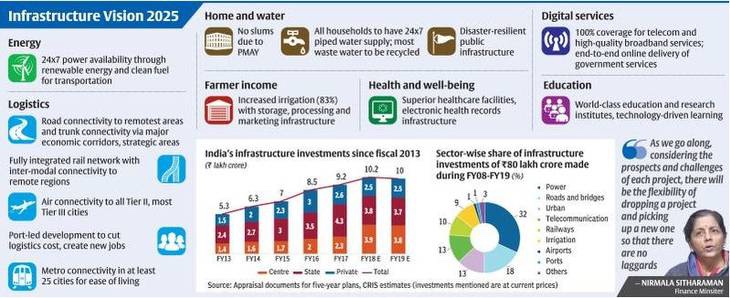
    Union Finance Minister has unveiled Rs 102 lakh crore of infrastructure projects, under National Infrastructure Pipeline. It will be implemented in the next five years as part of the government’s spending push in the infrastructure sector.

    What is the National Infrastructure Pipeline (NIP)?

    • NIP includes economic and social infrastructure projects.
    • During the fiscals 2020 to 2025, sectors such as Energy (24%), Roads (19%), Urban (16%), and Railways (13%) amount to around 70% of the projected capital expenditure in infrastructure in India.
    • It has outlined plans to invest more than ₹102 lakh crore on infrastructure projects by 2024-25, with the Centre, States and the private sector to share the capital expenditure in a 39:39:22 formula.

    Key benefits of NIP

    • Economic: Well-planned NIP will enable more infra projects, grow businesses, create jobs, improve ease of living, and provide equitable access to infrastructure for all, making growth more inclusive.
    • Government: Well-developed infrastructure enhances the level of economic activity, creates additional fiscal space by improving the revenue base of the government, and ensures the quality of expenditure focused in productive areas.
    • Developers: Provides a better view of project supply, provides time to be better prepared for project bidding, reduces aggressive bids/ failure in project delivery, ensures enhanced access to sources of finance as a result of increased investor confidence.
    • Banks/financial institutions (F1s)/investors: Builds investor confidence as identified projects are likely to be better prepared, exposures less likely to suffer stress given active project monitoring, thereby less likelihood of NPAs.

    Is NIP a road to $5 trillion economy?

    • Finance minister said that the Rs 102 lakh crore National Infrastructure Projects will help make India a $5 trillion economy by 2025.
    • These projects are on top of Rs 51 lakh crore spent by the Centre and the states during the last six years.
    • The new pipeline consists of 39 per cent projects each by the Centre and states and the balance by 22 per cent by private sector.
  • Millimeter Spectrum

    The DoT plans to auction the 24.75 – 27.25 gigahertz (GHz) spectrum in the 5G band in March-April 2020.

    Millimeter Spectrum

    • The new spectrum under the 5G band called the ‘millimeter-wave bands’ is separate from the 8,300 megahertz (MHz).
    • The millimeter-wave band or extremely high-frequency frequency spectrum is mainly designed for usage in airport security scanners, closed-circuit television, scientific research, machine-to-machine communication, and military fire control.

    What’s so special with this MM spectrum?

    • As the wavelength becomes smaller, the cell size becomes less, which is the footprint of the relay station. This will be used more by the industry.
    • If we you already have fiber connection and want to reach houses, this will be through millimeter bands.
  • Species in news: Senna spectabilis


    The Kerala Forest Department is planning to adopt steps to arrest the rampant growth of invasive plants, especially Senna spectabilis, in the forest areas of the Nilgiri Biosphere Reserve (NBR).

    Senna spectabilis

    • The Senna spectabilis species was planted as avenue trees in Wayanad. The vayal ecosystem (marshy land) of the forest area now has this plant in large numbers.
    • The spread is posing a major threat to the forest areas of the reserve, owing to its quick growth and coppicing character.
    • The tree species was found in nearly 10 sq km area of the 344.44 sq km sanctuary around five years ago.
    • The plant has started to invade the adjacent Bandipur and Nagarhole tiger reserves in Karnataka and the Mudumalai tiger reserve in Tamil Nadu.
    • Now, it had invaded to more than 50 sq km of the sanctuary Wayanad WLS.
    • A recent study of the Ferns Nature Conservation Society recorded the presence of the plant in 78.91 sq km area of the sanctuary.

    Impact

    • An adult tree grows up to 15 to 20 metres in a short period of time and every year distributes thousands of seeds after gregarious flowering.
    • The thick foliage arrests the growth of other indigenous tree and grass species and causes food shortage for the wildlife population, especially herbivores.
    • Moreover, wildlife will not feed on the leaf of the treeas it is not palatable for them.
    • The allelochemicals produced by this plant adversely affect the germination and growth of the native species.