Mains Ready By December. Smash Mains & Smash PYQ Admissions Open

GS Paper: Salient Features Of World’S Physical Geography

  • Earth’s magnetic North Pole is shifting toward Siberia

    Why in the News?

    Earth’s magnetic north pole, a critical point where the planet’s magnetic field lines converge, is in constant motion due to changes in the Earth’s molten core. Currently located in the Arctic Ocean above Canada, the magnetic north pole has been moving towards Siberia at an accelerated pace.

    What is the World Magnetic Model (WMM)?

    • The WMM is the standard model used for navigation, attitude, and heading referencing systems that rely on Earth’s geomagnetic field.
    • It is widely used in civilian applications, including navigation and heading systems, as well as in military operations.
    • The WMM provides accurate data on the Earth’s magnetic field and the location of the magnetic North Pole, combining measurements from ground stations and satellites.
    • Revisions and Updates:
      • A new version is updated every five years to address changes in the magnetic field.
      • The latest version, WMM2025, was released on December 17, 2024, and will remain valid until late 2029.
    • The WMM is jointly developed by the United States’ National Geospatial-Intelligence Agency (NGA) and the United Kingdom’s Defence Geographic Centre (DGC), with technical support from NCEI and the British Geological Survey (BGS).
    • It serves both civilian and military purposes, ensuring accuracy in navigation systems, GPS applications, and other tools dependent on Earth’s magnetic field.

    Why is the Magnetic North Pole Moving?

    • The magnetic North Pole moves due to the dynamic flow of molten iron and other metals in Earth’s outer core, which generates the planet’s magnetic field.
    • These movements cause shifts in magnetic field lines, leading to the pole’s drift over time.
    • The pole was first identified in Canada in 1831 and has since moved over 400 km toward Russia.
    • Key Observations of Movement:
      • From 1990 to 2000, the pole drifted at a rapid rate of 55 km/year.
      • By 2015, this rate slowed to 35 km/year, but the drift remains unpredictable.
      • Currently, the pole is moving closer to Siberia, reflecting changes in Earth’s core dynamics.
    • Impact of Movement:
      • The drift affects navigation systems, aviation routes, and Earth’s magnetic shielding against harmful solar radiation.
      • Scientists monitor this movement using the WMM to ensure updated predictions and mitigate potential impacts on navigation and environmental protection.
  • Hurricane Milton

    Why in the News?

    Hurricane Milton made landfall near Siesta Key, Florida, USA which caused heavy rain, flooding and strong winds resulting in significant damage and loss of lives.

    Hurricane Milton: Origin and Causes

    • Hurricane Milton was a powerful storm that made landfall in Florida near Siesta Key, causing widespread damage.
    • It was a Category 5 hurricane with wind speeds of 285 km/h, making it one of the strongest hurricanes ever recorded in the Atlantic Ocean.
    • It originated in the Gulf of Mexico, an area connected to the Atlantic Ocean.

    Why it was an unusual storm?

    • Milton went from a Category 1 storm to a Category 5 storm in just 12 hours.
      • Usually, hurricanes intensify at a slower pace, but Milton’s wind speeds increased by 145 km/h in one day, which is very rare.
    • Sea-surface temperatures of 31°C were much higher than the 26°C needed for hurricane formation.
      • This excess heat allowed Milton to intensify quickly.
    • Most hurricanes follow a westward path, but Milton moved eastward and made landfall on the western coast of Florida.
      • According to scientists, very few hurricanes have taken this path before.
    • Wind shear is a change in wind speed and direction that can weaken hurricanes.
      • In Milton’s case, there was almost no wind shear, allowing the storm to grow stronger without interference.

    PYQ:

    [2020] Consider the following statements:

    1. Jet streams occur in the Northern Hemisphere only.

    2. Only some cyclones develop an eye.

    3. The temperature inside the eye of a cyclone is nearly 10ºC lesser than that of the surroundings.

    Which of the statements given above is/are correct?

    (a) 1 only

    (b) 2 and 3 only

    (c) 2 only

    (d) 1 and 3 only

  • Annular Solar Eclipse

    Why in the News?

    An annular solar eclipse will be visible in parts of South America on October 2, 2023.  It, however, will not be visible from India.

    What is a Solar Eclipse?

    • A solar eclipse occurs when the Moon moves between the Earth and the Sun, blocking the Sun’s light either fully or partially, casting a shadow on certain parts of the Earth.
    • There are four types of solar eclipses:
      1. Total Solar Eclipse: When the Moon completely blocks the Sun, turning the sky dark. People in the path of a total solar eclipse can witness the Sun’s corona (its outer atmosphere), which is normally hidden by the bright sunlight.
      2. Annular Solar Eclipse: Occurs when the Moon is at or near its farthest point from Earth. The Moon does not fully cover the Sun, leaving a visible ring of fire around the Moon. This is what people in parts of South America will witness on October 2, 2023.
      3. Partial Solar Eclipse: Happens when the Moon blocks only a part of the Sun, giving it a crescent shape. During both partial and annular eclipses, areas outside the Moon’s umbra (the darkest part of its shadow) experience a partial eclipse. It is the most common type of solar eclipse.
      4. Hybrid Solar Eclipse: The rarest type, where the eclipse shifts between total and annular as the Moon’s shadow moves across the Earth. Some places see a total solar eclipse, while others see an annular one.

    Frequency of Solar Eclipses

    • A solar eclipse can only occur during the new moon, when the Moon and Sun are aligned on the same side of the Earth.
    • A new moon happens approximately every 29.5 days because that is the time it takes for the Moon to orbit the Earth.
    • However, solar eclipses don’t happen every month. They occur two to five times annually, but not every new moon results in an eclipse.
    • Why don’t they occur every month:
      • The Moon’s orbit around the Earth is tilted by about 5 degrees compared to the Earth’s orbit around the Sun.
      • This means the Moon’s shadow usually misses the Earth.
      • A solar eclipse only occur when the Moon crosses specific points in its orbit, called nodes, where the Moon’s orbit intersects the plane of Earth’s orbit around the Sun.
      • When a new moon occurs at one of these nodes, a solar eclipse is possible.

    PYQ:

    [2019] On 21st June, the Sun

    (a) does not set below the horizon at the Arctic Circle

    (b) does not set below the horizon at Antarctic Circle

    (c) shines vertically overhead at noon on the Equator

    (d) shines vertically overhead at the Tropic of Capricorn

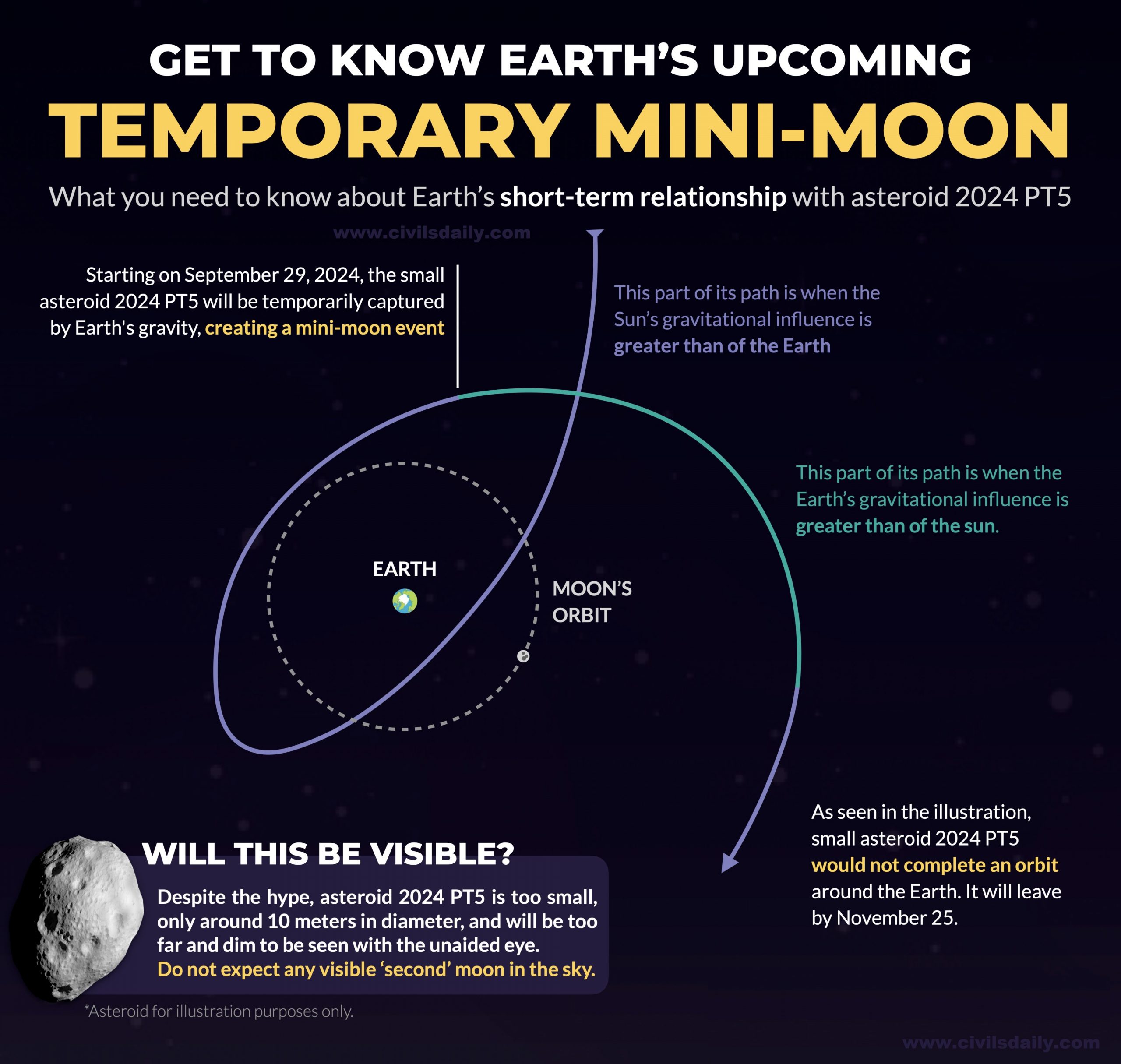
  • Why Earth will temporarily get a ‘Mini-Moon’ in September?

    Why in the News?

    In a rare celestial event, Earth’s gravitational field will witness a small asteroid, 2024 PT5, creating a “mini-moon” for two months.

    What is Mini-Moon?

    • A mini-moon is a small asteroid temporarily captured by Earth’s gravitational field, orbiting the planet for a short period before escaping back into space.
    • Unlike Earth’s permanent moon, mini-moons only stay for a few months to a few years before being ejected from orbit.
    • Mini-moons are a rare occurrence because most asteroids either pass by Earth or burn up in the atmosphere rather than being captured by Earth’s gravity.
    • Mini-moons are usually small, often just a few meters in diameter.
      • For example, 2024 PT5 is only about 33 feet (10 meters) in length.
    • They are hard to detect and are usually discovered using advanced telescopic surveys like NASA’s Asteroid Terrestrial-impact Last Alert System (ATLAS).

    Significance of Mini-Moons

    • Mini-moons offer scientists a unique opportunity to study near-Earth objects, enhancing our understanding of asteroids’ behavior and composition.
    • Mini-moons could contain valuable minerals or water, making them potential targets for future space missions to extract resources.
    • Studying mini-moons helps scientists learn more about Earth’s gravitational influence and how it interacts with space objects.

    PYQ:

    [2011] What is the difference between asteroids and comets?

    1. Asteroids are small rocky planetoids, while comets are formed of frozen gases held together by rocky and metallic material.
    2. Asteroids are found mostly between the orbits of Jupiter and Mars, while comets are found mostly between Venus and Mercury.
    3. Comets show a perceptible glowing tail, while asteroids do not.

    Which of the statements given above is/are correct?

    (a) 1 and 2 only
    (b) 1 and 3 only
    (c) 3 only
    (d) 1, 2 and 3

  • The Volcanic Island of Rapa Nui

    Rapa Nui

    Why in the News?

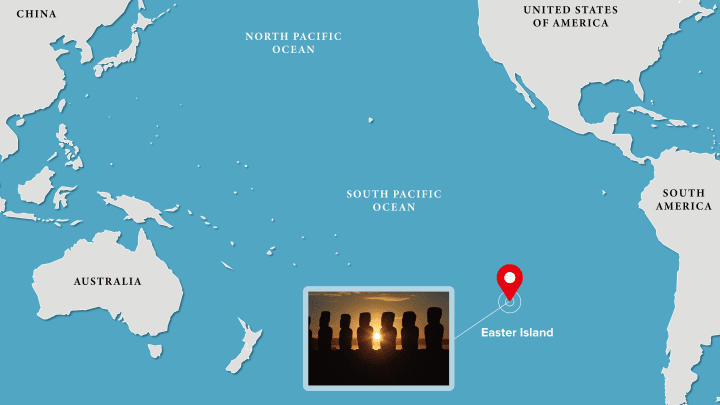
    The Volcanic Island of Rapa Nui (also known as Easter Island) has always been mysterious due to its harsh geography and iconic Moai statues.

    About Rapa Nui Island

    Details
    Location • Situated in the southeastern Pacific Ocean, Rapa Nui is part of Polynesia and a territory of Chile.
    • One of the most remote islands, about 3,500 km from Chile.
    Size • Covers an area of 160 sq. km.
    Geographical details • The island has a volcanic origin, featuring lava-covered terrain and rocky soil.

    • Notable volcanoes include Terevaka, Poike, and Rano Kau.

    • Tropical climate with average temperatures ranging between 18°C and 28°C.

    • Rainfall occurs mostly in the winter months.

    Moai Statues • Famous for over 900 moai statues, some as tall as 40 ft and weighing 75 tonnes.
    • These statues were built between the 13th and 16th centuries to honor revered ancestors.
    • Carved from volcanic rock and transported across great distances.
    Discovery • Discovered by European sailors on Easter Sunday, 1722, which gave it the name Easter Island.
    • The island had been settled centuries earlier by Polynesian explorers who navigated thousands of kilometers of ocean.
    Significance of New Findings • Recent studies, including the use of AI analysis of satellite images, have debunked earlier theories of ecological collapse.
    • Genetic studies show Native American ancestry before European contact, indicating earlier interactions with South America.


    PYQ:

    [2018] Consider the following statements:

    1. The Barren Island volcano is an active volcano located in the Indian territory.

    2. Barren Island lies about 140 km east of Great Nicobar.

    3. The last time the Barren Island volcano erupted was in 1991 and it has remained inactive since then.

    Which of the statements given above is/are correct?

    (a) 1 only

    (b) 2 and 3

    (c) 3 only

    (d) 1 and 3

  • What is the Perseid Meteor Shower?

    Why in the News?

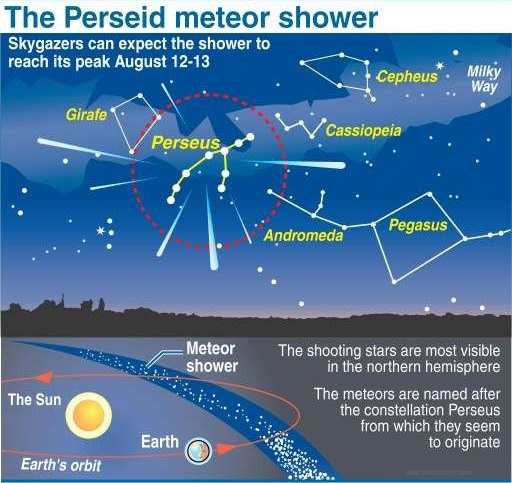
    The Perseid meteor shower, which began in July, is currently at its peak activity from August 11 to 13, 2024.

    About Perseid Meteor Shower

    Details
    Origin Named after the constellation Perseus, from which the meteors appear to originate.
    Cause Caused by debris left behind by Comet Swift-Tuttle as it orbits the Sun.
    How It Occurs
    • Consists of ice, rock, and dust particles shed by Comet Swift-Tuttle.
    • Earth passes through this debris field annually between mid-July and late August.
    • Particles enter Earth’s atmosphere at around 214,000 km/h, causing them to heat up and create bright streaks of light.
    Discovery The connection between the Perseid meteor shower and Comet Swift-Tuttle was established in 1862 by Lewis Swift and Horace Tuttle.
    Historical Observations Observed for centuries, with records dating back to ancient Chinese, Japanese, and European civilizations.
    Impact of Earth’s Gravity
    • Earth’s gravity pulls particles from the debris field, causing them to enter the atmosphere.
    • Larger particles can create fireballs—bright meteors that are more intense and last longer.

    Note: In the 1990s, scientists feared comet Swift-Tuttle might hit Earth or the Moon in 2126, but later calculations confirmed safety for two millennia.

    PYQ:

    [2011] What is the difference between asteroids and comets?

    1. Asteroids are small rocky planetoids, while comets are formed of frozen gases held together by rocky and metallic material.
    2. Asteroids are found mostly between the orbits of Jupiter and Mars, while comets are found mostly between Venus and Mercury.
    3. Comets show a perceptible glowing tail, while asteroids do not.

    Which of the statements given above is/are correct?

    (a) 1 and 2 only
    (b) 1 and 3 only
    (c) 3 only
    (d) 1, 2 and 3

  • Speculoos-3b: A New Earth-Sized Exoplanet Discovered

    Why in the News?

    • Astronomers have identified a new Earth-sized exoplanet, named Speculoos-3b, orbiting an ultracool red dwarf star.

    Back2Basics: Red Dwarf Star

    • A red dwarf is the most common type of star in the Milky Way galaxy.
    • However, due to their low luminosity, individual red dwarfs cannot be easily observed.
    • Proxima Centauri, the star nearest to the Sun, is a red dwarf, as are fifty of the sixty nearest stars.
    • According to some estimates, red dwarfs make up three-quarters of the fusing stars in the Milky Way.

    About Speculoos-3b

    • Speculoos-3b is an Earth-sized exoplanet recently discovered orbiting an ultracool dwarf star.
    • It was discovered by a team of astronomers led by Michael Gillon from the University of Liege in Belgium.
    • It is located approximately 55 light-years away from Earth.
    • Due to its short orbital period, Speculoos-3b receives almost ten times more energy per second than Earth does from the Sun.

    SPECULOOS Project 

    • Project Overview: The discovery was made under the SPECULOOS project, aimed at exploring exoplanets around ultra-cool dwarf stars.
    • The SPECULOOS Southern Observatory is a project carried out by the University of Liège (Belgium) and the Cavendish Laboratory in Cambridge (United Kingdom)

    Astrophysical Significance of the Discovery

    • Prevalence of Ultracool Dwarfs: Ultracool dwarf stars, like the host of Speculoos-3b, constitute about 70% of all stars in our galaxy and are known for their longevity, surviving up to 100 billion years.
    • Importance for Life’s Potential: The extended lifespan of these stars provides a stable environment that could potentially support the development of life on orbiting planets.

    PYQ:

    [2015] The term ‘Goldilocks Zone’ is often seen in the news in the context of:

    (a) the limits of habitable zone above the surface of the Earth

    (b) regions inside the Earth where shale gas is available

    (c) search for the Earth-like planets in outer space

    (d) search for meteorites containing precious metals

  • Taam Ja’: World’s Deepest Blue Hole

    Why in the news?

    Researchers have made a discovery in Mexico, uncovering the world’s deepest blue hole, known as Taam Ja’ Blue Hole (TJBH).

    What are Blue Holes?

    • Blue holes, such as TJBH, are formed in coastal regions with soluble bedrock, such as limestone, marble, or gypsum.
    • Water percolates through the rock, dissolving minerals and widening cracks, ultimately leading to the formation of sinkholes.
    • Famous examples: 410-foot Great Blue Hole in Belize, the 663-foot Dean’s Blue Hole in the Bahamas and the 328-foot Blue Hole in the Red Sea near Dahab, Egypt.

    About Taam Ja’ Blue Hole (TJBH)

    • TJBH extends at least 1,380 feet (420 meters) below sea level, making it the deepest known underwater sinkhole in the world.
    • It is located in Chetumal Bay off the southeast coast of the Yucatan Peninsula.
    • It was first discovered in 2021, was originally thought to be 900 feet deep.
    • This discovery surpasses the previous record-holder, the Sansha Yongle Blue Hole in the South China Sea, by an impressive 480 feet.

    Research Expedition and Findings

    • Scientists utilized a conductivity, temperature, and depth (CTD) profiler to collect data about the environmental conditions within the blue hole.
    • Despite reaching depths of 1,640 feet (500 meters), the CTD profiler was unable to reach the bottom of TJBH, indicating its remarkable depth.
    • Data from the profiler suggested the presence of different water layers within the blue hole, with conditions resembling those of the Caribbean Sea at depths below 1,312 feet (400 meters).

    PYQ:

    [2017] In the context of mitigating the impending global warming due to anthropogenic emissions of carbon dioxide, which of the following can be the potential sites for carbon sequestration?

    1. Abandoned and uneconomic coal seams.

    2. Depleted oil and gas reservoirs.

    3. Subterranean deep saline formations.

    Select the correct answer using the code given below:

    (a) 1 and 2 only

    (b) 3 only

    (c) 1 and 3 only

    (d) 1, 2 and 3

  • In news: Pripyat River

    Why in the news?

    • The WWF has issued a stark warning regarding the dredging of the Pripyat River, adjacent to the Chernobyl nuclear disaster site.
    • Concerns mount as the Pripyat River could transform into a permanent repository of radioactive substances, contaminating the water and food sources.

    About Pripyat River

    • Pripyat River is a significant waterway in Eastern Europe. It flows through Ukraine, Belarus, and a small portion of Russia.
    • It is primarily situated within the Polesian Lowland, a region characterized by marshes, wetlands, and forests.
    • The Pripyat River is approximately 761 km (473 miles) long.
    • Physical Features:
    • Tributaries: It has numerous tributaries, including the Stokhid River, Styr River, and Horyn River. The largest tributary of the Pripyat is the Teterev River, which joins it from the right bank.
    • Drainage Basin: Its basin covers an area of around 121,000 square kilometers (46,700 square miles). It is one of the major tributaries of the Dnieper River, which eventually flows into the Black Sea.

    Notable event: The Pripyat River gained international attention due to its proximity to the Chernobyl Nuclear Power Plant, where the catastrophic nuclear accident occurred in 1986.

    About Chernobyl Nuclear Disaster

    • The Chernobyl Disaster occurred on April 26, 1986.
    • It took place at the Chernobyl Nuclear Power Plant, near the town of Pripyat in northern Ukraine, then part of the Soviet Union.
    • The explosion and subsequent fire released a large amount of radioactive material such as cesium-137 and strontium-90 into the atmosphere, resulting in widespread contamination.


    PYQ:

    [2020] Consider the following pairs?

    River — Flows into

    1. Mekong — Andaman sea
    2. Thames — Irish Sea
    3. Volga — Caspian Sea
    4. Zambezi — Indian Ocean

    Which of the pairs above is/are correctly matched?

    (a) Only 1

    (b) Only 2

    (c) Only 3

    (d) None of the above/More than one of the above

  • Mount Ruang in Indonesia Erupts

    Why in the news?

    Indonesia witnessed a series of eruptions from Mount Ruang, a stratovolcano located in North Sulawesi Province.

    About Mount Ruang 

    • Ruang is situated in the Sangihe Islands arc, North Sulawesi, Indonesia.
    • It comprises an island that is 4 by 5 kilometers wide, with a summit containing a partial lava dome reaching an altitude of 725 meters (2,379 ft).
    • From its summit, peaks such as Klabat, Siau, and Ternate can be observed in the south, north, and east, respectively.
    • The volcano’s first recorded eruption was in 1808.

    Why so many volcanic eruptions in Indonesia this year?

    • Indonesia, an archipelago of 270 million people, has 120 active volcanoes.
    • It is prone to volcanic activity because it sits along the “Ring of Fire,” a horseshoe-shaped series of seismic fault lines around the Pacific Ocean.

    What is the Pacific ‘Ring of Fire’?

    • The Pacific ‘Ring of Fire’ or Pacific Rim, or the Circum-Pacific Belt, is an area along the Pacific Ocean that is characterized by active volcanoes and frequent earthquakes.
    • Volcanic arcs and oceanic trenches partly encircling the Pacific Basin form the so-called Ring of Fire.
    • It is home to about 75 per cent of the world’s volcanoes – more than 450 volcanoes.
    • Also, about 90 per cent of the world’s earthquakes occur here.

    Its spread

    • Its length is over 40,000 kilometres and traces from New Zealand clockwise in an almost circular arc covering Tonga, Kermadec Islands, Indonesia.
    • It is moving up to the Philippines, Japan, and stretching eastward to the Aleutian Islands, then southward along the western coast of North America and South America.

    Seismic activity of the region

    • The area is along several tectonic plates including the:
    1. Pacific plate,
    2. Philippine Plate,
    3. Juan de Fuca plate,
    4. Cocos plate,
    5. Nazca plate, and
    6. North American plate.
    • The movement of these plates or tectonic activity makes the area witness abundant earthquakes and tsunamis every year.
    • Along much of the Ring, tectonic plates move towards each other creating subduction zones.

    PYQ:

    [2018] Consider the following statements:

    1. The Barren Island volcano is an active volcano located in the Indian Territory.
    2. Barren Island lies about 140 km east of Great Nicobar.
    3. The last time the Barren Island volcano erupted was in 1991 and it has remained inactive since then.

    Which of the statements given above is/are correct?

    (a) 1 only

    (b) 2 and 3

    (c) 3 only

    (d) 1 and 3