The Citizen’s Charter, introduced in India in 1997 (DARPG) following the UK model, aims to make public services transparent, accountable, and citizen-centric by clearly defining service standards, timelines, and grievance redressal mechanisms.
Role in Ensuring Transparency and Accountability
Defines Service Standards – Eg- Passport Seva Kendra specifies delivery within 3 working days for Tatkal applications.
Enhances Administrative Transparency – Makes procedures, responsibilities, and timelines public, reducing scope for arbitrariness and discretion.
Promotes Accountability of Officials – Identifies responsible officers for each service and grievance redressal, ensuring answerability for delays or failures.
Empowers Citizens to demand better service delivery, question inefficiencies, and seek grievance redressal through defined channels.
Builds mutual expectations between government and citizens, enhancing trust in public institutions.
Provides a benchmark for assessing departmental efficiency and monitoring service outcomes through periodic audits.
Promotes feedback-based improvement by institutionalizing citizen input in service reforms.
Limitations of Citizen’s Charter
Charters are non-statutory and lack penal provisions for non-compliance, reducing accountability.
Top Down Approach – Charters are formulated by bureaucrats without citizen consultation, making them non-representative and unrealistic.
Low Public Awareness – Eg- only 36% of users knew of service standards (NITI Aayog, 2023).
Weak Grievance Redressal – Absence of clear escalation mechanisms leads to ineffective resolution and loss of citizen confidence.
Bureaucratic Resistance – Many departments treat the Charter as a procedural formality rather than a reform instrument.
Poor Review and Monitoring – Charters are rarely updated or evaluated; lack of performance metrics weakens impact.
Fragmented Implementation – No uniform structure or standards across ministries and states, causing inconsistency in service quality.
Accessibility issues due to absence of regional language versions
Measures for Greater Effectiveness
Enact a Citizen’s Charter Act with penalties for non-compliance, similar to Right to Public Services Acts in MP and Bihar.
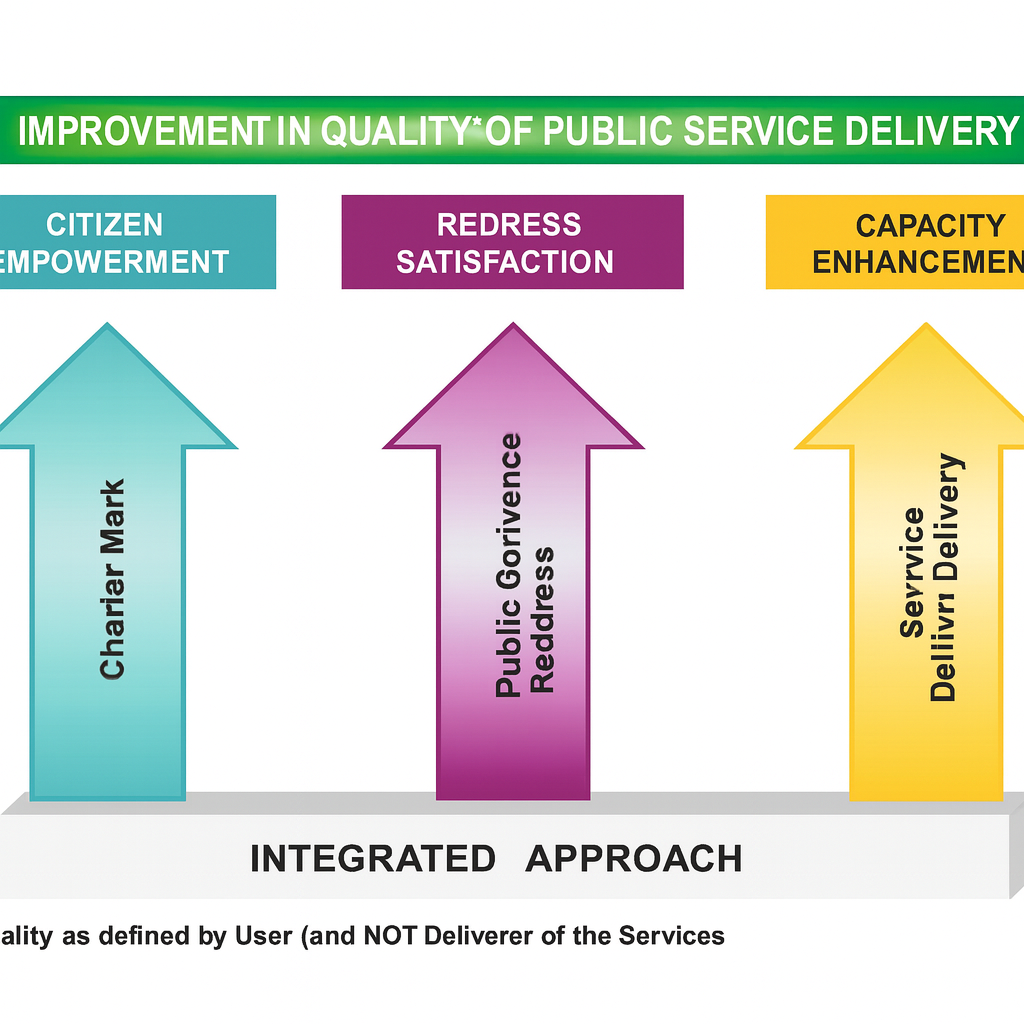
Integration with Grievance Systems – Link Charters with CPGRAMS and State Service Guarantee Acts for real-time grievance tracking.
Regular Review and Evaluation – Institutionalize annual audits and third-party evaluations to assess compliance and update service commitments.
Conduct public awareness campaigns and train officials under the Sevottam Framework for citizen-oriented delivery.
Technological Integration – Promote digital dashboards, online service tracking, and data-based performance monitoring.
Performance Incentives and Accountability – Introduce reward mechanisms for compliant departments and penalties for persistent failures.
By aligning it with the 2nd ARC recommendations, it can evolve from a symbolic commitment to a practical framework for responsive, transparent, and citizen-centric governance.