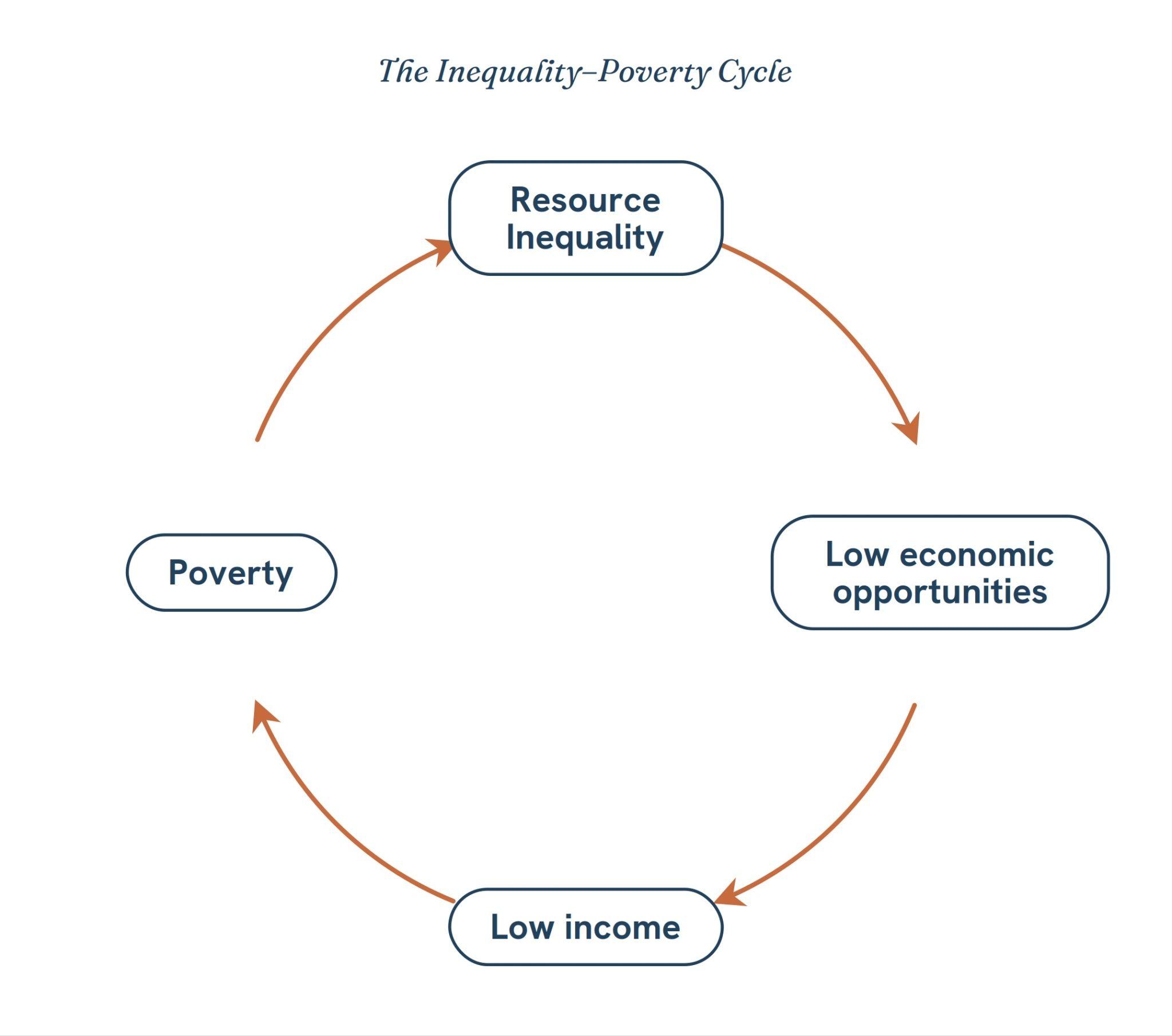
The “paradox of poverty” refers to the coexistence of abundant resources and persistent poverty. This paradox arises primarily due to inequality in the ownership and control of resources.
Paradox of poverty
Growth with Poverty – India is the 5th largest economy, yet 16.4% population lives in multidimensional poverty (NITI Aayog, 2023).
Urban Prosperity vs Slums – Cities contribute over 60% of GDP, but 65 million people live in urban slums.
Link Between Resource Inequality and Poverty
Land Ownership Inequality
According to NSSO 77th Round (2019), the top 10% of landowners control over 50% of agricultural land, while landless households form nearly 55% of the rural poor.
Small and marginal farmers face low productivity, credit exclusion, and income insecurity, perpetuating poverty.
Capital and Wealth Concentration
The Oxfam Inequality Report (2024) notes that the top 1% of Indians own over 40% of national wealth, while the bottom 50% own only 3%.
This leads to unequal access to investment, employment, and enterprise opportunities, reinforcing poverty among asset-poor households.
Unequal Access to Education and Skills – Poor families cannot invest in quality schooling, health, or digital access, resulting in low productivity and employability. This inequality in knowledge resources leads to income disparity.
Gender and Social Inequality
Only 13% of agricultural landholders in India are women (Agriculture Census 2021).
These groups remain disproportionately poor, illustrating how resource inequality and social hierarchy reinforce each other.
Regional Disparities
States rich in natural resources (e.g., Jharkhand, Odisha, Chhattisgarh) also show high poverty and low human development — a clear manifestation of the resource paradox.
Extraction without equitable sharing of benefits creates “resource curse” poverty.
Other Causes of Poverty
Colonial Legacy: deindustrialization of the economy and exploitation of agricultural resources. Eg- India’s GDP share fell from 24.4% in 1700 to 4.2% in 1950
Jobless Growth: Despite 7%+ GDP growth, unemployment among youth remains 17.3% (PLFS 2022-23).
Governance and Policy Failures due to high centralization, corruption, and overlapping. Eg- 30% of NREGA payments are delayed beyond the 15-day limit.
Populism rather than capacity building: Eg: Free Power Scheme in Punjab.
Polycrisis – multiple crises of slow economic growth, increased fragility, climate risks, and heightened uncertainty have come together at the same time. (WB)
Way Forward
Social Determinants Approach: Integrate health with nutrition, sanitation (Swachh Bharat), and clean energy (Ujjwala Yojana). Eg- Gati Shakti Mission Model
Expand MGNREGA and link with climate-resilient livelihoods (water conservation, afforestation).
Women Empowerment by adopting best practices like Kerala’s Kudumbshree Model
Adopt data-driven local interventions under Aspirational Districts Programme to target high-burden regions.
Adopt Brazil’s Bolsa Família conditional cash transfer scheme
Land and Asset Redistribution: Promote tenancy rights and women’s joint land ownership.
Inclusive Financial Access: Strengthen PM Jan Dhan-Aadhaar-Mobile (JAM) and MUDRA loans for micro-entrepreneurs.
As Amartya Sen observed, poverty is not merely lack of income but lack of capabilities. Bridging resource inequality is key to achieving inclusive growth and social justice (Article 39 (b) & (c)).
International Relations