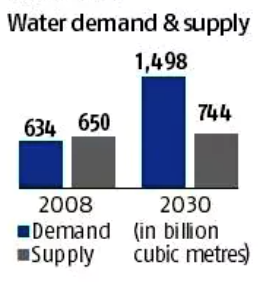
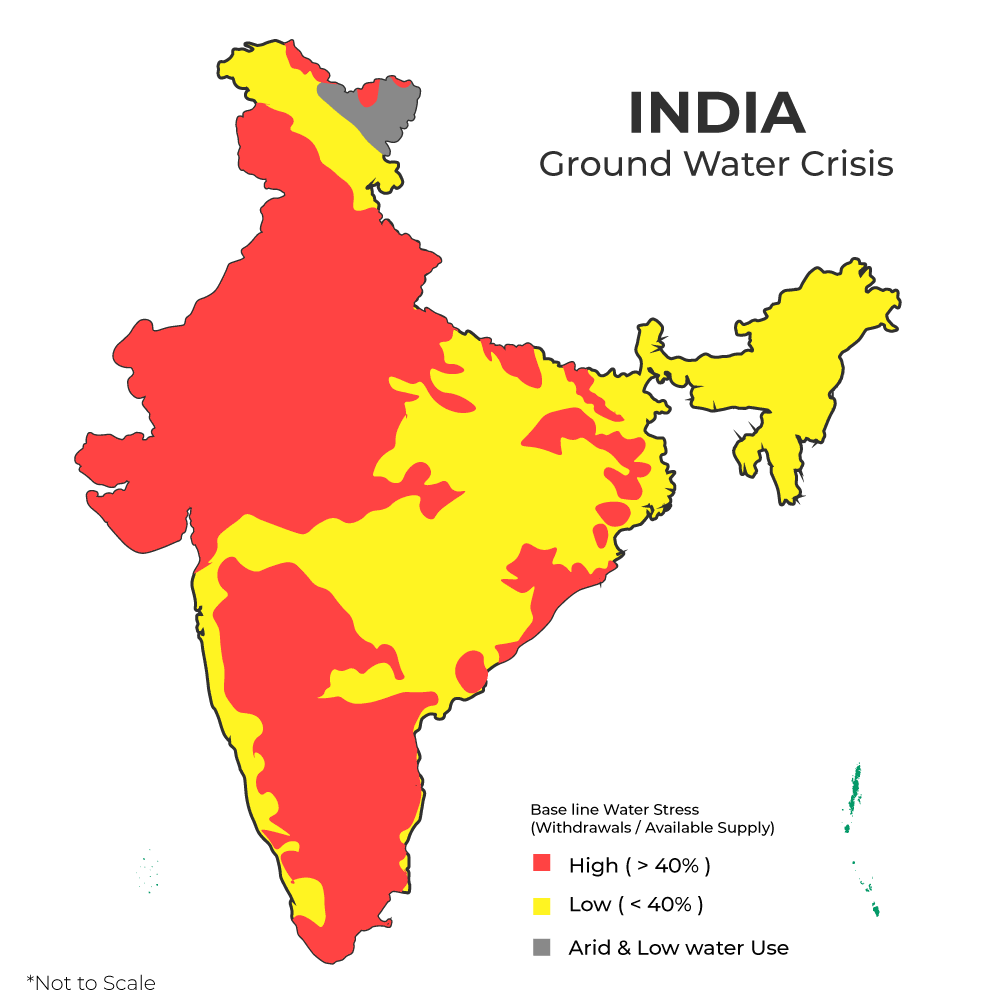
India’s groundwater is under severe stress due to rising demand and supply mismatch, threatening food security, rural livelihoods, and urban water supply. India is world’s largest groundwater extractor (25%).
According to a CSIR-NGRI study, north India has been experiencing rapid groundwater depletion exceeding 1.5 cm per year, resulting in net loss of 450 km³ between 2002 and 2021.
Factors Responsible for Depleting Groundwater in India
Fertilizer and Pesticide Runoff from agriculture – 56% of India’s districts have nitrates beyond the safe limit of 45 mg/L in their groundwater.
Energy Subsidies encouraging excess pumping and inefficient irrigation. Eg- in Punjab and Haryana
Unplanned urbanisation – Concrete surfaces prevent percolation and increase run-off. Eg – Chennai has lost 85% of its wetlands (WWF)
Population Growth – Between 2016 and 2023, India’s population increased from 1.29 billion to 1.45 billion – increase demand
Climate change and erratic monsoons reduce natural recharge of aquifers. IMD data shows a 10% long-term decline in monsoon rainfall in northwest India.
Poor water governance (Mihir Shah Committee report) – Eg – CGWB reports show over-exploited blocks increasing from 802 (2004) to >1,000 (2023).
Outdated legal framework – Eg- colonial-era Indian Easements Act of 1882 grants landowners the natural right to extract unlimited groundwater beneath their property.
Unregulated industrial discharges and untreated urban wastewater – Eg- chromium and mercury contamination in Kanpur’s industrial areas
Unsustainable Mining Activities lead to heavy metal contamination and aquifer depletion. Eg- Uranium and fluoride seepage in Rajasthan and Karnataka
Saline water intrusion into coastal aquifers due to over-pumping and rising sea levels.
Jal Shakti Abhiyan (Catch the Rain) – focuses on rainwater harvesting and water conservation through the convergence of various schemes.
AMRUT 2.0: supports rainwater harvesting in urban areas through ‘Aquifer Management Plans.’
Atal Bhujal Yojana (2020): targets water-stressed Gram Panchayats in 80 districts across 7 states.
Bureau of Water Use Efficiency – promotes water use efficiency in irrigation, drinking water supply, power generation, and industries.
National Aquifer Mapping by the Central Ground Water Board for conservation planning.
Watershed Development Component of PMKSY : focuses on rainfed and degraded lands, integrating activities like soil conservation, rainwater harvesting, and livelihoods development.
PMKSY – Per Drop More Crop – Promotion of micro-irrigation (drip/sprinkler) with subsidies to improve water-use efficiency in agriculture.
Way Forward
Demand-Side Management – Use financial incentives to promote efficient water use. Eg – Punjab’s Paani Bachao, Paisa Kamao
Supply-Side Augmentation by combining traditional and modern methods.
RWH mandatory under Model Building Bye Laws 2016
Khadins, check dams, percolation tanks, injection wells.
Integrated Water Management – Strengthen community-led, data-driven groundwater governance.
Use of technology – Eg- Biochar for Aquifer Recharge
Adopting global best practices
Tokyo’s Industrial Water Law and Building Water Law
China’s irrigation quotas
Adopting One Water Approach through National Water Commission (NWC) is essential to achieve a water-secure economy.