“Your right is to work only, but never to its fruits.” – Bhagavad Gita
The statement reflects the idea of Karma-Yoga – that sincere devotion to one’s duty leads to both moral excellence and inner fulfilment. For a civil servant, devotion to duty converts power into service.
Devotion to Duty leading to Sense of Responsibility
For a civil servant, duty is not just a job description, it is a moral contract with the sovereign the people. (Trusteeship principle)
Devotion ensures that the officer is upholding Constitutional Morality even under political pressure.
Professional Integrity- It manifests as doing the right thing when no one is watching. Eg- Satyendra Dubey
Accountability to the “Last Person”- A devoted officer views themselves as answerable to the most marginalized. Eg- Dr. Rajendra Bharud (IAS) – oxygen plants in tribal Nandurbar district.
Impartiality in Crisis- Devotion prevents personal biases from clouding administrative judgment.
Resource Stewardship- Eg- E. Sreedharan completed Metro projects under budget and ahead of time.
Compassionate Regulation- Balancing the “letter of the law” with the “spirit of justice.” Eg- delaying the demolition of encroachment until finalization of the rehabilitation plan.
Crisis Leadership- Eg- Krishna Teja (IAS) coordinated evacuation of over 2.5 lakh people during Kerala floods
Acts as a Internal moral compass ensuring accountability to conscience. Eg – Satish Dhawan taking responsibility for ISRO failure.
Devotion to Duty leading to Personal Fulfilment
Personal fulfilment in civil service comes from the alignment of one’s “inner conscience” with “outer action.”
Self-Actualization- Finding the highest version of oneself through service.
Emotional Intelligence- Developing a sense of “Wholeness” by connecting with the suffering and joy of the public.
The “Flow” State- Becoming so absorbed in problem-solving that work stops being stressful and becomes meditative.
Legacy Building- S.R. Sankaran – “an ideal people’s IAS officer” remained unmarried for service of nation
Inner Peace- knowing there is no gap between what you believe and what you do.
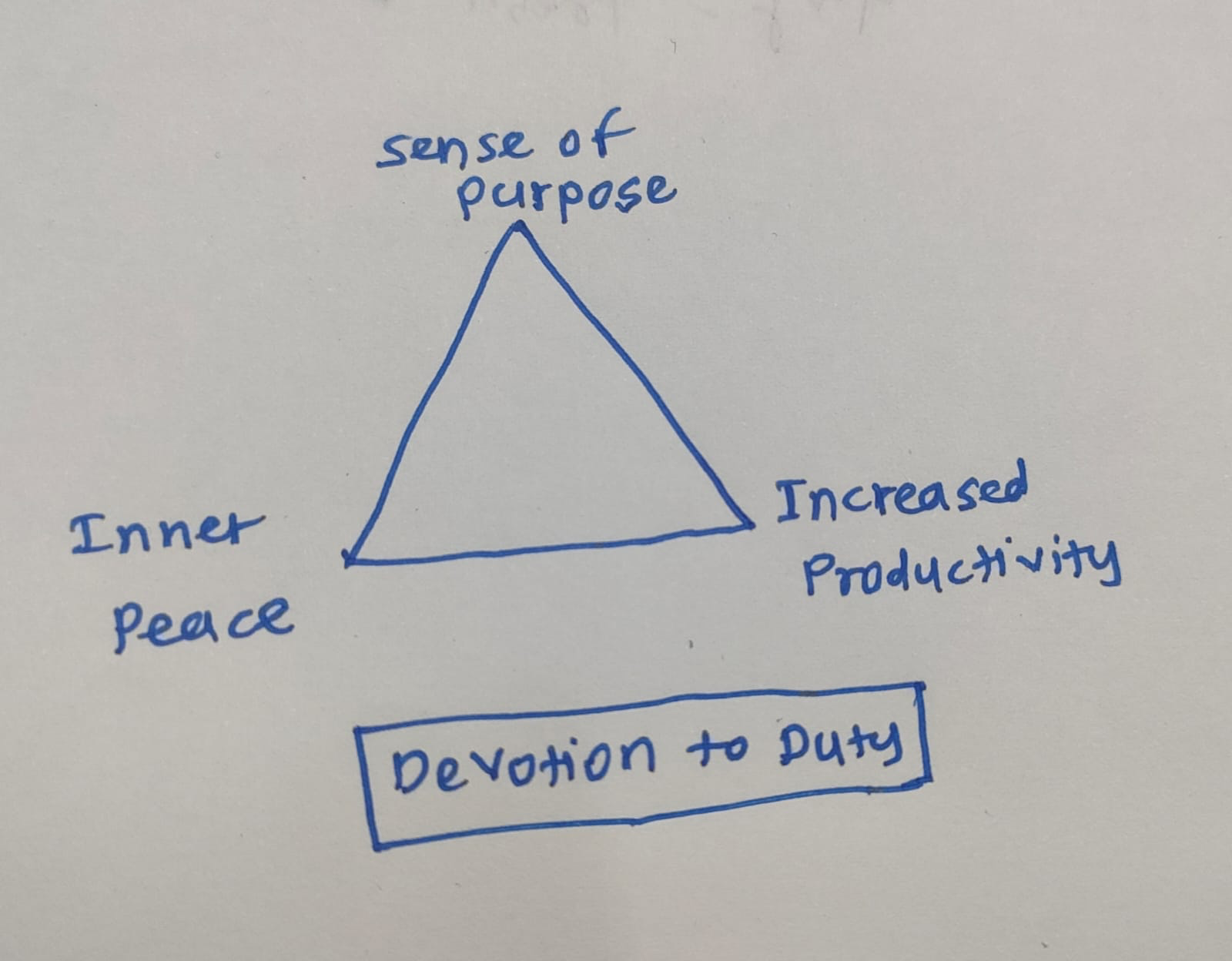
Resilience- Devotion provides the “buffer” against the frustrations of transfers or political interference.
A Clear Conscience- The ability to sleep peacefully, knowing one has not been a party to injustice
Transcendence- Moving beyond the “ego” (the I, Me, Mine) to a larger identity (The State, The People).
Institution building by prioritizing long-term public interest over short-term gain. Eg- Verghese Kurien building AMUL.
Devotion to Duty leading to Highest Perfection
“Highest Perfection” is the state where the administrator becomes an “Ethical Titan”
Sense of responsibility and fulfillment leads to unity of thought, word, and deed – a state of perfection. Eg- Mahatma Gandhi
Achieves Equanimity (Samatvam)- Remaining calm in both praise and blame, success and failure
Becoming a “Living Institution”- When the individual’s name becomes synonymous with the values of the office.
“To find yourself, lose yourself in the service of others.” – Mahatma Gandhi.
Devotion to duty is the “alchemy” that turns a bureaucrat into a public servant.