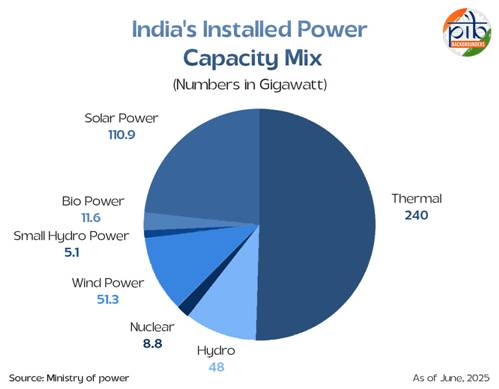
Nuclear energy contributes approximately 3.1% to India’s total electricity generation, with an installed capacity of 8,880 MW.
Evolution of Fusion Energy Programme in India
The Early Phase (1950s-1980s): India was one of the first countries to announce a national fusion programme at the 1955 Geneva Conference.
Indigenous Technology (1980s-2000s):
Establishment of the Institute for Plasma Research (IPR) in 1986.
Built its first indigenous tokamak ADITYA in 1989.
Followed by the SST-1 (Steady-State Superconducting Tokamak)
Global Integration (2005-Present): India joined ITER in 2005 as a full partner. Today, ITER-India manages India’s commitments, involving major industrial players like L&T and BHEL.
India’s Contributions to ITER
India is responsible for 9.1% of the construction cost (approx. $2.2 billion)
The Cryostat: high-vacuum pressure chamber (30m*30m), designed to insulate the ultra-hot plasma from the outside world.
In-Wall Shielding: India supplied 4,500 blocks of borated and ferritic steel to protect the reactor from neutron radiation.
Cooling Water Systems: Responsible for the complex heat rejection systems required to manage the thermal load.
Cryolines: Development of specialized pipelines to transport liquid helium at -269°C.
Implications of Success for Future Global Energy
Unlimited Fuel Supply: Fusion uses Deuterium (from seawater) and Tritium (from Lithium). One liter of seawater provides energy equivalent to 300 liters of gasoline.
Unlike solar/wind, fusion provides a constant power supply without $CO_2$ emissions, vital for the Global Net Zero goals.
Inherent Safety: There is no risk of a “meltdown.” If the plasma is disturbed, the reaction simply ceases instantly.
Minimal Waste: It produces no long-lived high-level radioactive waste as plant components can be recycled within 100 years.
High Energy Density: A fusion plant requires significantly less land than a solar farm to produce the same Terawatt-hours of energy.
Geopolitical Stability: Energy “resource wars” could end, as the fuel (Deuterium/Lithium) is distributed globally, unlike oil or gas.
Space Exploration: Compact fusion technology could revolutionize deep-space travel by providing high-thrust, long-duration propulsion.
Technological Spin-offs: Research for ITER has already advanced superconducting magnets (used in MRIs) and high-power microwave technologies.
Thus, fusion technology can help in transitioning from the Age of Combustion to the Age of Fusion.