While extreme poverty fell to 2.35% (World Bank, 2024), undernourishment (12%) and child wasting (18.7%) persist (SOFI 2025).
Growing Divergence between Poverty and Hunger
Decline in Monetary Poverty: About 24.82 crore individuals escaped multidimensional poverty in the last 9 years. (NITI Aayog)
Persistence of Hunger and Malnutrition:
Despite surplus food production, India’s GHI score (25.8) remains in the “serious” category.
Indicators such as stunting (32.9%), wasting (18.7%), and anemia (57% women) reveal continued deprivation.
Shift from Absolute Hunger to Hidden Hunger: 57% of women and 67% of children are anemic
Shrinking of Social Expenditure by the Government
Education expenditure: ~2.9% of GDP (NEP recommendation 2020).
Decline in allocation for MGNREGA
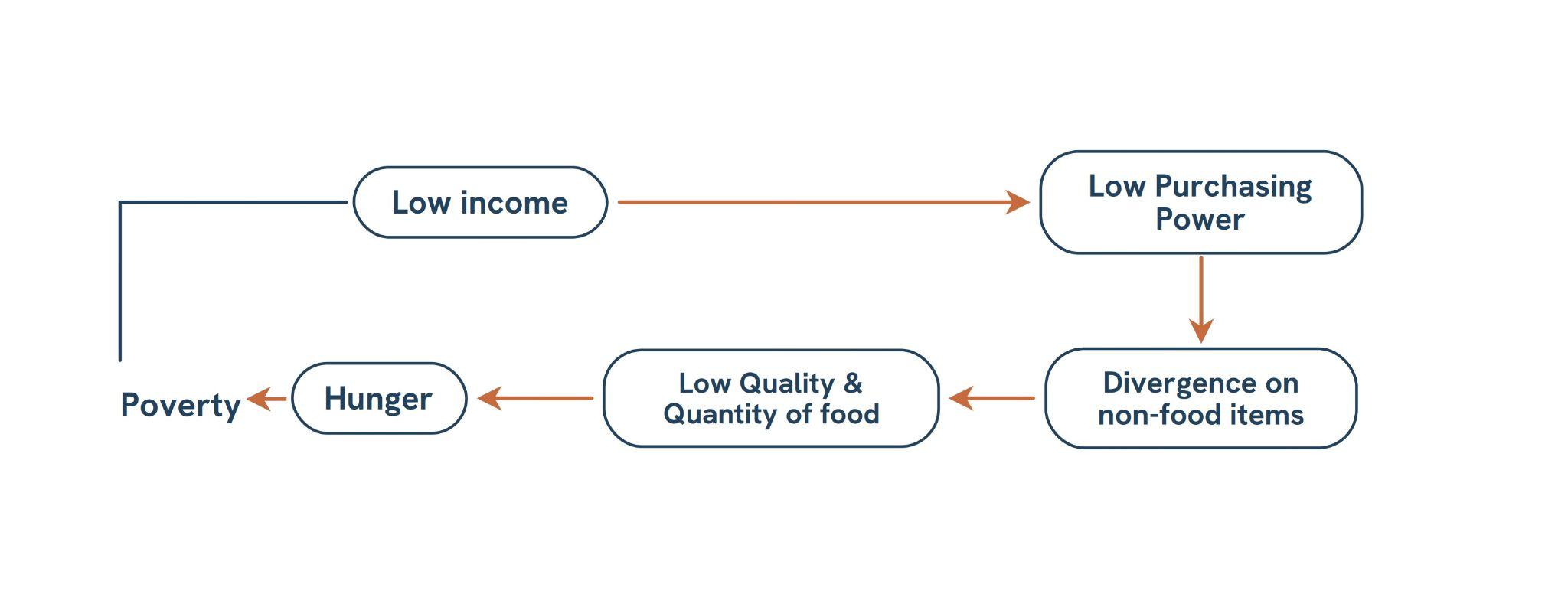
Impact on Poor Households:
Health: Out-of-pocket health spending forms 40% of total health expenditure (NHA 2023).
Indian Middle class is 1 Hospital Bill Away from poverty
Education: Rising private tuition and school costs strain household budgets.
Learning poverty – Over 70% of Class 3 students cannot read age-appropriate texts (ASER 2025)
Utilities and fuel: Increasing electricity, rent, and LPG costs raise non-food spending.
Proliferation of slums – 17% urban population living in slums
Way Forward
Social Determinants Approach: Integration of hunger and poverty with nutrition, sanitation (Swachh Bharat), and clean energy (Ujjwala Yojana).
Nutrition-Sensitive Policies: Diversify PDS with millets, pulses, fortified foods, and region-specific nutrition interventions.
Adopt data-driven local interventions under Aspirational Districts Programme to target high-burden regions.
Adopt Brazil’s Bolsa Família conditional cash transfer scheme
Scale State level best practices like TN’s inclusion of Eggs in MDM
This can help achieve SDG 1, 2 and realise Atmanirbhar Bharat.