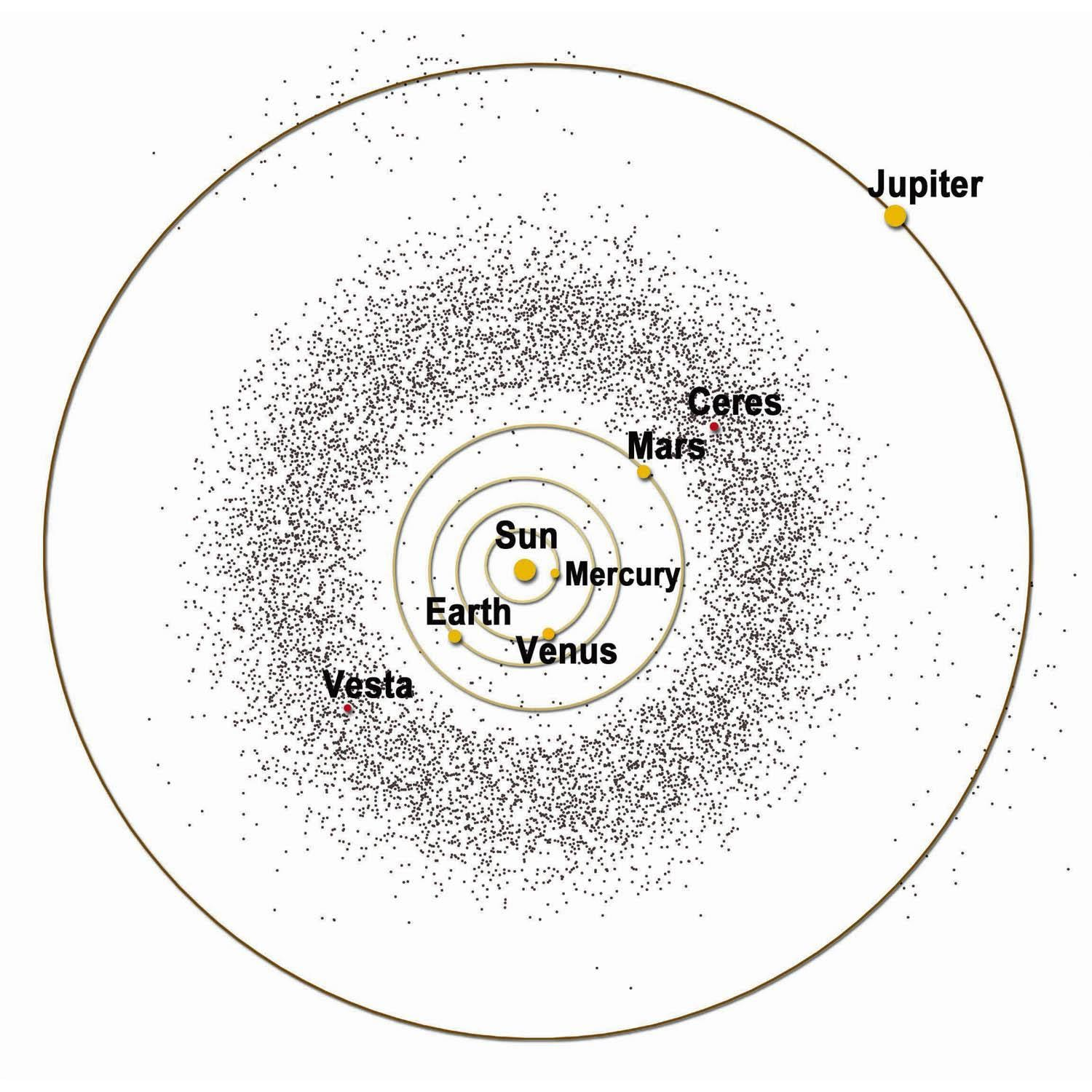
Asteroids are rocky, airless remnants from the early formation of the solar system, primarily orbiting the Sun between Mars and Jupiter (asteroid belt). Some asteroids, known as Near-Earth Objects (NEOs), have orbits that bring them close to Earth, raising concerns about impact hazards.
Key facts about asteroids
Types –
C-type (carbonaceous, most common)
S-type (silicaceous)
M-type (metal-rich)
The total mass of all the asteroids combined is less than that of Earth’s Moon.
Threat from asteroids
Historical Evidence – The Chicxulub asteroid impact (~66 million years ago) led to the extinction of dinosaurs.
Probability Assessment
Extinction-level asteroids (>10 km) are extremely rare
City or regional-scale impacts (50-300 m) are more frequent and pose serious human and economic risks.
Current Scientific Consensus
Low probability, high impact risk.
No known large asteroid is on a confirmed collision course with Earth in the foreseeable future.
No global policy framework or convention to prevent asteroid impact
Strategies Developed to Prevent or Mitigate Asteroid Impact
Detection and Tracking – Ground- and space-based surveys continuously monitor NEOs.
Kinetic Impact Deflection – A spacecraft collides with the asteroid to slightly alter its trajectory. Demonstrated successfully by NASA’s DART mission (2022).
Gravity Tractor – A spacecraft hovers near the asteroid, using mutual gravitational attraction to gradually change its path.
Nuclear Deflection (Last Resort) – Use of a nuclear device near (not on) the asteroid to vaporise surface material.
NASA’s Jet Propulsion Laboratory, accurately characterizes the orbits of all known near-Earth objects, predicts their close approaches with Earth
The International Asteroid Warning Network (IAWN) – UN-endorsed, global collaboration of over 60 scientific institutions that detects, tracks, and characterizes Near-Earth Objects (NEOs).
United Nations Committee on the Peaceful Uses of Outer Space (COPUOS) has recognised asteroid impact hazards as a global risk transcending national boundaries.
While extinction-level impacts are extremely rare, the consequences would be catastrophic, justifying sustained vigilance.