An aurora is a natural luminous phenomenon seen in high-latitude skies, caused by the interaction between charged particles from the Sun and Earth’s upper atmosphere, producing dynamic light displays in various colors.
Aurora Australis (Southern Lights)
Occurs in the Southern Hemisphere – Visible near the Antarctic Circle.
Observed in countries like – Antarctica, Tasmania (Australia), New Zealand, and the southern tip of Argentina.
Forms luminous arcs and curtains – Green, red, purple colors dominate.
Best viewed during the Southern Hemisphere’s winter (May to September) due to the long hours of darkness.
Aurora Borealis (Northern Lights)
Occurs in the Northern Hemisphere – Visible near the Arctic Circle.
Observed in countries like – Norway, Sweden, Finland, Canada, Alaska.
Displays dynamic wave-like patterns – Curtains, spirals, and arcs.
March and September equinoxes are peak viewing times due to the Russell-McPherron effect, which allows solar energy to enter the atmosphere more easily.
Triggers of Auroras
Solar Activity
The Sun’s corona constantly releases a stream of protons and electrons at speeds up to 900 km/s.
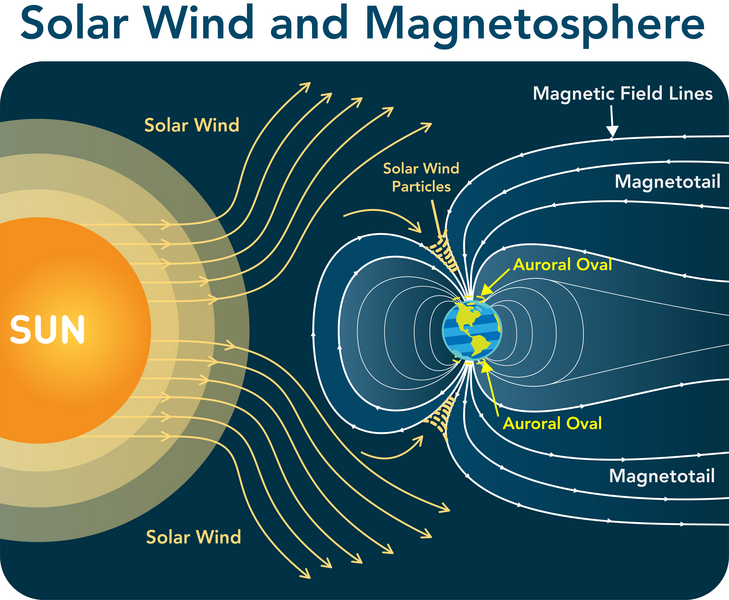
These particles hit the Magnetosphere (Earth’s magnetic shield), which deflects most of them.
Magnetic lines guide particles poleward as Earth’s magnetic field lines are weakest and more vertical at the North and South Poles.
Acceleration (Birkeland Currents)- Particles gain speed as they spiral down the field lines toward the Ionosphere.
Atmospheric Collision- Charged particles collide with gas atoms (Oxygen and Nitrogen) in the Thermosphere (approx. 100km-400km up).
The collision transfers energy to the gas atoms, moving their electrons to a higher-energy state.
These atoms release that energy as a photon (a packet of light).
Color Differentiation- Oxygen produces green and red, Nitrogen produces blue or purple light.
They illustrate the protective role of the magnetosphere while producing one of the most visually stunning atmospheric phenomena.