According to a report by TERI, India generates 62 million tonnes (MT) of waste annually. Only 43 MT of total waste gets collected and 12 MT treated before disposal.
Impediments in Disposing Huge Quantities of Solid Waste
Rapid Urbanisation – Cities generate waste faster than civic bodies can manage. Eg – Cities produce 160,000+ tonnes/day of solid waste.
Inadequate Segregation at Source – makes recycling and composting inefficient.
Limited Treatment & Processing Capacity – Only 50% of the waste produced is actually processed in India. (CPCB)
Dumping in Landfills – Eg – Ghazipur and Deonar operate beyond capacity.
Dominance of Informal Sector – Eg- 80% of plastic collection relies on the informal sector – lack safety mechanisms
Poor compliance with Solid Waste Management Rules, 2016. Eg – Many ULBs still rely on open dumping.
Lack of data transparency – Eg- according to the official estimates, plastic waste generation rate in India is 0.12 kg/capita/day, while as per ‘Nature’ , it is 0.54 kg/capita/day.
Limited capacity of ULB’s – Lack 3Fs and functional overlap with parastatal bodies
Inadequate Infrastructure for waste collection, segregation, transportation, processing, and disposal.
Lack of Interagency co-ordination – Eg- MoEFCC develop rules and guidelines while the Ministry of Housing and Urban Affairs oversees ground-level enforcement
Safe Removal of Toxic Wastes from the Environment
Technology adoption – Eg – Biomedical waste treated using controlled incinerators.
Smart Waste Management System using AI, IoT. Eg- RFID-enabled door-to-door waste collection monitoring
Promoting circular economy based on 6R principle – Refuse, Rethink, Reduce, Reuse, Repair, and Recycle
Promoting Composting, vermicomposting and bio-methanation for treating organic waste.
Enhanced Public-Private Partnerships – Eg- contractual arrangement with the private sector for setting up compost plants.
Decentralised Waste Processing – Eg- Micro-Composting Centres (MCC) with 5 TPD capacity for wet waste.
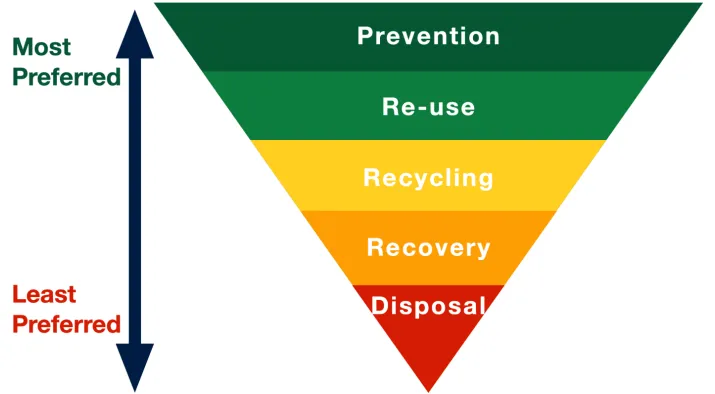
Adopting Waste Hierarchy principle
Strict implementation of ‘Polluter Pays Principle‘, to penalize non-compliance and shift towards ‘Government Pays Principle’
Efficient waste management is not just a regulatory obligation but a constitutional imperative to safeguard the fundamental rights of citizens.