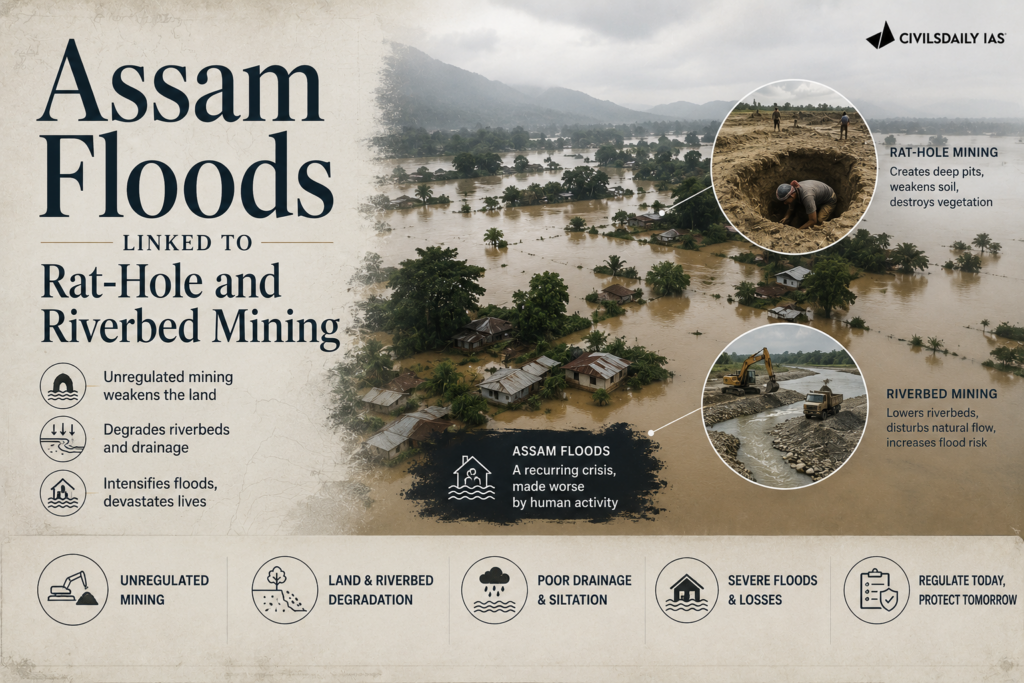
Why in the News
Localised floods in Sivasagar, Charaideo and Jorhat districts of Assam have drawn attention to the role of rat-hole coal mining and riverbed mining in altering local drainage and aggravating flood impacts.
What is Rat-Hole Mining?
- Method: A hazardous form of coal extraction through narrow horizontal tunnels, often too small for mechanised mining.
- Region: Historically prevalent in Meghalaya and other parts of Northeast India.
- NGT Ban: The National Green Tribunal (NGT) banned rat-hole coal mining in Meghalaya in 2014, citing environmental degradation and safety concerns.
- Environmental impact: Unregulated mining can disturb soil, drainage channels and river systems.
How Can Mining Aggravate Floods?
- Altered drainage: Mining and riverbed extraction can modify natural water-flow pathways.
- Siltation: Mining activities can increase sediment entering waterways, reducing effective channel capacity.
- Loss of natural buffers: Landscape disturbance can reduce the ability of terrain to absorb and retain water.
- Compounded disaster: Heavy rainfall combined with degraded drainage can intensify flooding and displacement.
Governance Issue
- NGT ban → weak enforcement → continued illegal mining → environmental degradation → greater disaster vulnerability
[2018] Which of the following is/are the possible consequence/s of heavy sand mining in riverbeds ?
1. Decreased salinity in the river
2.Pollution of groundwater
3.Lowering of the water-table
Select the correct answer using the code given below :
(a) 1 only
(b) 2 and 3 only
(c) 1 and 3 only
(d) 1, 2 and 3
