Why in the News
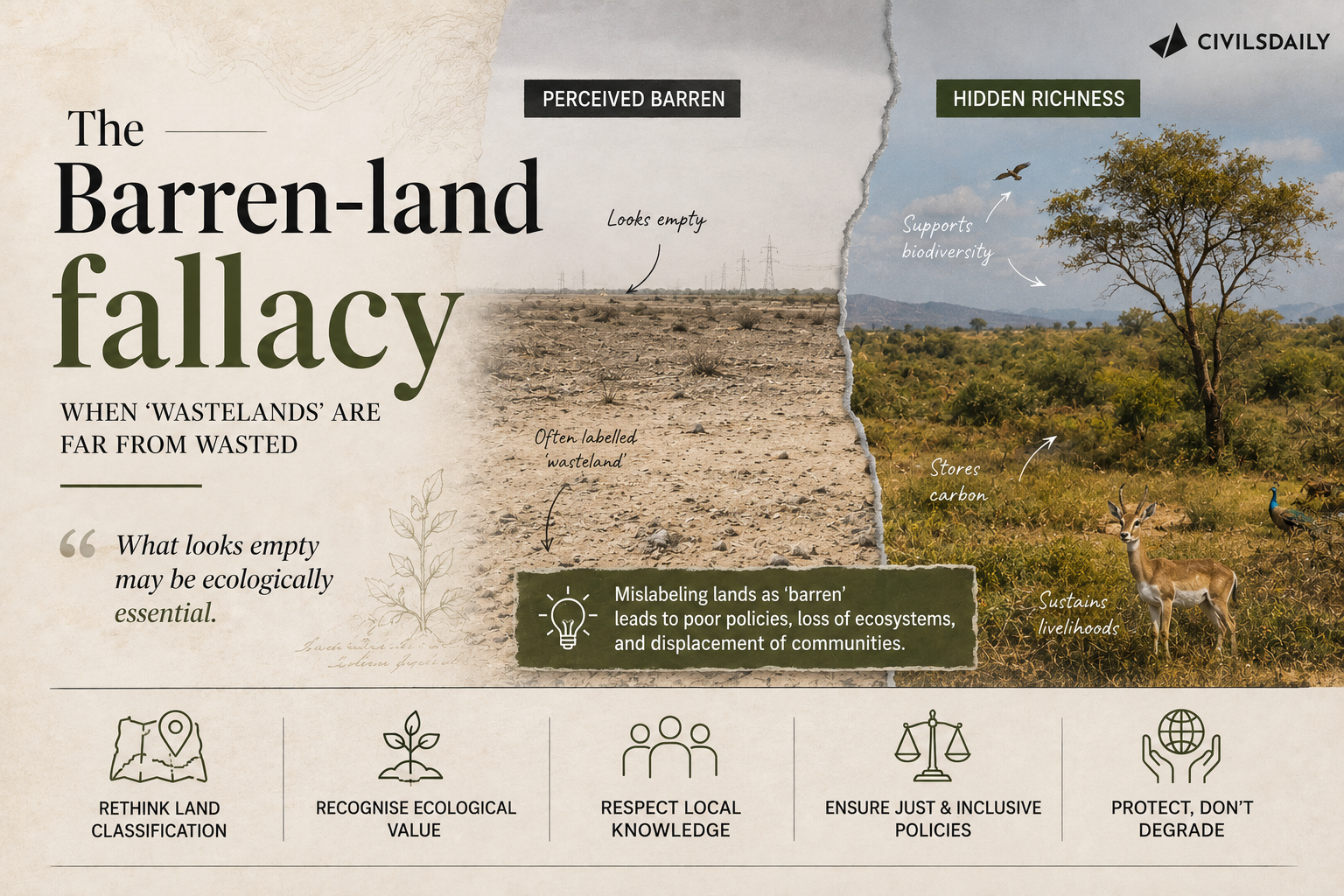
The barren-land fallacy is the assumption that land without tree cover is barren land, therefore ecologically deficient, and that it will evolve or should be helped to evolve into a forest. Tree-planting drives in India often perpetuate this fallacy by planting trees in the wrong ecosystems, and by planting species unsuited to local conditions. Trees deliver cooling, soil retention, carbon storage and habitat only where they belong ecologically, and outside that setting they cause harm. Ecological restoration therefore does not always mean planting more trees, and the assumption that it does drives programmes that damage the ecosystems they claim to repair.
What is the barren-land fallacy?
- The assumption in full: Land that does not carry tree cover is treated as barren, and barren land is in turn treated as ecologically deficient.
- The second step in the chain: Such land is then assumed to evolve, or to require help to evolve, into a forest, so absence of trees is read as an incomplete stage rather than a stable state.
- Where it becomes policy: The fallacy enters practice through tree-planting drives that select land for planting on the basis of missing tree cover rather than on the basis of what ecosystem the site naturally supports.
What do trees actually do, and when do those benefits hold?
- Local cooling: Trees lower air and surface temperature in the neighbourhood in which they stand, through shade and through the water they release into the air.
- Soil retention: Root systems hold soil in place and slow the runoff that strips it, which is why tree cover reduces erosion on slopes and along stream banks.
- Carbon drawdown and storage: Trees take carbon dioxide from the air and lock the carbon into wood and soil, which is the basis of the climate value claimed for planting.
- Habitat provision: A stand of trees supports birds, small animals and insects that depend on canopy, bark and leaf litter for nesting and for food.
- The benefits are conditional, not automatic: Each of these effects holds only where a forest is the ecosystem the site naturally supports. Planted outside it, the same trees do damage.
How do India’s tree-planting drives reproduce the fallacy?
- Planting in the wrong ecosystem: Drives place trees on land where a forest is not the native ecosystem, so the planting displaces the system that belongs there rather than restoring one.
- Species unsuited to local conditions: Drives often plant trees unsuitable for the site, such as eucalyptus, which draws a great deal of water, in a water-stressed area.
- Offsets substitute for restoration: Compensatory afforestation is treated as an equivalent to the forest cleared, and plantations cannot replace natural forests in biodiversity terms.
- Counting favours planting over ecosystem type: Programme performance is measured in area planted and saplings established, which gives no credit for protecting a grassland or a scrubland in place.
- Invasive species compound the damage: Species introduced to green open land spread beyond the planting site and suppress native ground cover. Prosopis juliflora has spread across Rajasthan, degrading grasslands.
What counts as ecological restoration instead?
- The correct objective: To ecologically restore a place does not always mean planting more trees. It is to do whatever will protect or restore the ecosystem that would naturally occur there.
- When planting is the right answer: Planting trees or regenerating forests is valuable where forests have been degraded or cleared, and where a forest is the native ecosystem.
- Forests are one ecosystem among several: Others include grasslands, savannah, scrubland, wetlands and deserts, along with many naturally open ecosystems.
- The dryland assumption has a documented cost: A University of California professor of history and geography has written that the assumption that the world’s drylands are worthless, deforested and overgrazed landscapes has led to programmes and policies that have often systematically damaged dryland environments.
- The semi-desert is not a failed forest: The Sahel region in Mali is a semi-desert landscape, and treating such a landscape as degraded forest misidentifies both its baseline and its restoration target.
Challenges to restoring India’s open natural ecosystems
- Open ecosystems have no protective legal category: Grasslands, savannahs and scrublands are classified as wasteland or revenue land in official records, so they can be allotted for planting or development without a diversion clearance. Eg. India’s grassland area has declined 31 per cent, from 18 million hectares to 12.3 million hectares. Fix. Create a distinct notified category for open natural ecosystems in land records, with diversion requiring the same clearance a forest diversion needs.
- Restoration targets are stated in tree cover: National and international commitments are measured in hectares brought under tree and forest cover, which makes planting the only countable action. Eg. India’s Bonn Challenge pledge is stated as restoring 26 million hectares by 2030. Fix. Report restoration by ecosystem type against a mapped reference state, so a restored grassland counts as much as a planted hectare.
- Species selection ignores water budgets: Fast growing exotics are chosen for survival rates rather than for their draw on local groundwater. Eg. Eucalyptus plantations in water-stressed districts lower the water table they depend on. Fix. Make a site water balance assessment a precondition to species approval in any planting programme.
- Open ecosystem species lose habitat to greening: Ground nesting and open country species need the absence of tall vegetation, so planting removes their habitat directly. Eg. Grassland conversion has driven the decline of the Great Indian Bustard and the Lesser Florican. Fix. Map and exclude critical open country species habitat from all afforestation and green cover programmes.
- Baseline ecosystem maps do not exist at working scale: Without a map of what ecosystem a site naturally supports, the planting decision defaults to the presence or absence of trees. Eg. Desertification assessment records 105.48 million hectares as degraded without separating naturally open land from degraded forest. Fix. Publish a national reference ecosystem map at the level of the revenue village, and tie every restoration sanction to it.
Conclusion
The barren-land fallacy treats absence of tree cover as a deficiency to be corrected, and the correction damages ecosystems that were never forests. Restoration means returning a site to the ecosystem that would naturally occur there, which in a grassland, a scrubland or a desert means protecting openness rather than closing it with canopy. The immediate consequence is that a planting drive on the wrong site is a conversion, not a restoration. Whether India’s restoration accounting can measure ecosystem type rather than tree cover is what determines if the fallacy continues to be funded.
“[2015] Which one of the following is the best description of the term ‘ecosystem’?
(a) A community of organisms interacting with one another
(b) That part of the Earth which is inhabited by living organisms
(c) A community of organisms together with the environment in which they live
(d) The flora and fauna of a geographical area
