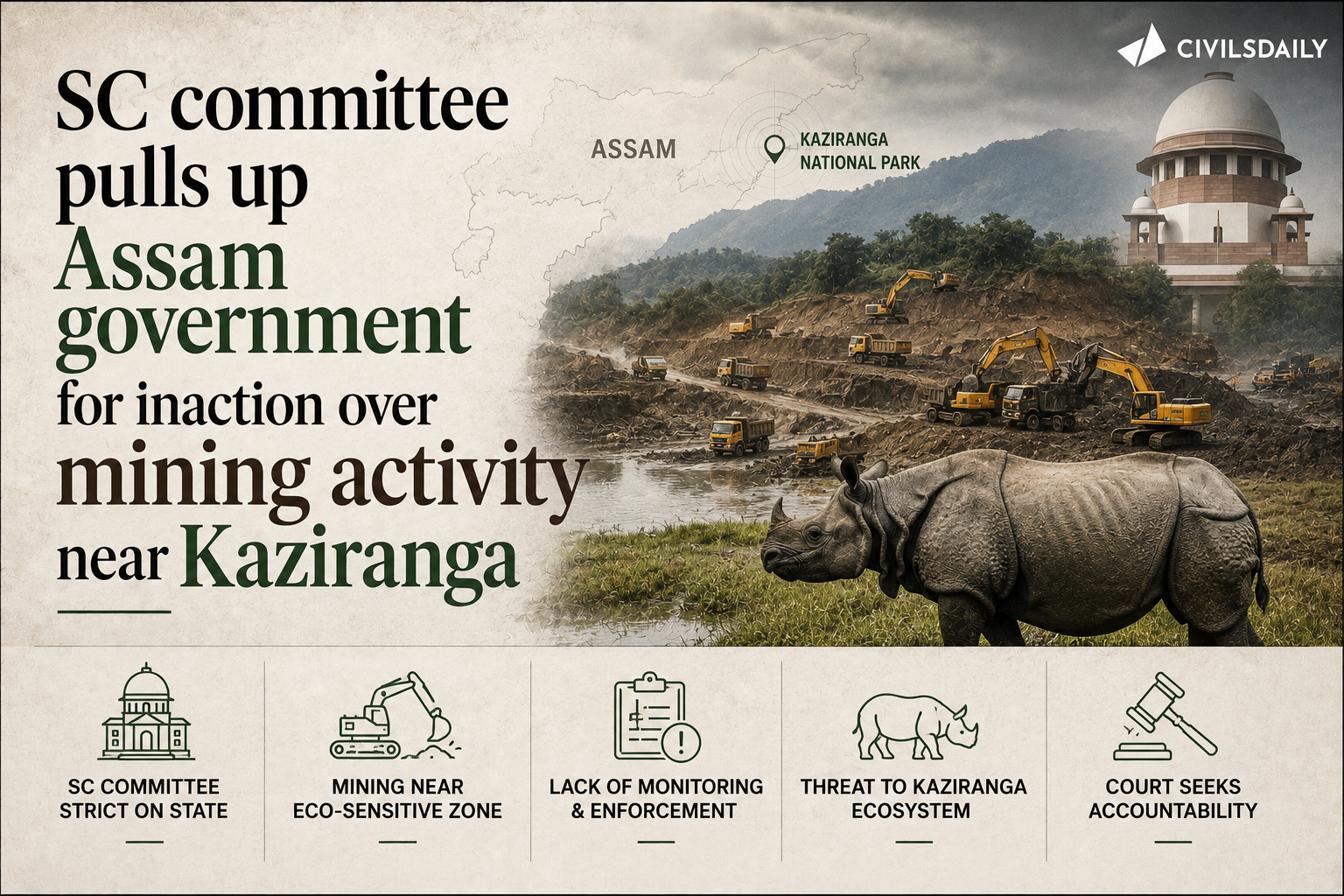
Why in the News
The Central Empowered Committee (CEC), a body constituted by the Supreme Court to monitor compliance with its forest and wildlife orders, has held that the Assam government did not address mining in and around the Parkup Pahar Range with the seriousness it deserved. The Range is a declared wildlife sanctuary and a vital ecological corridor on the southern boundary of Kaziranga National Park. The finding follows the CEC’s own directions of 30 May 2025 to the Assam Chief Secretary, which required a comprehensive Watershed Drainage Analysis Report and quarterly status reports on action against reported violations. The Supreme Court had already restrained all mining along Kaziranga’s southern boundary by an order of 12 April 2019. The committee’s finding lands amid a separate controversy over a plan to reduce the Eco-Sensitive Zone of Kaziranga National Park, so the State is seeking a narrower buffer while existing court-ordered protections remain unimplemented.
What is the Central Empowered Committee?
- A court appointed compliance body: The CEC was constituted by the Supreme Court to monitor and report on compliance with its orders in forest and wildlife matters, and to examine applications referred to it.
- What it produces: It examines complaints and applications, calls for records from State governments, and files reports and recommendations to the Supreme Court on which the Court then acts.
- How its directions reach a State: It writes directly to the State Chief Secretary with timelines and required submissions, and treats the absence of a submission as a compliance failure to be reported.
What did the Right to Information trail reveal?
- The application: A Right to Information (RTI) application was filed on 15 June by an environmental activist, seeking details of compliance with those directions.
- What was sought: It asked for copies of both submissions the directions had required of the State.
- The core document is missing: The CEC’s response of 17 July stated that it did not receive the comprehensive Watershed Drainage Analysis Report.
- Partial compliance only: The response said the quarterly status reports had been attached, and it does not show that the watershed exercise the CEC ordered was completed.
- The deadline had already passed: The CEC had fixed October 2025 as the deadline for submitting the watershed report.
What does the earlier record show?
- The originating proceeding: The CEC recorded allegations of renewed mining in Parkup Pahar in the same report that carried those directions, filed on “Application No.1592 of 2024”.
- The standing court order: The Supreme Court’s order of 12 April 2019 restrained all mining and related activities along the southern boundary of Kaziranga, and throughout the catchments of rivers and streams originating in the Karbi Anglong hills and flowing into the park.
- The construction bar: The same order prohibited new construction on private lands forming part of nine identified animal corridors.
- Mining continued regardless: On 3 March the CEC wrote to the Assam Chief Secretary noting that mining and related activities had been going on “in some way on one pretext or the other”.
- The local authority’s conduct: The same letter recorded that the Karbi Anglong Autonomous Council (KAAC) was not presenting a holistic picture to the courts. The KAAC administers Karbi Anglong, the district that forms Kaziranga’s southern boundary.
- A six year old request remains unanswered: The CEC’s letter of 6 May 2021 specifically asked the State government to communicate the action taken to notify the animal corridors connecting the park, and no response was received. The catchment areas of the streams and rivers originating in the Karbi Anglong hills remain unidentified after more than six years.
Why does the elephant reserve finding matter?
- The area is doubly protected: The Parkup Pahar Range is both a declared wildlife sanctuary and a vital ecological corridor linking the park to the Karbi Anglong hills.
- The reserve covers both landscapes: The Karbi Anglong Elephant Reserve covers Karbi Anglong and Kaziranga National Park, so the mining sits inside a notified elephant reserve rather than beside one.
- Documented damage: The panel pointed to areas of the reserve ravaged by large-scale mining, and to the death of several elephants due to conflicts with humans.
- The leases themselves are questioned: The CEC asked how mining leases around Borjuri could have been sanctioned at all, given that the area forms part of the elephant reserve.
- The administering council is faulted directly: The CEC recorded that the KAAC “seems oblivious of all these notifications and is not conscious of the measures that need to be taken to protect the ecology and wildlife of the area”.
- The corridor system is the stake: Animal corridors are what allow a population to move between the park and the hills, so an unnotified corridor is legally open to the construction the 2019 order sought to bar.
Challenges to enforcing the Central Empowered Committee’s directions
- The committee has no independent enforcement power: The CEC reports and recommends, and only the Supreme Court can compel a State, so a State that misses a deadline faces no immediate consequence. Eg. The October 2025 watershed report deadline passed without the report and without penalty. Fix. Attach a default consequence to a missed CEC deadline, such as automatic suspension of fresh mineral concessions in the area concerned until the submission is filed.
- Autonomous councils sit outside the reporting chain: Sixth Schedule councils administer land and minor minerals in their areas, and directions addressed to the State Chief Secretary do not bind them directly. Eg. The National Green Tribunal’s 2014 ban on rat-hole coal mining in Meghalaya was directed at the State government, while the land it covered is administered by Sixth Schedule district councils. Fix. Make the autonomous council a named respondent in compliance proceedings covering its area, with its own filing obligation.
- Corridor notification is discretionary in practice: Corridors are identified in reports and remain unnotified, so no legal restriction attaches to the land inside them. Eg. Nine animal corridors around Kaziranga identified in 2019 remain unnotified. Fix. Set a statutory deadline after identification, on the expiry of which the corridor stands provisionally notified pending State action.
- Baseline studies are the first casualty of delay: Watershed and catchment mapping is expensive and slow, and its absence makes every subsequent violation hard to establish. Eg. The catchment areas of streams flowing into the park remain unidentified after more than six years. Fix. Fund catchment mapping from the Compensatory Afforestation Fund and commission it through a central technical agency rather than the defaulting State.
- Compliance is monitored through citizen requests: The gap in this case surfaced through a private RTI application rather than through a compliance dashboard. Eg. The missing watershed report was revealed by an activist’s application of 15 June. Fix. Publish CEC directions and their compliance status on a public portal, so a lapsed deadline is visible without an application.
Conclusion
The Central Empowered Committee has reiterated that its earlier recommendations remain unimplemented and has asked the Assam government to ensure speedy implementation of all of them, and to immediately notify the nine identified animal corridors. The current status is that the watershed report is outstanding, the corridors are unnotified, and mining leases inside the Karbi Anglong Elephant Reserve remain unexplained. The next milestone is the State’s response on the corridor notification and the watershed exercise, alongside the separate decision on the proposed reduction of Kaziranga’s Eco-Sensitive Zone. The case turns on compliance rather than on the adequacy of the law, since the restraining order and the protected area notifications already exist.
“[2026] With reference to Madhav National Park, which of the following statements is/are correct?
1. It was declared a Tiger Reserve in India in 2025.
2. Sakhya Sagar, which is designated as a Ramsar Site, is situated within this National Park.
3. Its area is shared between Madhya Pradesh and Rajasthan.
(a) 1 only
(b) 1 and 2
(c) 2 and 3
(d) 3 only
