Why in the News
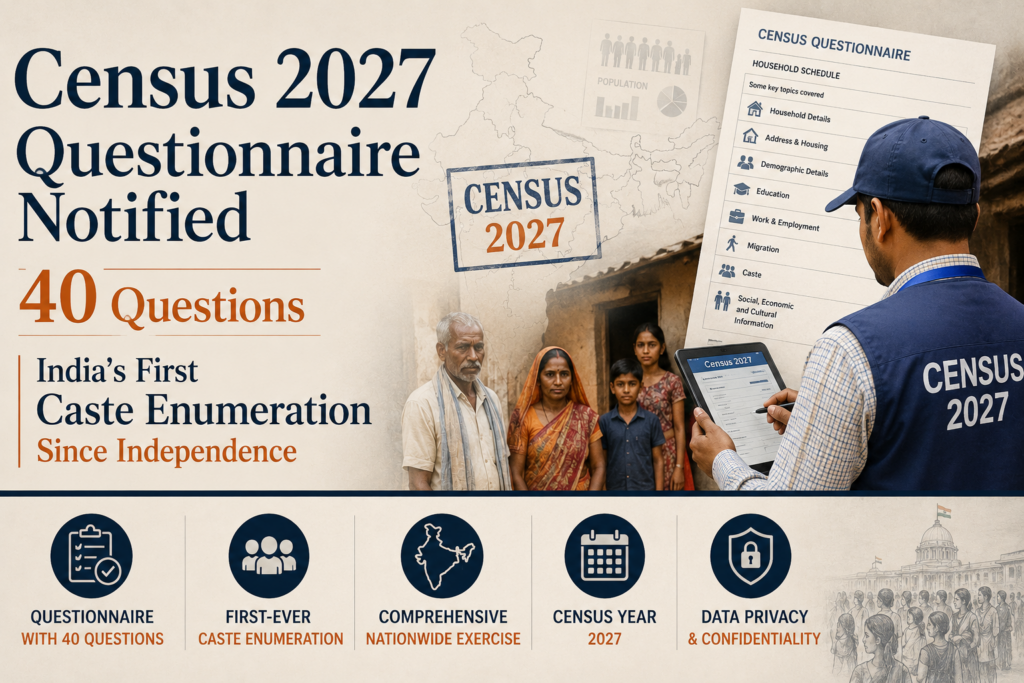
The Registrar General and Census Commissioner of India notified a schedule of 40 questions for the population enumeration phase of Census 2027 on 14 August, and the schedule went live on 17 August in Ladakh and the snow bound areas of Jammu and Kashmir, Uttarakhand and Himachal Pradesh through a self enumeration portal. The design of a single field decides the value of the whole exercise, since Scheduled Caste and Scheduled Tribe respondents select from a fixed drop down while every other respondent types a caste name into an open field, the same method that produced over 46 lakh caste names in the 2011 Socio-Economic and Caste Census.
What is the population enumeration phase of Census 2027?
- The second of two phases: The Census runs in two stages, a houselisting and housing phase followed by the population enumeration phase that records individual level characteristics.
- Scope of the notified schedule: The Registrar General notified 40 questions to be asked during this phase, against 29 questions in the Census 2011 questionnaire.
- Thirteen new data fields: The schedule adds 13 new questions or data fields that were not part of the 2011 questionnaire.
- Self enumeration route: The schedule was made available through a self enumeration portal, allowing a household to fill its own record rather than wait for an enumerator.
- Fields marked mandatory: The data fields in the caste section are marked mandatory, with declining to declare recorded as an option rather than left blank.
- Wider than the gazette text: The schedule made available to respondents further expands the data fields notified in the Gazette of India.
What was the Socio-Economic and Caste Census (SECC) of 2011?
- A separate survey, not the Census: The Socio-Economic and Caste Census (SECC) of 2011 was a household survey of deprivation indicators conducted alongside but separately from the decennial Census.
- The caste data outcome: Its open field method of recording caste returned over 46 lakh different caste names, and the government has maintained over the last decade that the data were unreliable because of errors in data collection.
What is the National Population Register (NPR)?
- A register of usual residents: The National Population Register (NPR) is a register of persons usually resident in a locality, distinct from a citizens’ register.
- Status of the update: The NPR was initially proposed to be updated along with the first phase of the Census, and has been put on the back burner amid opposition over concerns that the data could be used to build a country wide National Register of Citizens (NRC).
What are the new data fields added to the 2027 schedule?
- Parents’ religion, date and place of birth: Under the head Family Particulars, the schedule seeks the religion, date of birth and place of birth up to the village level of both the father and the mother.
- Birth outside India recorded: A separate option records the place of birth of the father and mother if either was born outside India.
- Religion categories fixed with an escape field: Six religious categories are listed, Hindu, Christian, Sikh, Buddhist, Muslim and Jain, with other religion recordable in a separate column.
- Identity document details: The schedule seeks Aadhaar, mobile, voter identity card and driving licence details.
- Place of COVID-19 vaccination: A question on the place of COVID-19 vaccination offers two options, within India or outside India.
- Overlap with the NPR rehearsal form: The additional questions on parents’ particulars, Aadhaar, mobile, voter identity card and driving licence mirror those asked in the 2019 rehearsal form for the National Population Register.
How will caste be recorded, and why does the method matter?
- A drop down for SC and ST respondents: Scheduled Caste and Scheduled Tribe respondents select their caste from a predetermined drop down menu, which fixes the universe of permissible answers.
- An open field for everyone else: Question 10(C) reads, if not SC or ST in this State or Union Territory, enter caste name, leaving the entry entirely to the respondent.
- Two additional recorded choices: Besides the caste field, the schedule carries Does not want to declare Caste and No Caste as recordable options.
- The first count since Independence: This is independent India’s first caste enumeration, since the last full caste count was conducted in 1931.
- Why the asymmetry matters: A closed list produces categories that can be aggregated and compared, while free text produces spelling variants, sub caste names, surnames and gotra entries that cannot.
- The objection raised: The principal Opposition party has questioned the open field methodology and alleged that the government has abandoned the caste census it announced on 30 April 2025.
Why does the open field method invite the 2011 failure?
- The precedent is documented: The same open field method in the 2011 SECC returned over 46 lakh caste names for a country whose recognised caste categories number in the thousands.
- The government’s own verdict on that data: The administration has maintained consistently over the last decade that the SECC caste data were unreliable because of errors in data collection.
- Asymmetric quality by design: SC and ST returns will be clean because they are drawn from a list, while Other Backward Classes and general category returns will carry the full noise of free text.
- Post enumeration classification burden: Reconciling millions of free text strings into usable categories becomes a discretionary exercise conducted after the count, not during it.
- Policy consequence: The categories that most need reliable numbers for reservation and welfare targeting are precisely the ones the open field leaves unstructured.
- Trust consequence: Recording caste as mandatory while leaving its classification unstructured invites the charge that the exercise is being conducted without an intention to use the result.
Challenges to Census 2027
- Migrant and homeless undercount: Circular migrants and street dwelling populations are systematically missed, e.g. the absence of updated migration data after 2011 left ration portability planning during the 2020 lockdown without a reliable base.
- Digital self enumeration excludes the least connected: A portal based first phase presumes smartphone access and digital literacy, e.g. only 57 percent of women in India have independent internet access against 72 percent of men.
- Enumerator capacity and training: The count relies on schoolteachers deputed for the task with short training, e.g. Booth Level Officers in the Telangana Special Intensive Revision of 2026 were found skipping door to door verification under workload pressure.
- Data privacy exposure: Collecting Aadhaar, mobile, voter identity and driving licence details in one record creates a linkable profile, e.g. the Digital Personal Data Protection Act, 2023 carries wide exemptions for State instrumentalities processing such data.
- Political contestation over the instrument: State level demands can stall the exercise itself, e.g. a 48 hour shutdown in Imphal in August 2026 demanded a National Register of Citizens before the Census in Manipur.
- Delimitation and reservation stakes raise the incentive to misreport: Census figures feed seat readjustment and reservation shares, e.g. Article 82 makes the census the basis for readjusting Lok Sabha seat allocation.
- Snow bound and conflict affected areas run on a different clock: A staggered reference date fragments comparability, e.g. Ladakh and the snow bound belts began enumeration in August 2026 while the rest of the country follows later.
Conclusion
The value of India’s first post Independence caste count now rests on a design choice rather than on the count itself, since a drop down for Scheduled Castes and Scheduled Tribes and free text for everyone else guarantees two grades of data from a single schedule. The stage reached is definite, the 40 question schedule was notified by the Registrar General and Census Commissioner of India on 14 August 2026, and self enumeration went live on 17 August 2026 in Ladakh and the snow bound areas of Jammu and Kashmir, Uttarakhand and Himachal Pradesh, with the self enumeration window running to 31 August. The next milestone is the extension of population enumeration to the rest of the country, for which the source names no separate date. Unless the free text entries are reconciled against a recognised list, the exercise will reproduce the 46 lakh name problem the government itself called unreliable.
