Why in the News
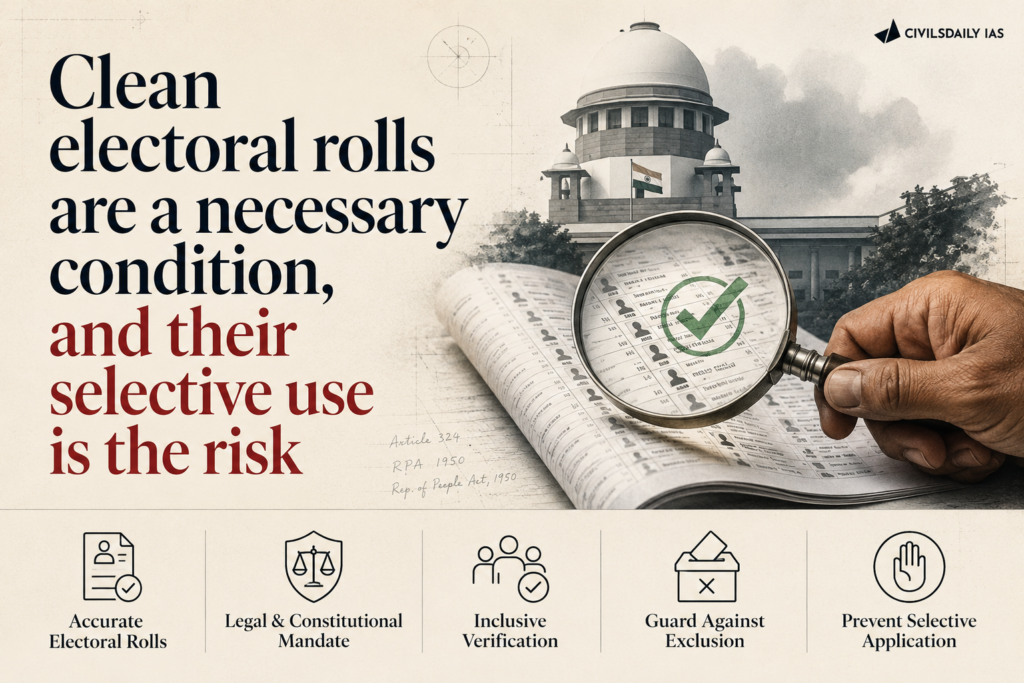
The United States President’s appreciation of India’s election mechanism, and his social media post citing India’s Chief Election Commissioner on how the United States conducts elections without a valid photo identity, has put election integrity in both democracies under simultaneous scrutiny. Both political systems agree that rolls should be clean and voting should be verified, and disagree completely on who the requirement is meant to exclude.
What is the Special Intensive Revision (SIR) of electoral rolls?
Source: Backgrounder, Elections Lifecycle Approach.docx
- Definition: Special Intensive Revision (SIR) is a comprehensive, time bound house to house verification drive involving fresh enumeration forms for all voters, door to door verification by Booth Level Officers, document verification of citizenship, deletion of ineligible entries and inclusion of omitted voters.
- How it differs from the routine exercise: Summary Revision is the routine annual update of additions, deletions and corrections carried out before general, Assembly and bye elections, with a qualifying date typically of 1 January.
- When it is triggered: SIR is exceptional and is triggered only when rolls have remained largely unchanged for years or when large scale irregularities are suspected.
- Statutory basis: Electoral rolls are prepared and maintained by the Election Commission of India under Article 324 of the Constitution and Section 21 of the Representation of the People Act, 1950, with intensive revision mandated under Sections 22 and 23 of that Act.
What is the current status of electoral roll revision in India?
Source: Backgrounder, Elections Lifecycle Approach.docx
- Frequency in history: Intensive revisions have been carried out only 13 times in India’s history, in 1952, 1957, 1961, 1965, 1966, 1983-84, 1987-89, 1992, 1993, 1995, 2002, 2003 and 2004.
- The current exercise: The Election Commission launched a nationwide SIR 2.0 from 4 November 2025, the first in 21 years, covering 9 States and 3 Union Territories and targeting approximately 51 crore voter records.
- Method used: The exercise uses artificial intelligence driven duplicate detection and facial and identity match algorithms alongside field verification.
- The officer chain: The Chief Electoral Officer at State level, the District Election Officer at district level, the Electoral Registration Officer at constituency level and Booth Level Officers at polling booth level carry out the work.
- The immediately preceding exercise: The January 2025 Special Summary Revision was completed with no issues raised before the Bihar SIR was announced.
- The presumption cutoff: The exercise uses 2003 as the citizenship presumption cutoff, which effectively re verifies every voter added between 2003 and 2025.
Constitutional Provisions Related to Elections and Electoral Rolls
Source: Backgrounder, Elections Lifecycle Approach.docx
- Article 324: Establishes the Election Commission of India and vests in it the superintendence, direction and control of elections to Parliament, State Legislatures and the offices of President and Vice President.
- Article 325: Guarantees that no person shall be ineligible for inclusion in, or claim to be included in, a special electoral roll on grounds of religion, race, caste or sex.
- Article 326: Provides that elections to the House of the People and State Legislative Assemblies shall be on the basis of adult suffrage, so every citizen not disqualified by a specific legal exception may vote.
- Articles 327 and 328: Authorise Parliament and State Legislatures respectively to make laws on all election related matters, including electoral rolls and delimitation of constituencies.
- Article 329: Bars courts from questioning laws relating to delimitation of constituencies, making Delimitation Commission orders final and non justiciable.
- Part XV: Articles 324 to 329 together constitute the electoral provisions of the Constitution, and they are the source of the Election Commission’s status as a constitutional body.
Why has election integrity become contested in both democracies at the same time?
- Partisan mistrust as the common driver: Partisan politics in both countries has fostered political mistrust, which leads election losers to repeatedly question electoral integrity.
- Both sides want purification, in opposite directions: The liberal and progressive strands and the conservative and nativist strands in both countries want to purify and streamline electoral rolls and processes, in different and often contradictory ways.
- The ruling side’s claim: Ruling dispensations in both countries hold that the election process is too permissive and allows foreigners to obtain voting rights.
- The opposition’s claim: Their opponents point to systematic and premeditated efforts to target social groups in the name of election integrity.
- The point of agreement is narrow: No one disagrees that the process should be fair and transparent, and the agreement ends there.
- The shared opportunity: India and the United States could lead a shared democratic agenda on election rules, but only after restoring trust and integrity in their own electoral processes.
How do the American and Indian election administration systems differ?
- United States, a decentralised and federalised process: The American electoral process is highly federalised and governed by fragmented rules and politics that resist the idea of a nationwide SIR type exercise.
- United States, the constitutional allocation: The Constitution grants each State its own methods, subject to the qualification that Congress may at any time by law make or alter such regulations.
- United States, the pending federal law: The expanded Safeguard American Voter Eligibility (SAVE) Act was passed in February and is pending in the Senate, and would require proof of citizenship for voter registration and photo identity for voting.
- United States, the gap identified: The decentralised system leaves too many loopholes in the process of enrolment and voting, and could benefit from a more robust national framework of the kind the Election Commission of India provides.
- India, a constitutional election authority: The Indian Constitution establishes the Election Commission as a constitutional body, unlike the American arrangement of State by State methods.
- India, a nationalised administration under strain: India’s nationalised election administration system has largely worked well and now faces a crisis of legitimacy.
- The common legal position: There is no ambiguity in existing law in either country that only citizens may register and vote, and the controversy is entirely about the process of ensuring this.
Why can a legitimate requirement of clean rolls still damage trust?
- The requirement itself is elementary: Clean electoral rolls of citizens, and voting with photo identity, are elementary requirements of a fair process, and neither is objectionable in principle.
- The manner of introduction is the objection: In India the SIR is introducing the citizenship proof requirement without transparency, adequate consultation or sufficient time.
- Frequency argues for care, not speed: SIR is meant to be conducted only once in 20 years, which is precisely why it should be carried out carefully and inclusively.
- The same rule can serve two purposes: A requirement designed to exclude non citizens can equally be used to exclude citizens who lack the documents, and the two outcomes are indistinguishable in the roll.
- The standard both countries must meet: In both countries the state must not selectively weaponise these requirements against those not in power.
Major debates surrounding electoral roll revision in India
Source: Backgrounder, Elections Lifecycle Approach.docx
- Bihar, the scale of deletion: A 47 lakh net reduction in the final roll, with 3.66 lakh removed in the last phase after draft publication, and allegations of large scale deletions in four border districts ahead of State elections.
- Bihar, the process failure: Booth Level Officers collected forms without acknowledgement slips, and contradictory deadlines of 25 July and 31 August caused mass confusion.
- West Bengal, the notice requirement: Large scale deletions were alleged, with Rule 18 of the Registration of Electors Rules, 1960, which requires individual notice before deletion, alleged to have been violated, and petitions filed in the Calcutta High Court against a contesting Commission affidavit.
- Uttar Pradesh, the quality of verification: Concerns were raised over disproportionate deletions in minority heavy constituencies, with field verification by Booth Level Officers reported as cursory and forms collected in bulk.
- Migrant voters: Multiple States including Jharkhand, Rajasthan and Assam reported that migrant workers away from their registered constituencies were deleted without notice.
- Timing without a stated trigger: The SIR was announced within six months of a clean January 2025 summary revision with no new justification offered.
- Feasibility of the timeline: The Commission’s own Assam National Register of Citizens experience shows that verification of this kind cannot be completed within the 90 days allotted.
Challenges to a credible electoral roll revision
- Burden of proof falls on the voter: An intensive revision requires the voter to establish eligibility rather than requiring the state to establish ineligibility. e.g. the 2003 presumption cutoff placing the documentary burden on everyone enrolled between 2003 and 2025.
- Migrant and mobile populations are structurally exposed: Voters absent from their registered address during door to door verification are recorded as untraceable and deleted. e.g. migrant workers in Jharkhand, Rajasthan and Assam reported as deleted without notice.
- Notice requirements are unevenly observed: Deletion without individual notice removes the only opportunity to contest an error before publication. e.g. the alleged violation of Rule 18 of the Registration of Electors Rules, 1960 in West Bengal.
- Field capacity does not match the timeline: Booth Level Officers carry the entire verification load within a compressed window, and shortcuts follow. e.g. forms collected in bulk without acknowledgement slips in Bihar and cursory verification reported in Uttar Pradesh.
- Algorithmic deduplication carries error: Facial and identity match algorithms produce false positives that are removed before any human confirms the match. e.g. SIR 2.0 applying artificial intelligence driven duplicate detection across approximately 51 crore records.
- Contradictory administrative communication: Multiple deadlines and changing instructions destroy the voter’s ability to comply. e.g. the 25 July and 31 August deadlines issued in Bihar.
- Verification errors survive to the draft roll: Voters who submitted forms still appear in the deleted category, which shifts the burden to a post publication correction process. e.g. voters in Telangana finding their names listed under permanently shifted or dead in the recently released draft roll despite having filed forms.
Conclusion
Clean electoral rolls of citizens and voting with photo identity are elementary requirements of a fair process, and the disagreement in both India and the United States is about who the requirement is applied to and how. India’s nationalised system offers the national framework the American process lacks, and it is that system that now faces a crisis of legitimacy. An exercise conducted once in 20 years, over approximately 51 crore records, has to be carried out carefully and inclusively or it converts a legitimate purification into a selective exclusion. The obligation on the state in both countries is the same, not to weaponise these requirements against those not in power.
What is Election Integrity?
Source: Backgrounder, Elections Lifecycle Approach.docx
- About: Election integrity is the condition in which every stage of an election, from enrolment to the declaration of results, is conducted according to law and is accepted as such by winners and losers alike.
- Rationale: Democratic legitimacy rests on the losing side accepting the result, so integrity is measured by trust in the process rather than by the accuracy of the count alone.
- Pre poll phase: Covers electoral roll preparation and revision, delimitation and representation, candidate scrutiny and disqualification, and the registration and recognition of political parties.
- During poll phase: Covers the Model Code of Conduct, the voting mechanism including electronic voting machines and the Voter Verifiable Paper Audit Trail, and corrupt practices under Section 123 of the Representation of the People Act, 1951.
- Post poll phase: Covers exit and opinion poll regulation under Sections 126A and 126(1)(b) of the Representation of the People Act, 1951, and election disputes through election petitions before High Courts.
- The statutory division: The Representation of the People Act, 1950 governs the preparatory side including rolls and delimitation, and the Representation of the People Act, 1951 governs the conduct of elections including candidates, offences and disputes.
Laws and Rules Governing Electoral Rolls and Elections
Source: Backgrounder, Elections Lifecycle Approach.docx, supplemented
- Representation of the People Act, 1950: Provides for allocation of seats in Parliament and State Legislatures, delimitation of constituencies, and the preparation and maintenance of electoral rolls, and defines the machinery of electoral officers.
- Section 21: The provision under which electoral rolls are prepared and maintained.
- Sections 22 and 23: The provisions mandating correction, deletion and inclusion of entries, under which intensive revision is conducted.
- Representation of the People Act, 1951: Governs the conduct of elections, qualifications and disqualifications of candidates, nomination and scrutiny, corrupt practices, election offences, expenditure limits and election petitions.
- Section 8: Provides for disqualification on conviction, with immediate disqualification of a sitting legislator convicted and sentenced to two years or more, continuing for six years after release.
- Section 29A: Provides for registration of political parties with the Election Commission.
- Section 29C: Requires parties to disclose all donations above twenty thousand rupees annually to the Commission.
- Section 100: Sets out the grounds on which an election may be declared void.
- Registration of Electors Rules, 1960: Prescribe the procedure for preparation and revision of rolls, with Rule 18 requiring individual notice before deletion of an entry.
- Election Symbols (Reservation and Allotment) Order, 1968: Governs recognition of parties as State or National parties and the allotment of reserved and free symbols.
- Chief Election Commissioner and Other Election Commissioners (Service Conditions) Act, 2023: Governs the appointment and service conditions of the Chief Election Commissioner and Election Commissioners.
- Conduct of Elections Rules, 1961 (supplemented, not drawn from the Backgrounder): Prescribe the detailed procedure for nomination, polling, counting and declaration of results under the Representation of the People Act, 1951.
Election Commission Initiatives to Strengthen the Electoral Process
Source: Backgrounder, Elections Lifecycle Approach.docx
- Electronic Voting Machines: Deployed across India since 2004, replacing the ballot box system used from 1952.
- Voter Verifiable Paper Audit Trail: Deployed at all polling stations from the 2019 elections, printing a slip visible to the voter for seven seconds before it falls into a sealed compartment.
- National Voters Services Portal: Allows voters to register, modify and confirm their electoral details online.
- cVIGIL mobile application: Introduced for the 2019 elections, enabling over 20,000 complaints of electoral malpractice to be reported directly to the Commission, with complaints attended within 100 minutes in Bihar.
- Systematic Voters Education and Electoral Participation: Targeted voter education campaigns that contributed to a turnout of approximately 67 percent in 2019, among the highest in Indian electoral history.
- Photo electoral rolls: All voter lists carried photographs by the 2019 elections, reducing impersonation risk.
- Election Seizure Management System: Provides real time reporting of interceptions of cash, liquor and other inducements, alongside 824 flying squads deployed in Bihar and static surveillance teams.
- Biometric identification: Piloted in select constituencies during State elections to verify voter identity more accurately.
Key Facts about Elections and Electoral Rolls in India
Source: Backgrounder, Elections Lifecycle Approach.docx
- Voter access commitments: No polling station is to have more than 1,200 voters, and polling stations are to be located within 2 km of voters’ residences.
- Urban apathy measures: Polling stations are set up inside high rise buildings and residential colonies, with basic amenities guaranteed at every polling station.
- Seat freeze: The Lok Sabha seat count has been frozen at 543 on the basis of 1971 Census figures, and average voters per constituency has grown from roughly 10 lakh in 1971 to 18 lakh today.
- Delimitation Commissions: Four have been constituted so far, in 1952, 1963, 1973 and 2002.
- Expenditure ceiling: The official Lok Sabha election expenditure limit is now 95 lakh rupees, up from 25,000 rupees in 1951-52.
- Verification record of the machines: Over 4 crore Voter Verifiable Paper Audit Trail slips have been tallied with the electronic counts of their control units without a single mismatch recorded.
Challenges in India’s Electoral System
Source: Backgrounder, Elections Lifecycle Approach.docx
- Criminalisation of politics: A record 251 of the 543 members elected to the 18th Lok Sabha in 2024, or 46 percent, have criminal cases registered against them, and the proportion with serious charges rose from 24 percent in 2004. e.g. the conviction rate for politicians involved in crimes standing at only 6 percent, so most accused legislators complete full terms.
- Money power and unaccounted funding: Over 60 percent of party income often comes from unknown sources, and registered political parties now exceed 2,800. e.g. cash, liquor and drugs worth over 100 crore rupees seized in Bihar in 2025 and 733.43 crore rupees in Karnataka in 2023.
- Seizures that do not convert into convictions: The burden of proving that seized cash was meant to influence votes defeats most cases. e.g. 303.86 crore rupees seized in the 2014 Lok Sabha election released after income assessment, with criminal cases filed in only three of hundreds of instances.
- Frozen representation: Seats fixed on 1971 population data leave voters in high growth States under represented, and any correction risks penalising States that reduced fertility. e.g. five southern States together standing to lose approximately 24 seats under a straight redistribution of the existing 543.
- Women’s under representation: Women form 49 percent of the population and held approximately 11 percent of Lok Sabha seats as of 2021. e.g. the Women’s Reservation Bill, first introduced in 1996, having failed multiple times, and state laws eroding the grassroots gains secured by the 73rd and 74th Amendments through retrograde eligibility criteria.
- Model Code of Conduct without statutory backing: The Code lacks statutory force and is enforced indirectly through existing law. e.g. the Supreme Court in Union of India versus Harbans Singh Jalal (2001) holding that the Code comes into force on the day the election date is announced, and opining that legalising the Code may not be suitable.
- Trust deficit in the Commission: Repeated controversies over electronic voting machines, SIR and turnout data have eroded the Commission’s moral authority. e.g. the demand that the Commission release detailed verification data and establish mechanisms for public scrutiny.
- Exit and opinion poll regulation gaps: Parliament limited only exit poll publication until the final phase, leaving opinion polls comparatively unrestricted. e.g. exit polls after the 2024 general elections significantly missing the actual result.
Back2Basics: Election Commission of India (ECI)
Source: Backgrounder, Elections Lifecycle Approach.docx
- Constitutional status: A constitutional body established on 25 January 1950 under Article 324, governed by Articles 324 to 329 in Part XV of the Constitution.
- Jurisdiction: Conducts and supervises elections to Parliament, State Legislatures and the offices of President and Vice President.
- Composition: A multi member body comprising one Chief Election Commissioner and up to two Election Commissioners.
- Status of the Chief Election Commissioner: Holds the same status, salary and perquisites as a judge of the Supreme Court, and can be removed only by a parliamentary address in the manner of a Supreme Court judge.
- Removal of Election Commissioners: An Election Commissioner can be removed by the President only on the recommendation of the Chief Election Commissioner.
- Appointment: Governed by the Chief Election Commissioner and Other Election Commissioners (Service Conditions) Act, 2023, under which a Selection Committee comprising the Prime Minister, a Union Cabinet Minister nominated by the Prime Minister and the Leader of the Opposition in the Lok Sabha recommends candidates.
- The appointment dispute: The Supreme Court in Anoop Baranwal versus Union of India (2023) had directed that the selection panel include the Chief Justice of India until Parliament enacted a law, and the 2023 Act omitted the Chief Justice, which is under challenge.
- Administrative functions: Preparation and revision of electoral rolls, notification of election dates, scrutiny of nomination papers, recognition of political parties and allotment of symbols.
- Advisory and quasi judicial functions: Advises the President on disqualification of members of Parliament and Governors on State legislature disqualifications, cancels and reschedules polls for rigging or violence, and acts as a court for disputes on party recognition and symbols.
Way Forward
- Publish the verification trail: Release booth level data on forms received, entries deleted and the reason recorded for each deletion, so that a claimed clean up is auditable rather than asserted.
- Enforce the individual notice requirement: Make compliance with Rule 18 of the Registration of Electors Rules, 1960 a precondition for deletion, with a recorded acknowledgement for every form collected.
- Match the timeline to the task: Set the revision period from the verification workload of the largest States rather than a uniform 90 day window, given the Assam experience.
- Provide a portable enrolment route for migrants: Enable remote or transferable enrolment so that absence from the registered address during verification does not by itself trigger deletion.
- Require human confirmation of algorithmic matches: Treat artificial intelligence generated duplicate and identity matches as flags for field verification rather than as grounds for deletion.
- Publish a single calendar: Issue one set of deadlines for each State at the outset, so that contradictory dates of the kind issued in Bihar do not recur.
- Restore the appointment safeguard: Settle the composition of the Selection Committee for Election Commissioners, since the Commission’s perceived independence is the foundation of any acceptance of its roll revision.
- Build a bilateral democratic agenda on rules, not on claims: Convert the shared interest of India and the United States in citizen only rolls and verified voting into a technical exchange on enrolment standards, after each restores trust in its own process.
“[2018, GS2, 10 marks] In the light of recent controversy regarding the use of Electronic Voting Machines (EVM), what are the challenges before the Election Commission of India to ensure the trustworthiness of elections in India?”
