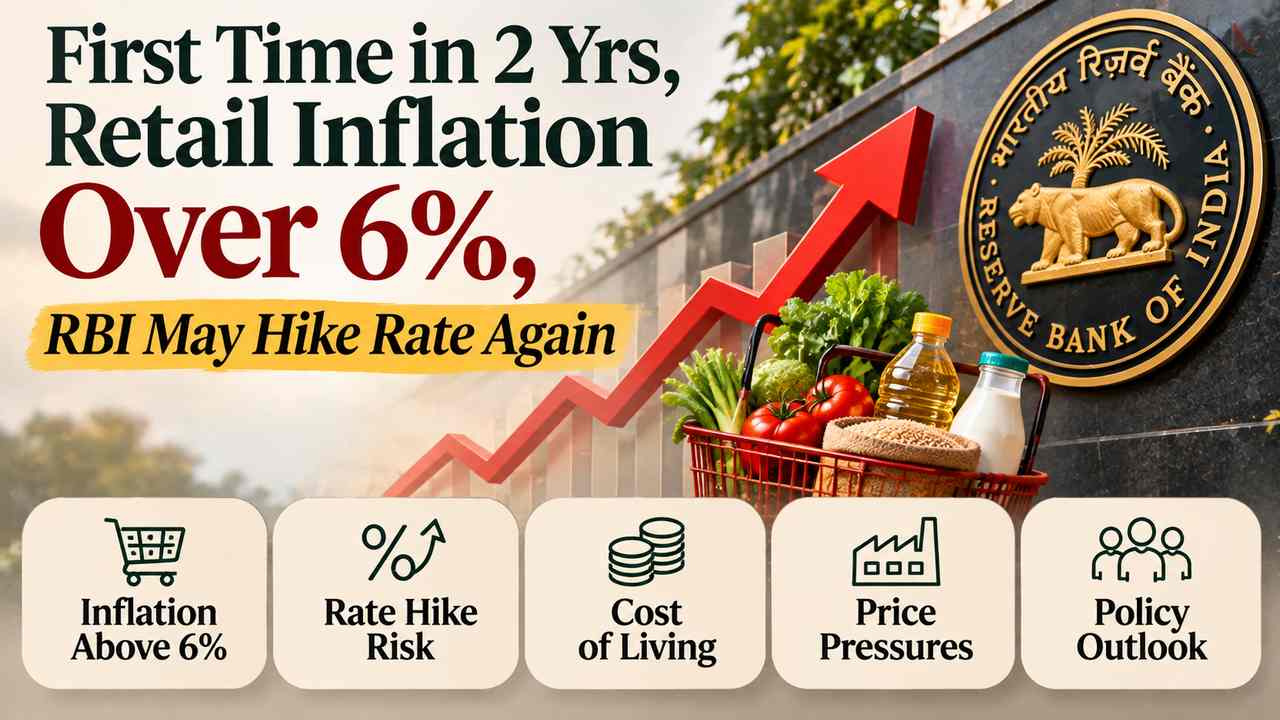
Why in the News
Retail inflation has moved above the Reserve Bank of India’s (RBI) tolerance band, crossing the 6% upper limit for the first time since October 2024. Data from the Ministry of Statistics and Programme Implementation (MoSPI) put inflation at 6.09% in October, up from 5.54% in September. A second successive rate hike next month now looks likely.
What is inflation targeting, and how does the RBI respond?
- What it is: Retail inflation is measured by the Consumer Price Index (CPI), the price of a fixed basket of household goods and services. It is like tracking the cost of one monthly shopping bag.
- The target: The RBI’s target is 4% CPI inflation, with a tolerance of 2 percentage points either side.
- The tool: The repo rate is the rate at which the RBI lends to banks. A higher repo rate leads banks to raise lending rates, so borrowing costs more and demand cools.
- Who decides: The six member Monetary Policy Committee (MPC), headed by the Governor, sets the repo rate.
- The takeaway: Once inflation breaks the band, the RBI is expected to keep raising rates even as growth slows.
What has changed in October?
- Sustained rise: October was the 12th straight month of rising inflation. It was also the fifth month in a row above the target.
- Food prices: Food inflation rose to 8.94% in October from 7.74% in September, led by vegetables such as onion and garlic.
- Eating out: Dining in restaurants and cafes cost 10.09% more than a year earlier. It was under 3% in February, before the West Asia war and a commercial cooking gas price rise.
- Wholesale prices: Wholesale inflation, measured at the producer and trader level, surged to 11.39% in September.
- Monthly momentum: Overall prices in October were 0.5% higher than in September, a sign that price pressure is still building.
Why are prices rising?
- Base effect: Prices grew slowly a year ago, so this year’s rise, measured against that low level, looks larger.
- Cost pass through: Weak rains and the war in West Asia raised costs, and producers passed them on to consumers.
- Crop risk: A deficient monsoon and poorly refilled reservoirs threaten the rabi (winter sown) crop. Lower sown area for rice, maize and oilseeds could lift food prices.
- Milk and staples: Amul and Mother Dairy have raised milk prices by Rs 2 to 4 a litre. Higher milk, sugar and onion prices will keep food inflation high in November.
- Broadening pressure: Seasonal clothing and cars cost more, and global shocks and festive demand add pressure, so inflation is spreading beyond food.
What will the RBI do next?
- October hike: In October the RBI raised the repo rate by 25 basis points, a quarter of a percentage point, to 5.5%. It was the first hike in nearly four years.
- RBI forecast: The RBI projects CPI inflation to average 6% in October to December, a figure economists expect to be revised higher at the MPC’s early December meeting.
- Strong growth: Gross Domestic Product (GDP) grew an unexpectedly high 7.8% in April to June, which adds pressure for hikes.
- Further tightening: BofA Securities expects another 75 basis points of hikes over the next six to nine months.
Challenges
- Supply driven inflation: Higher rates cool demand but cannot fix rain or war driven supply shortfalls.
- Cost to growth: Costlier credit can soften consumer demand and slow growth.
- External risks: Geopolitics, oil prices and El Nino threaten both prices and growth.
Way Forward
- Food supply management: The Centre should use buffer stocks and imports to cool onion and pulse prices.
- Rabi support: States should secure seed, fertiliser and irrigation for the rabi crop.
- Calibrated rate path: The MPC should pace hikes to return inflation to the band without choking growth.
Conclusion
Inflation has broken the RBI’s band on supply shocks that interest rates cannot directly fix. The MPC’s next decision, and whether inflation peaks before the rabi harvest, is what to watch.
Key numbers
- Highest item inflation, October: Onion 116%, garlic 61%, ginger 48%, lemon 47%.
- Regional spread: Under 4% in only 5 of 36 States and Union Territories; above 6% in 11, led by Puducherry at 7.96%.
- RBI CPI projections: 5.7% for January to March 2027 and 5.6% for April to June 2027.
- CPI base year: The new CPI series uses 2024 as its base; earlier data is on the 2012 base.
Matching Previous Year Question
“[2020] Consider the following statements: 1. The weightage of food in Consumer Price Index (CPI) is higher than that Wholesale Price Index (WPI). 2. The WPI does not capture changes in the prices of services, which CPI does. 3. Reserve Bank of India has now adopted WPI as its key measure of inflation and to decide on changing the key policy rates. Which of the statements given above is/are correct? (a) 1 and 2 only (b) 2 only (c) 3 only (d) 1, 2 and 3 ANSWER: (a)”
