Why in the News
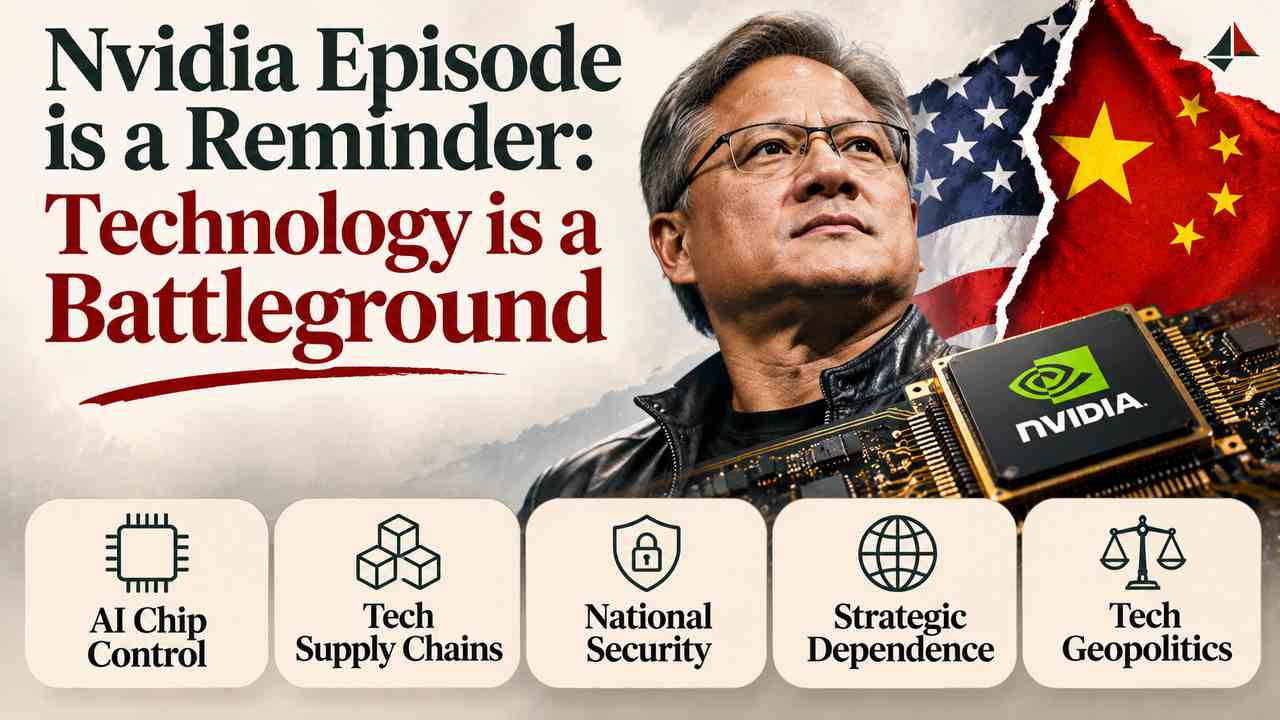
Nvidia’s chief executive has admitted to an affair with an executive of Megaspeed, a Singapore based data centre firm that United States (US) officials suspect of routing restricted chips to China. The US government reportedly identified her as working for China’s Ministry of State Security. The episode shows every route to artificial intelligence (AI) technology, including an executive, is now a target.
Why has AI compute become a geopolitical battleground?
- Contest over compute: AI is a lasting strategic shift, and powers now compete over compute, the advanced chips and data centres that run AI models.
- Market sensitivity: One US election wiped $2.5 to $3 trillion off AI stocks in a day, on fears of tighter rules for data centres.
- Weak end use checks: Checks on who actually uses exported chips have gaps. Eg. Some Chinese firms that Washington cleared to handle Nvidia’s H200 chips had offices that appeared unused.
- The takeaway: Chip export rules achieve little if the people and firms around the chips can be compromised.
How have rivals obtained technology through people and networks?
- Western assumption: For three decades Western democracies opened their markets and laboratories to China, expecting it to adopt their rules. China opened only selectively and exploited that openness.
- Social espionage: Rivals, especially China, reach technology through people posing as investors, researchers and romantic partners, a practice called “social espionage”.
- Cisco and Huawei: Cisco sued Huawei in 2003 over router code it said was copied. A court appointed expert found the code had been electronically copied, and the case settled confidentially.
- Nortel: Hackers using stolen executive passwords had access to Nortel’s network from at least 2000, sending data to Shanghai. Nortel went bankrupt in 2009, and Beijing and Huawei denied involvement.
Why does this pattern threaten India directly?
- Neighbourhood threat: China, Pakistan and North Korea each built their most dangerous capabilities partly by obtaining what the rules denied them. Two of the three are India’s neighbours.
- A Q Khan network: A Q Khan left the Netherlands in 1975 with stolen centrifuge designs from a contractor to the enrichment consortium URENCO. He later sold centrifuges and know how to Iran, Libya and North Korea.
- China’s record: The US Cox Committee concluded in 1999 that China obtained classified information on the US W88 warhead through espionage, a finding Beijing rejected.
Is a coalition of trusted partners enough?
- Pax Silica: Launched in December 2025, Pax Silica brings trusted countries together to secure the supply chains for chips, AI and critical minerals.
- India’s membership: India signed the Pax Silica declaration in February, alongside Japan, South Korea, the United Kingdom, Singapore and others.
- Gap in the coalition: The alleged channel in the Nvidia case ran through a firm in Singapore, itself a member, so trust must be verified, not declared.
- Openness retained: Open societies win by attracting talent and innovating faster than rivals, so the answer is openness to partners that can be verified.
Challenges
- Opaque ownership: Data centre operators, resellers and chip buyers can hide their real owners behind intermediaries, which defeats end use checks.
- Human channels: Approaches through investors, researchers and personal ties look like normal business, beyond the reach of export rules written for goods.
- Weak penalties: Firms absorb fines as a cost of doing business, so fines do not deter chip diversion.
Way Forward
- Shared counterintelligence: Brief executives, researchers and officials on approach tactics, and share findings on front companies across members.
- Beneficial ownership of compute: Make the real owners of data centre operators, resellers and chip buyers visible to every member’s regulators.
- Reciprocity: Offer openness to countries that reciprocate and scrutiny to those that do not.
- Deterrent penalties: Set penalties large enough to deter chip diversion.
Conclusion
Control over AI now depends as much on trust as on export rules. Whether Pax Silica moves from declared to verified trust will decide if open technology coalitions can protect what they build.
What are Export Control Regimes?
- About: Export control regimes are informal groups of supplier countries that agree lists of sensitive goods and technologies and coordinate their export licensing.
- Nuclear and missile regimes: The Nuclear Suppliers Group (NSG) covers nuclear items. The Missile Technology Control Regime (MTCR) covers missiles.
- Arms and chemical regimes: The Wassenaar Arrangement covers conventional arms and dual use (civil and military) goods. The Australia Group covers chemical and biological items.
- India’s status: India joined the MTCR, the Wassenaar Arrangement and the Australia Group between 2016 and 2018, but not the NSG.
Matching Previous Year Question
“[2011] Recently, the USA decided to support India’s membership in multilateral export control regimes called the “Australia Group” and the “Wassenaar Arrangement”. What is the difference between them? 1. The Australia Group is an informal arrangement which aims to allow exporting countries to minimize the risk of assisting chemical and biological weapons proliferation, whereas the Wassenaar- Arrangement is a formal group under the OECD holding identical objectives. 2. The Australia Group comprises predominantly of Asian, African, and North American countries, whereas the member countries of Wassenaar Arrangement are predominantly from the European Union and American continents. Which of the statements given above is/are correct? (a) 1 only (b) 2 only (c) Both 1 and 2 (d) Neither 1 nor 2 ANSWER: (d)”
