Why in the News
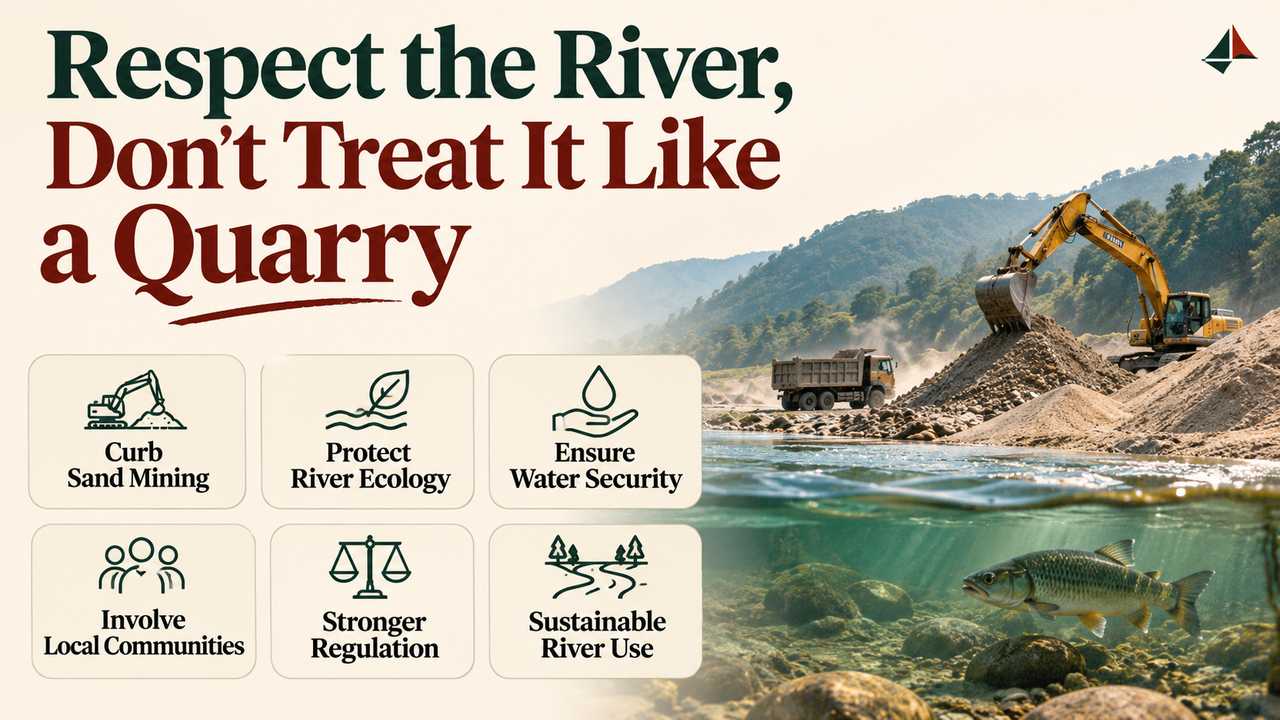
The Central Empowered Committee (CEC), the Supreme Court‘s adviser on forest related matters, has proposed a three year road map to phase out sand extraction from active river channels and to desilt dams and reservoirs. Court orders against illegal sand mining remain largely unimplemented because legal supply cannot meet construction demand. The task is to meet the need for building material and still keep rivers alive.
Why is river sand mining a problem?
- What it is: Sand mining is the extraction of sand from riverbeds, mainly for construction. Sand is the second most exploited natural resource after water in several parts of the world, including India.
- Damage to rivers: Unregulated extraction harms a river in several ways:
- it deepens and widens the riverbed;
- it destabilises riverbanks and alters natural water flow;
- it causes erosion downstream.
- Court orders ignored: The Supreme Court has censured State governments at least three times since 2023 for failing to check illegal sand mining.
- Supply gap: A nearly 40% gap in sand supply for India’s growing construction industry has kept those orders largely unimplemented.
- The takeaway: Bans alone fail where legal supply falls short, so any lasting answer must also find other sources of sand.
What has the CEC proposed?
- Report to the Court: The CEC submitted its report to the Supreme Court earlier this month.
- Phase-out: It recommends a road map to phase out sand extraction from active river channels, the parts of a riverbed where water flows, over three years.
- Alternative sources: It suggests alternatives that progressively reduce dependence on river sand.
- Desilting: It calls for desilting of dams and reservoirs, meaning removal of the sediment that settles in them.
- National framework: It has asked the Ministry of Jal Shakti to lead a national framework setting out how much sediment each reservoir holds, how removal is financed and what environmental safeguards apply.
Can desilting dams replace river sand?
- Case for desilting: Sand and gravel settle on riverbeds, raising them and lowering how much water they can carry. Desilting clears these deposits, lets water flow freely in heavy rain and could restore reservoir capacity.
- Sediments sustain rivers: Sediments do not always harm rivers. They sustain downstream river ecosystems, so removing them carries an ecological cost.
- Mittal committee: In 2022, a committee headed by former Central Water Commission (CWC) chairperson B K Mittal found large scale desilting technologically and economically unviable.
- Targeted dredging: Like the CEC, that committee backed dredging, digging sediment out from under water, only at specific reaches of rivers, when scientific studies support it.
- Unknown stock: The CEC acknowledges it does not know how much sand the country’s dams hold, which is why it seeks a long term plan.
Challenges
- State level enforcement: Sand is a minor mineral under the Mines and Minerals (Development and Regulation) Act, 1957, so each State frames and enforces its own rules.
- Short horizon: Phasing out river sand in three years needs alternative supply to grow fast enough to fill the gap.
- Many agencies: Rivers, dams and mining sit with different Central and State bodies, so the national framework needs all of them to act together.
- Unusable sediment: Much reservoir sediment is fine silt and clay rather than sand fit for construction.
Way Forward
- Reservoir sediment survey: The Ministry of Jal Shakti should first measure each reservoir’s sediment and the share usable as sand.
- Studies before dredging: Dredging should be allowed only at reaches cleared by scientific studies, as both committees advise.
- Alternatives first: States should scale up alternative sources of sand before closing river channels to extraction.
- Track sand movement: States should track the extraction, transport and end use of sand to curb illegal mining.
Conclusion
Rivers cannot keep serving as quarries for construction, yet demand for building material will not fall. Whether the Supreme Court adopts the CEC’s road map, and whether the Jal Shakti Ministry builds the sediment framework, will decide if that balance is struck.
Back2Basics: Central Empowered Committee
- Origin: The Supreme Court set up the CEC in 2002 in the T.N. Godavarman Thirumulpad forest case.
- Permanent status: In 2023, the Union Environment Ministry made it a permanent body under the Environment (Protection) Act, 1986.
- Role: It examines forest and wildlife matters before the Court and reports back with recommendations.
- Earlier coverage: The CEC’s sand mining report is compiled in “SC panel: Phase out ‘unsustainable’ river sand mining in 3 yrs, desilt dams” (11 November 2026).
Matching Previous Year Question
“[2019, GS3, 10 marks] Coastal sand mining, whether legal or illegal, poses one of the biggest threats to our environment. Analyse the impact of sand mining along the Indian coasts, citing specific examples.”