Why in the News
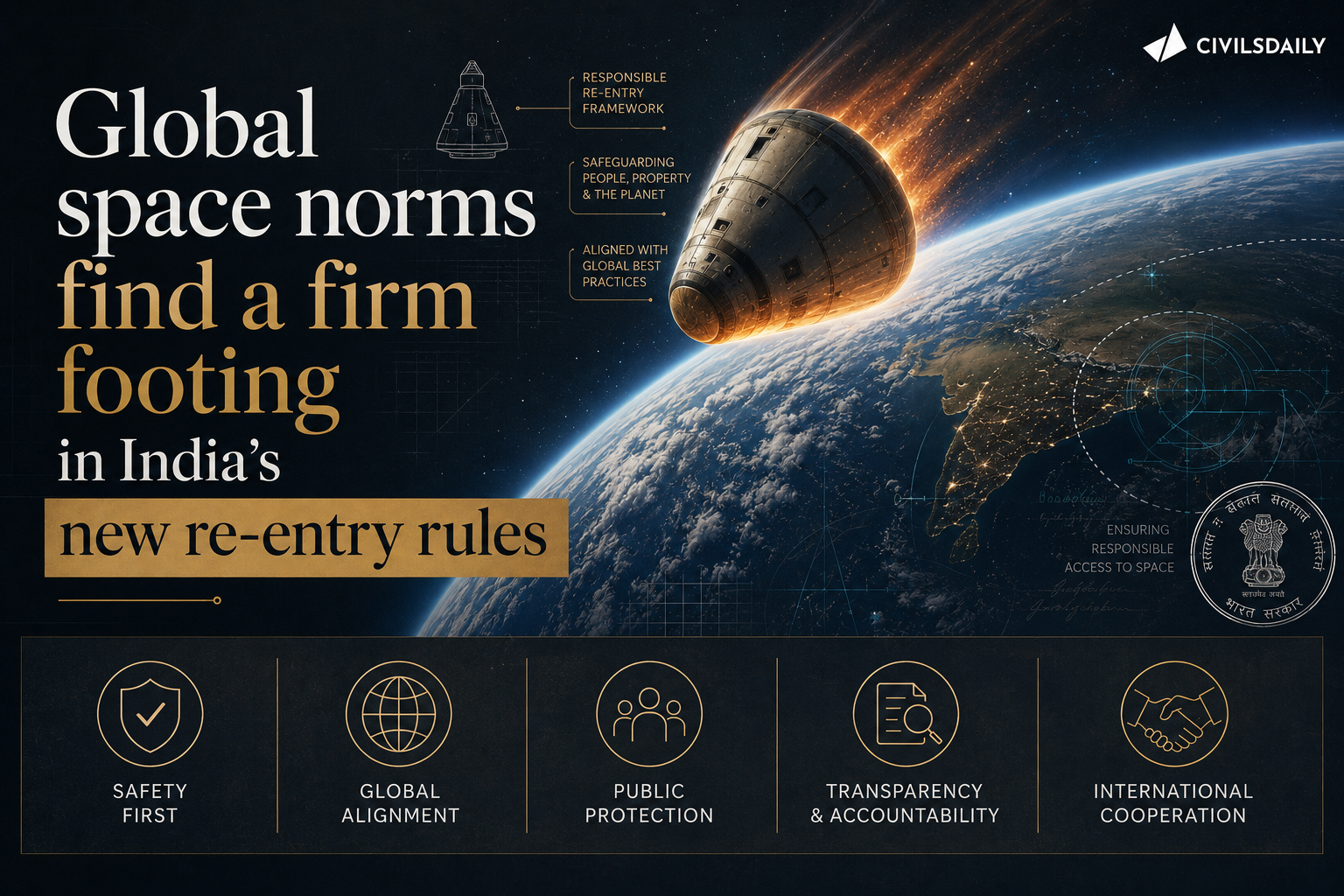
The Indian National Space Promotion and Authorisation Centre (IN-SPACe) has released India’s first guidelines on planned re-entry, requiring any Indian entity undertaking such a re-entry to obtain its authorisation, whether the re-entry occurs within or outside Indian territory.
What is a planned re-entry?
- The defining test is intent and survivability: Objects designed to survive re-entry, or intentionally controlled towards a particular landing or impact area, require separate authorisation. This is what makes a re-entry planned.
- What falls outside the definition: Objects expected to burn up, melt or fragment sufficiently during natural orbital decay do not count as a planned re-entry.
- Why the distinction carries regulatory weight: The category separates a return that must be assessed and cleared in advance from one that requires no clearance, so the definition determines the reach of the entire framework.
Why has re-entry become a governance problem now?
- The historical baseline was negligible: For many decades there were few rocket launches and few new satellites in orbit each year, so there were also few re-entries.
- The consequences used to be trivial: Most of those re-entries simply burned up in the atmosphere with little consequence.
- The orbital population has changed: Low-earth orbit, the band of orbits closest to the earth where most satellites operate, now hosts several thousand satellites, with private companies planning for many more.
- Deliberate de-orbiting has become routine: Satellite operators are also deliberately bringing satellites down at the end of their operational lives as part of post-mission disposal, in great numbers.
- The physical risks are specific: A spacecraft returning to the earth has to negotiate many risks, including deviating from its planned path and breaking up into smaller pieces.
- The risks cross jurisdictions: A returning object may affect airspace and maritime zones, and may potentially crash in the territory or jurisdiction of another state, which makes re-entry a governance problem as well as a physics problem.
What are the three important elements of the guidelines?
- Accountability: Any Indian entity undertaking a planned re-entry, whether within or outside Indian territory, now requires IN-SPACe authorisation.
- Foreign operators must route through an Indian entity: Non-Indian entities seeking to undertake planned re-entry over Indian territory must route the activity through an Indian-incorporated entity, such as a subsidiary, joint venture or partnership.
- The Indian entity carries the compliance duty: That Indian entity is responsible for complying with Indian laws, regulations and national security requirements.
- Why the accountability gap exists: Commercialisation separates ownership from consequence, since the spacecraft may belong to a private company and the effects of its return lie across maritime zones and jurisdictions. India has responded by attaching regulatory responsibility to a re-entering entity before the risk materialises.
- Risk must be acceptable: The expected casualty risk must remain below 1 in 10,000, supported by survivability and ground-casualty assessments.
- Failure scenarios must be modelled and shared: Operators have to analyse and share failure scenarios, fragmentation patterns, ballistic coefficients, de-orbit plans, flight-path angles and danger zones.
- Surviving and hazardous components must be identified: They must identify components likely to survive re-entry, and hazardous systems such as batteries and pressure vessels.
- A number makes sustainability measurable: By requiring quantitative studies and attaching a figure to the acceptable risk threshold, the guidelines make sustainability measurable and therefore trackable.
- Permissions: IN-SPACe will re-verify the latest re-entry parameters approximately three months before the proposed operation.
- A post-launch decision needs six months’ notice: If a planned re-entry is decided upon after launch, the operator must apply at least six months in advance.
- Airspace and maritime warnings at 45 days: Operators must obtain an IN-SPACe advisory note to issue warnings to airborne and marine vessels in the re-entry area at least 45 days before the re-entry begins.
- A foreign jurisdiction requires that state’s clearance: If a re-entry site falls within the territorial control of a non-Indian state, including its exclusive economic zone, the applicant must submit the relevant clearance or authorisation from that state.
- The checkpoints are intervention windows: These checkpoints give the regulator fixed windows and mechanisms to intervene when re-entry parameters change after the mission has launched, or when the risk pattern changes.
What international framework do the guidelines translate?
- The development period: For nearly two decades the international community has developed principles for sustainable space activities.
- The two leading instruments: They are the Inter-Agency Space Debris Coordination Committee’s Space Debris Mitigation Guidelines, and the Guidelines for the Long-term Sustainability of Outer Space Activities of the United Nations Committee for the Peaceful Uses of Outer Space.
- The treaty foundation: Article IX of the Outer Space Treaty 1967 provides an important foundation for environmental responsibility in the conduct of space activities.
- The working definition of sustainability: The UN Guidelines define sustainability as maintaining space activities while preserving the outer space environment for future generations.
- The structural weakness of that architecture: Most of the contemporary sustainability architecture works on guidelines and other similar forms of soft law, which operators are not obligated to follow.
- How the national regulator closes it: The IN-SPACe guidelines solve this problem for India by tying an operator’s fragmentation analysis and insurance policies to the national regulator, which converts a voluntary standard into a condition of permission.
How do the guidelines handle liability?
- The treaty position on liability: The Space Liability Convention 1972 places absolute liability on a launching state for damage caused by its space object on the surface of the earth, or to aircraft in flight.
- The state carries the claim, not the operator: Absolute liability means the launching state answers for the damage regardless of fault, so a private failure becomes a sovereign liability by default.
- The guidelines invert that internally: Operators must undertake planned re-entries at their own risk, and they remain liable for third-party damage and claims.
- Indemnity to the government: Operators indemnify the Government of India and its agencies for liability incurred under India’s international commitments.
- Insurance as the backing: Operators must satisfy the applicable third-party insurance requirements, so the indemnity is funded rather than merely promised.
Challenges to the IN-SPACe planned re-entry guidelines
- The regulator has no statutory backing: IN-SPACe functions as the sector’s regulator without legislative authority, so its guidelines rest on executive policy rather than on an Act. Eg. India has no dedicated space activities legislation, and the Indian Space Policy 2023 is a policy document. Fix. Enact a space activities law placing authorisation, liability and penalties on a statutory footing.
- The regulator sits inside the body it regulates: IN-SPACe authorises activities of private companies and government entities including ISRO, and it operates under the Department of Space. Eg. The same department is both the policy custodian and the parent of the entity it must clear. Fix. Place IN-SPACe under an independent appointments and reporting structure, with appeals lying outside the Department of Space.
- No appellate route for a refused authorisation: An operator refused authorisation, or held to a risk finding it disputes, has no defined appeal forum. Eg. The guidelines fix a casualty risk threshold without naming any forum before which an operator may contest a risk finding. Fix. Constitute a space disputes appellate tribunal with technical members, on the model used for telecom and electricity regulation.
- Verification capacity lags the requirement: A casualty risk below 1 in 10,000 must be independently verifiable, and that requires tracking and modelling capability the regulator does not itself hold. Eg. Debris tracking rests on ISRO’s Project NETRA, which is oriented to collision avoidance rather than to re-entry survivability audit. Fix. Build an independent re-entry analysis cell with access to radar and optical tracking data, empanelling accredited third-party assessors.
- Insurance capacity is untested at Indian scale: Third-party space insurance is a thin market, and a small operator may be unable to price cover for a low-probability, high-consequence event. Eg. Indian space startups have grown from a handful to around 200, most of them without balance sheets that carry catastrophic risk. Fix. Create a graded liability cap with a government-backed pool above it, on the model used for civil nuclear liability.
“[2026] Consider the following statements about involvement of private entities in India’s space programme:
1. IN-SPACe is an autonomous agency formed to facilitate participation of private entities.
2. Agnikul Cosmos launched the world’s first flight using 3D-printed rocket engine.
3. Skyroot Aerospace has developed liquid fuel for GSLV.
(a) 1 only
(b) 2 and 3 only
(c) 1 and 2 only
(d) 1, 2 and 3
