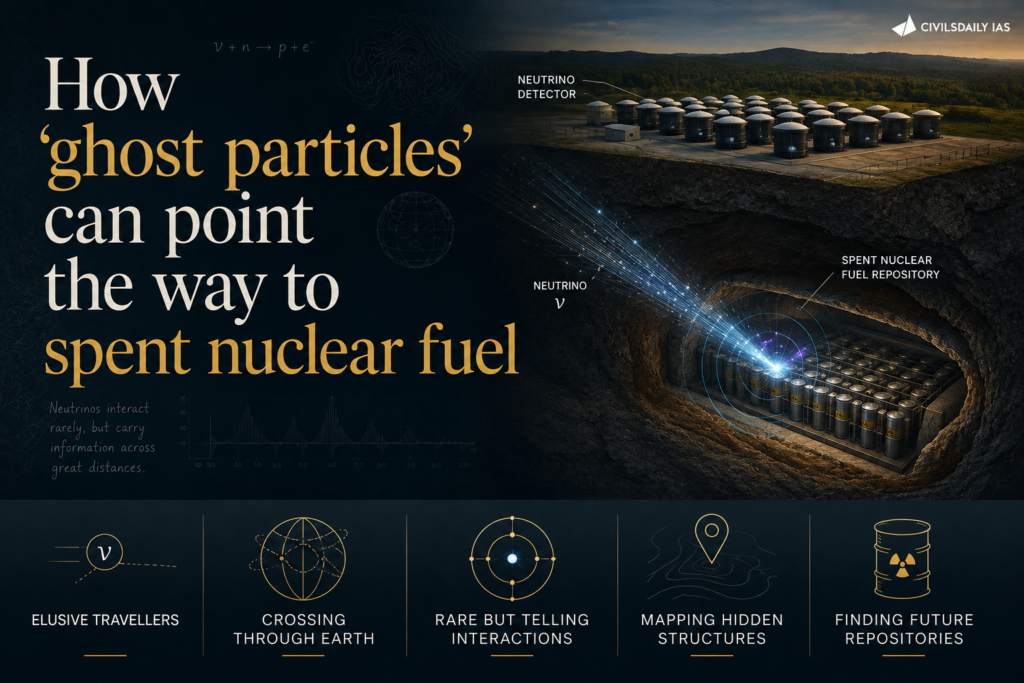
Why in the News
Scientists have achieved the first high precision measurement of the neutrino signature from spent nuclear fuel, enabling remote monitoring of nuclear material and strengthening global nuclear non proliferation efforts.
What is a neutrino?
- Ghost particle: A neutrino is a nearly massless, electrically neutral subatomic particle that interacts only through the weak nuclear force and gravity.
- Produced in nuclear reactions: They are emitted in large numbers during nuclear fission, radioactive decay, and reactions inside stars.
- Highly penetrating: Since neutrinos rarely interact with matter, they can pass through the Earth almost unaffected, making them extremely difficult to detect.
What did the study achieve?
- First precise measurement: Researchers in France made the first high precision measurement of the neutrino emissions from spent nuclear fuel.
- Remote monitoring: The neutrino signal can be measured without physically opening or handling the spent fuel.
- Scientific validation: The findings were published in a leading peer reviewed physics journal.
Why is this important for nuclear non proliferation?
- Supports IAEA safeguards: Enables the International Atomic Energy Agency (IAEA) to verify spent nuclear fuel remotely.
- Detects diversion: Changes in the neutrino signal can indicate diversion of plutonium or other fissile material for weapons.
- Strengthens nuclear safeguards: Provides a non intrusive and tamper resistant method to improve verification of nuclear material.
- Enhances transparency: Builds confidence in peaceful civilian nuclear programmes.
Prelims Pointers
- The International Atomic Energy Agency (IAEA) is the UN agency responsible for promoting peaceful uses of nuclear energy and implementing nuclear safeguards.
- Neutrinos are electrically neutral, nearly massless particles that interact via the weak nuclear force.
- Nuclear reactors and spent nuclear fuel continuously emit neutrinos.
- Spent nuclear fuel contains plutonium that can potentially be separated for nuclear weapons, making its monitoring important.
“[2020] In India, why are some nuclear reactors kept ‘IAEA Safeguards’ while others are not?
(a) Some use uranium and others use thorium
(b) Some use imported uranium and others use domestic supplies
(c) Some are operated by foreign enterprises and others are operated by domestic
(d) Some are State-owned and others are privately-owned