Why in the News
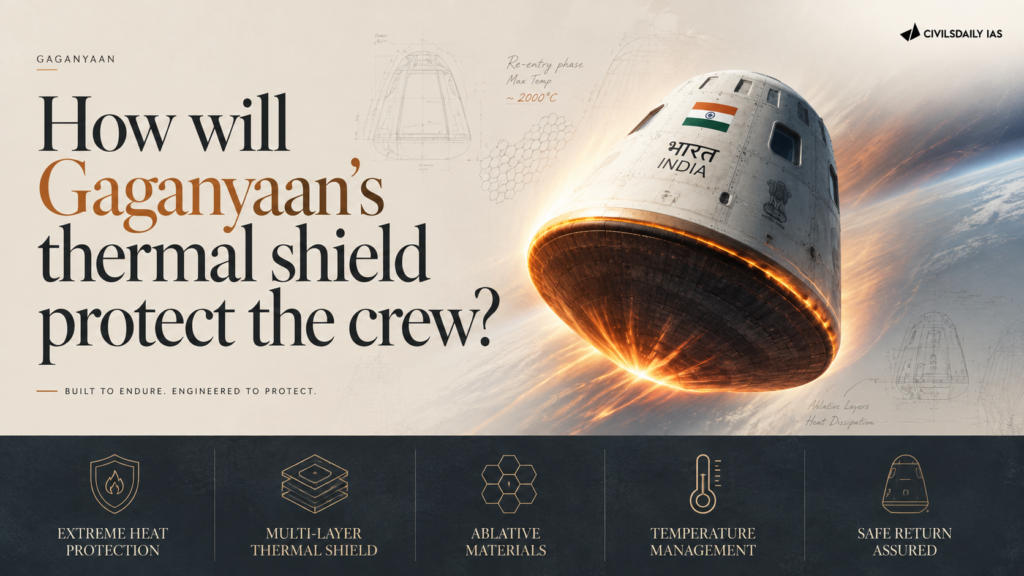
The Gaganyaan crew module will hit the atmosphere at 7,500 to 8,000 metres per second on return, with its exterior reaching 1,800 degrees Celsius while the structure must stay below 150 degrees Celsius. The shield chosen to hold that gap is a sacrificial ablative layer 30 to 35 millimetres thick, a choice driven by the mission’s single use design and India’s own re entry heritage rather than by peak performance.
What is a thermal protection system?
- What it does: A thermal protection system is the outer layer that keeps a re entering vehicle’s structure and interior within survivable temperature while its exterior is exposed to the heat of atmospheric entry.
- Why it is needed: Almost all of the crew module’s kinetic energy is dissipated into the atmosphere as heat energy, and the small portion directed back towards the module is still intense enough to melt it.
- What it protects: It maintains the module’s structural integrity and keeps the interior within the temperature limit the structure and the crew can tolerate.
- How it is classified: Systems are grouped by how they remove heat, into ablative, radiative and heat sink types.
What is heat flux?
- Definition: Heat flux is the rate at which heat energy passes through a unit area of a surface, measured in watts per square metre.
- Why it varies on a capsule: It is highest at the point of the vehicle that meets the airflow first, which is why the nose cap carries the most demanding shield material.
What is a boundary layer?
- Definition: The boundary layer is the thin region of gas immediately next to a moving vehicle’s surface, where the flow is slowed by contact with that surface.
- Why it matters in ablation: Gases escaping from the decomposing shield thicken and cool this layer, which blocks intense heat from being transferred into the module.
Why is atmospheric re entry harder than ascent for a crewed mission?
- Ascent is controlled and gradual: A rocket accelerates slowly through the atmosphere on the way up specifically to keep the mechanical loads on the vehicle to a minimum.
- Re entry cannot be aborted: Once the descent begins there is no provision to abort the mission, so every system must work through to splashdown.
- The crew cannot intervene: There is only a limited role for the crew to intervene and correct any system non conformance during descent.
- The event is too fast for human correction: Atmospheric descent is incredibly fast and the deceleration forces change constantly, and human response times are simply too high to manually correct a sudden system abnormality.
- What follows from this: All systems must therefore be made robust enough to withstand the scorching conditions of re entry on their own, since design margin substitutes for intervention.
What thermal conditions must the Gaganyaan crew module survive?
- Entry velocity: The crew module will hit the atmosphere at a speed of 7,500 to 8,000 metres per second on return from its orbit around the earth.
- Energy dissipation: More than 99 per cent of that kinetic energy will be dissipated into the atmosphere as heat energy.
- Exterior temperature: The exterior of the module will encounter temperatures as high as 1,800 degrees Celsius in some regions.
- Shield thickness: The thermal protection system is just 30 to 35 millimetres thick.
- Interior limit: That layer must keep the module’s temperature safely below 150 degrees Celsius while performing the task of maintaining structural integrity.
How do ablative, radiative and heat sink systems each remove heat?
- Ablative: A single use system that removes heat energy by sacrificing its own layers through chemical and physical processes, absorbing extreme quantities of thermal energy and chemically decomposing into a protective layer of solid char and outgassing vapours.
- The decomposition physically carries heat away from the module as the material burns off, and the escaping gases create a cooler boundary layer that blocks heat transfer into the module.
- Carbon phenolic and silica phenolic are examples of ablative materials.
- Radiative: A system that absorbs the extreme heat of re entry and then releases it back into space as electromagnetic radiation, primarily in the infrared spectrum and also as visible light when it is extremely hot.
- It remains intact and withstands the heat without melting or degrading, which makes it suited to reusable re entry vehicles.
- Heat sink: A system that absorbs heat energy and raises its own temperature without melting or changing phase in any other way.
- Copper and aluminium are examples of heat sink materials.
Why has the Indian Space Research Organisation chosen an ablative shield for the crew module?
- It matches the mission’s design philosophy: The Gaganyaan crew module is a single use vehicle, and an ablative system is a single use system, so the shield’s life and the module’s life are the same.
- It is proven and robust: The Indian Space Research Organisation (ISRO) has selected it as a proven and highly robust solution rather than the highest performing one available.
- It tolerates fluctuating heat loads: Ablative heat shields can easily handle fluctuating heat loads to protect the structure underneath, which matters when the descent profile varies.
- Radiative systems are less forgiving: Any design error in a radiative system can quickly cause dangerous overheating, so its margin for error is narrower.
- It avoids a maintenance burden: An ablative system withstands an extreme thermal load without requiring complex or delicate surface maintenance between flights.
- It avoids the reusable system’s cost structure: By avoiding the expensive manufacturing, specialised inspection and complex installation processes associated with a reusable radiative system, ISRO has taken the safer and more cost effective option.
Does choosing a single use shield trade away reusability for safety?
- What is given up: A sacrificial shield is consumed on every flight, so a new heat shield must be manufactured and installed for each mission rather than inspected and reflown.
- The recurring cost consequence: Per flight cost stays flat across a programme instead of falling with flight rate, which is the opposite of the economics a high cadence programme needs.
- Why the trade is correct for this mission: Reusability only pays back over a high flight rate, and a first generation crewed programme flying occasional missions never reaches that rate.
- Where the trade stops working: A sustained crew rotation programme to an orbital station changes the flight rate, at which point the reusable radiative option becomes the economically relevant one.
- The safety side of the trade: The ablative system’s tolerance of fluctuating heat loads and its independence from surface inspection are precisely the properties a programme flying its first crew needs most.
What does India’s own re entry heritage contribute to the Gaganyaan shield?
- The first re entry mission: The Space Capsule Recovery Experiment, India’s maiden re entry mission, used a carbon phenolic ablative to protect the module’s nose cap, where heat flux was the highest.
- The crew module demonstration: The Launch Vehicle Mark-3 (LVM3) flew the Crew Module Atmospheric Re-entry Experiment (CARE) in 2014. That flight successfully demonstrated crew module re entry using an ablative thermal protection system.
- What that established: The 2014 mission established the foundational technology that is now being used in the Gaganyaan programme, so the shield is an inheritance rather than a new development.
- Why heritage reduces risk: Material characterisation, manufacturing process and flight data already exist for the ablative route, which removes the qualification uncertainty a new material class would carry.
- The programme position: The Gaganyaan crew module is built on this ablative heritage and on the lessons learned from both earlier missions.
What does the SpaceX Crew Dragon comparison show about ablative shield design choices?
- United States, the Crew Dragon shield: The Crew Dragon capsule of SpaceX uses an ablative material named phenolic impregnated carbon ablator, or PICA, a lightweight carbon fibre matrix filled with a phenolic resin.
- The shared design logic: A crewed capsule operator with a very different cost structure has arrived at the same ablative class of solution, which indicates the choice follows from the capsule form rather than from budget constraint.
- The design feature that differs: PICA’s lightweight carbon fibre matrix trades density for mass saving, while carbon phenolic of the kind flown on India’s first re entry mission is denser and carries higher heat flux at the nose.
- The limit of this comparison: This is the single foreign system named in the evidence here, so it establishes that ablative shielding is the standard choice for crewed capsules, not a ranked comparison of national capsule programmes.
Challenges to the Gaganyaan thermal protection system
- Ground testing cannot reproduce full re entry: No ground facility reproduces the combined velocity, heat flux and duration of an orbital re entry, so qualification relies on partial simulation and analysis. Eg. Arc jet plasma facilities test coupons at representative heat flux but not at the full 7,500 to 8,000 metres per second entry velocity.
- Bond line integrity over a curved surface: A 30 to 35 millimetre layer must adhere uniformly over the module’s full curvature, and a bond defect creates a local hot path into the structure. Eg. Shuttle era thermal protection failures originated in localised damage to the protective layer rather than in the material’s bulk performance.
- Predicting the recession rate: Ablative design depends on predicting how much material burns off, and an over prediction adds dead mass while an under prediction risks burn through. Eg. Nose cap regions carry the highest heat flux and therefore the largest uncertainty in recession estimates.
- Mass penalty on the launch vehicle: A sacrificial shield sized with margin is heavy, and every kilogram of shield reduces the payload the human rated launcher can carry. Eg. The human rated LVM3 has to lift the crew module, service module and shield together to a 400 kilometre orbit.
- Manufacturing repeatability: Each mission needs a newly manufactured shield, so process variation between production batches becomes a flight safety variable rather than a quality issue. Eg. Carbon phenolic layup is a manual intensive process where resin content and fibre orientation must be reproduced identically each time.
- Recovery environment after splashdown: A charred shield must survive water impact and sea recovery without compromising the crew compartment. Eg. India’s first re entry mission was recovered from the Bay of Bengal, which is the recovery zone the crewed programme also plans to use.
- Single point criticality: With no abort provision once descent begins and limited crew intervention, the shield has no backup system to fall back on. Eg. Human response times are too high to correct a sudden thermal abnormality during a descent where deceleration forces change constantly.
Conclusion
The Gaganyaan crew module’s protection against a 1,800 degrees Celsius re entry rests on a 30 to 35 millimetre ablative layer that sacrifices itself to carry heat away and hold the structure below 150 degrees Celsius. The choice of an ablative over a radiative system follows from the module’s single use design, its tolerance of fluctuating heat loads and the technology base established by India’s first re entry mission and the 2014 crew module demonstration. The programme’s current status is that the shield is qualified on this heritage, with the first uncrewed test flight launching shortly.
Human Spaceflight Programme of India
- What it is: Gaganyaan is India’s human spaceflight programme, aimed at demonstrating the capability to launch a crew to low earth orbit and return them safely to Indian waters.
- Mission profile: The mission is designed to carry a crew of up to three to an orbit of about 400 kilometres for a mission duration of up to three days, followed by splashdown recovery.
- The launch vehicle: The launcher is a human rated version of the LVM3, designated the Human rated Launch Vehicle Mark-3 (HLVM3), modified with additional redundancy and a crew escape system.
- The orbital module: The crew module and the service module together form the orbital module, with the crew module being the pressurised habitable segment that returns.
- Institutional base: The Human Space Flight Centre was established at Bengaluru in 2019 to lead the programme, with the Vikram Sarabhai Space Centre responsible for launch vehicle and re entry systems.
- The longer roadmap: India’s stated goals extend to the Bharatiya Antariksh Station by 2035 and a crewed lunar landing by 2040.
Laws and Treaties Governing Space Activities
- Outer Space Treaty, 1967: Makes States internationally responsible for national space activities, whether carried on by governmental or non governmental entities, and bars national appropriation of outer space.
- Rescue Agreement, 1968: Obliges States to assist astronauts in distress and to return them and any recovered space objects to the launching authority.
- Liability Convention, 1972: Makes a launching State absolutely liable for damage caused by its space object on the surface of the earth or to aircraft in flight.
- Registration Convention, 1975: Requires launching States to maintain a national registry of space objects and to furnish details to the United Nations.
- Moon Agreement, 1979: Declares the Moon and its resources the common heritage of mankind, and India has signed but not ratified it.
- Indian Space Policy, 2023: Defines the roles of ISRO, the Indian National Space Promotion and Authorisation Centre, NewSpace India Limited and non governmental entities in the Indian space ecosystem.
- Space Activities Bill, 2017: A draft domestic law to license and regulate private space activity in India, which was circulated for comment and never enacted.
- Satellite Communications Policy and spectrum rules: Govern authorisation of satellite services, with spectrum assignment handled under the Telecommunications Act, 2023.
“[2025] Consider the following space missions:
I. Axiom-4
II. SpaDeX
III. Gaganyaan
How many of the space missions given above encourage and support microgravity research?
(a) Only one
(b) Only two
(c) All the three
(d) None
