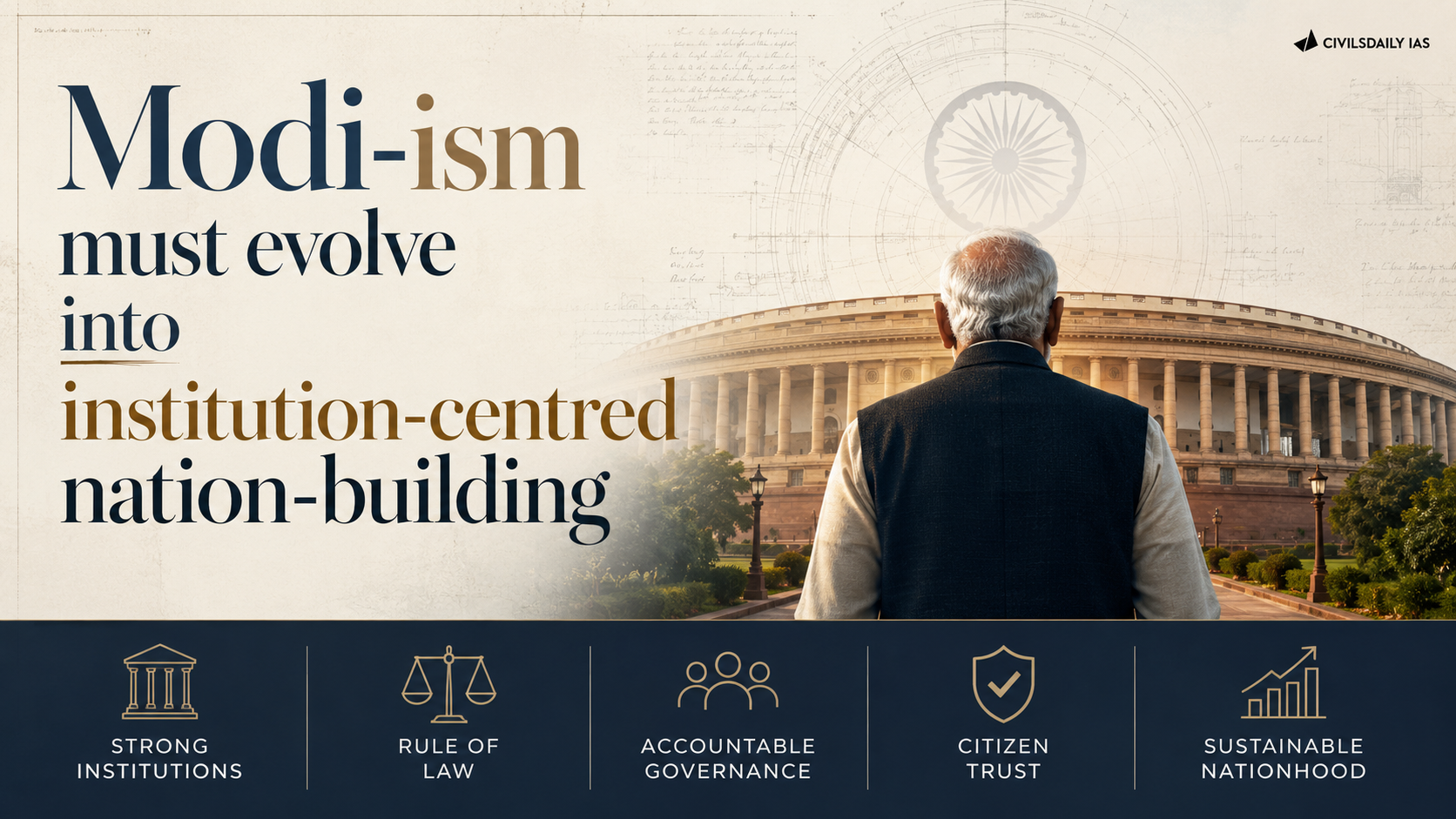
Why in the News
The political and governing order built around the Prime Minister, given the name Modi-ism, is being tested against the constitutional settlement rather than only against its delivery record. The 2024 verdict returned the Bharatiya Janata Party (BJP) with 240 seats and made coalition partners necessary, which qualified a leader centred mandate without rejecting it.
What is the governing order named Modi-ism?
- About: Modi-ism is the name given to the political and governing order built around the Prime Minister. It is a method of acquiring power, exercising authority and defining the nation.
- Named features: The order is built on eight elements: a commanding leader, a disciplined party organisation, civilisational assertion, centralised decision-making, technology-driven welfare, infrastructure-led development, high-energy national security and direct communication with citizens.
- Central promise: The promise is a strong leader, a purposeful state and a stronger India.
What has the order actually delivered?
- Political transformation: The BJP moved from being a major national formation to the central axis of Indian politics. It expanded beyond its traditional geographical and social constituencies and made leadership itself the principal electoral proposition.
- The 2024 qualification: The BJP fell to 240 seats in 2024 and required its National Democratic Alliance (NDA) partners to form the government. The verdict chose continuity and restored the relevance of consultation, coalition and restraint.
- Delivery at scale: Infrastructure construction, digital public platforms, direct benefit transfers, financial inclusion, sanitation, housing, electrification and welfare delivery at scale strengthened the state’s capacity to reach citizens.
- Poverty measurement: NITI Aayog estimated multidimensional poverty at 11.28 per cent in 2022-23, against 29.17 per cent in 2013-14. The methodology is contested, the improvement in delivery is not.
- Political containment: The order contained the undue proliferation of regional politics to some degree.
- Source of appeal: The order speaks in the language of aspiration, national confidence and civilisational recovery. Citizens long frustrated by delay, indecision and fragmented authority respond to a government promising speed and scale.
Why is effectiveness not a sufficient test of democratic government?
- The five charges: Critics allege that the order seeks to weaken pluralism, dilute socialism, replace rights with governmental charity, capture institutions and ultimately alter the Constitution.
- The counter position: Supporters dismiss these charges as partisan hostility or as resistance to India’s cultural resurgence. Both positions are too absolute, since constitutional character must be judged through the actual exercise of power rather than through slogans.
- Evidence against dismantling: Elections remain fiercely competitive, governments change in the States, Opposition parties govern substantial parts of the country, and courts continue to examine executive action and enforce fundamental rights.
- The Preamble ruling: In November 2024 the Supreme Court rejected petitions challenging the inclusion of the words socialist and secular in the Preamble.
- The real risk: A Constitution can be weakened without its words being formally deleted. Institutions may remain intact on paper as their independence, credibility and conventions erode.
- What sustains democracy: Democracy rests on five supports beyond periodic elections: restraints on power, respect for dissent, parliamentary accountability, federal balance and equal citizenship.
What do the pluralism and socialism debates actually turn on?
- Pluralism: Religious freedom has not been legally abolished. Majoritarian mobilisation and inflammatory language make minorities feel conditionally accepted.
- The distinction drawn: Cultural nationalism is constitutionally legitimate. Cultural supremacy is not.
- Equal citizenship: The republic belongs without qualification to every citizen. Equal citizenship cannot depend on religion, political loyalty or conformity with a preferred account of national identity.
- What socialism does not mean: Constitutional socialism does not demand a return to the licence-permit raj, hostility to private enterprise or indiscriminate state ownership.
- What socialism does mean: It requires social and economic justice, equality of opportunity and protection against degrading deprivation.
Why must welfare reach a citizen as a right rather than as a gift?
- The presentation problem: Statutory entitlements are politically presented as personal gifts from a leader. Food support, employment guarantees, housing, scholarships and social security are public obligations financed by citizens and delivered under law.
- The ordering principle: Rights-based governance must complement beneficiary politics rather than be displaced by it. A citizen must remain a rights-holder rather than a grateful beneficiary.
- What technology fixes: Technology reduces leakage and accelerates delivery.
- What technology creates: Citizens excluded by failed authentication, inaccurate databases or administrative discretion need accessible remedies.
- The four safeguards: Welfare requires enforceable standards, grievance redress, social audits and legislative scrutiny.
What does the record on Parliament and appointments show?
- Speed of legislation: During the seventeenth Lok Sabha, 58 per cent of bills were passed within two weeks of introduction.
- Committee referral: Only 16 per cent of bills were referred to parliamentary committees.
- Budget scrutiny: Around 80 per cent of the Union Budget was voted without discussion between 2019 and 2023.
- Political funding: The Supreme Court decision striking down the electoral bond scheme established that secrecy in political funding had crossed a constitutional boundary.
- Election commissioner appointments: The law governing the appointment of election commissioners gives the executive a majority on the selection committee, which has raised concerns about perceived independence.
- The test for autonomy: Institutional autonomy depends on more than technical legality. It requires transparent appointments, procedural fairness and visible distance from partisan command, so independence is protected in public perception as well as in fact.
What corrections would a shift to institution-centred nation-building require?
- Parliament: Parliament must recover serious deliberation, committee scrutiny and control over public expenditure.
- Federalism: Federal consultation must precede major decisions affecting the States.
- Appointments and agencies: Appointments to constitutional and regulatory bodies should command cross-party credibility. Investigative agencies must be demonstrably even-handed.
- Welfare and discourse: Welfare delivery must be joined to enforceable rights, and political discourse must replace habitual polarisation with constitutional fraternity.
- The next development phase: The eight stated goals are productive employment, competitive manufacturing, stronger small enterprises, higher farm incomes, quality public education, accessible healthcare, liveable cities and climate resilience.
- Party institutionalisation: No durable national party can remain indefinitely dependent on one personality. It needs empowered ministers, credible regional leaders, internal debate and an orderly culture of succession.
Challenges to Institution-Centred Nation-Building
- Executive control of the legislative calendar: A ruling coalition can clear the chamber of dissent before a contested bill is taken up. Eg. In December 2023, 146 members were suspended across both Houses, the largest mass suspension since Independence, and the Telecommunications Bill, 2023 was passed with the near entire opposition absent.
- A vacant Deputy Speaker’s chair: Article 93 mandates the election of a Deputy Speaker, and the post has been left unfilled for years. Eg. The post lay vacant through the entire seventeenth Lok Sabha and into the eighteenth, so a member from the Speaker’s own panel of chairpersons presided over the no-confidence motion against the Speaker in March 2026.
- Discretionary gatekeeping on removal motions: Section 3 of the Judges (Inquiry) Act, 1968 uses the word may, so the presiding officer may refuse a removal motion even when the numerical threshold is met. Eg. In April 2026 a notice signed by 193 opposition members seeking removal of the Chief Election Commissioner was refused admission in both Houses without stated reasons.
- The Money Bill route: Certifying a bill as a Money Bill removes the Rajya Sabha’s power to amend it and places the certification beyond ordinary challenge. Eg. The Aadhaar (Targeted Delivery of Financial and Other Subsidies, Benefits and Services) Act, 2016 was passed as a Money Bill, and the correctness of that certification remains before a larger bench of the Supreme Court.
- Bypassed pre-legislative consultation: Draft legislation is often introduced without the public comment period the executive’s own policy prescribes. Eg. The Pre-Legislative Consultation Policy of 2014 requires draft bills to be placed in the public domain for thirty days, and this step is routinely skipped.
- Federal consultation deficit: Consultative federal forums exist on paper and meet rarely. Eg. The Inter-State Council, constituted under Article 263, met only once between 2016 and 2024.
Conclusion
Effectiveness alone cannot settle the constitutional character of a government, and a Constitution can be hollowed out without a word of its text being altered. The productive core of the order, decisive leadership, infrastructure, digital innovation, credible defence capability and measurable delivery, should continue. What must change is the shift from leader-centred mobilisation to institution-centred nation-building, carried by parliamentary deliberation, federal consultation, cross-party credibility in appointments and welfare delivered as enforceable right. The choice is between an order disciplined by the Constitution and one that seeks to rise above it.
