Why in the News?
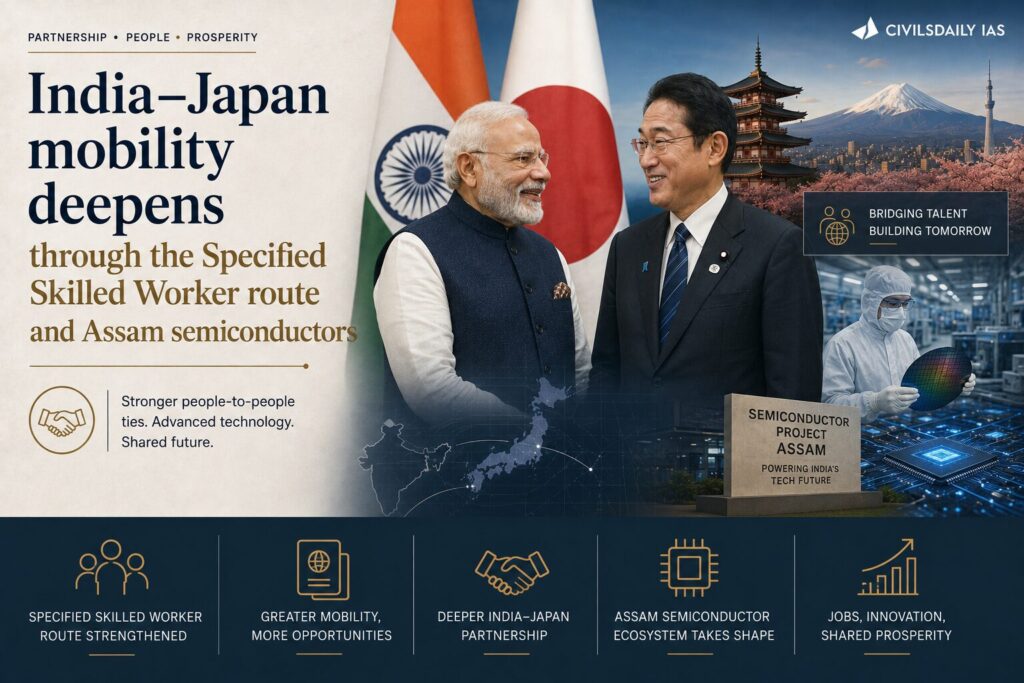
Youth from India’s Northeast are training as caregivers and agriculture workers for an ageing Japan under the Specified Skilled Worker (SSW) programme. This channels India’s demographic surplus into Japan’s labour shortage and links mobility to investment such as Japanese financed projects and the Assam semiconductor ecosystem.
What is the Specified Skilled Worker (SSW) programme?
- Residence status from 2019: Japan introduced the SSW status of residence in 2019 to let blue collar foreign workers obtain a working visa for up to five years.
- Eligibility: Applicants must pass a Japanese language test and a specified skills exam in one of 16 fields, including nursing care, food and beverage manufacturing and industrial products.
What is Official Development Assistance (ODA) through JICA?
- JICA loans: The Japan International Cooperation Agency (JICA) is Japan’s development agency that extends concessional ODA loans for infrastructure and social projects.
- Northeast footprint: JICA finances road corridors in Meghalaya, health facilities in Mizoram, Nagaland and Assam, and is joining Assam’s semiconductor ambitions.
What is the A-SEMI project?
- Assam semiconductor ecosystem: The Assam Semiconductor Ecosystem on Manufacturing and Innovation (A-SEMI) is a state government project with JICA, alongside Tata Electronics’ assembly and testing facility expected to begin production this year.
- Research linkage: A Japanese firm signed a memorandum with IIT Guwahati for collaborative research in semiconductor manufacturing.
Why is Japan turning to foreign workers?
- The 2040 problem: Japan’s working population is projected to fall from 66.34 million in 2025 to 55.42 million in 2040, threatening severe labour shortages.
- Ageing pressure: By 2040 there will be three seniors aged 65 and above for every teenager under 15.
- Scaled intake: Japan expects to accept 8.05 lakh Specified Skill Workers by the end of March 2029, with highest demand in industrial manufacturing, food and beverages and nursing care.
How does this pathway serve India and the Northeast?
- Remittances: A caregiver in Japan can send home Rs 50,000 to Rs 60,000 a month, far above local nursing wages of around Rs 15,000.
- State backing: Assam subsidises SSW training fees, Manipur University opened a Japanese Language Centre, and Mizoram signed agreements with training centres.
- Cultural affinity: Widespread interest in Japanese media and easier physical assimilation draw young people from the region into the programme.
Where does India stand among Japan’s foreign workforce?
- China leads: China was the largest foreign resident group in Japan at the end of 2025 with 9.3 lakh residents.
- Ahead of India: Vietnam, South Korea, the Philippines and Nepal all rank above India in resident numbers.
- India’s small slice: There were 53,974 Indian nationals in Japan as of December 2024, a fraction of the foreign worker pool.
- The joint target: India and Japan set an aspirational target of exchanging more than 5,00,000 personnel in both directions over five years, including 50,000 skilled personnel from India.
What are the challenges to India Japan labour mobility?
- Language barrier: School level Japanese proves inadequate for daily workplace use, slowing settlement and placement.
- Migration safeguards: Ensuring legal, documented channels is essential to prevent exploitation of workers moving abroad.
- Skill drain: Trained nurses and caregivers leaving India can deepen shortages in the Northeast’s own health system.
- Small scale: Placement numbers remain nascent relative to Japan’s demand and India’s demographic potential.
- Isolation and costs: New arrivals face social loneliness and heavy documentation and relocation costs before earning.
- Certification bottlenecks: Delays such as the Certificate of Eligibility can stall departures despite cleared exams.
Conclusion
India Japan mobility is at an early but expanding stage, with the SSW route, JICA financed projects and the A-SEMI semiconductor plan tying labour flows to investment. The next milestone is the launch of the A-SEMI project and progress towards the joint target of 5,00,000 personnel over five years, alongside Japan’s planned intake of 8.05 lakh Specified Skill Workers by March 2029.
Back2Basics:
Japan International Cooperation Agency (JICA)
- Type: Japan’s governmental agency for delivering Official Development Assistance (ODA).
- Headquarters: Tokyo, Japan.
- Mandate: Provides concessional loans, grants and technical cooperation for infrastructure and social development in partner countries.
- India role: A major bilateral development partner financing metro rail, connectivity, health and industrial projects, including in the Northeast.
PYQ Relevance
[UPSC 2019] The time has come for India and Japan to build a strong contemporary relationship, one involving global and strategic partnership that will have a great significance for Asia and the world as a whole.” Comment.
Linkage: The question examines the strategic and economic dimensions of the India-Japan Special Strategic and Global Partnership. The article shows how India-Japan ties are expanding beyond infrastructure to skilled mobility, human resource cooperation and semiconductor collaboration, deepening the strategic partnership.
