Why in the News
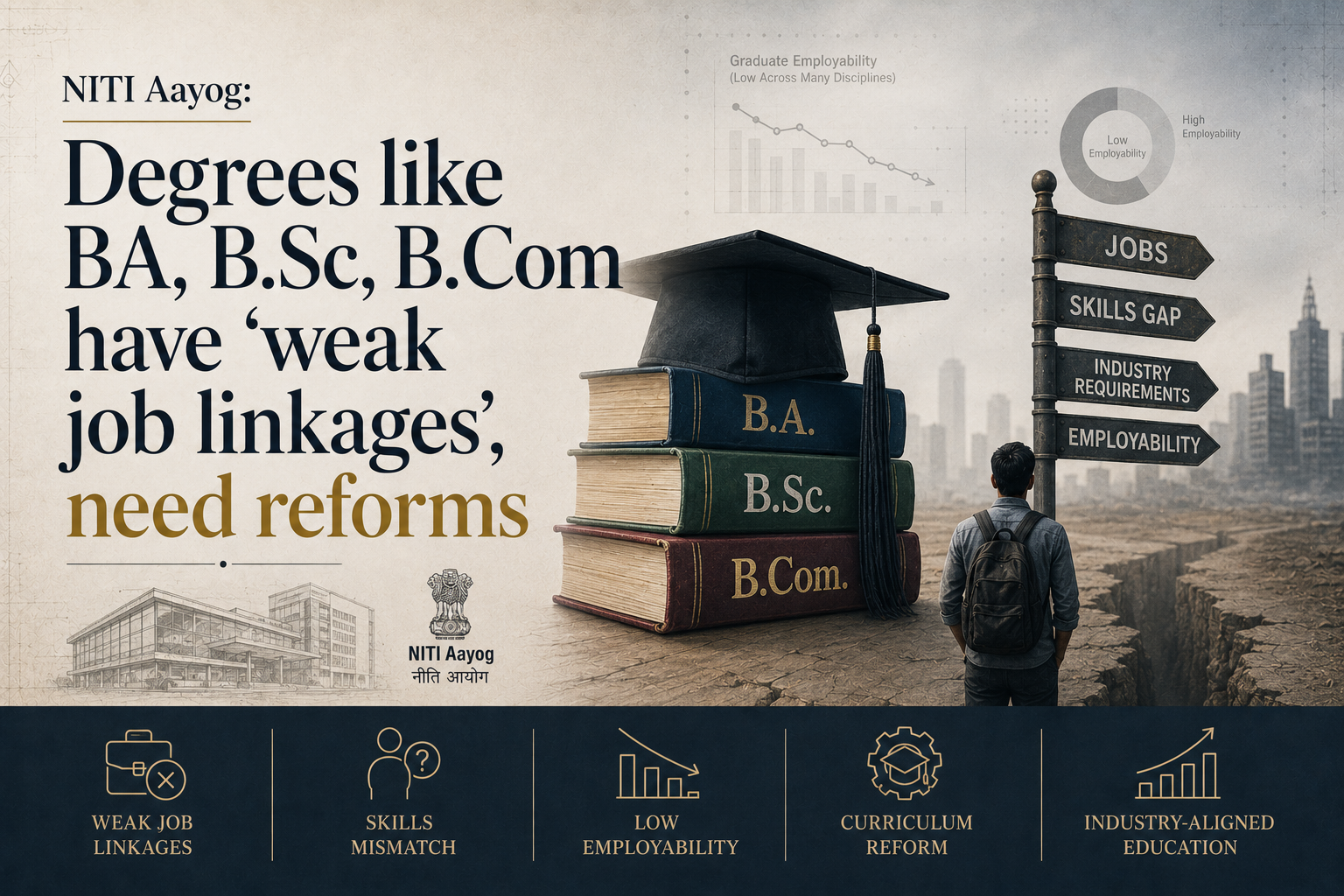
NITI Aayog has flagged that unemployment among graduates remains far higher than the national average, and that over-reliance on generic degrees such as BA, B.Sc and B.Com is contributing to the problem. The finding comes amid a renewed push to redesign India’s skilling architecture toward specialised, job-linked programmes.
What does NITI Aayog’s assessment find?
- Most graduates work outside their field of study: Over 90% of India’s graduates are employed in roles not aligned with their qualifications.
- The disconnect is curriculum level: NITI Aayog states that curriculum in most institutions remains outdated and misaligned with evolving industry needs, producing degrees and diplomas with weak job linkages.
- The proposed direction is sector specific: The think tank makes the case for moving toward specialised, job-linked programmes in high-growth sectors such as green industries and electric vehicles, with greater emphasis on apprenticeships.
Conclusion
NITI Aayog’s assessment reframes graduate unemployment as a curriculum design problem rather than only a labour demand problem, and its recommendation is a shift from generic degrees toward sector-specific, apprenticeship-linked training in high-growth industries.
“[2015, GS3, 12 marks] The nature of economic growth in India in recent times is often described as a jobless growth. Do you agree with this view? Give arguments in favour of your answer.”
