Why in the News
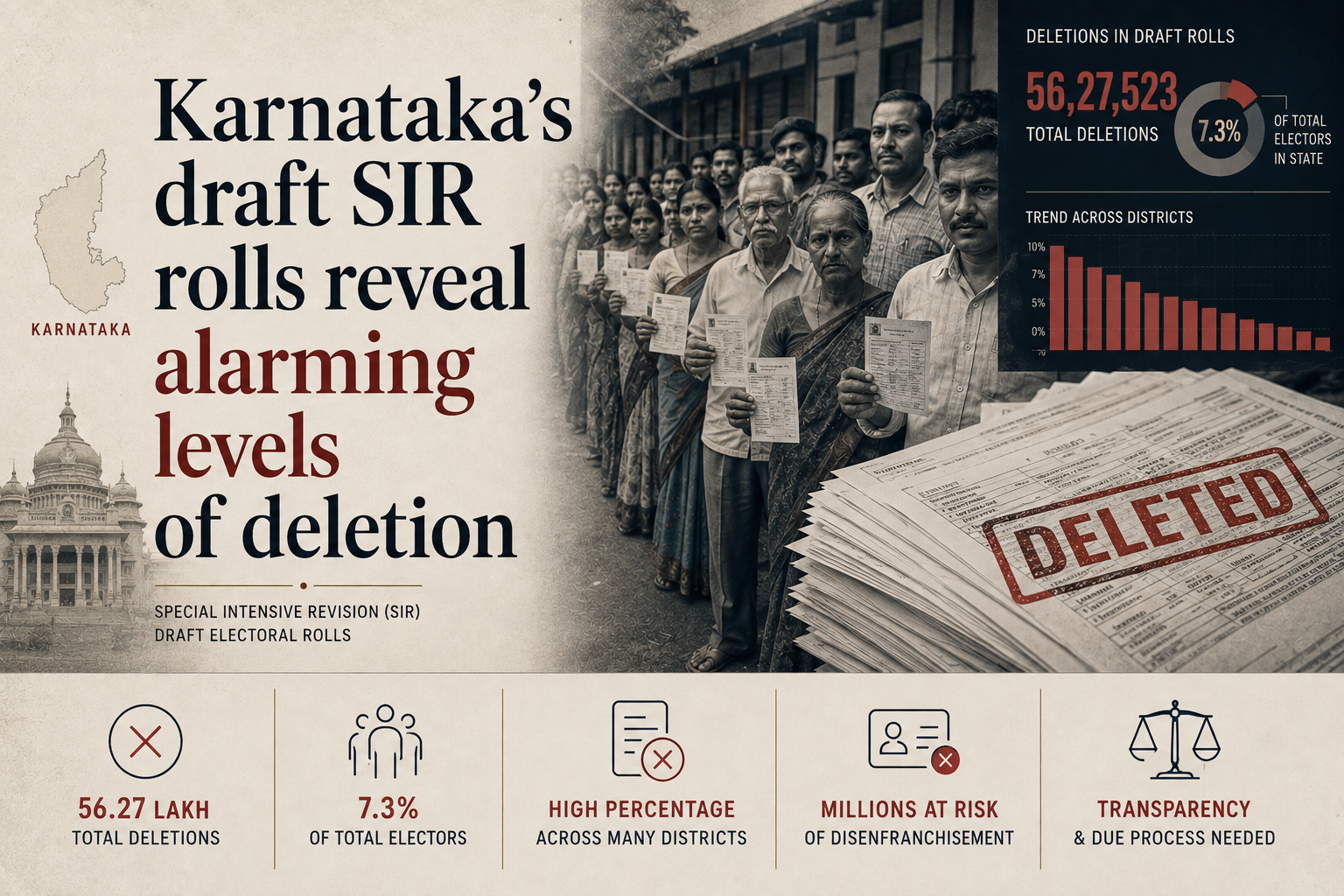
The draft electoral rolls released after the enumeration phase of the Special Intensive Revision (SIR) show Karnataka’s rolls shrinking by 19.5%, a deletion of 1.08 crore names, the second-highest deletion rate among major States after Telangana. Constituency-level analysis shows the deletions concentrated overwhelmingly in Bengaluru’s urban core, and the Election Commission’s continuing refusal to release the electors-to-population ratio, combined with Karnataka’s own opaque disclosure practices, has deepened concerns about whether the exercise can be independently verified.
What do the numbers show about how the deletions are distributed?
- Five constituencies lost more than half their electors: Bommanahalli (54.8%), Dasarahalli (52.1%), B.T.M. Layout (51.6%), Vijayanagar (51.1%), and C.V. Raman Nagar (51.1%) each saw over 50% of their rolls deleted, the first time any major State has recorded constituencies crossing that threshold during SIR enumeration, and all five sit in the core Bengaluru area.
- The deletions are heavily concentrated in a small number of seats: Half of the 1.08 crore deletions came from just 36 of Karnataka’s 224 Assembly Constituencies, of which 28 were in the core Bengaluru area.
- A structural gap against the eligible population persists: Karnataka’s draft SIR roll is at least 67 lakh short of the population eligible to vote as estimated by the Union government’s Technical Group on Population Projections, the largest shortfall among the major States compared in the underlying data.
- The “Shifted” category is unusually high even in rural constituencies: Unlike the urban-concentration pattern seen in other States, Karnataka recorded a high share of deletions marked “Shifted” even in predominantly rural constituencies.
Why is the process itself under scrutiny, independent of the deletion numbers?
- The Election Commission has not released the electors-to-population ratio for any State during this SIR round: This ratio, mandatory during every roll revision, is the standard check on under- or over-enrolment, and its absence is attributed by the Commission to the lack of Census data.
- Karnataka’s disclosure practice is the weakest among major States: Unlike other States that host a searchable deletion list, Karnataka’s Chief Electoral Officer has hosted the deleted-voters list only as booth-wise documents on scattered Google Drive links, in English only, without old booth numbers, making verification difficult for affected voters.
- Gender-disaggregated data on deletions is missing: Karnataka has not released gender-wise deletion data, unlike other States, and the Chief Electoral Officer’s office has stated it does not hold this data.
Conclusion
The scale and concentration of Karnataka’s SIR deletions, combined with the Election Commission’s continuing non-disclosure of the electors-to-population ratio and Karnataka’s own weak search and disclosure infrastructure, leave roughly 44 lakh voters in the draft rolls facing discrepancy notices with no independently verifiable baseline against which the exercise’s accuracy can be tested.
Back2Basics
- Special Intensive Revision (SIR): An intensive, house-to-house revision of electoral rolls carried out under the Representation of the People Act, 1950, distinct from the routine annual summary revision, undertaken to re-verify enrolment through fresh enumeration.
- Electors-to-Population (EP) ratio: The proportion of the population eligible to vote (18 years and above) that is actually enrolled on the electoral rolls; a low EP ratio indicates under-enrolment and a high one can indicate over-enrolment or padding.
