Why in the News
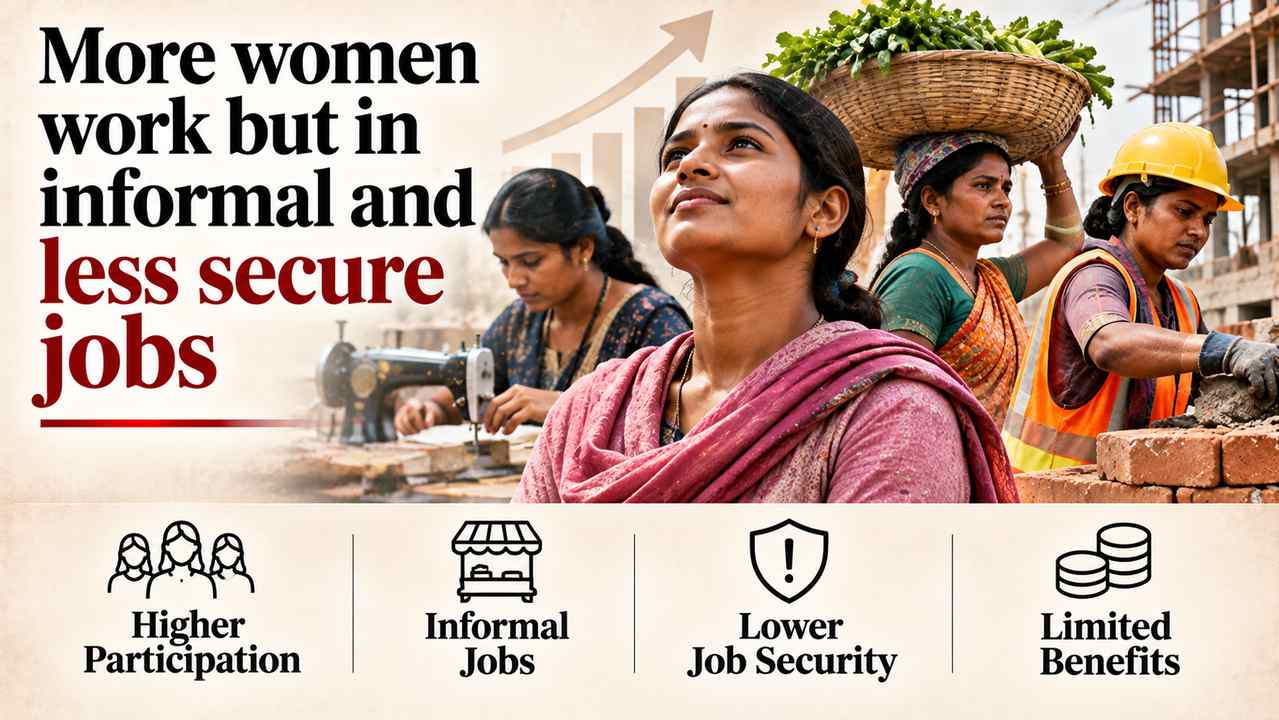
The number of working women in India nearly doubled between 2017-18 and 2025, from 104 million to 201 million. The report ‘The Participation Paradox’ by the Indian Council for Research on International Economic Relations (ICRIER) finds most of the new work in farming, self employment and unpaid family labour, with shorter hours and lower relative pay.
What is the ‘participation paradox’?
- What it is: Far more women are counted as working, but most new work is informal, low paid and insecure. It is like a school that doubles enrolment without adding classrooms.
- Data behind the report: The report uses the Periodic Labour Force Survey (PLFS), the government’s employment survey, and the Time Use Survey of how people spend their day.
- Gain from better counting: Women’s labour in fields and cattle sheds went mostly unrecorded for decades and is now counted.
- The takeaway: Counting shows how many women work, but the quality of the work decides whether their lives improve.
Where has the new work for women come from?
- Female worker population ratio: The share of women who are working rose from 22% to 38%, mostly in rural India.
- Agriculture absorbs the surge: Rural women in crop and animal production rose from 54 million to over 100 million. Rural men left farming, the usual shift as an economy grows, called structural transformation.
- Informal work outside farms: Women’s other job gains were in garments, retail and construction, where work is largely informal and done in micro and own account enterprises (one person, no hired workers).
- Shift to self employment: Rural women in own account work quadrupled, and their share in regular salaried jobs slipped from 10.5% to 9.3%.
What do hours and earnings show about the quality of this work?
- Falling hours: Weekly working hours fell for every group, most for rural women, by a little over six hours. Much new work is therefore marginal, filling only part of the week.
- Hours gap in textiles: In rural textiles, men’s lead in weekly hours widened from 11 to 21 hours. Many women there remain in home based or piece rate work, paid per item made.
- Widening wage gap: Women’s earnings rose but men’s rose faster. A rural woman now earns roughly 45% of what a rural man earns, down from 53%.
- Widest gaps where women work most: Per hour, men earn 2.1 times what women do in rural tobacco manufacturing. Women earn on par in about 20 urban sectors, which employ few women.
Why does unpaid care work hold women back?
- Reason for staying out: 60% of women outside the labour force cite childcare and household commitments, against fewer than 1% of men. This has barely changed since 2021-22.
- Daily time gap: Women spent 3.7 hours a day more than men on domestic work in 2024, and nearly an hour more on care.
- Paid work adds to the load: Working women still spend around four hours a day on domestic work and nearly two on care. Working men spend under three hours on the two together.
- Limit of skilling: Skilling and job creation help only if women have time for them. Unpaid work at home absorbs that time and is not counted in national income.
Challenges
- Uneven gains from growth: The gains from India’s structural transformation have gone largely to men.
- Maternity benefit gap: The Maternity Benefit Act, 1961 covers establishments with ten or more employees, which leaves out most self employed women.
- No paternity leave law: No central law gives private sector fathers paid paternity leave.
Way Forward
- Lower care burden: Provide affordable, good quality childcare, and finance paid paternity and shared parental leave partly through social insurance (pooled contributions).
- Industrial policy that works for women: Support for Micro, Small and Medium Enterprises (MSMEs) should reward hiring women, with hostels and transport in textile parks.
- Paid work close to home: Create such work for rural women through local enterprise clusters, livelihood missions and women led producer organisations.
Conclusion
India now counts women’s work, but most of it remains informal, low paid and insecure. The next test is whether childcare, parental leave and enterprise support move women into better paid and more secure jobs.
Key numbers
- Agriculture’s share in rural employment, 2017-18 to 2025: men 54.1% to 47.2%, women 70.7% to 73.3%.
- Urban women in agriculture: 2.6 million to 6.3 million, their largest employer.
- Men’s hourly earnings relative to women’s: 2 times in education, 1.8 in textiles, 1.7 in crop production.
Matching Previous Year Question
“No direct PYQ traced in the provided files. Thematic PYQ: [2025, GS2, 10 marks] Women’s social capital complements in advancing empowerment and gender equity. Explain.”
