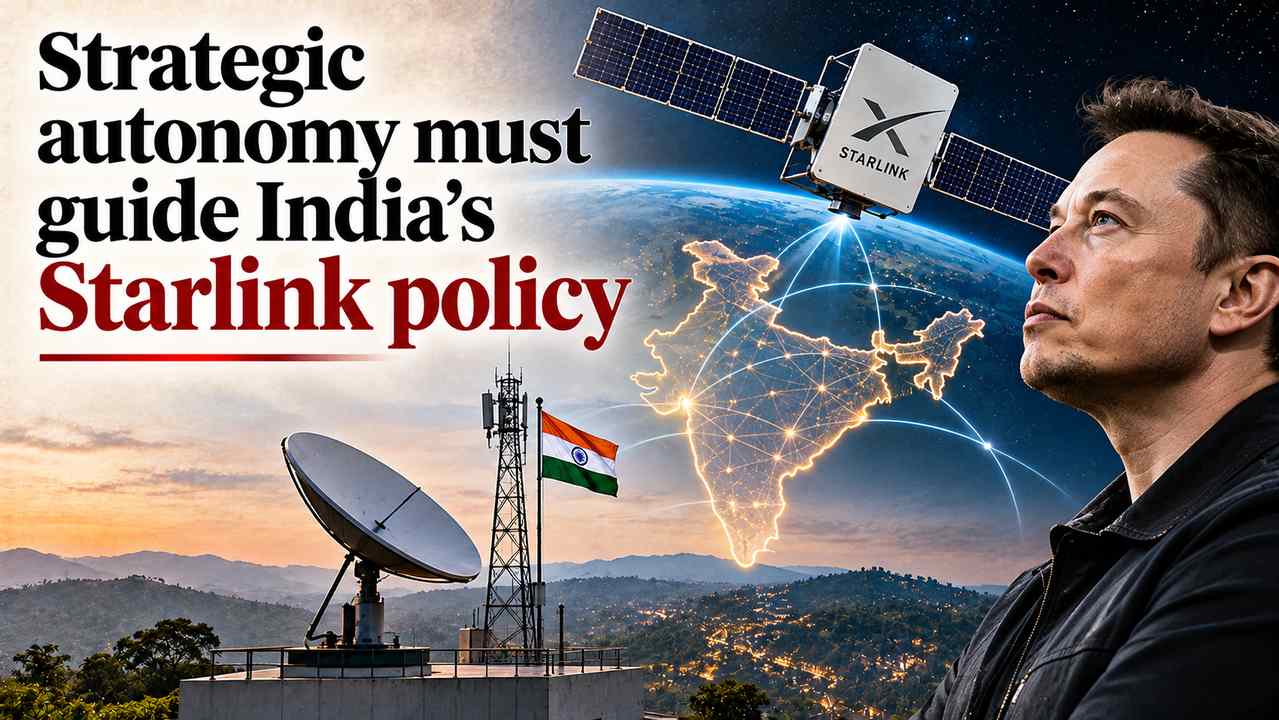
Why in the News
The debate over Starlink’s entry into India has centred on Elon Musk’s charge that Indian “oligarchs” are impeding it. The government replied that all satellite operators follow the same regulatory process. The larger question is how much control India will have over Starlink, a matter of national security and strategic autonomy, the freedom to act without depending on another power.
What is Starlink, and where does it fit in India’s networks?
- What it is: Starlink is the satellite internet service of SpaceX. It sends internet from satellites straight to a user’s terminal, like a mobile tower placed in the sky.
- Density versus reach: Fibre and mobile networks serve many people in one area. Starlink reaches remote places without towers or cables but serves few users per region, so it will not replace them.
- Best uses: Starlink suits isolated settlements, border regions, ships and disaster areas, and can connect soldiers, drones, sensors and command centres.
- The takeaway: Governments and the military need connectivity in exactly these places, so Starlink’s entry is a national security question.
What control does India have over Starlink, and where does it fall short?
- Limited control: India can license and penalise Starlink, but SpaceX controls the satellites, software and terminal access. The network could stay on where India orders it off, or go off when most needed.
- Routing condition: Operators must route Indian user traffic through ground stations in India, called gateways. Links between satellites cannot be used to bypass them or to send Indian traffic through stations abroad.
- Monitoring and shutdown: Operators must give security agencies monitoring facilities and restrict connectivity on security related orders. Starlink has indicated willingness to comply and announced ground station sites in India.
- Enforcement gap: Authorities can inspect ground stations in India. Checking if traffic was routed or copied abroad depends partly on SpaceX’s own information.
What do Iran and Ukraine show about controlling Starlink?
- Iran’s complaint: Iran has complained since 2023 to the International Telecommunication Union (ITU), the United Nations agency that coordinates radio frequencies, about unauthorised Starlink terminals on its soil.
- Limits of the regulator: In October 2026 the agency’s Radio Regulations Board again called for the transmissions to stop. It said it lacked authority to suspend the satellites’ assigned radio frequencies.
- Cooperation in Ukraine: In February, Ukrainian authorities and SpaceX identified authorised terminals and blocked those used by Russian forces. SpaceX acted on Ukraine’s requests, unlike in Iran.
- Disruption in Ukraine: On October 14, Ukrainian officials reported that Starshield, the military service built on Starlink technology, lost connectivity on terminals moving faster than about 160 km/h. This disrupted drone missions and frontline logistics.
- Contested cause: Ukraine’s President said the restrictions applied in Ukraine but not in European Union countries. Service returned on October 24, and the reason and responsibility remain contested.
Why can India neither shut Starlink out nor depend on it?
- Cost of exclusion: Keeping Starlink out would cost remote regions valuable connectivity.
- American leverage: SpaceX depends on American regulatory approvals and government contracts, which gives Washington leverage over it. Eg. The Ukraine disruption coincided with Washington’s pressure on Ukraine to stop striking Russian oil refineries.
- Disputed order: One report traced the Ukraine restriction to the White House. The US President denied personally issuing it.
- Divergent interests: If American and Indian interests diverge in a crisis, this dependence becomes a strategic vulnerability for armed forces, emergency responders and essential services.
Challenges
- Lost backup route: If Indian ground stations fail, the routing condition stops Starlink from rerouting traffic abroad, removing one backup.
- Limits of ground networks: Fibre and mobile towers cannot cover every ocean, mountain region or remote frontier.
- Weak rural broadband: Only 30% of gram panchayats had a functional connection under BharatNet, the rural broadband project, as of February 2026.
Way Forward
- Strict licensing with better checks: India should retain strict licensing conditions and improve compliance checks as Starlink evolves.
- Tested backups: Military and essential users should keep backup connections and tested switching procedures.
- Multiple providers: Use several satellite internet providers from different jurisdictions.
- Wider ground coverage: Expand ground networks so fewer communities depend on Starlink alone.
- Domestic constellations: Encourage Indian satellite constellations (networks of many satellites), whose demand for satellites and rockets builds Indian industry.
Conclusion
A licence gives India legal authority over a foreign satellite network but not operational control of it. India needs enough alternatives, on the ground and in orbit, to keep essential communications working when one provider will not or cannot serve.
Matching Previous Year Question
“[2026] Consider the following statements about Mission Sudarshan Chakra of India: 1. It aims to enhance India’s air defence, ballistic missile defence and aerial offensive capabilities. 2. Designed to enhance rapid, precise, and powerful defence responses, reinforcing India’s strategic autonomy. 3. One of the aims is to cover all public places of India by an expanded nationwide security shield by 2035. (a) 1, 2 and 3 (b) 1 and 2 only (c) 2 and 3 only (d) 1 only ANSWER: A”
