Why in the News
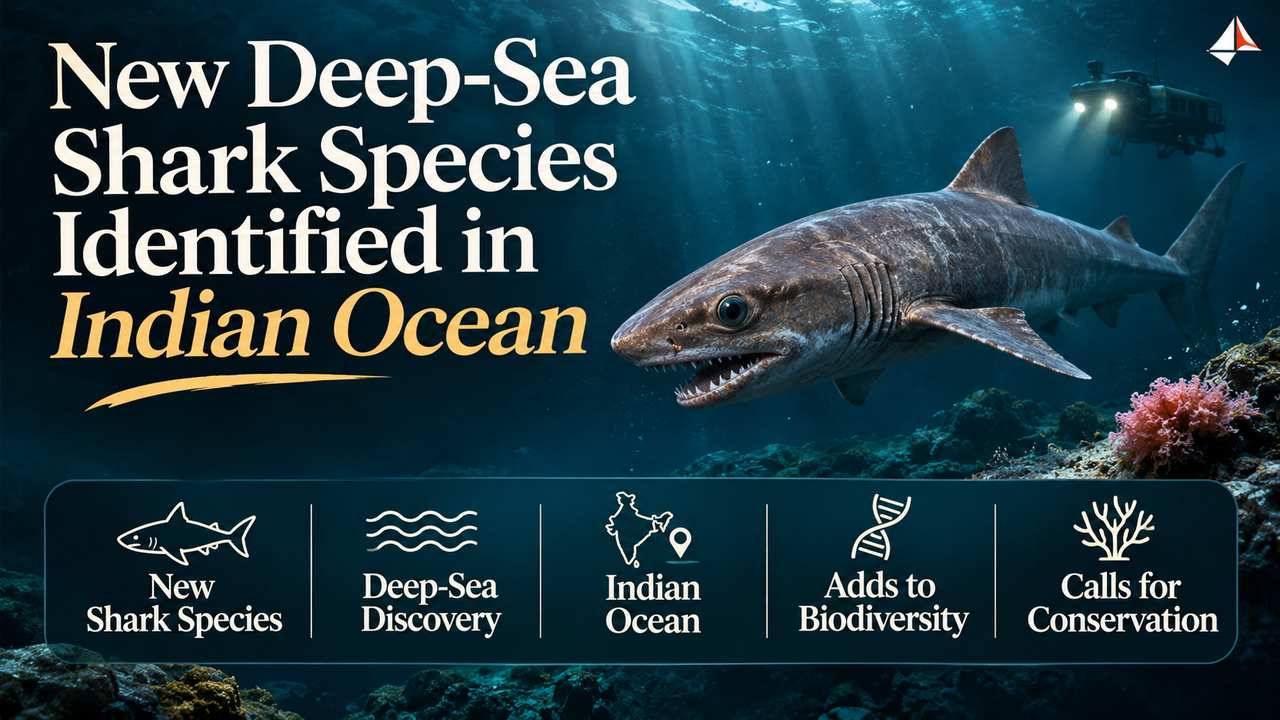
A deep-sea shark of the Indian Ocean, long believed identical to its Atlantic counterpart, is now recognised as a distinct species, the Indian Bramble Shark (*Echinorhinus roinee*). Researchers from the Zoological Survey of India (ZSI) and the Indian Council of Agricultural Research (ICAR)‘s Central Marine Fisheries Research Institute (CMFRI) identified it from specimens landed at a fishing harbour in Kollam, Kerala.
What has been identified?
- What it is: The Indian Bramble Shark is a deep-sea shark now named as a species of its own. Scientists had treated it as the same animal found in the Atlantic, like two lookalike cousins mistaken for twins.
- Scientific name: It is named *Echinorhinus roinee*, which places it in the genus *Echinorhinus*, the bramble sharks.
- The takeaway: A species thought to span two oceans can hide a separate Indian Ocean species that needs its own study and protection.
Who identified it, and how?
- Research institutions: Scientists of the ZSI, the national animal taxonomy body under the Union Environment Ministry, and of CMFRI, an ICAR institute, did the work.
- Publication: The findings have been published in a scientific journal.
Why do fishing harbours matter for such finds?
- Catch as a sample: Deep-sea sharks are rarely studied alive, so specimens landed by fishing boats give scientists material to examine.
- Earlier find: ZSI scientists earlier identified *Squalus hima*, a new deep-water dogfish shark, from the Sakthikulangara fishing harbour in Kerala. It had been misidentified as other species.
Challenges
- No assessment yet: A newly separated species has no conservation assessment of its own, so its status in Indian waters is unknown.
- Unknown living population: Little is known of the species’ living population.
- Lumped species: Other Indian Ocean species treated as identical to distant counterparts may also be distinct and unrecorded.
Way Forward
- Status assessment: ZSI and CMFRI should study the new species’ range and numbers so its conservation status can be set.
- Landing site records: Fisheries departments should record deep-sea shark landings at harbours such as Kollam by species.
- Taxonomic review: Researchers should re-examine other Indian Ocean sharks long treated as identical to their Atlantic or Pacific counterparts.
Conclusion
The Indian Bramble Shark is now recognised as distinct from its Atlantic counterpart. Its range, numbers and conservation status in Indian waters are what remain to be established.
Back2Basics: Bramble sharks (genus Echinorhinus)
- Family: The genus *Echinorhinus* makes up the family Echinorhinidae.
- Known species: It earlier held two recognised species, the bramble shark (*Echinorhinus brucus*) and the prickly shark (*Echinorhinus cookei*).
- Name: They are named for the large thorn-like denticles, tooth-like scales, scattered over the skin.
- Habitat: They are slow moving sharks of deep waters, usually found near the sea floor.
Matching Previous Year Question
“[2025] Regarding Peacock tarantula (Gooty tarantula), consider the following statements: I. It is an omnivorous crustacean. II. Its natural habitat in India is only limited to some forest areas. III. In its natural habitat, it is an arboreal species. Which of the statements given above is/are correct? (a) I only (b) I and III (c) II only (d) II and III ANSWER: (d)”