Why in the News?
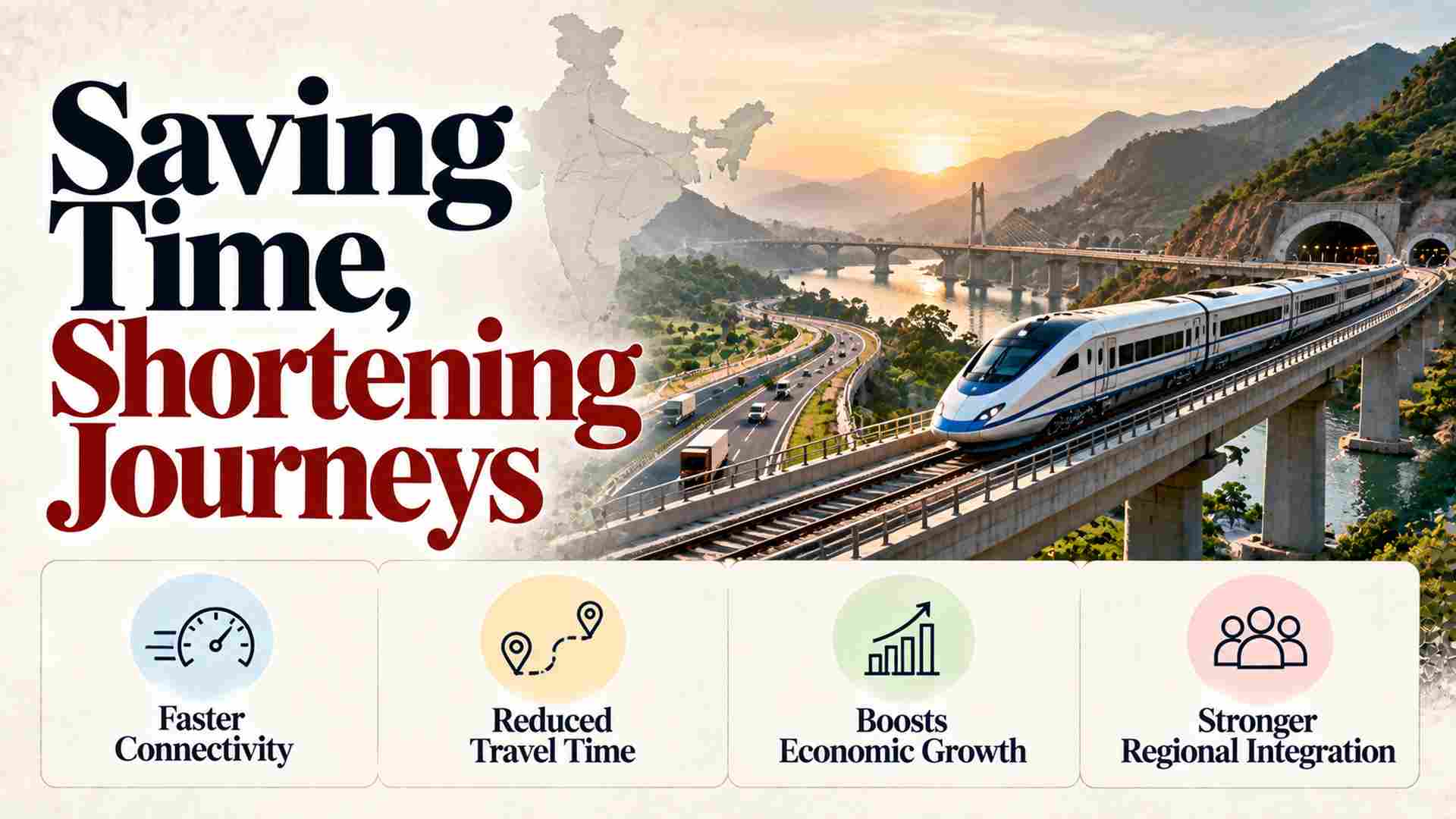
The PIB highlighted how bridges, tunnels, expressways and modern rail services are reducing travel time and improving connectivity across India. The focus is on infrastructure-led reduction in travel time rather than merely increasing physical connectivity.
Key Highlights
- Bridges, tunnels, expressways and railways are shortening travel time across difficult terrain and long-distance routes.
- Bhupen Hazarika Setu: Rupai to Meka/Roing travel time reduced from 6 hours to 1 hour.
- Bogibeel Bridge: Journeys between Dhemaji and Dibrugarh reduced from almost a day to 1-2 hours.
- Atal Setu: Mumbai-Navi Mumbai journey reduced from 2 hours to 20 minutes.
- Kosi Rail Mahasetu: Nirmali-Saraigarh rail journey reduced from 8 hours to 30 minutes; distance reduced from about 300 km to 22 km.
- Atal Tunnel: Saves 4-5 hours and reduces Manali-Sarchu distance by 46 km.
- Sela Tunnel: Located at about 13,000 feet and provides all-weather connectivity on the Tezpur-Tawang route.
- Delhi-Meerut Expressway: Travel time reduced from 2.5 hours to 50 minutes.
- Delhi-Dehradun Economic Corridor: Travel time reduced from 6 hours to 2.5 hours.
- Mumbai-Nagpur Samruddhi Mahamarg: Travel time reduced from 16 hours to about 8 hours.
- Delhi-Amritsar-Katra Expressway: Delhi-Katra travel time reduced from 14 hours to 6 hours.
- Delhi-Mumbai Expressway: Expected to reduce travel time from about 33 hours to 12 hours.
Railways and Vande Bharat
- The 2026 railway timetable speeded up 549 trains.
- 20 trains gained 60 minutes or more.
- 48 trains gained 31-59 minutes.
- 105 trains gained 16-30 minutes.
- 376 trains gained 5-15 minutes.
- Vande Bharat New Delhi-Varanasi: About 40-50% faster than earlier services.
- Vande Bharat Katra-Srinagar: Travel time reduced to about 3 hours.
- Vande Bharat Sleeper Howrah-Guwahati: Travel time reduced from about 17 hours to 14 hours.
High-Speed Rail Corridors
- Mumbai-Ahmedabad High-Speed Rail Corridor
- Length: 508 km
- Operational speed: 320 kmph
- 12 stations
- Travel time: about 1 hour 58 minutes
- Includes India’s first undersea rail tunnel, about 7 km beneath Thane Creek.
- First service targeted for August 2027.
- Seven announced HSR corridors:
- Total length: nearly 4,000 km
- Estimated investment: ₹16 lakh crore
- Major corridors include:
- Delhi-Varanasi: ~3 hours 50 minutes
- Varanasi-Patna-Siliguri: ~2 hours 55 minutes
- Chennai-Bengaluru: ~1 hour 13 minutes
- Bengaluru-Hyderabad: ~2 hours
- Mumbai-Pune: ~48 minutes
Prelims Quick Revision
- Bhupen Hazarika Setu: Assam-Arunachal Pradesh.
- Bogibeel Bridge: Rail-cum-road bridge over the Brahmaputra.
- Atal Setu: Mumbai Trans Harbour Link.
- Kosi Rail Mahasetu: Bihar; connects Nirmali and Saraigarh.
- Atal Tunnel: 9.02 km, bypasses Rohtang Pass.
- Sela Tunnel: Arunachal Pradesh, about 13,000 feet altitude.
- Mumbai-Ahmedabad HSR: 508 km, operational speed 320 kmph.
- Mumbai-Ahmedabad HSR includes an approximately 7-km undersea tunnel beneath Thane Creek.
UPSC Prelims Trap
- Atal Setu ≠ Atal Tunnel: Atal Setu is the Mumbai Trans Harbour Link, while Atal Tunnel is in Himachal Pradesh and bypasses Rohtang Pass.
- Bogibeel Bridge is a rail-cum-road bridge, whereas Kosi Rail Mahasetu is a rail bridge.
- Mumbai-Ahmedabad HSR is a high-speed rail corridor, not an expressway.
- The Mumbai-Ahmedabad HSR corridor is 508 km, while the seven newly announced HSR corridors together span nearly 4,000 km.
