Why in the News
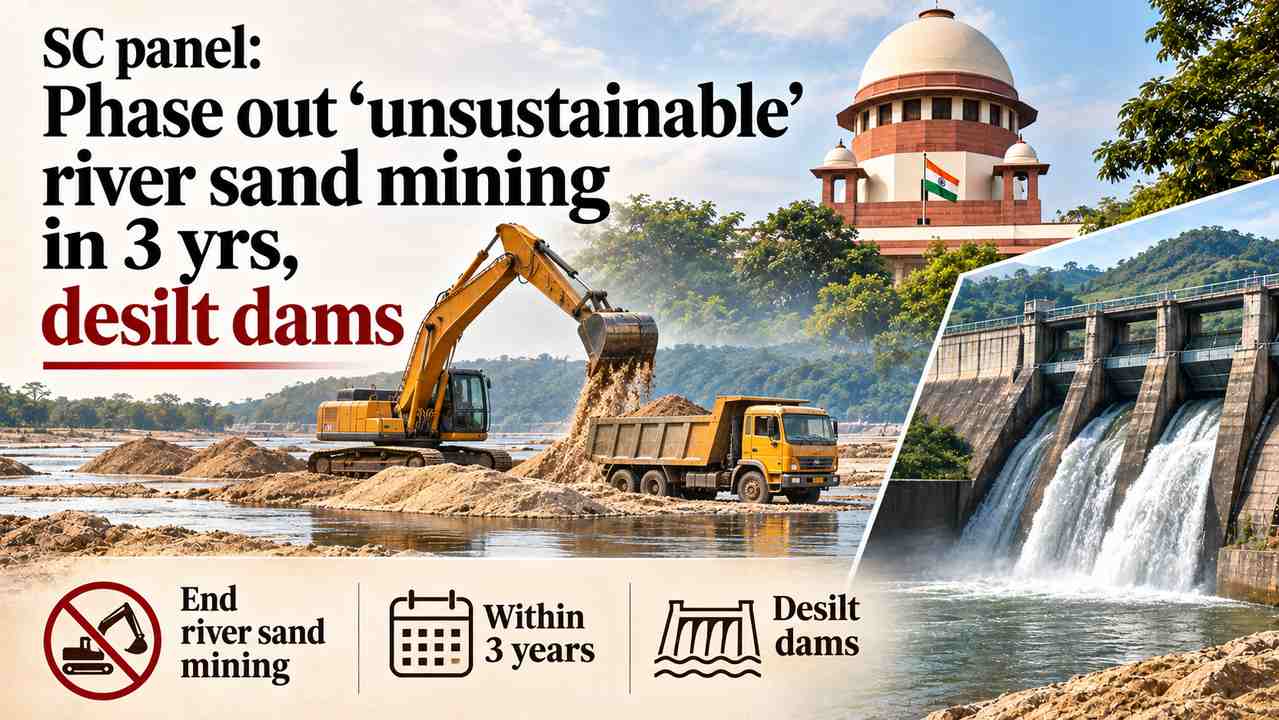
The proposed answer to illegal river sand mining has moved from bans in specified areas to a three year phase out of “unsustainable” extraction from rivers, with sand dug from dam reservoirs meeting construction demand. The Supreme Court’s Central Empowered Committee (CEC), its expert panel on environment matters, recommended this in Report No. 36 of 2026, filed in the National Chambal Sanctuary sand mining case. The CEC admits it does not know how much usable sand dams hold.
Why is river sand mining a problem, and what is the CEC’s answer?
- What it is: River sand mining is the digging of sand from riverbeds, mainly for concrete. The Supreme Court warned of its “disastrous effect” on river ecosystems.
- Nationwide scope: The Court took up the Chambal case on its own (suo motu). On October 6, a two judge Bench widened it to river sand mining nationwide and sought this report.
- Failure of bans: Rajasthan’s legal sand collection fell from about 57 million tonnes a year to 5 million after the Court restrained mining, an earlier CEC report found. This shortfall became illegal mining’s main driver.
- New roadmap: The CEC wants a time bound roadmap to phase out extraction from active river channels and develop alternatives, so that legitimate construction needs are still met.
- The takeaway: A ban without substitutes is like shutting a town’s only shop: buyers turn to the black market. The CEC seeks to replace river sand, not just stop it.
What alternatives and monitoring does the report propose?
- Three alternative sources: The report names reservoir sediment, manufactured sand (M-sand) and recycled construction and demolition waste.
- M-sand: It is made by crushing suitable rock and can replace river sand in concrete when it meets Bureau of Indian Standards (BIS) specifications.
- Electronic transit permits: Anyone moving sand would need a secure electronic permit carrying a unique QR code, barcode or radio frequency identification (RFID) tag.
- State digital systems: State mining departments would track permissions, quantities permitted, actual extraction, transit permits and end use.
How would dam desilting work?
- Dual purpose: Desilting removes sediment settled in a reservoir. It restores storage capacity and meets part of construction material demand.
- Storage already lost: Data placed before Parliament show 439 assessed reservoirs lost an average 19.24% of gross storage to sedimentation.
- Timeline: Contracts for eligible works would be awarded within three years, followed by a 10 year desilting cycle.
- Coverage: Storage dams over 15 years old that were never systematically desilted would be assessed. About one tenth of suitable reservoirs would be desilted each year, not every dam.
- Lead agency: The Ministry of Jal Shakti would lead a national framework with the Central Water Commission, the National Dam Safety Authority, the Environment Ministry and States.
What does the CEC admit it does not know?
- Usable sand in dams: The potential of reservoir sediment as construction sand “has not been adequately assessed at the national level”.
- Sediment versus sand: Total sediment does not equal usable sand. Only some of it is technically recoverable, environmentally permissible or commercially usable.
- Scale of illegal mining: “No consolidated, reliable national database” records the volume or value of illegally extracted river sand.
Challenges
- Distance from demand: Many reservoirs lie far from cities, so transport can make dam sand costlier than river sand.
- Unusable sediment: Much reservoir sediment is silt and clay unfit for concrete, and it needs safe disposal.
- Many authorities: Sand, a minor mineral, and water are State subjects, and mining rules, dams and enforcement sit with different State departments.
Way Forward
- National sediment assessment: The Ministry of Jal Shakti should first assess how much recoverable sand each reservoir holds.
- Illegal mining database: The Ministry of Mines and States should build a national record of seizures and cases.
- Bhakra model and open sale: States can adapt the Bhakra Beas Management Board plan to excavate deposits up to two metres deep, and sell recovered sand through transparent mechanisms.
Conclusion
The CEC’s report is before the Supreme Court, with no date stated for a decision. Whether the Court turns the roadmap into binding directions is what to watch.
Key numbers
- Reservoirs that lost over half their capacity: 23 (Ministry of Jal Shakti data, December 2025).
- Gobind Sagar storage: From 9,868 million cubic metres to about 7,300, a fall of 26%.
- Specified dams: 6,628 in the 2025 national register.
- Year of the earlier CEC report on Rajasthan: 2020.
Matching Previous Year Question
“[2019, GS3, 10 marks] Coastal sand mining, whether legal or illegal, poses one of the biggest threats to our environment. Analyse the impact of sand mining along the Indian coasts, citing specific examples.”
