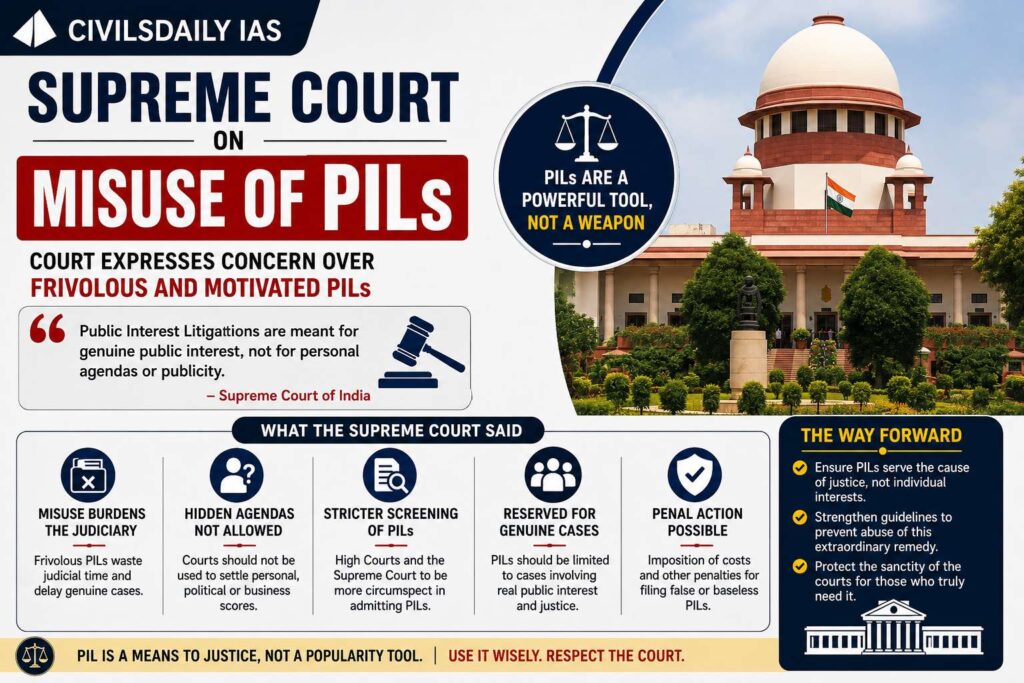
Why in the News
Justice B.V. Nagarathna of the Supreme Court of India remarked that Public Interest Litigation (PIL) has increasingly turned into “private interest litigation”, “publicity interest litigation”, and “paisa interest litigation” during hearings in the Sabarimala review case.
What is Public Interest Litigation (PIL)
- A legal mechanism allowing courts to address issues affecting the public at large
- Developed by the Indian judiciary after the Emergency period
- Intended to improve access to justice for:
- Poor
- Marginalised
- Vulnerable groups
Concerns Raised by the Court
- PILs increasingly filed for:
- Personal interest
- Political motives
- Publicity
- Financial gain (“paisa interest litigation”)
- Court stressed difference between:
- Genuine public interest
- Unnecessary interference
Key Legal Concept
- Locus Standi
- Right of a person or organisation to bring a case before court
- PIL relaxed traditional rules of locus standi
Important Constitutional Aspects
- PIL linked with:
- Article 32 (Right to Constitutional Remedies)
- Article 226 (High Court writ jurisdiction)
Constitutional and Legal Context
- Inter State and International Rivers
- Water is a State subject under State List
- Union can regulate inter state rivers under certain conditions
| [2022] With reference to the writs issued by the Courts in India, consider the following statements: 1. Mandamus will not lie against a private organisation unless it is entrusted with a public duty. 2. Mandamus will not lie against a Company even though it may be a Government Company. 3. Any public minded person can be a petitioner to move the Court to obtain the writ of Quo Warranto. Which of the statements given above are correct? [A] 1 and 2 only [B] 2 and 3 only [C] 1 and 3 only [D] 1, 2 and 3 |
