Why in the News
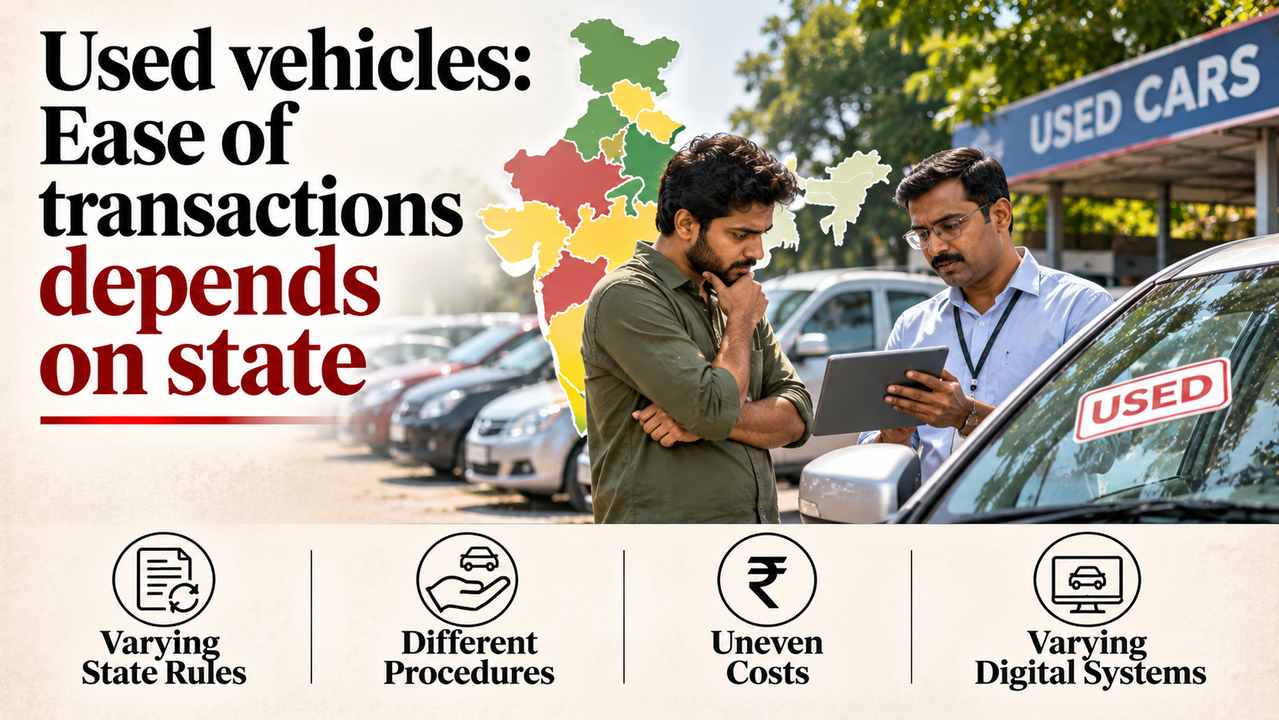
Transferring a used vehicle is meant to be a simple online process, yet a registration certificate (RC) transfer takes 7 to 10 days in Andhra Pradesh and over 30 days in Uttar Pradesh. The new Ease of Vehicle Ownership Index finds that no State scores above six out of ten.
What is the Ease of Vehicle Ownership Index?
- What it is: The index scores States on how easily a used vehicle changes hands, from transfer rules to the real cost paid. It works like a report card for each State’s transport offices.
- Who prepared it: The startup industry body IndiaTech.org prepared it with the consumer organisation Consumer VOICE. The Union Minister of State for Road Transport and Highways released it.
- Coverage: It covers 15 States, which together hold over 85% of India’s organised used-car market.
- Six metrics: States are scored on:
- clarity and consistency of ownership transfer rules;
- availability and reliability of online systems;
- speed, predictability and procedural burden;
- fee clarity, application tracking and grievance redress;
- consumer protection, dealer support and trade infrastructure;
- official fees against the actual all-in cost of transfer.
- The takeaway: How easily a used vehicle changes hands depends on the State, because each State runs its own transfer process.
How did the States perform?
- Top performers: Andhra Pradesh leads with 5.91 out of 10, followed by Kerala, Tamil Nadu and Delhi.
- Bottom performers: Uttar Pradesh comes last at 2.47, just behind Bihar and West Bengal.
- Cost, the weakest pillar: 12 States score below 3.5 on cost. Manual stages, court notaries, vehicle inspections and multiple departmental signatures push the real charge well above the official fee.
Why is transferring a vehicle so hard?
- Biometric versus manual: In Andhra Pradesh, buyer, seller and lender confirm identity biometrically, so the transfer moves fast. Elsewhere, paper checks stretch it to weeks.
- Dual submission: In 13 of the 15 States, applicants file online but must still deliver physical copies to the Regional Transport Office (RTO).
- Agents and uneven tax: Complex rules push buyers and sellers to paid agents, and road tax differs from State to State.
Why does it matter now?
- Rising used-to-new ratio: Used cars sold for every new car are expected to rise from 1.3 to 1.7 by the end of the decade. Used cars cost less upfront for middle-income households.
- First-time owners: 60% to 65% of used-vehicle buyers are first-time car owners, so procedural friction hits new buyers hardest.
- A doubling market: The pre-owned vehicle market is expected to roughly double by 2030, so slow transfers will affect far more households.
Challenges
- State-run patchwork: Registration and road tax sit with State transport departments, so procedures and fees change at every State border.
- Loan liens: Removing a bank’s hypothecation (its claim on a vehicle bought on loan) after repayment needs separate paperwork, which stalls transfers.
- Pending challans: Unpaid traffic fines block a transfer, and dealers cannot clear them without the owner’s one-time password (OTP).
- Seller liability: Until the RC changes hands, the seller stays the registered owner, answerable for fines and accidents involving the vehicle.
Way Forward
- Statutory timeline: Amend the Motor Vehicles Act, 1988 to fix a stepwise timeline for every transfer.
- Digital documents as proof: Accept DigiLocker and mParivahan documents as primary evidence at every RTO, ending dual submission.
- Bank-VAHAN integration: Link banks with VAHAN in real time so hypothecation is removed automatically when a loan closes.
- Dealer clearance of challans: Let authorised dealers clear pending challans during a transfer without the owner’s OTP.
Conclusion
Used-vehicle transfers remain slow and costly in most States because digital filing has been added on top of manual steps instead of replacing them. Whether the Centre and States act on the report’s recommendations, starting with a legal transfer timeline, will decide if a fast-growing market can shed its reliance on agents.
Key numbers
- Next-best scores (out of 10): Kerala 5.74; Tamil Nadu and Delhi 4.58 each.
- Lowest scores above Uttar Pradesh: Bihar 2.51; West Bengal 2.56.
- Pre-owned vehicle market: $36.4 billion (2024-25), projected $73.5 billion (2030).
Back2Basics: VAHAN
- What it is: VAHAN is the national vehicle registration system used by RTOs to record registration, ownership, tax, fitness and permits.
- Who runs it: It was built by the National Informatics Centre (NIC) for the Ministry of Road Transport and Highways.
- Companion system: Sarathi, its sister application, handles driving licences on the same national platform.
Matching Previous Year Question
“[2025, GS2, 10 marks] E-governance projects have a built-in bias towards technology and back-end integration than user-centric designs. Examine.”
