Why in the News
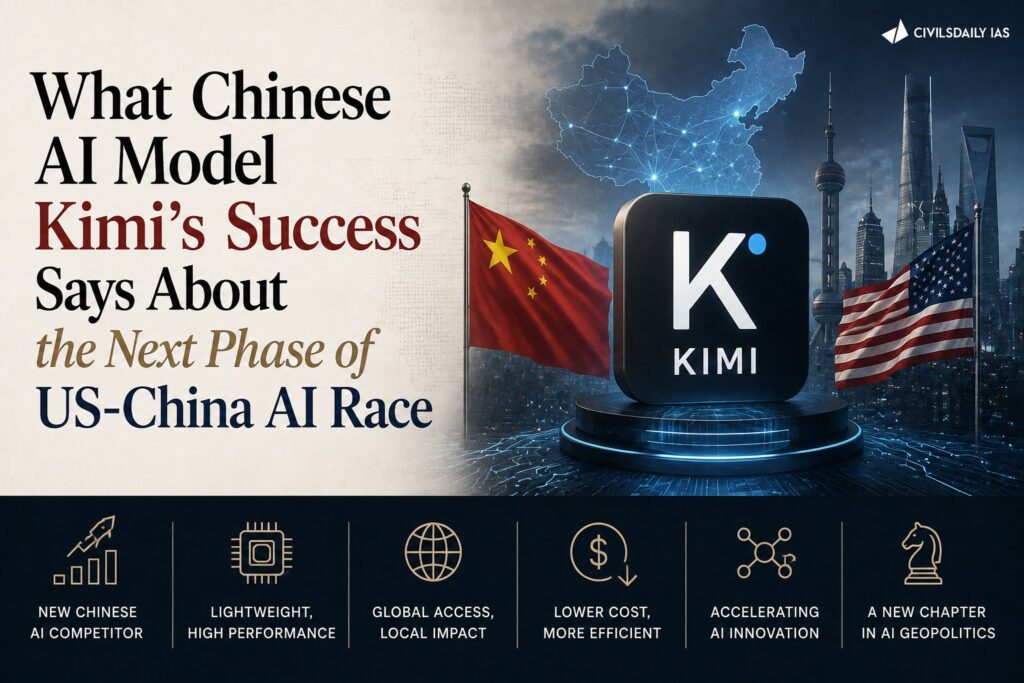
Moonshot AI’s Kimi K3, released in July with 2.8 trillion parameters, is being billed as the world’s largest open-weight artificial intelligence (AI) system, prompting Anthropic to accuse the Chinese company of illicitly extracting the capabilities of its Claude model. The episode echoes the shock caused by DeepSeek R1 in January 2025, and exposes a widening split between China’s open-weight AI strategy and the closed, proprietary approach favoured by leading US labs.
What is Kimi K3?
- Kimi K3: Kimi K3 is an advanced AI model released by the Chinese company Moonshot AI, said to rival models from OpenAI and Anthropic, built as an “open-weight” system that can be downloaded and modified by developers.
What is an open-weight AI model?
- Open-weight: An open-weight model allows developers to download its parameters, the numerical values that determine how the system responds to prompts, and run or customise it locally, unlike a closed model whose parameters remain proprietary.
Open-Weight vs. Closed Models
- Open-Weight: Anyone can download the core files, study how it works, and run it offline.
- Closed Models: The code and numbers stay hidden on a company’s private servers, and you can only use it through a web page or an API.
How does the Kimi K3 episode parallel the DeepSeek moment of January 2025?
- Prior shock: DeepSeek R1’s January 2025 release triggered global market panic after being compared favourably to leading US models, with OpenAI accusing DeepSeek of copying its technology.
- Repeated pattern: Kimi K3’s release in July 2026 has prompted a similar sequence, with Anthropic accusing Moonshot AI of illicitly extracting Claude’s capabilities and a US official describing it as an assault on economies that reward private capital and fair competition.
- Chinese countercharge: China’s Commerce Ministry responded by accusing the US of “AI hegemonism.”
Why is China favouring an open-weight strategy over proprietary models?
- Chip supply constraints: Chinese developers face chip supply constraints from Western export restrictions and domestic production bottlenecks, limiting their capacity to support commercial access to a closed model.
- Ecosystem building: Chinese labs use open weights to reach developers faster and build an ecosystem around their models, generating demand more quickly than a closed, enterprise-only distribution model would allow.
- Custom licensing approach: Kimi K3 uses a hybrid model, open-weight for most users but requiring large companies to strike a commercial agreement with Moonshot, an approach described as unusual among popular open-weight releases.
- Diplomatic dimension: China increasingly presents open models as part of international technological cooperation, illustrated by a new Chinese government AI governance body launched this month.
What does the US industry debate reveal about the open versus closed model split?
- Industry open letter: Industry figures have called for the US to shift toward open-weight models, arguing that open-source software already underlies most of the internet and systems used by the US military and federal agencies.
- Divergent incentives: Companies behind AI infrastructure, such as chip makers, have generally favoured open-weight models to spread adoption and demand for their hardware, while companies with proprietary models, such as Anthropic, have expressed reservations about this shift.
- US investigation: The US government is reportedly investigating whether Moonshot AI illegally accessed advanced chips to train its models.
Does China’s progress prove that US export controls have failed?
- Not proof of failure: Kimi K3’s capability does not prove that export controls have failed. It shows that progress in AI models depends on more than access to the most advanced chips.
- Gap still exists: Parity between US and Chinese AI companies remains distant, given the continuing US edge in compute capacity, capital, global distribution and chip access.
- Wider influence: The rise of Chinese AI companies could still give other countries more choice and lower-cost options for local deployment, extending China’s influence over global technical standards even without full parity.
Conclusion
Kimi K3 has intensified a two-player race for global AI dominance between the US and China, driven partly by a strategic divergence between China’s open-weight approach and the closed models favoured by leading American labs. Export controls have not stopped Chinese progress, but neither have they closed the underlying gap in compute, capital and distribution that still separates the two sides.
PYQ Relevance
[UPSC 2026] Which of the following statements with regard to Large Language Models (LLMs) used in machine learning is/are correct?
1. LLMs assign probabilities to the next possible words and then pick the one with the highest probability.
2. LLMs process data through mathematical optimisation to minimise prediction errors.
3. LLMs produce unbiased outputs.
(a) 1 only (b) 1 and 2 only (c) 2 and 3 only (d) 1, 2 and 3.
