Why in the News?
India’s gold exchange ecosystem, built on Electronic Gold Receipts (EGR), now sits at the centre of how Indians hold and trade gold. The shift exposes a tension between gold as a physical, trust based asset and a dematerialised, exchange traded instrument.
What is an Electronic Gold Receipt?
- Definition: An Electronic Gold Receipt (EGR) is a Securities and Exchange Board of India (SEBI) regulated digital security representing actual physical gold stored in secure, accredited vaults.
- Purpose: EGRs let investors buy, sell, and trade gold on exchanges such as the National Stock Exchange of India (NSE) and the Bombay Stock Exchange (BSE), without holding physical metal at home.
How does an Electronic Gold Receipt actually work?
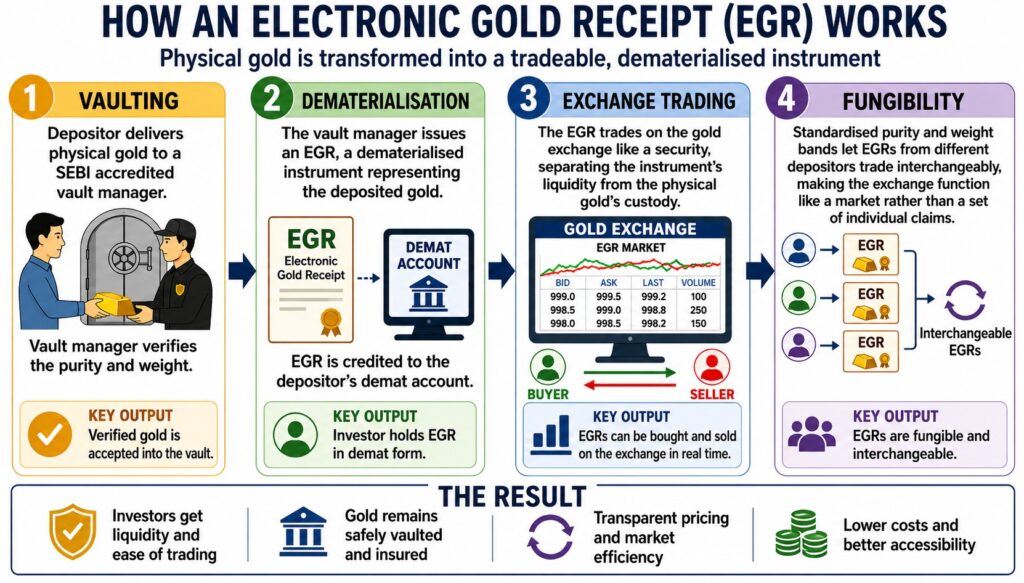
- Vaulting: A depositor delivers physical gold to a SEBI accredited vault manager, who verifies purity and weight.
- Dematerialisation: The vault manager issues an EGR, a dematerialised instrument representing the deposited gold. It is credited to the depositor’s demat account.
- Exchange trading: The EGR then trades on the gold exchange like a security, separating the instrument’s liquidity from the physical gold’s custody.
- Fungibility: Standardised purity and weight bands let EGRs from different depositors trade interchangeably, making the exchange function like a market rather than a set of individual claims.
What problem does this solve that physical gold trading could not?
- Price discovery: A centralised exchange produces a transparent, real time domestic gold price instead of fragmented jeweller quotes.
- Storage risk: Vault custody by regulated managers removes the theft and storage burden from individual holders.
- Import dependence: A liquid domestic exchange gives India a reference price less dependent on London or Dubai benchmarks.
- Quality assurance: Mandatory purity verification and standardised weight bands remove the adulteration risk common in unorganised physical gold trade.
- Two way convertibility: An EGR can convert back into physical gold and back again, allowing arbitrage that keeps the receipt aligned with physical gold prices.
Challenges to Electronic Gold Receipts
- Ecosystem complexity as due diligence burden: The EGR ecosystem distributes responsibility across vault managers, depositories, exchanges, clearing corporations, and brokers. An investor’s risk assessment must span multiple entities.
- Early stage caution: Informed participation requires investors to understand this multi institutional framework before adoption.
- Liquidity constraints: EGR trading volumes remain well behind Gold Exchange Traded Funds (ETF), resulting in thinner markets and wider bid ask spreads.
- Ongoing holding costs: Vaulting, storage, and withdrawal fees continue as long as the gold remains deposited, unlike Gold ETFs and Sovereign Gold Bonds (SGB).
- Vault manager risk: SEBI mandates minimum net worth, insurance, and a financial security deposit for every vault manager, but residual operational and financial risk remains.
Conclusion
The EGR system converts gold from an asset held on trust in a locker into a regulated, tradeable instrument. Its long term success depends on depositor confidence, vault managers, and depositories performing as certified.
