💥UPSC 2026, 2027, 2028 UAP Mentorship (March Batch) + Access XFactor Notes & Microthemes PDF

Search results for: “”

  • [Burning Issue] Global fuel dynamics and India’s Energy Security

    oil

    Context

    • Despite the global decline in crude oil prices over the last month and buying of cheap Russian crude oil, the retail prices of Petrol and Diesel in India have remained high. These increased prices have also caused high inflation in India, leading to an increase in key policy rates by RBI.
    • In this context, in this edition of the burning issue, we will study Global fuel dynamics and how it impacts India’s energy security.

    Global fuel dynamics

    • Global production of oil- averaged 95.6 million barrels per day in 2021. The top producing country group was OPEC (31.7 million b/d) followed by OECD (31.0 million b/d). The top three producing countries were the United States (18.9 million b/d), Saudi Arabia (10.8 million b/d), and Russia (10.8 million b/d).
    • Price of oil- The average Brent crude oil spot price declined to USD100/bbl in August from USD112/bbl in July. Brent crude oil prices have sunk by over USD20/bbl after peaking in June, pressured by tightening monetary policies and demand concerns in China
    • Demand of crude oil- Global liquids demand saw a slight increase in August to 99.4 MMb/d, but remained below June’s 100 MMb/d.
    • Factors impacting prices- Oilgenerates revenue for countries with enough oil reserves to produce more oil than they consume. Not surprisingly, events such as unrest in oil-producing regions, new oil field discoveries, and advances in extraction technology profoundly affect the oil industry.
    • Recent decline in prices- Benchmark Brent crude oil prices dipped to USD100/bbl in August – the lowest in the past six months. Elevated inflation levels, rate hikes by major central banks, and concerns about a slowdown in the Chinese economy have impacted oil and fuel demand, leading to a price decline.
    • Natural gas- accounts for 32% of primary energy consumption in the United States, the world’s largest producer. Russia is the second biggest producer, and also has at least 37 trillion cubic meters of natural gas reserves, the most in the world. Also, there was a steep rise in the international prices of natural gas triggered by the Russia-Ukraine war disrupting global supplies

    Why crude oil prices were high till last month?

    (A) Limited Supply:

    • Major oil-producing countries had cut oil production amid a sharp fall in demand due to the Covid-19 pandemic.
    • The Russian-Ukraine war has disrupted the supply chains. Also, sanctions on Russia, Iran and Venezuela by the US have reduced supplies of crude in international markets leading to price rises.
    • In early October 2022, OPEC agreed to cut back on oil production to increase prices.

    (B) Revival of Demand:

    • Theproduction and rollout of vaccines for Covid-19 and the rising consumption post the COVID lockdowns last year have both led to a revival in international crude oil prices.

    (C) Geopolitical reasons:

    • Geopolitical tension has risen between Russia, which is the second largest oil producer in the world, and neighbouring Ukraine.
    • In January, there were drone attacks on oil facilities in UAE, another major oil producer.
    • An outage on a major oil pipeline linking Saudi Arabia and Turkey further added to the pressures.

    Impacts of Global fuel dynamics on the Energy Security of India

    • Energy security of India is threatened– Sanctions on Iran & Russia and the reduction of oil production by OPEC have caused prices of Crude oil to sour to record high levels, making it unbearable for the economy and common man, thus negatively impacting the energy security of India.
    • Current Account Deficit: The increase in oil prices will increase the country’s import bill, and further disturb its current account deficit (excess of imports of goods and services over exports). According to estimates, a one-dollar increase in crude oil price increases the oil bill by around USD 1.6 billion per year.
    • Inflation: The increase in crude prices could also further increase inflationary pressures that have been building up over the past few months. This will decrease the space for the monetary policy committee to ease policy rates further.
    • Fiscal Health: If oil prices continue to increase, the government shall be forced to cut taxes on petroleum and diesel which may cause a loss of revenue and deteriorate its fiscal balance.The revenue lost will erode the government’s ability to spend or meet its fiscal commitments in the form of budgetary transfers to states, payment of dues and compensation for revenue shortfalls to state governments under the goods and services tax (GST) framework.

    Reasons for recent fall in crude oil prices

    • Strengthening of US Dollar: For the first time since early February, international crude benchmark Brent went below $90 a barrel last week. This level was last seen before Russia invaded Ukraine. The recent decline came amid expectations of further US dollar rise due to Fed rate hikes.
    • Reducing global demand: Global energy demand is softening, especially in China, where crude oil imports fell 9.4% last month compared to a year ago, as the country’s zero-Covid policy has led to full or partial lockdowns in more than 70 cities since late August.
    • Fear of global recession: US Fed has been increasing the policy rate aggressively causing the Dollar to appreciate vis-à-vis other currencies and outflow of capital thus generating fears of a global recession and thus reducing the demand for oil in the future.
    • Increasing Russian oil supplies: India is buying Russian crude in defiance of Western, especially US pressure, to isolate the country economically and financially. India is buying Russia’s flagship Urals grade at discounts of as much as $35 a barrel on prices before the war

    But why fuel prices are still high in India?

    • Non-passing of savings: Indian refiners are not passing on the cost savings derived from declining crude oil prices since last month.
    • No government support to companies: Petrol was deregulated in June 2010 and diesel in November 2014. Since then, the government does not pay oil firms any subsidy to compensate them for losses they might incur on selling fuel at rates below cost.
    • High losses: The three biggest oil retailers in India posted a combined net loss of Rs 18,480 crore in the June quarter.
    • Recover past losses: No revision of fuel prices by oil marketing companies is to recover the losses that state-owned fuel retailers incurred in keeping the fuel prices unchanged when international oil prices surged to multi-year highs.

    Current Energy scenario in India

    • Aim: Indian Government aims to increase energy in India and reduce energy poverty, with more focus on developing alternative sources of energy, particularly nuclear, solar and wind energy.  India attained 63% overall energy self-sufficiency in 2017.
    • 3rd biggest energy consumer: The primary energy consumption in India grew by 10.4% in CY2021 and is the third biggest with a 6% global share after China and USA.
    • The energy basket: The total primary energy consumption from coal (452.2 Mtoe; 45.88%), crude oil (239.1 Mtoe; 29.55%), natural gas (49.9 Mtoe; 6.17%), nuclear energy (8.8 Mtoe; 1.09%), hydro-electricity (31.6 Mtoe; 3.91%) and renewable power (27.5 Mtoe; 3.40%) is 809.2 Mtoe (excluding traditional biomass use) in the calendar year 2018.
    • Import dependency: In 2018, India’s net imports are nearly 205.3 million tons of crude oil and its products, 26.3 Mtoe of LNG and 141.7 Mtoe coal totalling 373.3 Mtoe of primary energy which is equal to 46.13% of total primary energy consumption. India is largely dependent on fossil fuel imports to meet its energy demands – by 2030.

    Challenges to Energy security in India

    • Low domestic resources: India, with 17% of the world’s population, has just 0.8% of the world’s known oil and natural gas resources.
    • High domestic demand: India’s domestic production is not sufficient to meet its demand. As a result, India already imports 80% of its crude oil needs. Without new and substantial domestic discoveries, imports will continue to increase.
    • Volatile energy supply regions: Problems of diversification of energy sources for India arise from the political volatility, and geopolitics of the regions from where India imports its energy products like the Persian Gulf region, and countries like Russia, Iran, etc.
    • Low share of natural gas usage in India: Natural gas currently provides only 8% of India’s primary energy supply despite the fact that 50% of that gas comes from domestic sources, onshore and offshore. Today, oil accounts for 36% of the country’s primary energy use. This figure is set to rise both in absolute and in percentage terms.
    • Low Private sector participation: Private sector’s Cold response to Government initiatives and policies such as HELP and mine auctions.
    • Lack of holistic policy: India currently does not have a holistic National energy policy but is divided into a national electricity policy, renewable energy policy, etc. leading to a lack of coherency in all energy sectors and ministries.

    Energy policy in India

    • In this context, in 2017, NITI Aayog published a draft National energy policy (NEP) with four key objectives of Access at affordable prices, Improved security and Independence, Greater Sustainability and Economic Growth.
    • The draft NEP proposes actions to meet the objectives in such a way that India’s economy is ‘energy ready’ in the year 2040.

    Some Draft NEP proposals for the Energy Sector

    • India has nearly 3.17 million square km of sedimentary area, out of which only 19% has been moderate to well-explored. To quickly appraise the entire sedimentary area, there is a need to offer geological data to prospective Exploration and Production (E&P) companies.
    • Setting up of 90-day consumption requirement of strategic and commercial storage, both for crude and petroleum products through innovative private investment strategies is needed.
    • To increase the penetration of natural gas, a National Gas Grid would have to be rolled out throughout the country.
    • There is a need to migrate the existing hydrocarbon regime (both Nomination and PSCs) to the emerging framework of market-determined prices and marketing freedom. However, this cannot be done overnight and needs to be achieved in gradual phases.
    • OMCs have done a commendable job in maintaining petroleum supplies throughout the country. The next step in this direction is to encourage competition through the entry of the private sector in a big way, to raise efficiency and consumer satisfaction levels.

    India’s Quest for Energy Security: The Steps Taken

    • Exploring domestic energy reserves: To promote oil and gas production at the domestic level, the Indian Government has been taking several steps which range from encouraging Indian companies to increase their domestic activities and widening its engagement with multinational companies, broadening opportunities for them to participate in oil and gas exploration in India.
    • HELP policy: Government has launched an Open licensing and acreage policy under the Hydrocarbon exploration and licensing policy (HELP) in 2017. The HELP marked an important transition from regulation to liberalization of India’s E&P sector; it is a very significant upstream reform of the fiscal regime.
    • Policy and operational changes: to stimulate the investments and development in the exploration of hydrocarbon sources of energy, some of the steps have focussed on regulatory changes, a transparent gas pricing policy and redevelopment of uneconomical assets.
    • Exploring alternative sources: The domestic efforts have also seen a concerted focus on exploring various alternative sources of energy that are infinite, renewable and environment-friendly. The government has given a massive push in this regard in energy production through solar energy, wind power, hydroelectricity power, and biomass, and nuclear energy.
    • Diversifying energy sourcing regions: Two-thirds of India’s oil imports come from Gulf region. India is following in the footsteps of other major oil-importing economies and making significant efforts to obtain supplies from sources outside the Gulf such as regions of Latin America, Africa, the Caspian Basin, Russia and the waters of the Indo-Pacific region.
    • Launch of NDR: In support of the OALP, the government launched the National Data Repository in June 2017. It is a comprehensive archive of geo-scientific data for E&P activities. By allowing companies to access the data through an e-platform and consult relevant information, the government helped the interested parties in making bidding decisions.
    • Small field policy launched: Discovered Small Field Policy was launched in 2016 to tap unmonetized small oil/gas discoveries in India, Discovered Small Field provides an easy and low-risk investment option for interested parties to encourage E&P activities.

    Way forward

    • Reinforce its oil emergency response policy- to adapt it to the expected strong growth in oil consumption, with increased dedicated emergency stocks and procedures, including demand restraint measures and a proper analysis of risks by using oil disruption scenarios.
    • Strengthen the regulatory oversight- of the sector. Non-discriminatory access to oil transport and the level-playing field in the mid-and downstream oil sector.
    • Promote the diversification- of oil sources and reduce India’s high oil import dependence by enhancing exploration and production activities and the development of alternative sources, such as biofuels.
    • Foster the creation of a liquid market- for natural gas in India, gradually moving from gas allocation and multiple pricing regimes to the creation of a gas hub, so that domestic gas and LNG imports can be used most efficiently and competition can flourish.
    • Strengthen and clarify the roles and responsibilities- of the regulatory supervision of natural gas market activities (upstream, midstream and downstream) to ensure a non-discriminatory access regime to pipeline capacity so that both LNG imports and new gas discoveries can find their way to markets and investment in gas transport and storage is encouraged.
    • Ensure gas is treated on a level playing field- with other fuels for taxation and is included under the GST, as the country strives to increase the share of gas in the total energy supply.
    • Enhance international engagement- by India on global oil security issues.

    Conclusion

    • Nation has achieved a lot in the energy sector in recent years which has propelled it to become one of the largest economies in the world.
    • But to continue on this growth path, India’s energy policy needs to be pursued more inclusively in its domestic and international settings to address its fast-growing energy demand in a competitive geo-political environment.
  • Aatmanirbhar in defence production: Where does India stand?

    India ranks fourth among 12 Indo-Pacific nations in self-reliant arms production capabilities, according to a study released this month by the Stockholm International Peace Research Institute (SIPRI).

    Study on Defence production

    • China tops the list, Japan is second, South Korea is in third place, and Pakistan is at number 8.
    • The study, which measures self-reliance until 2020, is based on three indicators of self-reliance in each country:
    1. Arms procurement — imports, licensed and domestic production as a proportion of the government’s total procurement of major conventional arms;
    2. Arms industry — the study presents the five largest arms companies in each country, where data are available, ranked by sales of arms and military services in 2020 to both domestic and export customers;
    3. Uncrewed maritime vehicles, the sea equivalent of drones — covering both uncrewed surface vehicles (USVs) and uncrewed underwater vehicles (UUVs), meant to provide a qualitative understanding of how countries are engaging domestic research institutes and firms to produce such cutting edge systems.

    How has China progressed?

    • China was the world’s fifth largest arms importer in 2016-20.
    • Its self-reliance policies, and its high economic growth in that period meant that the Chinese arms industry now increasingly fulfils the requirements of the People’s Liberation Army (PLA).
    • Its high volume of imports in absolute terms accounts for only 8 per cent of total procurement for the period, the lowest share for any of the 12 governments studied in this report.

    Why is India still lagging behind?

    • India is ranked as the second-largest importer of arms for its armed forces in 2016-20.
    • India is highly dependent on imports of complete foreign major arms, including many produced under licence or as components for its domestic production.
    • Of India’s total volume of procurement in 2016–20, 84 per cent was of foreign origin.
    • Domestic arms companies provide only 16 per cent of its total procurement.

    Steps taken by the Centre to boost defence production

    • Licensing relaxation: Measures announced to boost exports since 2014 include simplified defence industrial licensing, relaxation of export controls and grant of no-objection certificates.
    • Lines of Credit: Specific incentives were introduced under the foreign trade policy and the Ministry of External Affairs has facilitated Lines of Credit for countries to import defence product.
    • Policy boost: The Defence Ministry has also issued a draft Defence Production & Export Promotion Policy 2020.
    • Budgetary allocation: In addition, a percentage of the capital outlay of the defence budget has been reserved for procurement from domestic industry.
    • Defence Industrial Corridors: The government has also announced 2 dedicated Corridors in the States of TN and UP to act as clusters of defence manufacturing that leverage existing infrastructure, and human capital.
    • Long-term vision: The vision of the government is to achieve a turnover of $25 bn including export of $5 bn in Aerospace and Defence goods and services by 2025.
    • Push for self-reliance: The govt has identified the Defence and Aerospace sector as a focus area for the ‘Aatmanirbhar Bharat’ or Self-Reliant India initiative.

    Issues retarding defence indigenization

    • Excess reliance on Public Sector: India has four companies (Indian ordnance factories, Hindustan Aeronautics Limited (HAL), Bharat Electronics Limited (BEL) and Bharat Dynamics Limited (BDL)) among the top 100 biggest arms producers of the world.
    • Policy delays: In the past few years, the government has approved over 200 defence acquisition worth Rs 4 trillion, but most are still in relatively early stages of processing.
    • Lack of Critical Technologies: Poor design capability in critical technologies, inadequate investment in R&D and the inability to manufacture major subsystems and components hamper the indigenous manufacturing.
    • Long gestation: The creation of a manufacturing base is capital and technology-intensive and has a long gestation period. By that time newer technologies make products outdated.
    • ‘Unease’ in doing business: An issue related to stringent labour laws, compliance burden and lack of skills, affects the development of indigenous manufacturing in defence.
    • Multiple jurisdictions: Overlapping jurisdiction of the Ministry of Defence and Ministry of Industrial Promotion impair India’s capability of defence manufacturing.
    • Lack of quality: The higher indigenization in few cases is largely attributed to the low-end technology.
    • FDI Policy: The earlier FDI limit of 49% was not enough to enthuse global manufacturing houses to set up bases in India.
    • R&D Lacunae: A lip service to technology funding by making token allocations is an adequate commentary on our lack of seriousness in the area of Research and Development.
    • Lack of skills: There is a lack of engineering and research capability in our institutions. It again leads us back to the need for a stronger industry-academia interface.

    Way forward

    • Reducing import dependence: India was the world’s second-largest arms importer from 2014-18, ceding the long-held tag as the largest importer to Saudi Arabia, says 2019 SIPRI report.
    • Security Imperative: Indigenization in defence is critical to national security also. It keeps intact the technological expertise and encourages spin-off technologies and innovation that often stem from it.
    • Economic boost: Indigenization in defence can help create a large industry which also includes small manufacturers.
    • Employment generation: Defence manufacturing will lead to the generation of satellite industries that in turn will pave the way for a generation of employment opportunities.


    UPSC 2023 countdown has begun! Get your personal guidance plan now! (Click here)

  • Places in news: Solomon Islands

    solomon

    Solomon Islands PM has assured Australia that his nation will not allow a Chinese military presence in its territory.

    Where is the Solomon Islands located?

    • The Solomon Islands is a sovereign country consisting of six major islands and over 900 smaller islands in Oceania, to the east of Papua New Guinea and northwest of Vanuatu.
    • Its capital, Honiara, is located on the largest island, Guadalcanal.
    • It is part of the ethnically Melanesian group of islands in the Pacific and lies between Papua New Guinea and Vanuatu.
    • The country takes its name from the Solomon Islands archipelago, which is a collection of Melanesian islands that also includes the North Solomon Islands (a part of Papua New Guinea).
    • It excludes outlying islands, such as the Santa Cruz Islands and Rennell and Bellona.

    Quick recap of its past

    • The islands, which were initially controlled by the British Empire during the colonial era, went through the hands of Germany and Japan.
    • It then went back to the UK after the Americans took over the islands from the Japanese during World War II.
    • The islands became independent in 1978 to become a constitutional monarchy under the British Crown, with a parliamentary system of government.
    • Nevertheless, its inability to manage domestic ethnic conflicts led to close security relations with Australia, which is the traditional first responder to any crisis in the South Pacific.

    How did China enter the picture?

    • Earlier this year, the Solomon Islands established a security agreement with China, saying it needed Beijing’s assistance with its domestic security situation.
    • But the announcement had rattled the west, esp. the US, Australia and others in the Indo-Pacific region.
    • The concerns were that the agreement could potentially lead to a Chinese military base on the island nation and a gain in power-projection capabilities.
    • At that time, following intense scrutiny, the Solomon Islands had denied that the agreement would allow China to establish a naval base.
    • The Island insisted that the agreement was only to assist the Solomon Islands with what he called “hard internal threats”.

    What is the Solomon Islands’ stance?

    • The government has asked all partner countries with plans to conduct naval visits or patrols to put them on hold until a revised national mechanism is in place.
    • The revised national mechanism applied to all foreign vessels seeking access to the country’s ports.
    • The nation wanted to build up its own naval capacity.
    • It has some unfortunate experiences of foreign naval vessels entering its waters without any diplomatic clearance.

    What is behind China’s growing influence in the region?

    • There is no dispute that China has been rapidly increasing its presence and influence in the region for over three decades, particularly in the South Pacific.
    • Certainly Beijing views the Pacific Island region as an important component of its Belt and Road Initiative (BRI).
    • Specifically, it sees the region as a critical air freight hub in its so-called Air Silk Road, which connects Asia with Central and South America.

    Concerns of the West

    • The United States and its regional allies, such as Australia and New Zealand, are concerned that the China-Solomon Islands security pact allows Chinese naval vessels to replenish there.
    • That could open the door to a Chinese naval base, which would significantly extend China’s military reach in the South Pacific.”
    • It is likely that this security agreement between China and the Solomon Islands has been driven by, what the CFR calls, Beijing’s “sense of vulnerability” in the region.

    What is the rationale for the Solomon Islands’ increasing proximity to China?

    • The Solomon Islands had cultivated strong ties with Taiwan, which ended with the emergence of the current government in Honiara.
    • In 2019, the regime change switched Taiwan for China.
    • This was supposedly after Beijing offered half a billion US dollars in financial aid, roughly five times what Taiwan spent on the islands in the past two decades.
    • It has been alleged by the pro-Taiwan Opposition that the incumbent government has been bribed by China.

    Why is China interested in the Solomon Islands?

    • Isolating Taiwan: The Solomon Islands was one among the six Pacific island states which had official bilateral relations with Taiwan.
    • Supporter in UN: The small Pacific island states act as potential vote banks for mobilising support for the great powers in international fora like the United Nations.
    • Larger EEZ: These states have disproportionately large maritime Exclusive Economic Zones when compared to their small sizes.
    • Natural resources: Solomon Islands, in particular, have significant reserves of timber and mineral resources, along with fisheries.
    • Countering US: But more importantly, they are strategically located for China to insert itself between America’s military bases in the Pacific islands and Australia.

    What does this mean for the established geopolitical configuration in the region?

    • Diminishing western influence: The Pacific islands, in the post-World War II scenario, were exclusively under the spheres of influence of the Western powers, in particular, the US, UK, France and Australia and New Zealand.
    • Inserting into western hegemony: All of them have territorial possessions in the region, with the three nuclear powers among them having used the region as a nuclear weapons testing ground.
    • Shifting of dependencies: The smaller island nations of the region are heavily dependent on them, especially Australia as it is a resident power.


    UPSC 2023 countdown has begun! Get your personal guidance plan now! (Click here)

  • Amendments to Bharat Series Rules

    bharat

    The Ministry of Road Transport and Highway has issued a draft notification proposing new rules to further increase the scope of implementation of the BH series vehicle registrations.

    Bharat series (BH-series)

    • There was a procedure of re-registration of a vehicle while moving to another state.
    • A vehicle bearing BH registration mark shall not require assignment of a new registration mark when the owner of the vehicle shifts from one State to another.
    • Format of Bharat series (BH-series) Registration Mark –

    Registration Mark Format:

    1. YY BH #### XX
    2. YY – Year of first registration
    3. BH- Code for Bharat Series
    4. ####- 0000 to 9999 (randomized)
    5. XX- Alphabets (AA to ZZ)

    Why such move?

    • Station relocation occurs with both Government and private sector employees.
    • Such movements create a sense of unease in the minds of such employees with regard to transfer of registration from the parent state to another state.
    • Under section 47 of the Motor Vehicles Act, 1988, a person is allowed to keep the vehicle for not more than 12 months in any state other than the state where the vehicle is registered.

    Who can get this BH series?

    • BH-series will be available on voluntary basis to Defense personnel, employees of Central Government/ State Government/ Central/ State PSUs and private sector companies/organizations.
    • The motor vehicle tax will be levied for two years or in multiple of two.
    • This scheme will facilitate free movement of personal vehicles across States/UTs of India upon relocation to a new State/UT.
    • After the completion of the fourteenth year, the motor vehicle tax shall be levied annually which shall be half of the amount which was charged earlier for that vehicle.


    UPSC 2023 countdown has begun! Get your personal guidance plan now! (Click here)

  • Essay Essential Program 2023: Personalized Mentorship led Essay Writing and Evaluation program | Foundation building lectures by Zeeshan sir, Tests, and 1-1 mentorship | Enrollment open

    Essay Essential Program 2023: Personalized Mentorship led Essay Writing and Evaluation program | Foundation building lectures by Zeeshan sir, Tests, and 1-1 mentorship | Enrollment open

    Aspirants, UPSC 2023 is around 8 months away and it is high time now to start Essay writing. A lot of aspirants delay it till the post-prelims phase, considering the weightage of this Exam (250 marks in mains), this is a poor strategy and a recipe for disaster.

    Before you get into the Prelims 2023 zone, which will be from Feb, you must utilize the next few months (Oct-Feb) for Essay particularly.

    An Essay is a ‘Written Interview’ in UPSC mains 

    CivilsDaily is pleased to launch Essay Essential Program 2023 and this time we have made it holistic for you. One of the changes is lectures, that Zeeshan sir will be imparting skills in Essay writing.

    Table of content:

    1. About Essay Writing for UPSC-CSE
    2. Essay Program Details: Essay Essential Plus Program 2023 with Zeeshan sir’s mentorship and Essay Essential Program 2023
    3. Program inclusion and Course Fee
    4. Experience of our 2022 batch of students

    Essay writing for UPSC-CSE

    • Two essays are given and have to be written in under 3 hours in 1000-1200 words. Each essay carries 125 marks for a total of 250
    • The essay paper is divided into two sections- Section A and Section B. Each section carries a choice of 4 essays, and the aspirants have to choose only one essay from each section.
    • The instructions in the syllabus are clear in what is expected from aspirants. And Aspirants are expected to keep their thoughts closely to the subject and arrange their ideas accordingly. It further states that credit is given for effective and coherent expression
    • The underline keywords are super important because, after content, these are the exact parameters on which the essay will be evaluated.

    Essay writing is an important component of the Civil Services Examination (CSE), which tries to gauge the writing skills, knowledge, critical thinking, imagination, and creativity of the candidates. Particularly, in the UPSC CSE (Main), scoring well in the Essay paper, which is allocated a decent share of 250 marks, has become crucial to final selection into the coveted services like IAS, IPS, IFS, etc.

    In the Essay paper, the UPSC demands certain attributes, which focus on “conciseness, relevance, and effective and exact expression” of the views presented, in an orderly fashion. However, the scenario may not be as simple as it appears. This segment is not easy to master, and getting a good score in an Essay has always been a challenge for the aspirants.

    An essay is an organized piece of writing. This means that it consists of several paragraphs which are arranged in such a way that there is a beginning, a middle, and an end.

    Although many say that practice makes one perfect, in the case of UPSC essays practice alone is not enough. To clear and get top rank in UPSC, certain things are required, like; Accurate basic structure, Body Keywords, Central idea of the thesis statement, Brainstorming, Adding elements, PESTLE analysis, Outlining the essay, Sticking to the word and time limit, fitting introduction and mark-leaving conclusion, Quotes, Etc.

    And for a beginner, acquiring all these concepts, dimensions, and solutions required to solve is nothing but deep pain. 

    Writing a good essay can be very challenging and confusing. Time and again we’ve received many queries from students like:

    • Reviews provide additional points but don’t address the inherent shortcomings and deficiencies in my skills.
    • Will reading ready-made sample essays help me prepare for essays?
    • Don’t know how to start an essay, or how to organize one.
    • Can we do well in essays without practicing by re-using our GS paper knowledge alone?
    • Is there a universal format that I can stick to?
    • Content related- some suffer from information overload others from information deficit.
    • Importance of rough work for essays.
    • Difficulty in balancing time and quality in both topics.

    That’s why we’ve invested a great deal of energy to create a program the likes of which are offered by no one else


    Civilsdaily’s Essay Programs 2023

    Civilsdaily’s Essay program is now complete with Essay Writing, Test series, evaluation, and 1-1 mentorship component.

    There are two variants this time:

    1. Essay Essential Program 2023 with lectures and 1-1 mentorship
    2. Essay Essential Program Plus 2023 with lectures and Zeeshan sir’s mentorship

    What are we offering and how is it unique?

    What makes CivilsDaily’s program distinctive is – its process-driven approach. The process may have some common minimum steps for all but your individuality in the form of your essay writing is paramount. Here comes the role of a mentor with whom a reliable one-to-one discussion will certainly be a game-changer.

    Not information-centric but rather an analytical and critical style of Essay writing. Our focus is on personalized attention in evaluation, execution, and course correction.

    Essay writing and foundation-building lectures by Zeeshan sir

    Zeeshan sir will be taking 15 lectures covering different themes and frameworks for UPSC Essays. These lectures will form the foundation of your content for the essay.

    Zeeshan sir will also be discussing different frameworks for writing an Essay.

    CEP Methodology:

    • Orientation Session – brainstorming, thesis statement, types of introduction, way to conclude, main body arguments, and their organization in your essay.
    • Pre-test discussion on the theme for building the arguments and content.
    • Post-test one-on-one discussion with an evaluated copy.

    Highly relevant, precise, and thoughtful topic selection

    Our research tells us there are 8 broad themes of essays being asked since 2010 – Economy, Polity, Women Issues, Education, Science & Tech, Philosophy, IR, Miscellaneous.

    1. Social Issues- Women Issues, Social Movements, Class, Caste, Youth, Geriatric
    2. Economy,
    3. Political System and Governance
    4. Human Development- Health, Education, Employment
    5. Science & Technology- IT/ITeS, AI
    6. Ethical, Abstract or Philosophical,
    7. IR
    8. Miscellaneous

    An innovative methodology for reviews

    Our biggest innovation lies in our review methodology. Specific portions of your essay will be highlighted with symbols to indicate issues in essay writing:

    • Fundamental Flaws like judgments/strong postures that you need to be avoided at all costs.
    • Appreciation for uniqueness.
    • Structure is not maintained. Issues with Language and expression.
    • General Suggestions for candidates.

    Along with this, Zeeshan sir and senior mentors will also leave specific reviews on strengths and weaknesses.

    We don’t want to merely suggest additional points that can be googled by the student or point out superficial flaws like not ‘sticking to the topic’. They don’t necessarily highlight the shortcomings in the essay. This adds very little value to students. We go much beyond that and help students fix major flaws in their essays.

    10 parameters on which your essays are going to get evaluated

    1. Comprehension of the Essay topic
    2. Language and Expression of Essay writing
    3. Structure and Organization of thought.
    4. Objectivity and Biases. Balance of perception
    5. Attitude whether a learner or judgmental
    6. Focus and attention
    7. Content, Knowledge, and information processing capability
    8. Ability to forge links in an interdisciplinary manner
    9. The simplicity of disposition
    10. Observational Skills

    Model essays with indicative structure and good essay copies

    You will be provided with good essay copies to serve as sample answers. This is a better alternative than sample answers which are hastily written and at times not updated with the latest figures.

    Students have an incorrect impression that going through a sample essay will somehow help them write better essays. This is incorrect.

    To develop your competency in tackling different topics, you have to be able to come up with appropriate structures. This aspect of the program addresses this issue.

    The expectation from you would be that you study the solutions in detail and try to address the shortcomings in your essays. Should doubts persist, we’re here to help.

    One-to-one Mentorship and CivilsDaily’s handholding

    This component of the program is the most important. Post-evaluation of your essay test you will get on a one-to-one discussion with senior mentors and in the case of Essay Essential Plus Program 2023 with Zeeshan sir. You will be discussing the topics in considerable depth, appropriate structure, pitfalls to avoid, etc.

    Along with that, Sir will also discuss copies presenting different styles in which the essays could be attempted.

    Membership to an exclusive community

    Habitat is our learning platform, here you’ll be given membership to an exclusive Essay group. This group will be administered by Zeeshan sir, Sajal sir, in-service officers, rankers, and other mentors.

    For essays, you need multiple perspectives to understand a topic or an issue in its entirety. You need discussions; arguments; confluence, confrontation, and integration of ideas. Here, discussions will be facilitated by mentors and enriched by different viewpoints from peers. Moreover, you can ask and discuss any of your doubts with peers and Zeeshan sir.

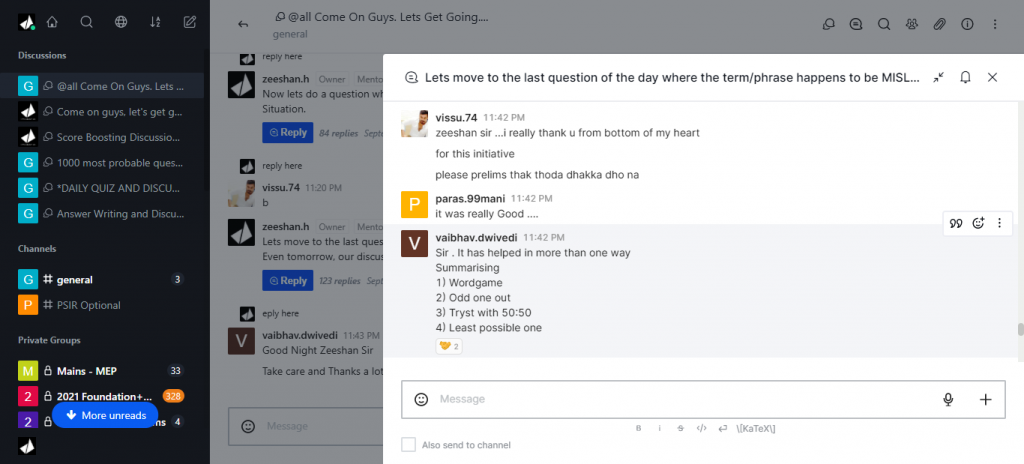
    Habitat discussions

    Besides these, you will be given the following

    • Any additional material that we release for essays.
    • Notes and reference material including good articles, essays, etc. on Habitat group.

    Program inclusion

    • 8 FLTs before Prelims and 5 FLTs Post Prelims
    • Zeeshan sir’s lectures that will include – Orientation, Process building session, Content/approach building session.
    • Model essays
    • One-to-one mentorship
      • In Essay Essential Program 2023 by senior mentors
      • In Essay Essential Plus Program 2023 by Zeeshan sir
    • Membership in an exclusive Essay group on Habitat
    • Notes and references as required
    • Topic-wise arranged PYQs

    Course Fee:

    Essay Essential Program 2023: Rs 12,000 + GST = Rs 14,160

    Essay Essential Plus Program 2023 with Zeeshan sir’s mentorship: Rs 16000 + GST = Rs 18,880

    (Admission to Essay Essential Plus Program 2023 is subject to Zeeshan sir’s discretion)

    How did our 2022 Essay students feel about UPSC Essay 2022?

  • 7th October 2022| Daily Answer Writing Enhancement(AWE)

    Topics for Today’s questions:

    GS-1          Indian culture will cover the salient aspects of Art Forms, literature and Architecture from ancient to modern times.

    GS-2          Constitution of India—historical underpinnings, evolution, features, amendments, significant provisions and basic structure.

    GS-3         Issues of buffer stocks and food security

    GS-4         Case Studies

    Question 1)

    Q.1 Although a bit different from modern democracy, democratic traditions have been a part of ancient Indian culture establishing the view that India is not just the world’s largest democracy, but also the “mother of democracy”. Discuss. (10 Marks)

    Question 2)

    Q.2 Do you think reservations for economically weaker sections (EWS) is justified? What are the arguments against it? (10 Marks)

    Question 3)

    Q.3 Rice export restrictions by India have heightened food security anxieties across the global market. Highlighting the reasons behind the move, examine its significance. (10 Marks)

    Question 4)  

    Q.4 Mr. X is a billionaire businessman who heads a conglomerate engaged in insurance, energy generation and distribution, and manufacturing. Despite being globally known as a great philanthropist, he turned down a shareholder request seeking the disclosure of the conglomerate’s actions on issues related to climate change as well as diversity and inclusion. Because of increased attention to climate and diversity issues, many leading firms have committed themselves to incorporate relevant considerations in their business strategies. Therefore, some industry-observors wonder if Mr. X is out of touch with the industry at large and have warned him that failing to address climate change issues puts his businesses under systemic risk. But, Mr. X maintained his vote against the disclosure proposal, while at the same time acknowledged the importance of both climate change and a diverse and inclusive work force. However, Mr. X believes that such ethical issues take secondary importance to maximising shareholder profit. (a) Discuss the importance of including climate change strategies and diversity and inclusion in a business organisation? (b) In your opinion, what matters more for a business organisation – socio-environmental concerns or shareholder profit? (c) How can the two above-mentioned issues be reconciled? (20 Marks)

    HOW TO ATTEMPT ANSWERS IN DAILY ANSWER WRITING ENHANCEMENT(AWE)?

    1. Daily 4 questions from General studies 1, 2, 3, and 4 will be provided to you.

    2. A Mentor’s Comment will be available for all answers. This can be used as a guidance tool but we encourage you to write original answers.

    3. You can write your answer on an A4 sheet and scan/click pictures of the same.

    4.  Upload the scanned answer in the comment section of the same question.

    5. Along with the scanned answer, please share your Razor payment ID, so that paid members are given priority.

    6. If you upload the answer on the same day like the answer of 11th  February is uploaded on 11th February then your answer will be checked within 72 hours. Also, reviews will be in the order of submission- First come first serve basis

    7. If you are writing answers late, for example, 11th February is uploaded on 13th February , then these answers will be evaluated as per the mentor’s schedule.

    8. We encourage you to write answers on the same day. However, if you are uploading an answer late then tag the mentor like @Staff so that the mentor is notified about your answer.

    *In case your answer is not reviewed, reply to your answer saying *NOT CHECKED*. 

    1. For the philosophy of AWE and payment: 

  • Moonlighting: Overemployment or Underpayment

    MoonlightingContext

    • In July, Kotak Securities said in a study that at least 60% of 400 employees surveyed said they themselves had, or knew someone who had engaged in moonlighting.

    What is mean by moonlighting?

    • Moonlighting is a state where employees work for remuneration with entities other than their employers. It is not defined in any of the statutes in India. However, there are enactments that deal with double employment.

    MoonlightingHow does it affect companies and what are latest examples?

    • Wipro: According to Wipro CEO, there is a lot of chatter about people moonlighting in the tech industry. This is cheating plain and simple. The company sacked 300 employees following the discovery that they were working for rival firms on the side, leading to conflict of interest.
    • Infosys: Infosys has warned staff against moonlighting, saying it could lead to termination.
    • Effect of WFH: Another software firm DXC Technologies said that moonlighting by employees was a challenge for employers but that wouldn’t affect its WFH (work from home) policy that has worked well for both the firm and its staff.
    • Moonlighting policy: Swiggy announced a moonlighting policy’ that allows employees to pursue their passion for economic interests alongside their fulltime employment.”

    MoonlightingWhat is the Legal status of moonlighting?

    • Factory act: Section 60 of the Factories Act deals with restriction on double employment stating that “No adult worker shall be required or allowed to work in any factory on any day on which he has already been working in any other factory, save in such circumstances as may be prescribed. However, this enactment is applicable only to employees working in factories.
    • The Tamil Nadu Shops & Establishments Act, 1947: There are State enactments which deal with employment of persons working in offices, banks, shops, etc. In Tamil Nadu, it is termed as The Tamil Nadu Shops & Establishments Act, 1947. However, there is no provision wherein dealing with dual employment.
    • Glaxo Laboratories (I) Limited vs Labour Court, Meerut and others: The apex court held that “The employer has hardly any extra territorial jurisdiction. He is not the custodian of general law and order situation or the Guru or mentor of his workmen for their well-regulated cultural advancement. If the power to regulate the behaviour of the workmen outside the duty hours and at any place wherever they may be was conferred upon the employer, contract of service may be reduced to contract of slavery.” This case was not specifically about moonlighting but the court’s observation gives us an idea as to how the law may view such cases.

    MoonlightingWay forward

    • More earning: The Minister of State for Skill Development and Entrepreneurship, and Electronics and IT, said that employers should not to suppress employees who want to monetise, develop and demonstrate but also urged employees not to violate their agreements with employers.
    • Working hours: Moonlighting is subject to law of the land. The sphere of employment cannot be extended by the employer beyond working hours and outside his place of employment.
    • Socialistic view: The Courts of law in India dealing with employment are Writ Courts and Labour Courts, which exercise jurisdiction based on equity or fairness. Therefore, the Courts may lean in favour of the employee unless the contravention of the employee has led to serious prejudice and loss to the employer

    Conclusion

    • Employees are not the slaves of employers. What they do beyond the working hours is none of the business of employer unless it affects company financially or causes substantial damage to business. Government should bring the legal statute to regulate moonlighting and prevent the unjustified punishment of employees.

    Mains Question

    Q. What is moonlighting? Why employees do moonlighting? Discuss the legal framework about moonlighting in India.

    UPSC 2023 countdown has begun! Get your personal guidance plan now! (Click here)

  • Corporate Social Responsibility(CSR) & Social Justice

    SocialContext

    • Since the establishment of the Corporate Social Responsibility (CSR) regime in India under Section 135 of the Companies Act 2013, CSR spending in India has risen from RS.10,065 crore in 2014-15to Rs.24,865crore in 2020-21.But there is no data to verify whether this increase is commensurate with the increase in profits of Indian and foreign (having a registered arm in India) companies.

    What is Corporate Social Responsibility (CSR)?

    • Voluntary spending: Corporate social responsibility (CSR) is a form of international private business self-regulation which aims to contribute to societal goals of a philanthropic, activist, or charitable nature by engaging in or supporting volunteering or ethically oriented practices.
    • Ministry Corporate Affairs: The National Corporate Social Responsibility Data Portal is an initiative by Ministry of Corporate Affairs, Government of India to establish a platform to disseminate Corporate Social Responsibility related data and information filed by the companies registered with it.
    • Companies Act, 2013: The Corporate Social Responsibility concept in India is governed by Section 135 of the Companies Act, 2013 (‘Act’), Schedule VII of the Act and Companies (CSR Policy) Rules, 2014 wherein the criteria has been provided for assessing the CSR eligibility of a company, Implementation and Reporting of their CSR Policies.

    Social

    How CSR helps in achieving social justice?

    • Sustainable Goals: India having the most elaborated CSR mechanism and implementation strategy has started its journey to set a benchmark in attaining sustainability goals and stakeholder activism in nation building.
    • Corporate philanthropy: company donations to charity, including cash, goods, and services, sometimes via a corporate foundation.
    • Community volunteering: company-organized volunteer activities, sometimes while an employee receives pay for pro-bono work on behalf of a non-profit organization
    • Socially-responsible business practices: ethically produced products that appeal to a customer segment.
    • Corporate social marketing: Company-funded behaviour-change campaigns, Company-funded advocacy campaigns, donations to charity based on product sales.

    Why there is need to review the CSR?

    • Declining number: There was also a decline in the number of companies participating in CSR 25,103 in FY2019 to 17,007 in FY2021.
    • Flaw in the law: If a company spends an amount in excess of the minimum 2%, as stipulated, the excess amount is liable to be set off against spending in the succeeding three financial years. Ideally, companies should have been shown courage to spend more than this.
    • Own trusts: many private companies have registered their own foundations/trusts to which they transfer the statutory CSR budgets for utilisation. It is unclear if this is allowed under the Companies Act/CSR rules.
    • Geographical bias: The first proviso to Section 135(5) of the Act is that the company should give preference to local areas/areas around it where it operates. This is logical. However, a report by Ashoka University’s Centre for Social Impact and Philanthropy says that 54% of CSR companies are concentrated in Maharashtra, Tamil Nadu, Karnataka, and Gujarat(receiving the largest CSR spends) while populous Uttar Pradesh and Madhya Pradesh receive little.
    • Spending on environment: Item (iv) of Schedule VII of the Act deals with broader environmental issues to create a countervailing effect. However, an analysis of CSR spending (2014-18)reveals that while most CSR spending is in education (37%) and health and sanitation (29%), only 9% was spent on the environment even as extractive industries such as mining function in an environmentally detrimental manner in several States
    • Incomplete information: The Standing Committee on Finance had observed that the information regarding CSR spending by companies is insufficient and difficult to access. As per the ‘Technical Guide on Accounting’ issued by the Institute of Chartered Accountants of India, a company is only required to mention its CSR spends, non-spend, under-spend, and overspend in the ‘Notes to Accounts’.

    SocialWhat are the suggestions to improve the mechanism of CSR?

    • Centralized platform: There is a need to curate a national level platform centralised by the MCA where all States could list their potential CSR admissible projects so that companies can assess where their CSR funds would be most impactful across India with, of course, preferential treatment to areas where they operate.
    • India Investment Grid: Invest India’s ‘Corporate Social Responsibility Projects Repository’ on the India Investment Grid (IIG) can serve as a guide for such efforts. This model would be very useful for supporting deserving projects in the 112aspirational districts and projects identified by MPs under the Government’s Sansad AdarshGram Yojana.
    • Increase environment spending: Companies need to prioritise environment restoration in the area where they operate, earmarking at least 25% for environment regeneration.
    • Public participation: All CSR projects should be selected and implemented with the active involvement of communities, district administration and public representatives.
    • Transparency: Recommendations by the high-level committee in 2018 should be incorporated in the current CSR framework to improve the existing monitoring and evaluation regime. These include strengthening the reporting mechanisms with enhanced disclosures concerning selection of projects, locations, implementing agencies, etc.; bringing CSR within the purview of statutory financial audit with details of CSR expenditure included in the financial statement of a company, and mandatory independent third party impact assessment audits.
    • Monitoring by government: The MCA and the line departments need to exercise greater direct monitoring and supervision over CSR spend by companies through the line ministries (for public sector undertakings) and other industry associations(for non-public units) instead of merely hosting all information on the Ministry’s website.

    SocialConclusion

    • Corporate social responsibility is an effective tool to address the social and income inequality. Present legal arrangements are toothless and based on voluntary actions. For an effective change CSR spending should be made more transparent and accountable.

    Mains Question.

    Q.Present arrangement of CSR is not yielding the desired result. Enlist the current weakness in CSR spending Suggest the changes needed for efficient implantation of CSR.

    UPSC 2023 countdown has begun! Get your personal guidance plan now! (Click here)


  • India’s Rice Exports and food Insecurity

    ExportsContext

    • On August 8, India banned the exports of broken rice and imposed a 20 per cent duty on the exports of various grades of rice amid high cereal inflation and uncertainties with respect to domestic supply.

    Background

    • This is surely not the first time an attempt is being made to ban wheat and rice exports.
    • It was also done in 2007-08, in the wake of the global financial crisis.
    • Perhaps government will also impose stocking limits on traders for a host of commodities, suspend futures trading in food items, and even conduct income tax raids on traders of food.

    Exports

    What is the current status of rice in India?

    • World’s largest rice exporter: India has exported more than 20 MT of rice worth a record $9. 6 billion to more than 150 countries in 2021-22.It has been the world’s largest rice exporter of the grain in the last decade and has a share of around 44% global trade.
    • Likely to fall in production: India’s rice production is likely to decline by 6 per cent t to 104.99 million tonnes in the kharif season due to a fall in paddy acreage amidst rainfall deficit in key producing states, including Jharkhand, Madhya Pradesh and West Bengal.
    • Kharif season: Sowing in the kharif season begins with the onset of the southwest monsoon from June and harvesting from October onwards .About 85 per cent of India’s total production comes from this season.
    • Deficient rainfall: West Bengal, the biggest rice producer amongst states, has received deficient rainfall in 15 of its 23 districts, raising the likelihood of crop loss. Uttar Pradesh, the second biggest producer of rice has received 42% less rainfall than benchmark. The rainfall deficiency in the other eastern states Bihar (-34%) and Jharkhand (-48%).
    • Depleting stocks: There are concerns about rice stocks with the Food Corporation of India (FCI) depleting to a 10-year low level by April, 2023 year, if the free ration scheme is extended to the second half of the financial year. The government may have to impose some curbs on rice exports though minimum export price or an export tax if the scheme is extended.

    Why India’s rice export ban is cause for worry?

    • Thin world rice market and the impact on prices: Given that 90 per cent of production is consumed domestically, As a result, any small change in exports and imports has an enormous impact on prices, especially if it leads to panic buying of food grains by rich countries.
    • Limited Import option: The stakes are higher as it is India’s largest agricultural crop. Unlike with wheat, the options for import in rice due to any production shortfall are limited, when India’s own share in the global trade of the cereal is more than 40%.
    • Affect the credibility: The export uncertainties will affect the credibility of Indian exporters, create a disincentive for future exports, and will enable buyers to shift towards other major rice-exporting countries.
    • Affect a section of farmers: Though Indian farmers in general lack market access, and hence do not take advantage of high market prices, the fall in prices may adversely affect a section of farmers who hope to get a better price for their produce through exports. The exporters who face the burden of the unfeasibility of exports may pass it on to farmers in the form of lower prices during procurement.
    • Affect low-income and low middle-income Countries: India’s export restrictions will adversely affect several low-income and low-middle-income countries like Bangladesh, Senegal, Nepal and Benin, which are among the largest importers of Indian rice.
    • Domestic prices and to safeguard food security: Frequent changes in export policies undoubtedly have long-term ramifications on domestic prices

    Exports

    What are the Issues in India’s rice export strategy?

    • Highest ever volume: India exported the highest-ever volume of 21 million metric tonnes (MMT) of rice in 2021-22 (FY22) in a global market of about 51.3 MMT, which amounts to about 41 per cent of global exports.
    • Reduced price: Such large volumes of rice exports brought down global prices of rice by about 23 per cent in March (YoY), when all other cereal prices, be it wheat or maize, were going up substantially in global markets. In fact, in FY22, the unit value of exports of common rice was just $354/tonne, which was lower than the minimum support price (MSP) of rice.
    • Below MSP buying or leakage from PMGKAY: This meant that rice exporters were either buying rice (paddy) from farmers and millersat below the MSP or that quite a substantial part of rice was given free under the PM Garib Kalyan Ann Yojana (PMGKAY) was being siphoned away for exports at prices below MSP.
    • Artificial competitive advantage: Free electricity for irrigation in several states, most notably Punjab, and highly subsidised fertilisers, especially urea, create an artificial competitive advantage for Indian rice in global markets.

    Problems with India’s rice cultivation

    • Lower yield: India’s rice yield is lower than the world average. However, India’s yield is better than Thailand and Pakistan but worse than Vietnam, China and the US.
    • Higher cost of cultivation and price support: The cost of cultivation in India is also increasing, and hence there will be a need for a higher MSP to make production remunerative. This will exacerbate the pressure to re-think its price-support-backed food security mechanism.
    • Water-intensive nature: India’s rice production likely to fall amidst the shortfall of rainfall in major rice producing states and increasing salinity of soil because of over usage of water. The water-intensive nature of rice cultivation, along with frequent export restrictions will adversely affect the long-run sustainability of rice production. In India, around 49 per cent of rice cultivation depends on groundwater which is depleting rapidly.

    ExportsWhat is the link between Rice cultivation and groundwater depletion?

    • Ground water depletion: In India, around 49 per cent of rice cultivation depends on groundwater which is depleting rapidly.
    • Food and Agriculture Organization (FAO) data: As per the latest data available from the Food and Agriculture Organization (FAO), agricultural water withdrawal as a percentage of total available renewable water resources has increased from 26.7 per cent in 1993 to 36 per cent in 2022.
    • Virtual water trade (VWT): Rice exports are leading to an indirect export of water to other countries a phenomenon known as virtual water trade (VWT). The relative per capita water availability in India is lower than a majority of its major importing countries. The other major exporters of rice, such as Thailand and Vietnam, also have better per capita water availability in comparison to India.
    • Renewable water resources: Out of 133 countries in which India has positive net rice exports, only 39 countries have relatively lower per capita renewable water resources. Out of these 39 countries, 12 countries are high-income countries with the ability to buy food at a higher price.

    Conclusion

    • Depletion of groundwater resources and rising cost of cultivation may threaten rice production in the future. Adequate water saving measures in the form of widespread adoption of water saving practices like System of Rice Intensification (SRI) need to be taken to keep input requirements, costs and production sustainable.

    Mains question

    Q.As many developing countries depend on Indian rice, rice export restrictions have raised food security concerns in the global market. In this context discuss the causes and effects of India’s restrictions on rice export.

    UPSC 2023 countdown has begun! Get your personal guidance plan now! (Click here)

More posts