💥UPSC 2026, 2027, 2028 UAP Mentorship (March Batch) + Access XFactor Notes & Microthemes PDF

Search results for: “”

  • EU’s Markets in Crypto-Assets (MiCA) Law

    The Markets in Crypto-Assets (MiCA) law of European Parliament is the first comprehensive regulation for cryptos, and some expect it to become a trendsetter for crypto regulation globally.

    What is MiCA Legislation?

    • The MiCA law seeks to address concerns like money-laundering, protection of consumers and investors, accountability of crypto firms, stablecoins and the environmental footprint of crypto mining.
    • It would regulate the “wild west” of crypto assets and provide legal certainty for those issuing crypto assets, while ensuring high standards for investors and consumers.
    • It also excludes non-fungible tokens, but the EU may make a horizontal legislation for NFTs in 18 months, after a separate assessment.

    How will MiCA regulate stablecoins?

    • The efficacy of stablecoins, which claim to be less volatile that other cryptos, came into question after the crash of some crypto-currencies.
    • The MiCA would mandate that stablecoin issuers maintain minimum liquidity to provide for sudden large withdrawals by users, and the reserves must also be protected from insolvency.
    • The European Banking Authority (EBA) has been brought in to supervise stablecoins, and the law asks stablecoin issuers to provide claims to investors free of charge.
    • In addition, large coins which are used as a means of payment will be capped at €200 million worth of transactions per day.

    How will the new law regulate money laundering?

    • MiCA requires the EBA to maintain a public register of non-compliant crypto asset service providers (CASPs).
    • Additional checks will be required, in line with the EU Anti-Money-Laundering (AML) framework.

    How does it address green concerns?

    • Under MiCA, crypto companies will be required to declare their environmental and climate footprint.
    • The European Securities and Markets Authority will develop regulatory technical standards on methodologies, content and presentation of such information.
    • The EC will also have to provide a report on the impact of crypto assets on environment.
    • It would introduce mandatory minimum sustainability standards for mining mechanisms, especially the proof-of-work system which raises overall computing power.

    Will it affect Indian regulations?

    • India’s crypto regulations seem to have taken a back seat at the moment.
    • Industry executives and experts say the government and industry are more concerned about taxation.
    • India levied a 30% tax on income from transfer of cryptos from April, and added a 1% tax deduction at source from 1 July.
    • This, along with the overall bear market, has depressed trading volumes, and revenues of crypto exchanges.
    • Indian regulators are also expected to consider rules being developed in the US before taking concrete decisions.

    Back2Basics: Stablecoins

    • Stablecoins are cryptocurrencies where the price is designed to be pegged to a cryptocurrency, fiat money, or to exchange-traded commodities (such as precious metals or industrial metals).
    • Advantages of asset-backed cryptocurrencies are that coins are stabilized by assets that fluctuate outside of the cryptocurrency space, that is, the underlying asset is not correlated, reducing financial risk.
    • Bitcoin and altcoins are highly correlated, so that cryptocurrency holders cannot escape widespread price falls without exiting the market or taking refuge in asset backed stablecoins.
    • Furthermore, such coins, assuming they are managed in good faith, and have a mechanism for redeeming the asset(s) backing them, are unlikely to drop below the value of the underlying physical asset, due to arbitrage.


    UPSC 2023 countdown has begun! Get your personal guidance plan now! (Click here)

  • Curtailing ‘unparliamentary’ expressions could stifle voice of MPs

    Context

    The Lok Sabha secretariat recently released a booklet of unparliamentary words that will henceforth be banned and if used, will be expunged, it created an uproar among the opposing parties.

    Historical Background

    • In the early days of parliamentary functioning in England, members would challenge one another to a duel if they felt dishonoured by another member’s speech.
    • It led to the Speaker of the House of Commons removing the offending words from the written proceedings.
    • In 1873, the constitutional theorist Erskine May started recording words and expressions that the Speaker considered unparliamentary in an eponymous guide to parliamentary procedure.
    •  Later editions of the book laid down the principle of parliamentary language.

    Who decides the nature of a word

    • MPs have freedom of speech in Parliament.
    • But the presiding officers of Parliament have the final authority on what gets recorded in the day’s proceedings.
    •  MPs can also draw attention to any unparliamentary words and urge the chair to delete them.
    • Any reporting of the parliamentary discussion that includes the deleted portion is a breach of parliamentary privilege and invites the ire of the House.
    • Deleted words are then added by the parliament secretariat to its compilation of unparliamentary expressions.
    • Why context is important? In any language, the context in which an individual uses a word is critical.
    • “Context” means how the word is said, the circumstances in which it is said and when it is said.

    Issues with addition of unparliamentary words

    • Effectiveness of measure: The first issues about the list is its effectiveness in maintaining decency in parliamentary debates.
    • Impact on the debate: The second that that needs to be considered is the effectiveness of such a list help in promoting or stifling discussion.
    • Role of technology: Technological advances have ensured that Parliament can no longer control how its proceedings are recorded and disseminated.
    • As a result, even if Parliament edits its record, the unparliamentary expression will be available online.
    • In such a scenario, a compilation of the words classified as unparliamentary will not deter an MP from using them.

    Conclusion

    Parliament is all about the cut and thrust of debate. And in a political discussion, a restriction of unparliamentary expression, without considering context, will unnecessarily stifle the voices of MPs.

    UPSC 2023 countdown has begun! Get your personal guidance plan now! (Click here)

  • Last Chance to Attempt EKLAVYA – All India FREE IAS Scholarship Test. No Issues, Give your Best in next test and get up to 60% Scholarship || TEST IS LIVE

    Last Chance to Attempt EKLAVYA – All India FREE IAS Scholarship Test. No Issues, Give your Best in next test and get up to 60% Scholarship || TEST IS LIVE

    Attend & score above the cut-off marks and get 60% on all the Civilsdaily courses under Smash Foundation Course.

    https://youtu.be/aANKfbU0cy4

    Dear Students!

    Civilsdaily is glad to announce that we are back with our pioneering initiative that has given our institute several top positions since its inception: the much-acclaimed Mentorship Programs!

    ATTEMPT THE TEST HERE

    Test is available under LEARN Section.

    But wait, we have another exciting news! We will repeat our entrance-cum-scholarship exam, Mission Eklavya 2023 on July 24, 2022.

    It can be the best kick-start opportunity to save your Time, Money and Energy up to 60%.


    Table of Content


    1. What is Mission Eklavya 2023 program?

    Guys, Mission Ekalavya is a National Scholarship Test Program for UPSC 2023. This is the perfect opporunity for a beginner who has no idea about UPSC, but want to check if he has the aptitude for the same. If you take the upcoming free UPSC national scholarship test and come out with flying colours, you will get about 60% scholarship on the Civilsdaily Flagship Foundation Course.

    Ultimate Assessment Program and Foundation Program includes – 

    • Mentorship (1:1, throughout the preparation till Interview stage)
    • Masterclasses (complete GS syllabus covered, Only provided in Foundation course)
    • Samachar Manthan (Current affairs Programme)
    • Decimate Prelims (Prelims Crash course)
    • Mains Answer Writing Initiative (On a weekly basis)
    • Smash Mains (upon Qualifying prelims 2023)
    • Essay Guidance Program (To score above 120+ in Essay Mains Paper)
    • Interview Guidance Program (more than 1 mock interview will be conducted with a panel)
    • Civilsdaily IAS Community for Peer to Peer Interaction
    Get all the Civilsdaily courses under Smash Foundation Course for 60% off after you attend our scholarship test and score above the cut-off marks!

    2. Details of the Civilsdaily Free National Scholarship Test

    Date – 24th July, 2022.

    CLICK: Register Here for ‘EKLAVYA’

    • Mode: Online
    • Registration Fee – Free
    • Language: English
    • Time: 2 Hours
    • Syllabus: GS Paper 1 (Preliminary exam)
    • No. of Questions: 100
    • Date: 24th July
    • Time: 10 AM
    • Result: 27/07/2022

    3. Mentorship: Our Every student is a batch.

    An average aspirant, pays for Prelims Course, Mains Program, Interview Guidance, Test Series & Study Materials all separately. The fees then comes up to 2-3 Lakhs for one attempt alone.

    Identifying this issue, Civilsdaily has designed the Flagship mentorship cum Foundation Course for 2023 aspirants. This course covers the entire 3-stage journey of a UPSC aspirant. From Prelims to Interview –

    • 1:1 Mentorship: Dedicated mentor to each student
    • Weekly, Monthly, Quarterly Study Plans
    • Weekly Test Series
    • Classes & Study Materials will be provided.

    Another benefit of the program is that it’s an umbrella course wherein an aspirant can access other paid courses of Civilsdaily for FREE.

    The main objective of the program is to identify and nurture serious aspirants to become future UPSC toppers. And that’s why we have designed a scholarship test.

    Our foundation course will be intensive yet personalised. You will be getting individual coaching on how to conquer the basics, develop analytical skills, inculcate conceptual clarity and acquire the necessary knowledge to face the unpredictable and dynamic UPSC.

    Apart from conducting subject-wise classes that covers all the Prelims-Mains syllabus from scratch, aspirants will follow a customised timetable and will complete their revision on a daily basis to attempt our weekly prelims and mains tests. Once the test is over, they will get a strategy call from a mentor, who will clear their doubts and tell them how to improve their performance from next test onwards.

    Simply put, like Ekalavya you will be getting a unique coaching experience that eludes other UPSC aspirants. Even aspects like Essay, Ethics and CSAT which is ignored in other normal coaching programs, will be covered over here with tests, mentorship, classes and notes.


    4. Toppers’ Talk


    5. Why should you take the CD’s Scholarship Test? 

    1. Test your preparation on UPSC-CSE grade questions, at national level.

    2. Chance to compete against the best. See where you stand.

    3. Identify your subjectwise strengths, weak points, and problem areas before you start preparation.

    4. Mentors will provide personalised counselling based on your performance in the scholarship test. 

    5. A detailed discussion will help you navigate through the challenges during the preparation.

    6. Achieve up to 60% scholarship in our exclusive umbrella foundation course.

    As the program is rigorous and involves individual attention, we can take only limited enrollments. Hence, we are conducting a Scholarship Exam to identify serious UPSC aspirants on 13th and 20th of March. Depending on your relative score, you can get up to a 60% scholarship.

    We are looking for

    1. Serious and hardworking aspirants.

    2. Ready to dedicate a minimum of 5-8 hours daily.

    3. Can complete assigned targets and tests without fail.

    4. Only 1 thought in mind and that is – to clear UPSC Civil Services 2023.

    5. Willing to take constructive feedback from mentors after each test.

    ATTEMPT THE TEST HERE

  • India’s climate Vulnerability

    Context

    In the absence of COVID-19, climate change-induced disasters would have been India’s biggest red alert in recent years.
    India’s vulnerabilities

    • Temperatures over the Indian Ocean have risen by over 1°C since the 1950s, increasing extreme weather events.
    • India is the fourth worst-hit in climate migration.
    • Heat waves in India have claimed an estimated 17,000 lives since the 1970s.
    • Labour losses from rising heat, by one estimate, could reach ₹1.6 lakh crore annually if global warming exceeds 2°C, with India among the hardest hit.
    • Extreme heat waves hit swathes of India. Heatwaves are aggravated by deforestation and land degradation, which also exacerbate fires.
    • Agriculture, being water-intensive, does not do well in heat wave-prone areas.

    Way forward

    • Two part approach: India needs a two-part approach:
    • Adaptation: one, to adapt to climate impacts by building resilience against weather extremes, and
    • Mitigation: to mitigate environmental destruction to prevent climate change from becoming more lethal.
    • Climate resistant agriculture: Agricultural practices which are not water-intensive and to support afforestation that has a salutary effect on warming.
    • Financial transfers can be targeted to help farmers plant trees and buy equipment — for example, for drip irrigation that reduces heavy water usage.
    • Crop diversification: Climate-resilient agriculture calls for diversification — for example, the cultivation of multiple crops on the same farm.
    • Climate-resilient agriculture calls for diversification — for example, the cultivation of multiple crops on the same farm
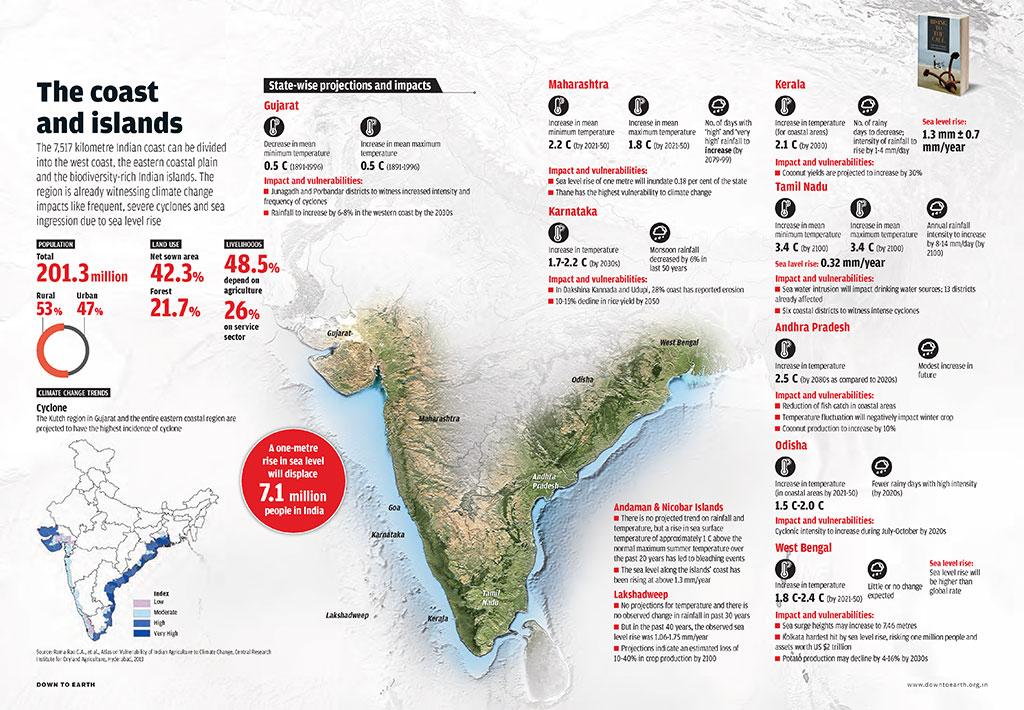
    • Managing vulnerable regions in coastal zones: Floods and storms are worsened by vast sea ingress and coastline erosion in the low-lying areas in the south.
    • It is vital to map flood-risk zones to manage vulnerable regions.
    • Environment Impact Assessments must be mandatory for commercial projects.
    • Design changes: Communities can build round-shaped houses, considering optimum aerodynamic orientation to reduce the strength of the winds.
    • Roofs with multiple slopes can stand well in strong winds, and central shafts reduce wind pressure on the roof by sucking in air from outside.
    • Moving away from fossil fuels: Adaptation alone will not slow climate damages if the warming of the sea level temperatures is not confronted.
    • Leading emitters, including India, must move away from fossil fuels.
    • Expanding and protecting forest cover: a big part of climate action lies in protecting and expanding forest coverage.
    • India gains from being part of the Glasgow declaration on forest protection that 141 countries signed in 2021.
    • Management of dams: Nearly 295 dams in India are more than 100 years old and need repairs.
    • In stemming landslides in Uttarakhand, regulations must stop the building of dams on steep slopes and eco-fragile areas, as well as the dynamiting of hills, sand mining, and quarrying.
    • Climate financing: India’s share in disaster management should be raised to 2.5% of GDP.
    • Climate finance is most suited for large-scale global funding from the World Bank, the International Monetary Fund, and the Asian Development Bank.
    • But smaller-scale financing can also be vital.

    Conclusion

    For public pressure to drive climate action, we need to consider climate catastrophes as largely man-made.


  • Lessons on navigating the evolving geopolitics in the Middle East

    Context

    The US President’s visit to Saudi Arabia and Israel highlights not only some new trends that are reshaping the region but also eternal truths about international politics that are lost in the din of public discourse about the Middle East.

    What is the significance of the visit

    1] The US is not abandoning the Middle East

    • Contrary to the popular perception in the US, the region, and India, the US is not about to abandon the Middle East.
    • Many in the US political class believed that given America’s oil independence from the Middle East no longer needed the region.
    • American withdrawal from Afghanistan last year intensified these concerns and the region looked for alternative means to secure itself.
    • But as in the Indo-Pacific and Europe, the Biden Administration has concluded that it can’t cede its regional primacy in the Middle East and is ready to reclaim its leadership.
    • But as in the Indo-Pacific and Europe, the Biden Administration has concluded that it can’t cede its regional primacy in the Middle East and is ready to reclaim its leadership.

    2] No direct involvement

    • While the US will stay put in the Middle East, it is certainly changing the manner in which it acts.
    • In the past, the US saw itself as the sole provider of regional security and was ready to send its troops frequently into the region.
    • While the US does not want to be drawn directly into the region’s wars, it is determined to help its partners develop capabilities to secure themselves.
    • Arab-Israel reconciliation: Efforts are also being taken to produce greater reconciliation among Arabs and Israel and create stronger networks within and beyond the region to strengthen deterrence against adversaries.
    • The current effort to craft a Middle East Air Defence coalition is an example of this,
    • The I2U2 signals that the US no longer views the Middle East in isolation from its neighbourhood.

    3] Setting aside the differences on democracy vs autocracy debate

    • Biden had to modify his sweeping rhetoric about the “conflict between democracies and autocracies” as the principal contradiction in the world.
    • To sustain the US position in the region, Biden had no option but to sit with leaders of monarchies and autocracies that are America’s long-standing partners.

    4] Nation above identities

    • Biden’s focus on national interest found an echo in the Middle East, which is learning to put nation above other identities such as ethnicity and religion.
    • In the past, the region seemed immune to nationalism as it focused on transcendental notions of “pan Arabism” and “pan Islamism”.
    • Although the idea of Arab solidarity on the Palestine issue endures, many Arab leaders are not willing to let that come in the way of normalisation of relations with Israel.
    • A critical section of the Arabs, long seen as irreconcilably opposed to Israel, are now joining hands with the Jewish state to counter threats to their national security from Iran.
    • Many Gulf kingdoms, including Saudi Arabia and the UAE, are now consciously promoting a national identity among their peoples.
    •  Despite shared religion, Turkey’s leader Recep Erdogan has in recent years sought to undermine many of the Arab regimes.
    • Qatar has often found itself closer to non-Arab Turkey and in opposition to its Gulf Arab neighbours.

    Conclusion

    Delhi, whose Middle East policy today is imbued with greater realism, can hopefully discard the inherited ideological inertia, avoid the temptation of seeing the Middle East through a religious lens, and strive hard to realise the full possibilities awaiting India in the region.

    UPSC 2023 countdown has begun! Get your personal guidance plan now! (Click here)

  • Forest restoration in India

    Context

    This month is time for Van Mahotsav, which literally means “celebrate the forest”.

    Why tree planting matters

    • According to the International Union for Conservation of Nature (IUCN), deforestation and forest degradation contribute around 12% of global greenhouse gas emissions.
    • The total area occupied by primary forests in India has decreased by 3.6%.
    • Tree planting comes with varied environmental and ecological benefits.
    • Forests are integral in regulating ecosystems, influencing the carbon cycle and mitigating the effects of climate change.
    • Annually, forests absorb roughly 2.6 billion tonnes of carbon dioxide.
    • This absorption includes nearly 33% of the carbon dioxide released from burning fossil fuels.
    • Livelihood: Forests are a boon for local communities and their livelihoods by functioning as a resource base for goods and services.
    • Enrich soil fertility: According to academics from the World Resources Institute, forest ecosystems enrich soil fertility and water availability, enhancing agricultural productivity, and in turn the rural economy.
    • Prevents erosion and flooding: Tree planting prevents erosion and stems flooding.
    • Sustainable forest crops reduce food insecurity and empower women, allowing them to gain access to more nutritional diets and new income streams.
    • Agroforestry lessens rural-to-urban migration and contributes to an increase in resources and household income.
    • Planting trees is deeply linked to the ‘wholistic’ well-being of all individuals, the community, and the planet.

    Afforestation through forest landscape restoration

    • Typically, governments have relied on afforestation and reforestation as a means of establishing trees on non-treed land. These strategies have now evolved.
    • Focus on forest landscape restoration: The focus is now on forest landscape restoration — the process of regaining ecological functionality and improving human welfare across deforested or degraded forest landscapes.
    • Community participation: Forest landscape restoration seeks to involve communities in the process of designing and executing mutually advantageous interventions for the upgradation of landscapes.
    • Nearly two billion hectares of degraded land in the world (and 140 million hectares in India) have scope for potential restoration as forest land.
    • Ensuring diversity of species: A crucial aspect of this process is to ensure the diversity of the species while planting trees.
    •  Natural forests with diverse native tree species are more efficient in sequestering carbon than monoculture tree plantations.
    • Planting diverse species is also healthier for local communities and their livelihoods.
    • An international study published earlier this year in the journal, Science, found that diversifying species in forest plantations has a positive impact on the quality of the forests.

    Programs and initiative for forest restoration

    • The span 2021-2030 is the UN Decade on Ecosystem Restoration, emphasising efforts to restore degraded terrestrial ecosystems including forests.
    • Bonn Challenge: In 2011, the Bonn Challenge was launched with a global goal to restore 150 million hectares of degraded and deforested landscapes by 2020 and 350 million hectares by 2030.
    • India joined the Bonn Challenge in 2015, pledging to restore 26 million hectares of degraded and deforested land by 2030.
    • An additional carbon sink of 2.5 billion-3 billion tonnes of carbon dioxide equivalent through forest and tree cover is to be created by 2030.
    • There are a myriad government programmes such as Compensatory Afforestation, the National Afforestation Programme, the National Mission for a Green India (Green India Mission), the Nagar Van scheme and the Forest Fire Prevention and Management Scheme to name a few.
    • The Green Skill Development Programme is for the youth who aspire to attain employment in the environment and forest sectors.

    Challenges

    • Forest restoration in India faces hurdles in terms of the identification of areas for restoration, a lack of importance accorded to research and scientific strategies in tree planting, stakeholders’ conflicts of interest, and financing.

    Way forward

    • To be successful, forest landscape restoration must be implemented proactively, bolstering landscapes and forest ecosystems to be durable and adjustable in the face of future challenges and societal needs.
    • Involvement of stakeholders: It also needs the involvement and the alignment of a host of stakeholders including the community, champions, government and landowners.
    • Participatory governance: The restoration of natural forest ecosystems can be strengthened through participatory governance by engaging stakeholders.
    • Taking into account socio-economic context: Vulnerable forest-dependent communities should be factored in, and any effort should be tailored to the local socio-economic context and landscape history of a region.

    Conclusion

    In today’s world, forests need to be celebrated more than ever before. Simultaneously, more forests need to be created and restored.

    UPSC 2022 countdown has begun! Get your personal guidance plan now! (Click here)

  • 19th July 2022| Daily Answer Writing Enhancement(AWE)

    Topics for Today’s questions:

    GS-1        History of the world will include events from 18th century such as industrial revolution, world wars, redrawal of national boundaries, colonization, decolonization, political philosophies like communism, capitalism, socialism etc.— their forms and effect on the society.

    GS-2         Parliament and state legislatures

    GS-3         Agriculture and related issues

    GS-4        Attitude : content, structure and function; its influence and relation with thought and behaviour; moral and political attitudes;  Social influence and persuasion

    Question 1)


    Q.1 Bring out the social and political conditions in Russia that led to the October Revolution in 1917. (15 Marks)


    Question 2)

    Q.2 What is the role of the Opposition in a democracy? How loopholes in the anti-defection law adds to the challenges posed to the Opposition in India? (10 Marks)

    Question 3)

    Q.3 What are the lessons India can draw from the growth story of China and the role played by agriculture in it? Where does the agri-sector stand in India in comparison to China? (10 Marks)

    Question 4)  

    Q.4 According to you, what are the main reasons behind prejudice against certain sections of a society? Discuss with examples. (10 Marks)


    HOW TO ATTEMPT ANSWERS IN DAILY ANSWER WRITING ENHANCEMENT(AWE)?

    1. Daily 4 questions from General studies 1, 2, 3, and 4 will be provided to you.

    2. A Mentor’s Comment will be available for all answers. This can be used as a guidance tool but we encourage you to write original answers.

    3. You can write your answer on an A4 sheet and scan/click pictures of the same.

    4.  Upload the scanned answer in the comment section of the same question.

    5. Along with the scanned answer, please share your Razor payment ID, so that paid members are given priority.

    6. If you upload the answer on the same day like the answer of 11th  February is uploaded on 11th February then your answer will be checked within 72 hours. Also, reviews will be in the order of submission- First come first serve basis

    7. If you are writing answers late, for example, 11th February is uploaded on 13th February , then these answers will be evaluated as per the mentor’s schedule.

    8. We encourage you to write answers on the same day. However, if you are uploading an answer late then tag the mentor like @Staff so that the mentor is notified about your answer.

    *In case your answer is not reviewed, reply to your answer saying *NOT CHECKED*. 

    1. For the philosophy of AWE and payment: 

  • Know the most important thing to clear UPSC from AIR 32, UPSC 2021, Anay Navandar| Sajal sir helped him improve 80+ marks in UPSC Mains |CivilsDaily’s Mentorship student | Talk to his mentors

    Anay Navandar with his mentor and guru, Sajal Singh sir

    Anay Navandar was a mentorship student under Sajal sir, Sukanya ma’am, and other mentors under the Smash Mains program. Anay was relentless about improving himself in order to serve the country he loves dearly. He improved by 80+ marks in this 2021 Mains.

    Anay Navandar, AIR 32, UPSC 2021

    This was Anay’s second attempt and in the first attempt, he was able to reach the interview stage. Anay’s optional was Agriculture as it was one of his areas of interest.

    Anay hails from Pune and has been exceptional in his studies all through school and college. He is an engineer by education. A classical music lover Anay plays Tabla. He is health conscious and believes in the maxim ‘healthy body healthy mind’ and to keep himself fit he plays Badminton and practices Yoga regularly.

    One of the exchanges between him and Sajal sir

    Anay has made us proud by securing AIR 32 in UPSC 2021 exam. It is yet another validation of CivilsDaily’s vision and approach to personalized mentorship.

    In a candid conversation with his mentor and guru Sajal sir, Anay shared his journey, motivations, up and downs, lessons learned, and his secret of what kept him going. Listen to his story.

    Anay has given us inspiration and we wish him all the best. He’s going to be an administrator of great integrity!

    Register for Anay’s mains answer copies and notes.

    Schedule your FREE mentorship session with Anay’s mentors.

    Anay was one of 200 rankers from CivilsDaily’s mentorship programs.

More posts
