💥UPSC 2026, 2027, 2028 UAP Mentorship (March Batch) + Access XFactor Notes & Microthemes PDF

Search results for: “”

  • India’s climate Vulnerability

    Context

    In the absence of COVID-19, climate change-induced disasters would have been India’s biggest red alert in recent years.

    India’s vulnerabilities
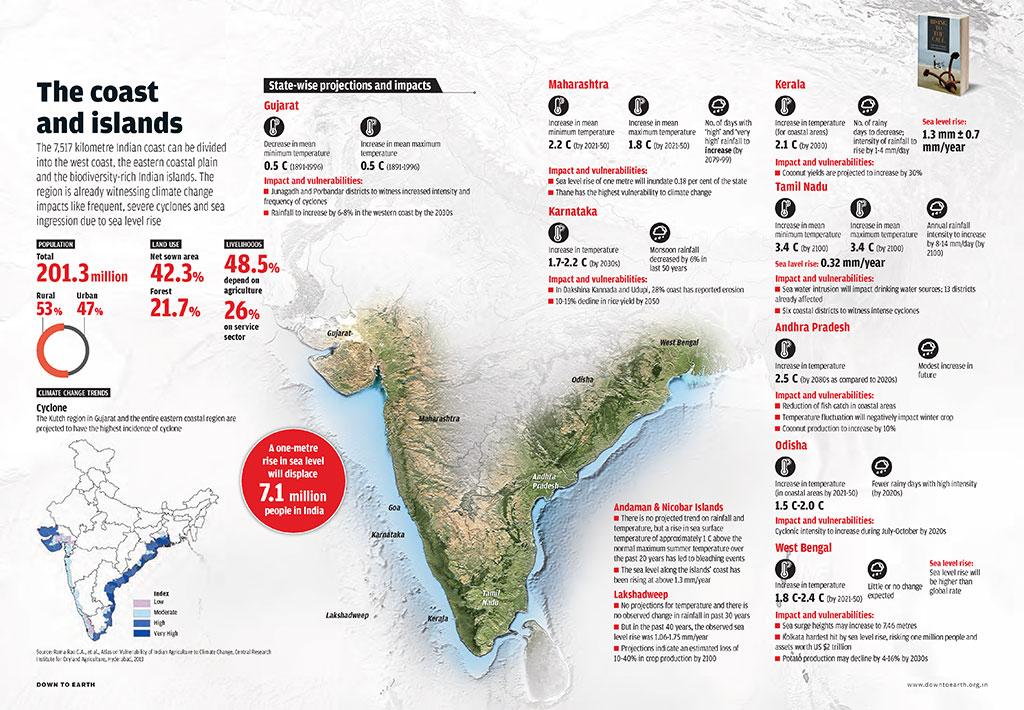
    • Temperatures over the Indian Ocean have risen by over 1°C since the 1950s, increasing extreme weather events.
    • India is the fourth worst-hit in climate migration.
    • Heat waves in India have claimed an estimated 17,000 lives since the 1970s.
    • Labour losses from rising heat, by one estimate, could reach ₹1.6 lakh crore annually if global warming exceeds 2°C, with India among the hardest hit.
    • Extreme heat waves hit swathes of India. Heatwaves are aggravated by deforestation and land degradation, which also exacerbate fires.
    • Agriculture, being water-intensive, does not do well in heat wave-prone areas.

    Way forward

    • Two part approach: India needs a two-part approach:
    • Adaptation: one, to adapt to climate impacts by building resilience against weather extremes, and
    • Mitigation: to mitigate environmental destruction to prevent climate change from becoming more lethal.
    • Climate resistant agriculture: Agricultural practices which are not water-intensive and to support afforestation that has a salutary effect on warming.
    • Financial transfers can be targeted to help farmers plant trees and buy equipment — for example, for drip irrigation that reduces heavy water usage.
    • Crop diversification: Climate-resilient agriculture calls for diversification — for example, the cultivation of multiple crops on the same farm.
    • Climate-resilient agriculture calls for diversification — for example, the cultivation of multiple crops on the same farm
    • Managing vulnerable regions in coastal zones: Floods and storms are worsened by vast sea ingress and coastline erosion in the low-lying areas in the south.
    • It is vital to map flood-risk zones to manage vulnerable regions.
    • Environment Impact Assessments must be mandatory for commercial projects.
    • Design changes: Communities can build round-shaped houses, considering optimum aerodynamic orientation to reduce the strength of the winds.
    • Roofs with multiple slopes can stand well in strong winds, and central shafts reduce wind pressure on the roof by sucking in air from outside.
    • Moving away from fossil fuels: Adaptation alone will not slow climate damages if the warming of the sea level temperatures is not confronted.
    • Leading emitters, including India, must move away from fossil fuels.
    • Expanding and protecting forest cover: a big part of climate action lies in protecting and expanding forest coverage.
    • India gains from being part of the Glasgow declaration on forest protection that 141 countries signed in 2021.
    • Management of dams: Nearly 295 dams in India are more than 100 years old and need repairs.
    • In stemming landslides in Uttarakhand, regulations must stop the building of dams on steep slopes and eco-fragile areas, as well as the dynamiting of hills, sand mining, and quarrying.
    • Climate financing: India’s share in disaster management should be raised to 2.5% of GDP.
    • Climate finance is most suited for large-scale global funding from the World Bank, the International Monetary Fund, and the Asian Development Bank.
    • But smaller-scale financing can also be vital.

    Conclusion

    For public pressure to drive climate action, we need to consider climate catastrophes as largely man-made.


  • Lessons on navigating the evolving geopolitics in the Middle East

    Context

    The US President’s visit to Saudi Arabia and Israel highlights not only some new trends that are reshaping the region but also eternal truths about international politics that are lost in the din of public discourse about the Middle East.

    What is the significance of the visit

    1] The US is not abandoning the Middle East

    • Contrary to the popular perception in the US, the region, and India, the US is not about to abandon the Middle East.
    • Many in the US political class believed that given America’s oil independence from the Middle East no longer needed the region.
    • American withdrawal from Afghanistan last year intensified these concerns and the region looked for alternative means to secure itself.
    • But as in the Indo-Pacific and Europe, the Biden Administration has concluded that it can’t cede its regional primacy in the Middle East and is ready to reclaim its leadership.
    • But as in the Indo-Pacific and Europe, the Biden Administration has concluded that it can’t cede its regional primacy in the Middle East and is ready to reclaim its leadership.

    2] No direct involvement

    • While the US will stay put in the Middle East, it is certainly changing the manner in which it acts.
    • In the past, the US saw itself as the sole provider of regional security and was ready to send its troops frequently into the region.
    • While the US does not want to be drawn directly into the region’s wars, it is determined to help its partners develop capabilities to secure themselves.
    • Arab-Israel reconciliation: Efforts are also being taken to produce greater reconciliation among Arabs and Israel and create stronger networks within and beyond the region to strengthen deterrence against adversaries.
    • The current effort to craft a Middle East Air Defence coalition is an example of this,
    • The I2U2 signals that the US no longer views the Middle East in isolation from its neighbourhood.

    3] Setting aside the differences on democracy vs autocracy debate

    • Biden had to modify his sweeping rhetoric about the “conflict between democracies and autocracies” as the principal contradiction in the world.
    • To sustain the US position in the region, Biden had no option but to sit with leaders of monarchies and autocracies that are America’s long-standing partners.

    4] Nation above identities

    • Biden’s focus on national interest found an echo in the Middle East, which is learning to put nation above other identities such as ethnicity and religion.
    • In the past, the region seemed immune to nationalism as it focused on transcendental notions of “pan Arabism” and “pan Islamism”.
    • Although the idea of Arab solidarity on the Palestine issue endures, many Arab leaders are not willing to let that come in the way of normalisation of relations with Israel.
    • A critical section of the Arabs, long seen as irreconcilably opposed to Israel, are now joining hands with the Jewish state to counter threats to their national security from Iran.
    • Many Gulf kingdoms, including Saudi Arabia and the UAE, are now consciously promoting a national identity among their peoples.
    •  Despite shared religion, Turkey’s leader Recep Erdogan has in recent years sought to undermine many of the Arab regimes.
    • Qatar has often found itself closer to non-Arab Turkey and in opposition to its Gulf Arab neighbours.

    Conclusion

    Delhi, whose Middle East policy today is imbued with greater realism, can hopefully discard the inherited ideological inertia, avoid the temptation of seeing the Middle East through a religious lens, and strive hard to realise the full possibilities awaiting India in the region.

    UPSC 2023 countdown has begun! Get your personal guidance plan now! (Click here)

  • Forest restoration in India

    Context

    This month is time for Van Mahotsav, which literally means “celebrate the forest”.

    Why tree planting matters

    • According to the International Union for Conservation of Nature (IUCN), deforestation and forest degradation contribute around 12% of global greenhouse gas emissions.
    • The total area occupied by primary forests in India has decreased by 3.6%.
    • Tree planting comes with varied environmental and ecological benefits.
    • Forests are integral in regulating ecosystems, influencing the carbon cycle and mitigating the effects of climate change.
    • Annually, forests absorb roughly 2.6 billion tonnes of carbon dioxide.
    • This absorption includes nearly 33% of the carbon dioxide released from burning fossil fuels.
    • Livelihood: Forests are a boon for local communities and their livelihoods by functioning as a resource base for goods and services.
    • Enrich soil fertility: According to academics from the World Resources Institute, forest ecosystems enrich soil fertility and water availability, enhancing agricultural productivity, and in turn the rural economy.
    • Prevents erosion and flooding: Tree planting prevents erosion and stems flooding.
    • Sustainable forest crops reduce food insecurity and empower women, allowing them to gain access to more nutritional diets and new income streams.
    • Agroforestry lessens rural-to-urban migration and contributes to an increase in resources and household income.
    • Planting trees is deeply linked to the ‘wholistic’ well-being of all individuals, the community, and the planet.

    Afforestation through forest landscape restoration

    • Typically, governments have relied on afforestation and reforestation as a means of establishing trees on non-treed land. These strategies have now evolved.
    • Focus on forest landscape restoration: The focus is now on forest landscape restoration — the process of regaining ecological functionality and improving human welfare across deforested or degraded forest landscapes.
    • Community participation: Forest landscape restoration seeks to involve communities in the process of designing and executing mutually advantageous interventions for the upgradation of landscapes.
    • Nearly two billion hectares of degraded land in the world (and 140 million hectares in India) have scope for potential restoration as forest land.
    • Ensuring diversity of species: A crucial aspect of this process is to ensure the diversity of the species while planting trees.
    •  Natural forests with diverse native tree species are more efficient in sequestering carbon than monoculture tree plantations.
    • Planting diverse species is also healthier for local communities and their livelihoods.
    • An international study published earlier this year in the journal, Science, found that diversifying species in forest plantations has a positive impact on the quality of the forests.

    Programs and initiative for forest restoration

    • The span 2021-2030 is the UN Decade on Ecosystem Restoration, emphasising efforts to restore degraded terrestrial ecosystems including forests.
    • Bonn Challenge: In 2011, the Bonn Challenge was launched with a global goal to restore 150 million hectares of degraded and deforested landscapes by 2020 and 350 million hectares by 2030.
    • India joined the Bonn Challenge in 2015, pledging to restore 26 million hectares of degraded and deforested land by 2030.
    • An additional carbon sink of 2.5 billion-3 billion tonnes of carbon dioxide equivalent through forest and tree cover is to be created by 2030.
    • There are a myriad government programmes such as Compensatory Afforestation, the National Afforestation Programme, the National Mission for a Green India (Green India Mission), the Nagar Van scheme and the Forest Fire Prevention and Management Scheme to name a few.
    • The Green Skill Development Programme is for the youth who aspire to attain employment in the environment and forest sectors.

    Challenges

    • Forest restoration in India faces hurdles in terms of the identification of areas for restoration, a lack of importance accorded to research and scientific strategies in tree planting, stakeholders’ conflicts of interest, and financing.

    Way forward

    • To be successful, forest landscape restoration must be implemented proactively, bolstering landscapes and forest ecosystems to be durable and adjustable in the face of future challenges and societal needs.
    • Involvement of stakeholders: It also needs the involvement and the alignment of a host of stakeholders including the community, champions, government and landowners.
    • Participatory governance: The restoration of natural forest ecosystems can be strengthened through participatory governance by engaging stakeholders.
    • Taking into account socio-economic context: Vulnerable forest-dependent communities should be factored in, and any effort should be tailored to the local socio-economic context and landscape history of a region.

    Conclusion

    In today’s world, forests need to be celebrated more than ever before. Simultaneously, more forests need to be created and restored.

    UPSC 2022 countdown has begun! Get your personal guidance plan now! (Click here)

  • 19th July 2022| Daily Answer Writing Enhancement(AWE)

    Topics for Today’s questions:

    GS-1        History of the world will include events from 18th century such as industrial revolution, world wars, redrawal of national boundaries, colonization, decolonization, political philosophies like communism, capitalism, socialism etc.— their forms and effect on the society.

    GS-2         Parliament and state legislatures

    GS-3         Agriculture and related issues

    GS-4        Attitude : content, structure and function; its influence and relation with thought and behaviour; moral and political attitudes;  Social influence and persuasion

    Question 1)


    Q.1 Bring out the social and political conditions in Russia that led to the October Revolution in 1917. (15 Marks)


    Question 2)

    Q.2 What is the role of the Opposition in a democracy? How loopholes in the anti-defection law adds to the challenges posed to the Opposition in India? (10 Marks)

    Question 3)

    Q.3 What are the lessons India can draw from the growth story of China and the role played by agriculture in it? Where does the agri-sector stand in India in comparison to China? (10 Marks)

    Question 4)  

    Q.4 According to you, what are the main reasons behind prejudice against certain sections of a society? Discuss with examples. (10 Marks)


    HOW TO ATTEMPT ANSWERS IN DAILY ANSWER WRITING ENHANCEMENT(AWE)?

    1. Daily 4 questions from General studies 1, 2, 3, and 4 will be provided to you.

    2. A Mentor’s Comment will be available for all answers. This can be used as a guidance tool but we encourage you to write original answers.

    3. You can write your answer on an A4 sheet and scan/click pictures of the same.

    4.  Upload the scanned answer in the comment section of the same question.

    5. Along with the scanned answer, please share your Razor payment ID, so that paid members are given priority.

    6. If you upload the answer on the same day like the answer of 11th  February is uploaded on 11th February then your answer will be checked within 72 hours. Also, reviews will be in the order of submission- First come first serve basis

    7. If you are writing answers late, for example, 11th February is uploaded on 13th February , then these answers will be evaluated as per the mentor’s schedule.

    8. We encourage you to write answers on the same day. However, if you are uploading an answer late then tag the mentor like @Staff so that the mentor is notified about your answer.

    *In case your answer is not reviewed, reply to your answer saying *NOT CHECKED*. 

    1. For the philosophy of AWE and payment: 

  • Know the most important thing to clear UPSC from AIR 32, UPSC 2021, Anay Navandar| Sajal sir helped him improve 80+ marks in UPSC Mains |CivilsDaily’s Mentorship student | Talk to his mentors

    Anay Navandar with his mentor and guru, Sajal Singh sir

    Anay Navandar was a mentorship student under Sajal sir, Sukanya ma’am, and other mentors under the Smash Mains program. Anay was relentless about improving himself in order to serve the country he loves dearly. He improved by 80+ marks in this 2021 Mains.

    Anay Navandar, AIR 32, UPSC 2021

    This was Anay’s second attempt and in the first attempt, he was able to reach the interview stage. Anay’s optional was Agriculture as it was one of his areas of interest.

    Anay hails from Pune and has been exceptional in his studies all through school and college. He is an engineer by education. A classical music lover Anay plays Tabla. He is health conscious and believes in the maxim ‘healthy body healthy mind’ and to keep himself fit he plays Badminton and practices Yoga regularly.

    One of the exchanges between him and Sajal sir

    Anay has made us proud by securing AIR 32 in UPSC 2021 exam. It is yet another validation of CivilsDaily’s vision and approach to personalized mentorship.

    In a candid conversation with his mentor and guru Sajal sir, Anay shared his journey, motivations, up and downs, lessons learned, and his secret of what kept him going. Listen to his story.

    Anay has given us inspiration and we wish him all the best. He’s going to be an administrator of great integrity!

    Register for Anay’s mains answer copies and notes.

    Schedule your FREE mentorship session with Anay’s mentors.

    Anay was one of 200 rankers from CivilsDaily’s mentorship programs.

  • Pakistan and IMF talks: What lies ahead?

    The latest IMF press release maintains it would consider an extension of the current Extended Fund Facility (EFF) to end June 2023 and augment the fund amount to $7 billion for Pakistan.

    Pakistan seeks IMF bailout

    • Surprisingly, it took five months to reach the staff-level agreement.
    • The total disbursement under the current EFF to Pakistan has now been $4.2 billion.
    • The talks were originally aimed at releasing a tranche of $900 million.

    What is Extended Fund Facility (EFF)?

    • The EFF was established by the IMF to provide assistance to countries experiencing serious payment imbalances because of structural impediments or slow growth and an inherently weak balance-of-payments position.
    • An EFF provides support for comprehensive programs including the policies needed to correct structural imbalances over an extended period.

    What was the Pakistani EFF?

    • The 39-month EFF between the two was signed in July 2019 to provide funds amounting to Self-Drawing Rights (SDR) — $4,268 million.
    • The EFF was signed by Pakistan to address the medium-term balance of payment problem, and work on structural impediments and increase per capita income.

    Why did the talks take longer to conclude?

    • The IMF placed demands (all of which seem impossible for Pakistan) includes :
    1. Fiscal consolidation to reduce debt and build resilience
    2. Market-determined exchange rate to restore competitiveness
    3. Eliminate ‘quasi-fiscal’ losses in the energy sector and
    4. Strengthened institutions with transparency
    • Ousted Pakistani PM eased fuel prices. This was considered a major deviation under the EFF benchmarks.
    • Then govt gave tax amnesties to the industrial sector, impacted the tax regime and a structural benchmark for fiscal consolidation.
    • The IMF insisted on its demands before approving any release of the tranche.

    How important is the IMF support to Pakistan?

    • Pakistan’s economic situation is dire.
    • According to the Economic Survey of Pakistan 2022, the fiscal deficit in FY 22 was $18.6 billion, and the net public debt at $252 billion, which is 66.3% of the GDP.
    • The power sector’s circular debt is $14 billion.

    Why have the Pakistan-IMF relations remained complicated?

    • Structural reforms require long-term commitment, which have been sacrificed due to Pakistan’s short-sighted political goals.
    • Hence the urge to go to the IMF for fiscal stability has been repeated over time.

    Risks posed by a failed Pakistan

    • There is also a narrative that Pakistan has the fifth largest population with nuclear weapons that cannot be allowed to fail.
    • A section within Pakistan also places the geo-strategic location of the country would provide an edge for cooperation, rather than coercion.
    • Hence, this section believes, the IMF would continue to support.
    • Given the IMF’s increased assertion, Pakistan’s political calculations and the elections ahead, the relationship between the two is likely to remain complicated.

    What lies ahead for Pakistan and the IMF?

    • Despite the latest agreement, the road ahead for the IMF and Pakistan is not an easy one.
    • Political calculations and the elections ahead will play a role in Pakistan’s economic decision-making.
    • However, one thing is eminent Pakistan will certainly collapse someday badly like Sri Lanka.

    Try this PYQ from CSP 2022

    “Rapid Financing Instrument” and “Rapid Credit Facility” are related to the provisions of lending by which one of the following?

    (a) Asian Development Bank

    (b) International Monetary fund

    (c) United National Environment Programme Finance initiative

    (d) Word bank


    Post your answer here.


    Back2Basics: Special Drawing Rights (SDRs)

    • SDRs, created by the IMF in 1969, are an international reserve asset and are meant to supplement countries’ reserves.
    • Adding SDRs to the country’s international reserves makes it more financially resilient.
    • Providing liquidity support to developing and low-income countries allows them to tide over the balance of payments (BOP) situations like the one India has been experiencing due to the pandemic and the one it faced earlier in 1991.
    • SDRs being one of the components of foreign exchange reserves (FER) of a country, an increase in its holdings is reflected in the BOP.


    UPSC 2023 countdown has begun! Get your personal guidance plan now! (Click here)

  • Minority Status in India is State-dependent: Supreme Court

    The minority status of religious and linguistic communities is “State-dependent”, said the Supreme Court.

    What did the Supreme Court say?

    • Every person in India can be a minority in one State or the other.
    • One can be a minority outside his/her State.
    • Similarly, a Kannada-speaking person may be in minority in States other than Karnataka.

    What was the petition about?

    • The court was hearing a petition complaining that followers of Judaism, Bahaism and Hinduism are the real minorities in Ladakh, Mizoram, Lakshadweep, Kashmir, Punjab and the North-East States.
    • However, they cannot establish and administer educational institutions of their choice because of the non-identification of ‘minority’ at the State level.
    • Religious communities such as Hindus here are socially, economically, politically non-dominant and numerically inferior in several States.

    Various states on Minorities

    • The Centre gave the example of how Maharashtra notified ‘Jews’ as a minority community within the State.
    • Again, Karnataka notified Urdu, Telugu, Tamil, Malayalam, Marathi, Tulu, Lambadi, Hindi, Konkani and Gujarati as minority languages within the State.

    Who are the Minorities?

    • Muslims, Sikhs, Christians, Buddhists, Jain and Zoroastrians (Parsis) have been notified as minority communities under Section 2 (c) of the National Commission for Minorities Act, 1992.
    • As per the Census 2011, the percentage of minorities in the country is about 19.3% of the total population of the country.
    • The population of Muslims are 14.2%; Christians 2.3%; Sikhs 1.7%, Buddhists 0.7%, Jain 0.4% and Parsis 0.006%.
    • Minority Concentration Districts (MCD), Minority Concentration Blocks and Minority Concentration Towns, have been identified on the basis of both population data and backwardness parameters of Census 2001 of these areas.

    Defining Minorities

    • The Constitution recognizes Religious minorities in India and Linguistic minorities in India through Article 29 and Article 30.
    • But Minority is not defined in the Constitution.
    • Currently, the Linguistic minorities in India are identified on a state-wise basis thus determined by the state government whereas Religious minorities in India are determined by the Central Government.
    • The Parliament has the legislative powers and the Centre has the executive competence to notify a community as a minority under Section 2(c) of the National Commission for Minorities Act of 1992.

    Article 29: It provides that any section of the citizens residing in any part of India having a distinct language, script, or culture of its own, shall have the rights of minorities in India to conserve the same. Article 29 is applied to both minorities (religious minorities in India and Linguistic minorities in India) and also the majority. It also includes – rights of minorities in India to agitate for the protection of language.

    Article 30: All minorities shall have the rights of minorities in India to establish and administer educational institutions of their choice. Article 30 recognizes only Religious minorities in India and Linguistic minorities in India (not the majority). It includes the rights of minorities in India to impart education to their children in their own language.

    Article 350-B: Originally, the Constitution of India did not make any provision with respect to the Special Officer for Linguistic minorities in India. However, the 7th Constitutional Amendment Act, 1956 inserted Article 350-B in the Constitution. It provides for a Special Officer for Linguistic Minorities appointed by the President of India. It would be the duty of the Special Officer to investigate all matters relating to the safeguards provided for linguistic minorities under the Constitution.

    Try this PYQ:

    Which one of the following categories of Fundamental Rights incorporates protection against untouchability as a form of discrimination?

    (a) Right against Exploitation

    (b) Right to Freedom

    (c) Right to Constitutional Remedies

    (d) Right to Equality


    Post your answers here.


    UPSC 2023 countdown has begun! Get your personal guidance plan now! (Click here)

  • Centre forms panel for Minimum Support Price (MSP)

    The Centre has finally constituted a committee headed by former Union Agriculture Secretary Sanjay Agrawal here to look into the issues of Minimum Support Price (MSP), as promised to protestant farmers after the repeal of three farm laws.

    Panel on MSP: Terms of reference

    • The panel will consist of representatives of the Central and State governments, farmers, agricultural scientists and agricultural economists.
    • This panel will be constituted:
    1. To promote zero budget-based farming,
    2. To change crop patterns keeping in mind the changing needs of the country
    3. To make MSP more effective and transparent
    • It also says that the committee will discuss methods to strengthen the Agricultural Marketing System as per the changing requirements of the country
    • It would ensure higher value to the farmers through remunerative prices of their produce by taking advantage of the domestic output and export.
    • On natural farming, the committee will make suggestions for programs and schemes for value chain development, protocol validation, and research for future needs.
    • It would support area expansion under the Indian Natural Farming System through publicity and through the involvement and contribution of farmer organizations.

    What is MSP?

    • The MSP assures the farmers of a fixed price for their crops, well above their production costs.
    • MSP, by contrast, is devoid of any legal backing. Access to it, unlike subsidized grains through the PDS, isn’t an entitlement for farmers.
    • They cannot demand it as a matter of right. It is only a government policy that is part of administrative decision-making.
    • The Centre currently fixes MSPs for 23 farm commodities based on the Commission for Agricultural Costs and Prices (CACP) recommendations.

    Fixing of MSPs

    • The CACP considered various factors while recommending the MSP for a commodity, including the cost of cultivation.
    • It also takes into account the supply and demand situation for the commodity; market price trends (domestic and global) and parity vis-à-vis other crops; and implications for consumers (inflation), environment (soil and water use) and terms of trade between agriculture and non-agriculture sectors.

    What changed with the 2018 budget?

    • The Budget for 2018-19 announced that MSPs would henceforth be fixed at 1.5 times of the production costs for crops as a “pre-determined principle”.
    • Simply put, the CACP’s job now was only to estimate production costs for a season and recommend the MSPs by applying the 1.5-times formula.

    How was this production cost arrived at?

    • The CACP projects three kinds of production cost for every crop, both at the state and all-India average levels.
    • ‘A2’ covers all paid-out costs directly incurred by the farmer — in cash and kind — on seeds, fertilizers, pesticides, hired labor, leased-in land, fuel, irrigation, etc.
    • ‘A2+FL’ includes A2 plus an imputed value of unpaid family labor.
    • ‘C2’ is a more comprehensive cost that factors in rentals and interest forgone on owned land and fixed capital assets, on top of A2+FL.

    How much produce can the government procure at MSP?

    • The MSP value of the total production of the 23 crops worked out to around Rs 10.78 lakh crore in 2019-20.
    • Not all this produce, however, is marketed. Farmers retain part of it for self-consumption, the seed for the next season’s sowing, and also for feeding their animals.
    • The marketed surplus ratio for different crops is estimated to range differently for various crops.
    • It ranges from below 50% for ragi and 65-70% for bajra (pearl millet) and jawar (sorghum) to 75% for wheat, 80% for paddy, 85% for sugarcane, 90% for most pulses, and 95%-plus for cotton, soybean, etc.
    • Taking an average of 75% would yield a number of just over Rs 8 lakh crore.
    • This is the MSP value of production that is the marketable surplus — which farmers actually sell.

    Nature of MSP

    • There is currently no statutory backing for these prices, nor any law mandating their enforcement.

    Farmers demand legalization

    • Legal entitlement: There is a demand that MSP based on a C2+50% formula should be made a legal entitlement for all agricultural produce.
    • Private traders’ responsibility: Some says that most of the cost should be borne by private traders, noting that both middlemen and corporate giants are buying commodities at low rates from farmers.
    • Mandatory purchase at MSP: A left-affiliated farm union has suggested a law that simply stipulates that no one — neither the Government nor private players — will be allowed to buy at a rate lower than MSP.
    • Surplus payment by the govt.: Other unions have said that if private buyers fail to purchase their crops, the Government must be prepared to buy out the entire surplus at MSP rates.
    • Expansion of C2: Farm unions are demanding that C2 must also include capital assets and the rentals and interest forgone on owned land as recommended by the National Commission for Farmers.

    Government’s position

    • The PM has announced the formation of a committee to make MSP more transparent, as well as to change crop patterns — often determined by MSP and procurement.
    • The panel will have representatives from farm groups as well as from the State and Central Governments, along with agricultural scientists and economists.

    Issues with legal backing

    • Demand-supply dynamics: Economic theory, as well as experience, indicates that the price level that is not supported by demand and supply cannot be sustained through legal means.
    • States responsibility: The Centre has suggested that the States are free to guarantee MSP rates if they wish, but also offers two failed examples of such a policy:

    [I] Sugar FRP

    • In the sugar sector, private mills are mandated to buy cane from farmers at prices set by the Government.
    • Faced with low sugar prices, high surplus stock, and low liquidity, mills failed to make full payments to farmers, resulting in an accumulation of thousands of crores worth of dues pending for years.

    [II] Withdrawal of traders

    • The other example is a 2018 amendment to the Maharashtra law penalizing traders with hefty fines and jail terms if they bought crops at rates lower than MSP.
    • As open market prices were lower than the (legalized) MSP levels declared by the State, the buyers withdrew from the market and farmers had to suffer.

    Will a legal backing for MSP solve all the ills that plague the Agriculture sector?

    • Only one side of the coin: Actually, no. Remunerative price or MSP is only one part of the problems farmers face.  Farmers face many other issues other than price, which itself is not guaranteed given the influence of politicians and cartels in mandis.
    • Information deficit: They lack information on which crop to grow, when to sow, apply plant nutrients and which pest is attacking their crop.
    • Lack of technology: Farmers are also short of post-harvest technologies to ensure a better shelf life for their produce.
    • Irrigation and storage problem: They do not get adequate facilities to irrigate their lands, with nearly 50 percent of the land being rain-fed and lacking ample warehouses to store their produce at the village level, besides proper roads to connect them to the mandis.
    • Threat of new loopholes: Legal backing for the MSP could also lead to the danger of the trade keeping away from places where the law is implemented vigorously.

    Fiscal cost of making the MSP legally binding

    • The MSP value of the total output of all the 23 notified crops worked out to about Rs 11.9 lakh crore in 2020-21.
    • Taking an average of 75% yields a number – the MSP value of production actually sold by farmers – just under Rs 9 lakh crore.
    • The government is further, as it is, procuring many crops. The MSP value of the 89.42 mt of paddy and 43.34 mt of wheat alone bought during 2020-21 was around Rs 253,275 crore.
    • All in all, then, the MSP is already being enforced, directly or through fiat, on roughly Rs 3.8 lakh crore worth of produce.
    • Providing a legal guarantee for the entire marketable surplus of the 23 MSP crops would mean covering another Rs 5 lakh crore or so.

    Conclusion

    • A growing consensus among economists for guaranteeing minimum “incomes”, as against “prices”, to farmers.
    • That would essentially entail making more direct cash transfers either on a flat per-acre (as in the Telangana government’s Rythu Bandhu scheme) or per-farm household (the Centre’s PM-Kisan) basis.
    • The resource requirement of such interventions will be so huge that no government will be left with resources to help farmers through other means like investment in public infrastructure, irrigation, and other incentives.
    • The danger of over-reliance on MSP is already visible in the state of Punjab. Agriculture has reached an almost static stage there.
    • The state is unable to diversify away from crops like paddy, which is destroying its natural resources and environment, marring long-term prospects of farming.


    UPSC 2023 countdown has begun! Get your personal guidance plan now! (Click here)

  • India’s Defence Exports have grown up 7x: PM

    Our defence exports have increased seven times in the last eight years, informed the Prime Minister. We had achieved defence exports worth ₹13,000 crore and of this 70% was from the private sector.

    Why in news?

    • The Indian Defence sector, the second largest armed force is at the cusp of revolution.

    India’s Defence Exports

    • India has put out a range of military hardware on sale which includes various missile systems, Light Combat Aircraft (LCA), helicopters, warship and patrol vessels, artillery guns, tanks, radars etc.
    • From 2016-17 to 2018-19, the country’s defence exports have increased from ₹1,521 crore to ₹10,745 crore, a staggering 700% growth.

    Steps taken by the Centre to boost defence production

    • Licensing relaxation: Measures announced to boost exports since 2014 include simplified defence industrial licensing, relaxation of export controls and grant of no-objection certificates.
    • Lines of Credit: Specific incentives were introduced under the foreign trade policy and the Ministry of External Affairs has facilitated Lines of Credit for countries to import defence product.
    • Policy boost: The Defence Ministry has also issued a draft Defence Production & Export Promotion Policy 2020.
    • Indigenization lists: On the domestic front, to boost indigenous manufacturing, the Government had issued two “positive indigenization lists” consisting of 209 items that cannot be imported.
    • Budgetary allocation: In addition, a percentage of the capital outlay of the defence budget has been reserved for procurement from domestic industry.
    • Defence Industrial Corridors: The government has also announced 2 dedicated Corridors in the States of TN and UP to act as clusters of defence manufacturing that leverage existing infrastructure, and human capital.
    • Long-term vision: The vision of the government is to achieve a turnover of $25 bn including export of $5 bn in Aerospace and Defence goods and services by 2025.
    • Push for self-reliance: The govt has identified the Defence and Aerospace sector as a focus area for the ‘Aatmanirbhar Bharat’ or Self-Reliant India initiative.

    Issues retarding defence exports

    • Excess reliance on Public Sector: India has four companies (Indian ordnance factories, Hindustan Aeronautics Limited (HAL), Bharat Electronics Limited (BEL) and Bharat Dynamics Limited (BDL)) among the top 100 biggest arms producers of the world.
    • Policy delays: In the past few years, the government has approved over 200 defence acquisition worth Rs 4 trillion, but most are still in relatively early stages of processing.
    • Lack of Critical Technologies: Poor design capability in critical technologies, inadequate investment in R&D and the inability to manufacture major subsystems and components hamper the indigenous manufacturing.
    • Long gestation: The creation of a manufacturing base is capital and technology-intensive and has a long gestation period. By that time newer technologies make products outdated.
    • ‘Unease’ in doing business: An issue related to stringent labour laws, compliance burden and lack of skills, affects the development of indigenous manufacturing in defence.
    • Multiple jurisdictions: Overlapping jurisdiction of the Ministry of Defence and Ministry of Industrial Promotion impair India’s capability of defence manufacturing.
    • Lack of quality: The higher indigenization in few cases is largely attributed to the low-end technology.
    • FDI Policy: The earlier FDI limit of 49% was not enough to enthuse global manufacturing houses to set up bases in India.
    • R&D Lacunae: A lip service to technology funding by making token allocations is an adequate commentary on our lack of seriousness in the area of Research and Development.
    • Lack of skills: There is a lack of engineering and research capability in our institutions. It again leads us back to the need for a stronger industry-academia interface.

    Way forward

    • Reducing import dependence: India was the world’s second-largest arms importer from 2014-18, ceding the long-held tag as the largest importer to Saudi Arabia, says 2019 SIPRI report.
    • Security Imperative: Indigenization in defence is critical to national security also. It keeps intact the technological expertise and encourages spin-off technologies and innovation that often stem from it.
    • Economic boost: Indigenization in defence can help create a large industry which also includes small manufacturers.
    • Employment generation: Defence manufacturing will lead to the generation of satellite industries that in turn will pave the way for a generation of employment opportunities.


    UPSC 2023 countdown has begun! Get your personal guidance plan now! (Click here)

More posts
