💥UPSC 2026, 2027, 2028 UAP Mentorship (March Batch) + Access XFactor Notes & Microthemes PDF

Search results for: “”

  • Fundamental Duties

    The Supreme Court has allowed the Centre’s request for two months’ time to file a reply to a petition seeking the enforcement of fundamental duties of citizens, including patriotism and unity of nation, through “comprehensive, and well-defined laws”.

    Why in news?

    • The need to enforce fundamental duties arises due to new illegal trend of protest by protesters in the garb of freedom of speech and expression.
    • Vandalism, blocking of road and rail routes in order to compel the government to meet their demands is a sheer violation of the FDs which are generally not enforceable.

    What are Fundamental Duties?

    • The fundamental duties of citizens were added to the constitution by the 42nd Amendment in 1976, upon the recommendations of the Swaran Singh Committee.
    • It basically imply the moral obligations of all citizens of a country and today, there are 11 fundamental duties in India, which are written in Part IV-A of the Constitution, to promote patriotism and strengthen the unity of India.
    • The FDs obligate all citizens to respect the national symbols of India, including the constitution, to cherish its heritage, preserve its composite culture and assist in its defence.
    • They also obligate all Indians to promote the spirit of common brotherhood, protect the environment and public property, develop scientific temper, abjure violence, and strive towards excellence in all spheres of life.

    Judicial interpretation of FDs

    • The Supreme Court has held that FDs are not enforceable in any Court of Law.
    • It ruled that these fundamental duties can also help the court to decide the constitutionality of a law passed by the legislature.
    • There is a reference to such duties in international instruments such as the Universal Declaration of Human Rights and International Covenant on Civil and Political Rights, and Article 51A brings the Indian constitution into conformity with these treaties.

    Total FDs

    • Originally ten in number, the fundamental duties were increased to eleven by the 86th Amendment in 2002.

    The 10 fundamental duties are as follows:

    1. To oblige with the Indian Constitution and respect the National Anthem and Flag
    2. To cherish and follow the noble ideas that inspired the national struggle for freedom
    3. To protect the integrity, sovereignty, and unity of India
    4. To defend the country and perform national services if and when the country requires
    5. To promote the spirit of harmony and brotherhood amongst all the people of India and renounce any practices that are derogatory to women
    6. To cherish and preserve the rich national heritage of our composite culture
    7. To protect and improve the natural environment including lakes, wildlife, rivers, forests, etc.
    8. To develop scientific temper, humanism, and spirit of inquiry
    9. To safeguard all public property
    10. To strive towards excellence in all genres of individual and collective activities

    The 11th fundamental duty which was added to this list is:

    1. To provide opportunities for education to children between 6-14 years of age, and duty as parents to ensure that such opportunities are being awarded to their child. (86th Amendment, 2002)


    Try this PYQ:

    Which of the following is/are among the Fundamental Duties of citizens laid down in the Indian Constitution?

    1. To preserve the rich heritage of our composite culture
    2. To protect the weaker sections from social injustice
    3. To develop the scientific temper and spirit of inquiry
    4. To strive towards excellence in all spheres of individual and collective activity.

    Select the correct answer using the codes given below:

    (a) 1 and 2 only

    (b) Only 2

    (c) 1, 3 and 4 only

    (d) 1, 2, 3 and 4


    Post your answers here.


    UPSC 2023 countdown has begun! Get your personal guidance plan now! (Click here)

  • Pradhan Mantri Fasal Bima Yojana (PMFBY)

    Andhra Pradesh has decided to rejoin the crop insurance scheme Pradhan Mantri Fasal Bima Yojana (PMFBY) from the ongoing kharif season.

    Why in news?

    • Andhra Pradesh was one of six states that have stopped the implementation of the scheme over the last four years.
    • The other five, which remain out, are Bihar, Jharkhand, West Bengal, Jharkhand, and Telangana.

    What is PMFBY?

    • The PMFBY was launched in February 2016. It is being administered by Ministry of Agriculture.
    • It provides a comprehensive insurance cover against failure of the crop thus helping in stabilising the income of the farmers.
    • It is implemented by general insurance companies.

    Its functioning

    • PMFBY insures farmers against all non-preventable natural risks from pre-sowing to post-harvest.
    • Farmers have to pay a maximum of 2 per cent of the total premium of the insured amount for kharif crops, 1.5 per cent for rabi food crops and oilseeds as well as 5 per cent for commercial / horticultural crops.
    • The balance premium is shared by the Union and state governments on a 50:50 basis and on a 90:10 basis in the case of northeastern states.

    Farmers covered

    • All farmers growing notified crops in a notified area during the season who have insurable interest in the crop are eligible.
    • Earlier to Kharif 2020, the enrolment under the scheme was compulsory for following categories of farmers:
    1. Farmers in the notified area who possess a Crop Loan account/KCC account (called as Loanee Farmers) to whom credit limit is sanctioned/renewed for the notified crop during the crop season. and
    2. Such other farmers whom the Government may decide to include from time to time.

    Risks covered under the scheme

    • Comprehensive risk insurance is provided to cover yield losses due to non-preventable risks, such as Natural Fire and Lightning, Storm, Hailstorm, Cyclone, Typhoon, Tempest, Hurricane, Tornado.
    • Risks due to Flood, Inundation and Landslide, Drought, Dry spells, Pests/ Diseases also will be covered.
    • Post-harvest losses coverage will be available up to a maximum period of 14 days from harvesting for those crops which are kept in “cut & spread” condition to dry in the field.
    • For certain localized problems such as loss/damage resulting from the occurrence of identified localized risks like hailstorm, landslide, and Inundation affecting isolated farms in the notified area would also be covered.

    Why many states has opted out?

    The opting-out states had mentioned several reasons:

    • The scheme should be voluntary.
    • States should be given options to choose the risks covered and the scheme should be universal.
    • State should be given option to use their own database of E-crop, an application used by the state government to collect information about crops.
    • Many state government wanted zero premium for farmers (meaning the entire premium should be paid by the government.
    • The non-payment of the State Share of premium subsidy within the prescribed timelines as defined in the seasonality discipline lea to the disqualification of the State Government.
    • The reason for West Bengal not implementing the PMFBY is purely “political” as it wants to implement the scheme without mentioning Pradhan Mantri in the name.

    How was the scheme structured, and what has changed since?

    • Initially, the scheme was compulsory for loanee farmers; in February 2020, the Centre revised it to make it optional for all farmers.
    • Now states and UTs are free to extend additional subsidy over and above the normal subsidy from their budgets.
    • In February 2020, the Centre decided to restrict its premium subsidy to 30% for unirrigated areas and 25% for irrigated areas (from the existing unlimited). Earlier, there was no upper limit.
    • Food crops (cereals, millets and pulses); oilseeds; and annual commercial / annual horticultural crops are broadly covered under the scheme.


    UPSC 2023 countdown has begun! Get your personal guidance plan now! (Click here)

  • Increase in Current Account Deficit (CAD)

    The Finance Ministry has asserted that the current account deficit (CAD) could, however, deteriorate this year mainly due to rising trade deficits.

    What is Current Account Deficit (CAD)?

    • A current account is a key component of balance of payments, which is the account of transactions or exchanges made between entities in a country and the rest of the world.
    • This includes a nation’s net trade in products and services, its net earnings on cross border investments including interest and dividends, and its net transfer payments such as remittances and foreign aid.
    • A CAD arises when the value of goods and services imported exceeds the value of exports, while the trade balance refers to the net balance of export and import of goods or merchandise trade.

    Components of Current Account

    Current Account Deficit (CAD) = Trade Deficit + Net Income + Net Transfers

    (1) Trade Deficit

    • Trade Deficit = Imports – Exports
    • A Country is said to have a trade deficit when it imports more goods and services than it exports.
    • Trade deficit is an economic measure of a negative balance of trade in which a country’s imports exceeds its exports.
    • A trade deficit represents an outflow of domestic currency to foreign markets.

    (2) Net Income

    • Net Income = Income Earned by MNCs from their investments in India.
    • When foreign investment income exceeds the savings of the country’s residents, then the country has net income deficit.
    • This foreign investment can help a country’s economy grow. But if foreign investors worry they won’t get a return in a reasonable amount of time, they will cut off funding.
    • Net income is measured by the following things:
    1. Payments made to foreigners in the form of dividends of domestic stocks.
    2. Interest payments on bonds.
    3. Wages paid to foreigners working in the country.

    (3) Net Transfers

    • In Net Transfers, foreign residents send back money to their home countries. It also includes government grants to foreigners.
    • It Includes Remittances, Gifts, Donation etc

    How Current Account Transaction does takes place?

    • While understanding the Current Account Deficit in detail, it is important to understand what the current account transactions are.
    • Current account transactions are transactions that require foreign currency.
    • Following transactions with from which component these transactions belong to :
    1. Component 1 : Payments connection with Foreign trade – Import & Export
    2. Component 2 : Interest on loans to other countries and Net income from investments in other countries
    3. Component 3 : Remittances for living expenses of parents, spouse and children residing abroad, and Expenses in connection with Foreign travel, Education and Medical care of parents, spouse and children

    What has been the recent trend?

    • In Q4 FY 2021-22, CAD improved to 1.5% of GDP or $13.4 billion from 2.6% of GDP in Q3 FY 2021-22 ($22.2 billion).
    • The difference between the value of goods imported and exported fell to $54.48 million in Q4FY 2021-22 from $59.75 million in Q3 FY2021-22.
    • However, based on robust performance by computer and business services, net service receipts rose both sequentially and on a year-on-year basis.
    • Remittances by Indians abroad also rose.

    What are the reasons for the current account deficit?

    • Intensifying geopolitical tensions and supply chain disruptions leading to crude oil and commodity prices soaring globally have been exerting upward pressure on the import bill.
    • A rise in prices of coal, natural gas, fertilizers, and edible oils have added to the pressure on trade deficit.
    • However, with global demand picking up, merchandise exports have also been rising.

    How will a large CAD affect the economy?

    • A large CAD will result in demand for foreign currency rising, thus leading to depreciation of the home currency.
    • Nations balance CAD by attracting capital inflows and running a surplus in capital accounts through increased foreign direct investments (FDI).
    • However, worsening CAD will put pressure on inflow under the capital account.
    • Nevertheless, if an increase in the import bill is because of imports for technological upgradation it would help in long-term development.


    UPSC 2023 countdown has begun! Get your personal guidance plan now! (Click here)

  • Govt. extends RoSCTL Scheme for Garment Exports

    The RoSCTL scheme will continue for export of garments/apparels, and made-ups till March 31, 2024, according to a press release from the Union Ministry of Textiles.

    What is RoSCTL Scheme?

    • RoSCTL stands for Rebate of State and Central Taxes and Levies (RoSCTL).
    • It is an export incentive in the form of transferable and sellable duty credit scrips (certificate) offered on the basis of the value of the export.
    • It replaces the Rebate of State Levies (RoSL) scheme, a monetary incentive scheme under which Customs would deposit the rebate directly into the exporter’s bank account.
    • This scheme was seen as India’s reaction to the increasing international pressure on export incentives provided by the Indian government.

    Why was this scheme introduced?

    • The US, in particular, has been very vocal, urging the discontinuation of export incentive schemes like the Merchandise Exports from India Scheme (MEIS).
    • It held that they flouted the WTO Agreement on Subsidies and Countervailing Measures.

    Why was this scheme extended to textile sector?

    • With a view to boost exports and job creation in the textile sector, the government has approved the continuation of the scheme.
    • The scheme aims to help them cut high logistics and other costs and enable them to compete globally.


    UPSC 2023 countdown has begun! Get your personal guidance plan now! (Click here)

  • Kerala reports India’s first Monkeypox Case

    The first known lab-confirmed case of monkeypox in India has been reported in a 35-year-old man in Kerala.

    What is Monkeypox?

    • The monkeypox virus is an orthopoxvirus, which is a genus of viruses that also includes the variola virus, which causes smallpox, and vaccinia virus, which was used in the smallpox vaccine.
    • It causes symptoms similar to smallpox, although they are less severe.
    • While vaccination eradicated smallpox worldwide in 1980, monkeypox continues to occur in a swathe of countries in Central and West Africa, and has on occasion showed up elsewhere.
    • According to the WHO, two distinct clade are identified: the West African clade and the Congo Basin clade, also known as the Central African clade.

    Its origin

    • Monkeypox is a zoonosis, that is, a disease that is transmitted from infected animals to humans.
    • Monkeypox virus infection has been detected in squirrels, Gambian poached rats, dormice, and some species of monkeys.
    • According to the WHO, cases occur close to tropical rainforests inhabited by animals that carry the virus.

    Symptoms and treatment

    • Monkeypox begins with a fever, headache, muscle aches, back ache, and exhaustion.
    • It also causes the lymph nodes to swell (lymphadenopathy), which smallpox does not.
    • The WHO underlines that it is important to not confuse monkeypox with chickenpox, measles, bacterial skin infections, scabies, syphilis and medication-associated allergies.
    • The incubation period (time from infection to symptoms) for monkeypox is usually 7-14 days but can range from 5-21 days.
    • There is no safe, proven treatment for monkeypox yet.


    UPSC 2023 countdown has begun! Get your personal guidance plan now! (Click here)

  • Cross the UPSC Prelims 2023 hurdle with Smash Prelims | From failing thrice, to scoring 130+ in UPSC Prelims – read success stories | Intake only 100 students – Register now!

    Cross the UPSC Prelims 2023 hurdle with Smash Prelims | From failing thrice, to scoring 130+ in UPSC Prelims – read success stories | Intake only 100 students – Register now!

    Smash Prelims 2023 under Santosh Gupta sir’s mentorship can increase your chances to clear Prelims by 85%

    CLICK:- Download Smash Prelims 2023 Timetable

    Read about Arsalanali and Tavishi’s success

    Click here for Smash Prelims 2023 details: Test series, 1-1 Mentorship, lectures and notes


    There is no doubt that UPSC Prelims could be the toughest stage. It is the great filter that weeds out the not so serious candidates but at times many serious ones too.

    While there could be many reasons for failing in Prelims like insufficient syllabus coverage, mocks or test series not attempted, no proper planning, lack of conceptual understanding, etc but the major one is lack of guidance, preparation analysis and course correction at regular intervals.


    Tavishi failed thrice in the Prelims before but after joining Santosh sir’s mentorship cleared Prelim 2022 in her 4th attempt. Schedule a call with Tavishi’s mentor

    Moreover, aspirants must be prepared for the googlies thrown at them by UPSC in the Prelims (new things being tried out by UPSC- like options, topics, etc).

    To bridge this gap we had introduced Smash Prelims program under Santosh Gupta sir last year and the results were amazing.


    You are 8 times more likely to clear Prelims 2023 with Santosh sir’s mentorship

    SMASH PRELIMS 2023: PERSONALIZED MENTORSHIP, TEST SERIES, LECTURES, NOTES

    Our Smash Prelims Program started as a pilot project last year with an aim to introduce step-wise improvement in our chosen 40 aspirants. Over a period of 2 months, Santhosh sir inculcated confidence in aspirants who were either newbies or gave too many attempts. This year, we achieved a remarkable 80% success ratio. This year, we have set our eyes on 100%. Yes, we are as ambitious and aspirational just like any other UPSC aspirant.

    About 6 pillared approach of Smash Prelims 2023

    Pillar-1: 44 Prelims test

    Prelims Tests: 44 (14 Basic + 8 Advanced + 6 CA tests + 10 Full tests + 6 CSAT tests)

    Pillar-2: Special Value Additions Notes and Classes by Santosh Gupta

    50 Special classes on topics including Polity, History, Economics, Geography, Sessions to cover Environment innovatively, Science & Technology and more.

    Pillar-3: Mentorship calls

    One-to-one mentorship by core faculty and toppers

    • One to one Mentor calls after tests
    • Habitat/WhatsApp support from mentors
    • Frequent sessions with toppers for support and guidance.
    You are 8 times more likely to clear Prelims 2023 with Santosh sir’s mentorship

    Pillar-4: Weekly zoom session by Santosh Gupta 

    Doubt clearance and continuous improvement

    Pillar-5: Learn Question-solving 

    • Strategic Live 1000 Questions solving with Santosh Gupta sir for Prelims-2023
    • Learn Art of Question-solving: Using Logical approach + Elimination techniques
    • Live Question solving of Previous year’s questions

    Pillar-6: Current Affairs

    Specifically made Current affairs notes + Live classes by core faculty for the entire two years for prelims.

    You are 8 times more likely to clear Prelims 2023 with Santosh sir’s mentorship under Smash Prelims program

    About Santosh Gupta sir

    Santosh Gupta sir has scored above 140 twice in UPSC prelims and always 120 plus in all 6 attempts. He wrote all 6 mains and appeared for Interviews 3 times. He has qualified UPSC EPFO and BPSC 56-59th also. He has been teaching and mentoring UPSC aspirants for the last 5 years.

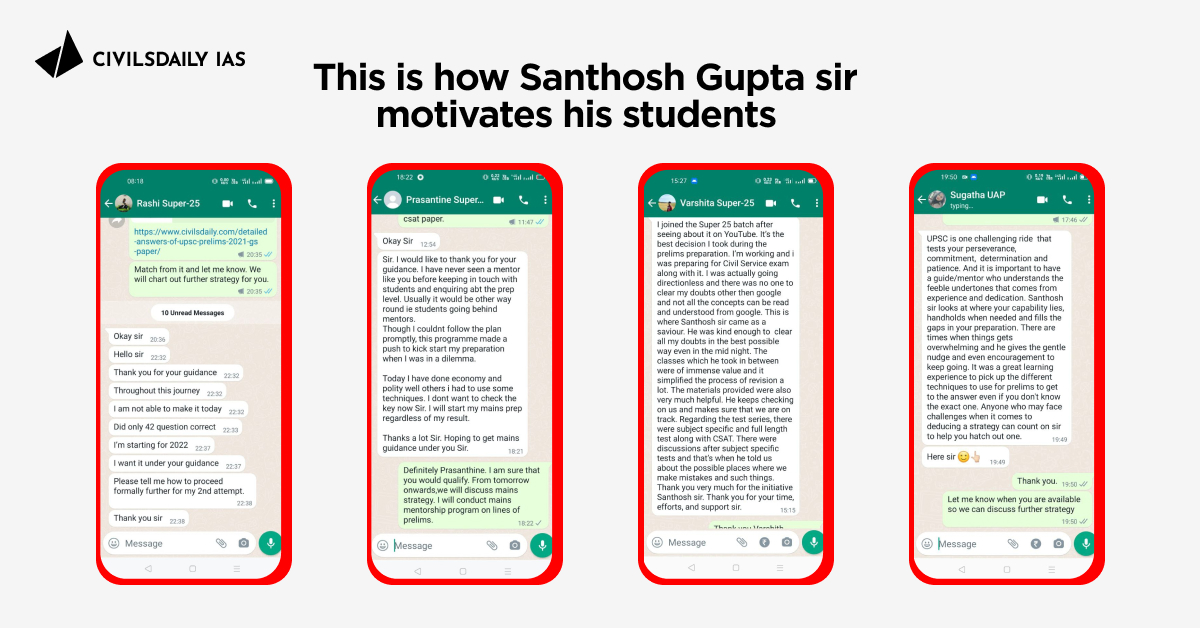
    What CivilsDaily’s Smash Prelims students have to say?

    Success Stories of Smash Prelims 2022

    From failing twice-thrice to clearing Prelims 2022
    Click and Enroll here
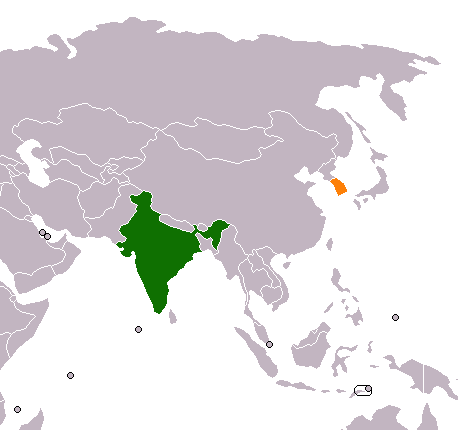
  • India-South Korea Relations

    Context

    • During the past five years, India and South Korea have experienced considerable divergence in their respective national objectives.

    Background

    India–South Korea relations - Wikipedia

    • Bilateral relations between India and South Korea, officially known as the Republic of Korea, were established in 1962 and upgraded to Ambassador-level in 1973.
    • South Korea’s open market policies found resonance with India’s economic liberalization, and its ‘look east policy’ and ‘act east policy’.
    • The relations has become truly multidimensional, spurred by a significant convergence of interests, mutual goodwill and high level exchanges.
    • During PM Modi’s visit to ROK in May 2015, the sides elevated the ties to ‘Special Strategic Partnership’.
    • President Moon’s India visit marked the 45th anniversary of bilateral diplomatic ties.

    Why India is important for South-Korea?

    • One of the points that the Koreans have been making to India is that they see India as a country that is now strategically important to them
    • South Korea also finds in India a very acceptable partner.
    • India doesn’t have edges which can create problems for them. They are aware of one factor which they have grown up with, which is the Pakistan factor.
    • With new issues cropping up in ties with China and America, export-driven South Korea must find new markets.
    • South Korea’s economic growth has slowed, presenting it with important challenges.
    • South Korea is targeting economies with the greatest growth potential like India.
    • South Korea is too heavily dependent on China’s market. So diversification is essential for South Korea..
    • Need cooperation for development in third countries, like capacity building programmes in Africa

    India – South Korea Relations

    • Political:
      • In May 2015, the bilateral relationship was upgraded to ‘special strategic partnership’.
      • India has a major role to play in South Korea’s Southern Policy under which Korea is looking at expanding relations beyond its immediate region.
      • Similarly, South Korea is a major player in India’s Act East Policy under which India aims to promote economic cooperation, cultural ties and develop strategic relationships with countries in the Asia-Pacific.
    • Regional Stability:
      • The regional tensions in South Asia especially between India and China create a common interest for India and South Korea.
      • This could be a collaborative approach for regional stability.
    • Nuclear: 
      • South Korea’s key interest in managing their nuclear neighbour (North Korea) is similar to India’s considerations toward Pakistan.
      • The US alliance system, established with South Korea and Japan, puts pressure on North Korea to cap its nuclear programme.
      • Containing North Korea is beneficial to India’s economic and regional ambit in East Asia.
      • It also adds to its approach to the nuclear non-proliferation regime as a responsible nuclear state.
    • Economic:
      • The current bilateral trade between India and South Korea is at USD 21 billion and the target that has been set is USD 50 billion by the year 2030.
      • India and South Korea have signed the Comprehensive Economic Partnership Agreement (CEPA), 2010 which has facilitated the growth of trade relations.
      • To facilitate investment from Korea, India has launched a “Korea Plus”facilitation cell under ‘Invest India’ to guide, assist and handhold investors.
    • Diplomatic:
      • There is a long-lasting regional security dilemma with the continued verbal provocations and a conventional arms race.
      • Thus, despite the alliance system, Seoul appears to be searching for a stronger diplomatic stand on imminent regional issues beyond the alliance system.
      • South Korea’s approach to India comes with strategic optimism for expanding ties to ensure a convergence of interest in planning global and regional strategic frameworks.
    • Cultural:
      • Korean Buddhist Monk Hyecho or Hong Jiao visited India from 723 to 729 AD and wrote the travelogue “Pilgrimage to the five kingdoms of India” which gives a vivid account of Indian culture, politics & society.
      • Nobel Laureate Rabindranath Tagore had composed a short but evocative poem – ‘Lamp of the East’ – in 1929 about Korea’s glorious past and its promising bright future.

    Challenges

    • Stagnation in Economic relationship:
      • The economic partnership is struck at $22 billion annually.
      • Also, the defence partnership appears to have receded from great all-round promise to the mere sale and purchase of weapon systems.
      • Trade between the two countries was sluggish and there was no major inflow of South Korean investment into India.
      • No upgrade in CEPA: India and South Korea were also trying to upgrade their Comprehensive Economic Partnership Agreement (CEPA) agreement, but to no avail.
    • Cultural Prejudices on both sides preventing people-to-people ties
      • Cold War Era perception: There may be a widespread perception among South Koreans of India as a third world country, rife with poverty and hunger.?
      • Indian Diaspora: Within South Korea, the integration of Indians in the local population is far from complete, with some instances of racial prejudice or discrimination toward Indians
      • Inadequate acknowledgment of Korean Culture: To a certain extent Indians are unable to distinguish between the cultural and social characteristics of South Koreans from that of Japanese/Chinese.
    • Unfulfilled potential of Cultural Centres
      • Indian Culture Centre (ICC) was established in Seoul 10 years ago?to promote people-to-people contacts.
      • However, ICC has to reach an exponentially wider audience and its focus has to expand beyond the urban, English-speaking elite of Seoul.
      • The same may be applicable to South Korean culture centres in India.
    •  Divergence in objectives
    • During the past five years, India and South Korea have experienced considerable divergence in their respective national objectives.
    • There was a clear drift by South Korea away from multilateral security initiatives led by the United States, such as the Quad (the U.S., Australia, India and Japan); meanwhile, India has been actively participating in them.

    Change in Korean foreign and security policies and opportunities for India

    • The newly elected Korean President, Yoon Suk Yeol, has brought about a paradigm shift in South Korean foreign and security policies.
    • He has proposed that South Korea should step up to become a “global pivotal state, anchored in liberal values and a rules-based order”.
    • Opportunities for India: South Korea’s new willingness to become a global pivotal state and play an active role in regional affairs is bound to create multiple opportunities for a multi-dimensional India- Korea partnership.
    • South Korea’s strategic policy shift to correct its heavy tilt towards China is bound to bring new economic opportunities for both countries.
    • The trade target of $50 billion by 2030, which looked all but impossible a few months ago, now seems within reach.
    • Convergence of capabilities: The emerging strategic alignment is creating a new convergence of capabilities and closer synergy in new areas of economic cooperation such as public health, green growth, digital connectivity, and trade, among others.
    • With the strategic shift in South Korea’s defence orientation, new doors of cooperation for defence and security have emerged.
    • Defence cooperation: Advanced defence technologies and modern combat systems are the new domains for the next level of defence cooperation between the two countries.
    • A Roadmap for Defence Industries Cooperation between the Republic of India and the Republic of Korea (ROK) was signed in 2020.
    • Maritime security: South Korea’s participation in additional maritime security activities in the Indian Ocean, such as the annual Malabar and other exercises with Quad countries, will further strengthen India’s naval footprint in the Indo-Pacific region.
    • Defence policy coordination: The shift in South Korean policies will enable a strong India, South Korea and Japan defence policy coordination that could effectively forge new joint regional security policies.

    Challenges

    • Chinese pressure: The Chinese leadership is adversely impacted by policy changes brought in by the Yoon administration.
    • The real challenge for global geopolitics is this: can South Korea withstand the inevitable Chinese pressure and stick to its new alignment?
    • Tension with North Korea: South Korea’s peace process with North Korea has completely collapsed.
    • In the coming days, as North Korea conducts more missile and nuclear tests, it may lead to regional tension.
    • Any breakout of hostilities on the Korean Peninsula can derail South Korea’s Indo-Pacific project.

    Way forward

    • Strategic partnership: India has evolved excellent strategic partnerships with Japan, Vietnam and Australia.
    • South Korea could be the fourth pillar in India’s Indo-Pacific strategy along with Japan, Australia, and Vietnam.
    • This can bring about a paradigm shift in India’s position and influence in the region.
    • The time has come for the Indian and South Korean bilateral partnership to be strategically scaled up at the political, diplomatic and security domain levels.
    • With South Korea’s emergence as a leader in critical technologies, cybersecurity and cyber-capacity building, outer space and space situational awareness capabilities, South Korea can contribute immensely to enhance India’s foundational strengths in the Indo-Pacific.
    • India can help South Korea withstand Chinese pressure and North Korean threats.
    • This new partnership can have a long-term positive impact for both countries and the Indo-Pacific region.
    • It is an opportunity that neither country can afford to miss.

    Conclusion

    An independent, strong, and democratic South Korea can be a long-term partner with India, that will add significant value to India’s Indo-Pacific strategy.


  • What kind of President does India need?

    Context

    India is going to elect its new President on July 18. The new President will be sworn in on July 25. Choosing the presidential candidate is an intensely political exercise.

    Election of the President

    • Direct or indirect election: The main question debated therein was whether India should have a directly elected President or an indirectly elected one.
    • The Assembly opted for an indirectly elected President.
    • Dr. B.R. Ambedkar said: “Our President is merely a nominal figurehead. He has no discretion; he has no powers of administration at all.”
    • Article 53 of the Constitution says that “the executive power of the Union shall be vested in the President and shall be exercised by him either directly or through officers subordinate to him in accordance with this Constitution.”
    • It means the President exercises these powers only on the aid and the advice of the Council of Ministers.

    People’s presence in the election of the President

    • It is an indirect election in the sense that the people do not directly elect the President.
    • Under Article 54, the President is elected by an electoral college consisting of only the elected members of both Houses of Parliament and the elected members of the State and Union Territory Assemblies.
    • A matter of importance in this context is the vote value of Members of the Legislative Assemblies (MLAs) and the formula for its computation.
    •  The vote of an MLA, though one, is assigned a certain higher value.
    • This value is calculated by first dividing the total population of the State (as per the 1971 Census) by the total strength of the Assembly, and then the quotient is divided by one thousand.
    •  In the computation of the value, the population of the State figures in a significant way.
    •  In other words, the population of the country is a crucial factor in the election of the President, which means the people’s presence in the process of electing the President is very much visible.

    Moral authority of the President

    • Wider base: The people’s presence in the election of the President gives a wider base to the President than a mere vote by the legislators on the basis of one member, one vote.
    • This also gives the President a greater moral authority.
    • So, the Indian President is not and cannot be a mere rubber stamp.
    • Reconsideration of decision: He does not directly exercise the executive authority of the Union, but he can disagree with the decision of the Council of Ministers, caution them, counsel them, and so on.
    • The President can ask the Cabinet to reconsider its decisions.
    • However, the Cabinet, after such reconsideration, sends the same proposal back without any change, the President will have to sign it.

    Role of the President as envisage by the Constitution

    • Broader view of the things: The Constitution of India wants the President to be vigilant and responsive, and gives the freedom to him or her to take a broader view of things uninfluenced by the narrow political view of the executive.
    • Preserve, protect and defend the Constitution: The above point becomes clearer when we take a look at the oath the President takes before entering office.
    • The oath contains two solemn promises.
    • First, the President shall preserve, protect and defend the Constitution.
    • Second, the President shall devote himself or herself to the service and the well-being of the people of India.
    • Thus, it is possible for a President to disagree with the government or intervene on behalf of the citizenry against the tyranny of the executive and persuade it to give up its ways.

    Conclusion

    The method adopted for the election of the President and the promises made in the oath makes it clear that the President cannot act as a gramophone of the Prime Minister as mentioned by professor K.T. Shah.

    UPSC 2023 countdown has begun! Get your personal guidance plan now! (Click here)

  • 14th July 2022| Daily Answer Writing Enhancement(AWE)

    Topics for Today’s questions:

    GS-1         Modern Indian history from about the middle of the eighteenth century until the present – significant events, personalities, issues.

    GS-2      Executive and Judiciary

    GS-3       Conservation, Environment Pollution and Degradation

    GS-4        Human Values- Lessons from the lives and teachings of great leaders

    Question 1)


    Q.1 The Swarajists played a crucial role in the nationalist movement, but they had their own limitations. Discuss. (10 Marks)


    Question 2)

    Q.2 The population of the country is a crucial factor in the election of the President, which means the people’s presence in the process of electing the President is very much visible. In context of this, explain the method followed for the election of the President of India and what are the implications of the people’s presence in the process? (10 Marks)

    Question 3)

    Q.3 What are the various sources of funding and instruments used for climate finance? What are the reasons for funding bial in favour of climate-change mitigation and against the climate-change adaptation activities? (10 Marks)

    Question 4)  

    Q.4 “It is compassion, the most gracious of virtues, which moves the world.” ― Tiruvalluvar, Kural. What does this quote mean to you?


    HOW TO ATTEMPT ANSWERS IN DAILY ANSWER WRITING ENHANCEMENT(AWE)?

    1. Daily 4 questions from General studies 1, 2, 3, and 4 will be provided to you.

    2. A Mentor’s Comment will be available for all answers. This can be used as a guidance tool but we encourage you to write original answers.

    3. You can write your answer on an A4 sheet and scan/click pictures of the same.

    4.  Upload the scanned answer in the comment section of the same question.

    5. Along with the scanned answer, please share your Razor payment ID, so that paid members are given priority.

    6. If you upload the answer on the same day like the answer of 11th  February is uploaded on 11th February then your answer will be checked within 72 hours. Also, reviews will be in the order of submission- First come first serve basis

    7. If you are writing answers late, for example, 11th February is uploaded on 13th February , then these answers will be evaluated as per the mentor’s schedule.

    8. We encourage you to write answers on the same day. However, if you are uploading an answer late then tag the mentor like @Staff so that the mentor is notified about your answer.

    *In case your answer is not reviewed, reply to your answer saying *NOT CHECKED*. 

    1. For the philosophy of AWE and payment: 

More posts