[WpProQuiz 1623]
[WpProQuiz_toplist 1623]
UPSC 2024 countdown has begun! Get your personal guidance plan now! (Click here)
[WpProQuiz 1623]
[WpProQuiz_toplist 1623]
UPSC 2024 countdown has begun! Get your personal guidance plan now! (Click here)
![[16 March 2024] The Hindu Op-ed: Looking to the future on St. Patrick’s Day](https://d18x2uyjeekruj.cloudfront.net/wp-content/uploads/2024/03/WhatsApp-Image-2024-03-17-at-2.41.10-PM-1-1568x882.jpeg)
| PYQ Relevance:Mains: At the international level, the bilateral relations between most nations are governed on the policy of promoting one’s own national interest without any regard for the interest of other nations. This leads to conflicts and tensions between the nations. How can ethical consideration help resolve such tensions? Discuss with specific examples. [UPSC 2015] Some of the International funding agencies have special terms for economic participation stipulating a substantial component of the aid used for sourcing equipment from the leading countries. Discuss the merits of such terms and there exists a strong case not to accept such conditions in the Indian context. [UPSC 2014]. Prelims: Consider the following Statements regarding the DPSP/Directive Principles of State Policy: 1) The Principles spell out the socio-economic democracy in the country. 2) The provisions contained in these Principles are not enforceable by any court. Which of the statements given above is/are correct? (a) 1 only (b) 2 only (c) Both 1 and 2 (d) Neither 1 nor 2 |
Prelims: Bilateral Relations; European Countries;
Mains: Bilateral Relations; European Countries;
Mentor comments: Ireland and India celebrate 75 years of diplomatic relations, highlighting their shared history of fighting colonial oppression and growing connections in trade, education, and people-to-people ties. Despite global conflicts, Ireland maintains a principled stance, advocating for accountability and humanitarian assistance. Recently, Ireland has chalked out its Asia Pacific Strategy targeting EUROS 100 billion in trades with the region by 2025. We need to note here that the India-Ireland relationship extends beyond politics to encompass education, literature, and cultural exchanges.
Let’s learn.
—
As Ireland commemorates St. Patrick’s Day (March 17), both India-Ireland emphasize the significance of supporting each other and nurturing lasting partnerships, especially through the engagement of young people.
| Ireland’s initiatives and Stand on Conflicts: Russian Brutality in Ukraine: Ireland condemns the unprovoked Russian brutality in Ukraine, advocating for accountability and supporting Ukraine’s path to European Union membership. Hamas Attack on Israel: Ireland strongly denounced Hamas’s appalling attack on Israel, calling for the unconditional release of hostages in Gaza. Humanitarian Assistance: Ireland advocates for upholding international humanitarian law, a humanitarian ceasefire, and providing sustained humanitarian assistance to over two million civilians in Gaza. Factors that makes Ireland’s Stance for Global initiatives: Its Historical Background: Ireland’s history of famine, poverty, forced migration, and conflicts like those in Northern Ireland have shaped its perspective on global issues. Its Resilience and Empathy: Despite past challenges, Ireland’s experiences have cultivated resilience and empathy, influencing its approach to conflicts and humanitarian crises worldwide. |
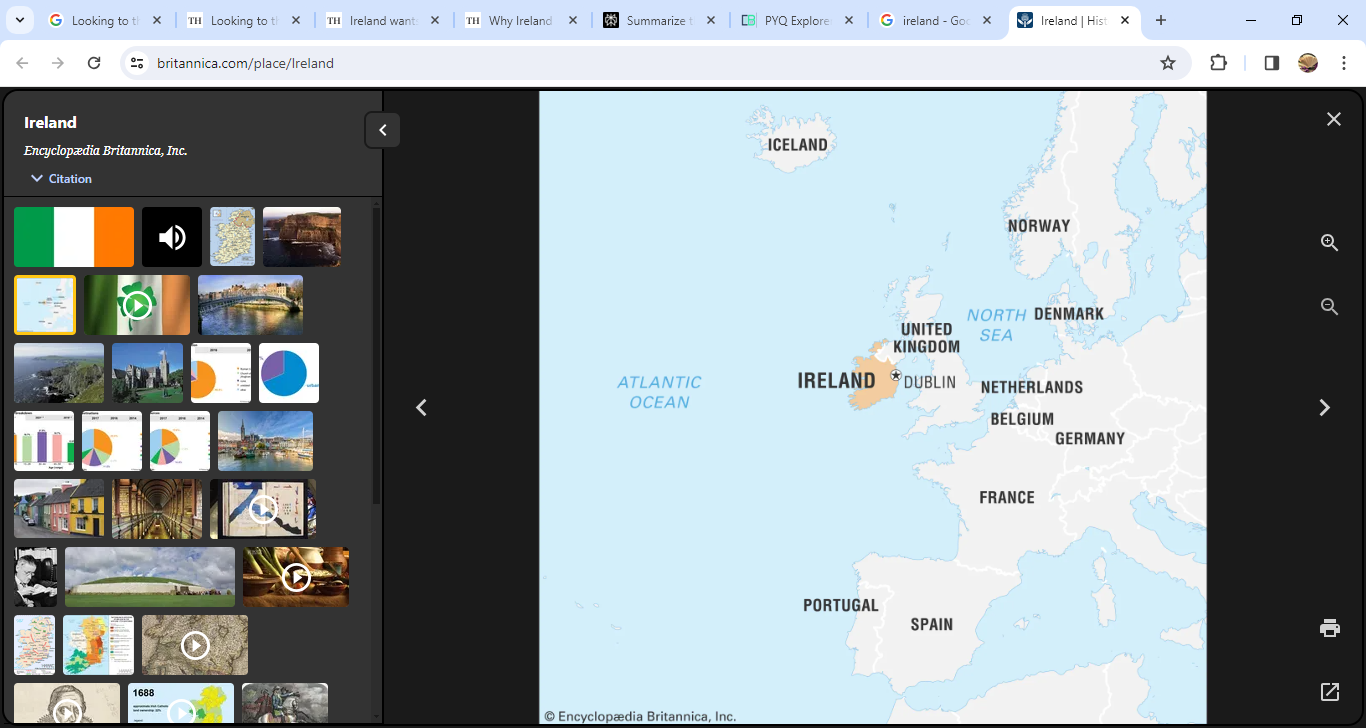
The Irish government wants to further deepen its strong economic and cultural relationship with India as part of its renewed Asia Pacific strategy launched recently on various fields:
Ireland aims to deepen its robust economic and cultural connections with India as part of its renewed Asia Pacific strategy.
Conclusion:
Apart from booming economic benefits, job security, and work-life balance, Ireland offers multiculturalism for overseas students, helping them to merge into the new landscape. International students strive for personal growth, development, and a hospitable environment to sustain.
| What did the Indian Constitution borrow from Ireland? The makers of the Constitution of India were influenced by the Irish Home Rule Movement and other national movements of Ireland. Hence, the Indian Constitution borrowed the idea of Directive Principles of State Policy (DPSP) from Ireland. Part IV of the Indian constitution deals with the DPSP. |
![[15 March 2024] The Hindu Op-ed: Bhutan’s opening move, its Gelephu gambit](https://d18x2uyjeekruj.cloudfront.net/wp-content/uploads/2024/03/WhatsApp-Image-2024-03-17-at-2.41.10-PM-1568x882.jpeg)
| Mains PYQ Relevance: How does illegal transborder migration pose a threat to India’s security? Discuss the strategies to curb this, bringing out the factors which give impetus to such migration. [UPSC 2014] Border management is a complex task due to difficult terrain and hostile relations with some countries. Elucidate the challenges and strategies for effective border management. [UPSC 2016] ‘China is using its economic relations and positive trade surplus as tools to develop potential military power status in Asia’, In the light of this statement, discuss its impact on India as her neighbor. [UPSC 2017] |
Prelims: Bilateral Relations; Neighboring Countries;
Mains: Bilateral Relations; Neighboring Countries;
Mentor comments: Bhutan’s Gelephu project, aims to create a “Gelephu Mindfulness City” as a carbon-neutral economic hub spanning 1,000 square kilometers. This initiative focuses on sustainable industries like IT, education, and healthcare, positioning Gelephu as an investment destination and health and wellness center. This project is aligned with Bhutan’s Gross National Happiness philosophy, aiming to drive regional development and job creation responsibly. The project is crucial for Bhutan’s economic challenges, including the need to boost tourism revenues and address outmigration of youth seeking jobs abroad. Along this infrastructural learning, we need to align India’s involvement with its regional connectivity to emphasize the importance of land-based connectivity throughout Asia and the Indo-Pacific region.
Let’s learn.
—
The recent project by Bhutan government of “Gelephu Mindfulness City” holds geopolitical significance, offering Bhutan a controlled way to engage globally while managing relations with China.
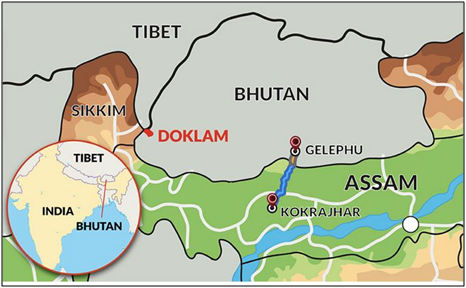
| About the Gelephu Project: The Gelephu Mindfulness City project in Bhutan is a significant initiative envisioned by His Majesty the King Jigme Khesar Namgyel Wangchuck to create a unique economic hub with a focus on sustainable development and cultural preservation. This project involves the establishment of a Special Administrative Region (SAR) covering 1000 square kilometers, emphasizing conscious and sustainable businesses inspired by Bhutan’s spiritual heritage and values. The SAR will have executive autonomy, legal independence, and will prioritize businesses that align with Bhutan’s Gross National Happiness philosophy, aiming to drive regional development and job creation responsibly. India’s involvement aligns with its regional connectivity plans, emphasizing the importance of land-based connectivity across South Asia and the Indo-Pacific region. |
| Prevailing India-Bhutan Relationship: Officially, the diplomatic relations between Bhutan and India were established in January 1968. This Bilateral relationship is majorly guided by the Indo-Bhutan Friendship Treaty. Article 2 of the Treaty declares that India would not interfere in Bhutan’s administrative affairs and the latter would be guided by the former’s advice in its external relations. Economic Cooperation: Since 2014, India’s trade with Bhutan has almost tripled from USD 484 million in 2014-15 to USD 1422 million in 2021-22. This accounts for about 80% of Bhutan’s overall trade, with the balance of trade in India’s favor. India is the leading source of investments in Bhutan, comprising 50% of the country’s total FDI. Interestingly, Bhutanese currency Ngultrum is officially pegged to the Indian Rupee. Infrastructural Cooperation: India has constructed three Hydroelectric Projects (HEPs) in Bhutan: 336 MW Chukha HEP, 60 MW Kurichhu HEP and 1020 MW Tala HEP. These three plants are operational and export surplus power to India. Hydropower projects in Bhutan are an example of win-win cooperation, providing a reliable source of inexpensive and clean electricity to India, generating export revenue for Bhutan and cementing our economic integration. Growth Cooperation: For the 12th Five-Year Plan of Bhutan, India is assisting Rs. 45 billion. |
At the 7th Indian Ocean Conference 2024, External Affairs Minister highlighted the need for lateral land-based connectivity across the Indian Ocean region, which is essential to supplement and complement the maritime flows. The Gelephu project offers a chance for the region to conjure an imagination beyond the problematic present. Although it is a huge gamble for Bhutan, but also a potential game changer for the region, with help from India.
https://www.thehindu.com/opinion/op-ed/bhutans-opening-move-its-gelephu-gambit/article67951801.ece
https://thediplomat.com/2024/01/gelephu-the-worlds-first-mindfulness-city-is-in-bhutan/
[WpProQuiz 1622]
[WpProQuiz_toplist 1622]
UPSC 2024 countdown has begun! Get your personal guidance plan now! (Click here)
What are the provisions proposed through the New framework?
|
AI can play a crucial role in both detecting diseases and predicting floods by leveraging various data sources, advanced algorithms, and computational power-
In the way forward, global consensus on AI principles is vital. Continued efforts in developing regulatory frameworks and assisting developing nations are essential. AI’s role in disease detection and flood prediction underscores its potential for addressing global challenges effectively.
Mains Question for Practise-
Discuss the global efforts towards establishing regulatory frameworks for Artificial Intelligence (AI) and its applications in healthcare and disaster management. Examine the significance of international cooperation in ensuring the safe and beneficial deployment of AI technologies. (250 words)
What is Simultaneous elections?
Article 83 (Duration of Houses of Parliament): Article 83 specifies the tenure of the Lok Sabha, the lower house of Parliament. It states that the Lok Sabha’s duration is five years from the date of its first sitting unless dissolved earlier. The President has the authority to dissolve the Lok Sabha before the completion of its five-year term, leading to general elections. Article 172 (Duration of State Legislatures): Article 172 deals with the duration of the Legislative Assemblies in the states. It mandates that the Legislative Assembly of a state will continue for five years from the date of its first sitting unless dissolved earlier. Similar to the Lok Sabha, the Governor of a state holds the power to dissolve the Legislative Assembly before the completion of its five-year term, leading to fresh elections. |
The proposal for simultaneous elections requires constitutional amendments and careful implementation. Cooperation among states and the Election Commission is essential for its success.
Q- Simultaneous election to the Lok Sabha and the State Assemblies will limit the amount of time and money spent in electioneering but it will reduce the government’s accountability to the people’ Discuss.( UPSC IAS/2017)
![[14 March 2024] The Hindu Op-ed: The Karnataka civil engineers Bill, its pathway](https://d18x2uyjeekruj.cloudfront.net/wp-content/uploads/2024/03/WhatsApp-Image-2024-03-17-at-2.41.11-PM-1568x882.jpeg)
| Mains PYQ Relevance: Major cities of India are becoming vulnerable to flood conditions. Discuss. (2015) Discussion the various social problems which originated out of the speedy process of urbanization in India. (2013) |
Mains: Social Issues; Governance; Urbanization;
Mentor comments: The Karnataka Legislative Assembly passed the Karnataka Professional Civil Engineers Bill, 2024 to allow only registered engineers to approve building plans ensuring that they will be accountable for any eventualities. In light of this, the registration of professional Civil Engineers, standards of professional conduct, code of ethics and etiquette for professional civil engineers are connected. Although it’s State news, we need to look at this news because India, one of the most populated countries, has grappled with many issues related to Urbanization and unplanned cities for decades.
Let’s learn.
—
Recently, the Karnataka Legislative Assembly passed the Karnataka Professional Civil Engineers Bill, 2024 to allow only registered engineers to approve building plans ensuring that they will be accountable for any eventualities.
| Provisions of the Karnataka Professional Civil Engineers Bill, 2024: Aim: To improve professionalization and construction standards by requiring only certified civil engineers to offer engineering designs. However, this approach may create confusion, become restrictive, and remain out of sync with best practices The Bill establishes the following key aspects: Defining a civil engineer: Anyone with a diploma or a degree in a civil engineering discipline in India or abroad can qualify as a civil engineer. Those with Degrees need 1 year of experience; those with Diplomas require 2 years of experience; Must be registered with the Karnataka Council of Professional Civil Engineers within 1 year from the date of commencement of the Act. In addition, they should obtain a certificate to become a ‘professional civil engineer’ in Karnataka. Listing engineering designs and Restricting who can offer engineering design services: Only professional civil engineers can offer engineering designs (civil, structural, geotechnical, and environmental).Instructing how to ensure compliance; Instructing how to ensure compliance: Firstly, the Bill insists that any building more than 50 square meters in plinth area or taller than the ground floor or not built with a load-bearing masonry structure. Secondly, a group housing project with more than three buildings must be supervised or executed or certified only by professional civil engineers. Thirdly, strict gate-keeping is imposed by instructing government authorities not to permit construction unless registered professional civil engineers certify designs and drawings. On Reservation: Out of all tenders not exceeding One Crore rupees, 4% of tenders are reserved for Category 1 Castes and 15% of tenders are reserved for Category 2A castes. |
| Case Study: The Engineering Council in the UK clarifies that there are no restrictions on practicing as an engineer. However, it protects titles offered to the qualified and those who pass professional reviews. Only a limited number of high-risk constructions, such as reservoir design and road tunnel safety regulations, are reserved for licensed persons. In comparison, the Karnataka Bill seeks an absolute protection of services and falls short of licensing requirements. There are no examinations and fewer experience requirements in the Bill. It would serve better to tighten the process leading to certification. |
The question professional must be decided on an event-to-event basis, locally and based on education, experience, and special knowledge. What would be even better is to resist the demand for professional turfs to control supply. An effective solution would be to influence the demand side by continuously demonstrating the usefulness of professionals and certification.
What does the HCES Survey say?
|
The poverty line in India, historically based on the Tendulkar poverty line, needs revision due to its lack of conceptual basis and the absence of an official declaration. Despite reductions in extreme poverty, concerns persist over stagnant wage growth, misleading employment data, and the need for improved poverty measurement methodologies.
About Citizenship Amendment Act 2019:
Citizenship Amendment Rules, 2024:Despite a delay of over four years, the Ministry of Home Affairs has officially issued the Citizenship Amendment Rules, 2024, facilitating the implementation of the Citizenship Amendment Act 2019. The key provisions include:
|
What is the significance of the challenge to Section 6A?
|