💥UPSC 2026, 2027, 2028 UAP Mentorship (March Batch) + Access XFactor Notes & Microthemes PDF

Search results for: “”

  • How Russia-Ukraine conflict will effect inflation in India

    Context

    With the Russia-Ukraine conflict flaring into a war, global commodity prices, especially that of crude oil and gas, are likely to see a strong surge. This poses a challenge not only for India to contain inflationary pressures but also the world at large.

    The problem of rising inflation

    • At 6 per cent, India’s consumer price index (CPI) inflation crossed the upper limit of RBI’s tolerance band in January 2022.
    • Implications: High inflation inflicts a large “inflation tax” on the general public whose bank savings earn an interest of less than 1 per cent.
    • This is robbing the general public in the name of fuelling growth.
    • India is not impervious to this tendency. Most of the major banks in the country offer interest rates between 3 to 4 per cent to depositors.
    • Both the finance ministry and the RBI are betting on revving up growth, at least for the time being.
    • This is fine as long as they can tame inflation within reasonable limits.
    •  If we want to do justice to the masses on whose deposits the entire banking system hinges, one must ensure positive real rates of interest.

    How to ensure lower rates of inflation

    • Given that food has a weight of more than 45 per cent in CPI in India, understanding the dynamics of food inflation is critical.
    • India imports roughly 60 per cent of its consumption of edible oils, and global prices of edible oils have gone up by more than 50 per cent over the last year.
    • Edible oil inflation in India was touching 35 per cent a few months back.
    • This has come down to 18 per cent after the reduction on import duties.
    • The Union Minister of Commerce has also recently claimed that they have brought down the inflation in pulses by imposing stock limits on traders and by lowering import duties and importing more pulses.
    • The Centre has also imposed stocking limits on domestic oil/oilseed traders. 

    Way forward:  Reform the grain-management-cum-food-subsidy system

    • Stock limit on wheat and rice with FCI:  As on January 1, it is saddled with stocks that are almost four times the buffer stock norms.
    • By unloading the excess grain in the open market, FCI could help in bringing down food inflation substantially as rice and wheat have a high weightage in CPI.
    •  In the name of the poor, India runs one of the largest but perhaps the most inefficient and corrupt public distribution system (PDS) in the world.
    • Stop competitive populism: Every political party promises freebies before elections.
    •  Unless the Election Commission comes down heavily on such promises or a public interest litigation is filed in the Supreme Court to stop this competitive populism, Indian policymaking cannot be growth-oriented.
    • Reduce the population coverage under PDS:  India’s food subsidy policy covers 67 per cent of the population and distributes rice and wheat at more than 90 per cent subsidy under the National Food Security Act of 2013.
    • Raise productivity: This should be combined with taking giant strides to raise productivity and producing more nutritious food while protecting the environment.
    • Focus on R&D in agriculture: It’s well-known agri-R&D gives a much higher return in terms of promoting growth with competitiveness, and reduces poverty by making food cheaper and controlling food inflation

    Conclusion

    It is important to reform the grain-management-cum-food-subsidy system to release precious resources for growth of agriculture.

    UPSC 2022 countdown has begun! Get your personal guidance plan now! (Click here)

  • 28th February 2022| Daily Answer Writing Enhancement(AWE)

    Topics for Today’s questions:

    GS-1     Modern Indian history from about the middle of the eighteenth century until the present – significant events, personalities, issues.

    GS-2      Bilateral, regional and global groupings and agreements involving India and/or affecting  India’s interests.

    GS-3    Conservation, environmental pollution and degradation, environmental impact assessment.

    GS-4    Probity in Governance: Concept of public service; Information sharing and transparency in government, Right to Information, Codes of Ethics, Codes of Conduct, Citizen’s Charters, Work culture, Quality of service delivery, Utilization of public funds, challenges of corruption.

    Question 1) 

    Q.1 Trace the evolution of British policy towards the princely states in India. How did the freedom movement impact the people of these princely states? (15 Marks)


    Question 2)

    Q.2 What are the implications of the Ukraine crisis for the West-led global order? Also elaborate on the implications for the Indo-Pacific region.(15 Marks)

    Question 3)

    Q.3 How does plastic waste harm the environment? Suggest the approaches to deal with the problem.

    Question 4)  

    Q.4 What do you understand by social capital? Explain its relationship with good governance. (10 Marks)


    HOW TO ATTEMPT ANSWERS IN DAILY ANSWER WRITING ENHANCEMENT(AWE)?

    1. Daily 4 questions from General studies 1, 2, 3, and 4 will be provided to you.

    2. A Mentor’s Comment will be available for all answers. This can be used as a guidance tool but we encourage you to write original answers.

    3. You can write your answer on an A4 sheet and scan/click pictures of the same.

    4.  Upload the scanned answer in the comment section of the same question.

    5. Along with the scanned answer, please share your Razor payment ID, so that paid members are given priority.

    6. If you upload the answer on the same day like the answer of 11th  February is uploaded on 11th February then your answer will be checked within 72 hours. Also, reviews will be in the order of submission- First come first serve basis

    7. If you are writing answers late, for example, 11th February is uploaded on 13th February , then these answers will be evaluated as per the mentor’s schedule.

    8. We encourage you to write answers on the same day. However, if you are uploading an answer late then tag the mentor like @Staff so that the mentor is notified about your answer.

    *In case your answer is not reviewed, reply to your answer saying *NOT CHECKED*. 

    For the philosophy of AWE and payment: 

  • Natural farming

    Context

    In her budget speech, Finance Minister Nirmala Sitharaman reaffirmed the Centre’s commitment to natural, chemical-free, organic and zero-budget farming.

    No specific allocation in Budget

    • No specific allocations have been made to the Ministry of Agriculture and Farmers Welfare.
    •  In fact, currently-operational schemes such as the Paramparagat Krishi Vikas Yojana and the National Project on Organic Farming did not find any mention in the budget.
    • The Rashtriya Krishi Vikas Yojana, which has received a 4.2-times (year-on-year) larger allocation of Rs 10,433 crore, will earmark some funds for the on-ground implementation of chemical-free farming.

    Suggestions

    • As the ministry plans the fund utilisation under RKVY, here are eight suggestions to scale up chemical-free farming.
    • 1] Focus on rainfed area: focus on promoting natural farming in rainfed areas beyond the Gangetic basin.
    • Home to half of India’s farmers, rainfed regions use only a third of the fertilisers per hectarecompared to the areas where irrigation is prevalent.
    • The shift to chemical-free farming will be easier in these regions. 
    • 2] Crop insurance:  enable automatic enrolment of farmers transitioning to chemical-free farming into the government’s crop insurance scheme, PM Fasal Bima Yojana (PMFBY).
    • 3] Promote microenterprise producing inputs:  promote microenterprises that produce inputs for chemical-free agriculture.
    • An often-cited barrier by farmers in transitioning to chemical-free agriculture is the lack of readily available natural inputs.
    • 4] Leverage NGOs:  leverage NGOs and champion farmers who have been promoting and practising sustainable agriculture across the country.
    • CEEW research estimates that at least five million farmers are already practising some form of sustainable agriculture and hundreds of NGOs are involved in promoting them.
    • 5] Upskill workers: Beyond evolving the curriculum in agricultural universities, upskill the agriculture extension workers on sustainable agriculture practices.
    • 6] Leverage community institution: Sixth, leverage community institutions for awareness generation, inspiration, and social support. In other words, the government should facilitate an ecosystem in which farmers learn from and support each other while making the transition.
    • 7] support monitoring and impact studies: Such assessments would ensure an informed approach to scaling up sustainable agriculture.
    • 8] Millet promotion: Dovetail the ambition on millet promotion with the aim to promote sustainable agriculture.
    • Instead of the two remaining in silos, why not promote chemical-free millets and create awareness about both?

    Conclusion

    India’s food system needs a holistic transformation in demand, production, and supply chains. Let’s hope 2022-23 is the inflection point when we convert intent into action in our journey towards achieving a chemical-free food system.

    UPSC 2022 countdown has begun! Get your personal guidance plan now! (Click here)

  • Plastic waste Management

    Context

    The UN Environment Assembly meeting in February-March 2022 may finalise a way forward for global cooperation on the emissions of plastic waste into the aquatic ecosystems.

    Plastic as a consumption externality

    • Plastics represent an example of a consumption externality, which involves many people, rather than a production externality, which involves one or multiple firms.
    • Why is it challenging to address? Consumption externality is more challenging to address, as it is difficult to differentiate the behaviour of consumers.

    2 Approaches and issues with them

    • Imposing the cost of the harm on all consumers may not yield efficient solutions.
    • As the number of consumers is high, the cost of controlling them is also high.
    • 1] Banning plastic: This approach promotes a sustainable environment, intergenerational equity, saves marine and wildlife ecosystems, and restores soil quality.
    • But it also causes inconvenience for consumers, increases substitution cost, and creates unemployment shocks as it affects the production of plastics, leading to less economic activity, less income generation and finally less employment.
    • 2] Tax on plastic: Other key aspects that may be considered for global cooperation are the options if plastics are banned, the effectiveness of imposing tax and the potential problems with both these approaches.
    • It is difficult to identify the exact tax to be imposed, which may depend on country-specific circumstances.

    Way forward

    1] Command and control approach

    • The environment regulation for plastics may include a ‘command and control’ approach, and fiscal reforms like eco-taxes or subsidies.
    • The efficiency of such a regulation depends on its architecture — how well it is planned, designed and executed. It should be credible, transparent and predictable.

    2] Fiscal reforms like eco-taxes or subsidies

    • Eco-taxes may be imposed in the various stages of production, consumption or disposal of plastics.
    • Pollution due to plastics may happen during the production stage.
    • That is the logic for imposing tax on polluting inputs, as it forces the producer to look for cleaner substitutes.
    • Pollution also occurs during the consumption stage, and thus an eco-tax is recommended to discourage consumption.

    3] Estimating the social cost at the local and global level

    • Social cost should be evaluated differently in the local/regional and global contexts.
    • While health and hygiene are predominant considerations in the former case, climate change is the predominant consideration in the latter.
    • Ideally, eco-tax rates on plastics ought to be equal to the marginal social cost arising from the negative externality associated with production, consumption or disposal of goods and services.

    Comprehensive policy measures

    • Comprehensive policy measures against plastics may generally involve three complementary activities:
    • 1] The removal of existing taxes and subsidies that have a negative environmental impact.
    • 2] Taking into account the different types or grades of plastics.
    • 3] Restructuring existing taxes in an environmentally friendly manner.
    • Other suggestions include: Promoting multiple use of plastics through better waste management,
    • Educating the public on the harmful use of plastics,
    • Providing subsidy for research and development activity for substitute development.
    • Appropriate disposal mechanisms and waste management and use of waste for constructive usage like roads.

    Conclusion

    The key aspects that may be considered for global cooperation are the options if plastics are banned, the effectiveness of imposing tax and the potential problems with both these approaches.

    UPSC 2022 countdown has begun! Get your personal guidance plan now! (Click here)

  • Need for integrated approach to power sector

    Context

    Electricity and development sectors need a more integrated approach to achieve the vision set forth in instruments such as the Union Budget that guide policy implementation at other administrative levels.

    Reduction in allocation

    • While the health sector witnessed a 16% increase in estimated Budget allocations from last year, medical and public health spending was reduced by 45% for 2022-23.
    • Budget estimates demonstrate intent, but the proof of the pudding lies in the actual expenditure which reiterates the need for greater attention to be paid to our health and education sectors.
    •  While the health sector was allocated ₹74,602 crore in 2021-22, the Government exceeded its spending by over ₹5,000 crore more (₹80,026 crore) on health, signalling a spike in demand, likely propelled by the ongoing COVID-19 pandemic.
    • Given this scenario, a less than ₹1,000 crore increase in the Budget Estimate (₹86,606 crore) in 2022-23 when compared with last year’s Revised Estimates (₹85,915 crore) appears incongruent with the Government’s aim of providing quality public health care at scale.

    Role of reliable energy

    • It is widely recognised that the availability of reliable electricity supply can improve the delivery of health and education services.
    •  74% of the targets of the Sustainable Development Goals are interlinked with universal access to reliable energy.
    •  Its reliability in terms of the number of hours that electricity is available steadily without any voltage fluctuations also plays a significant role in delivering services.
    •  Sometimes, multiple policies can complement each other to achieve the larger sectoral objectives.
    • For example, in Assam, the Energy Vision document that lays out the electricity and development outcomes is to be applied in tandem with the Solar Energy Policy 2017 that operationalises this vision via an action plan.

    Reasons for lack of integration of electrification in the development sector

    • The lack of integration of electrification requirements in development sector policy documents may be partly due to lack of information about electricity and development linkages, poor coordination mechanisms between the sectors and departments, and poor access to appropriate finance.
    • Even while electricity is considered, it is to the limited extent of being a one-time civil infrastructure activity rather than a continuous feature necessary for the day-to-day operations of these services.

    Way forward

    •  To successfully integrate electricity provisioning and maintenance, policy frameworks should include innovative coordination and financing mechanisms.
    • These mechanisms, while developing clear compliance mandates, must also allow sufficient room for flexibility to respond to local contexts.
    • Providing reliable electricity for health centres and schools should be the responsibility of centralised decision-making entities at the State or national level.
    • As India has witnessed with other cross-sectoral and centralised statistical, planning, and implementation data governance, diverse contexts must support oversight mechanisms that ensure data credibility.
    • Finance is largely unavailable to ensure reliable electricity supply to schools and health facilities.
    • Some directives, such as those governing the use of untied funds, need to be more flexible in allowing these facilities to prioritise providing reliable and sustainable electricity.

    Conclusion

    A successful policy outcome might be dependent on several invisible aspects that do not get the attention and funding necessary to aid in successful policy delivery. Electricity is one of them.

    UPSC 2022 countdown has begun! Get your personal guidance plan now! (Click here)

  • The anatomy of India’s Ukraine dilemma

    Context

    Late last week, India abstained from a United Nations Security Council (UNSC) resolution which called for condemning the Russian military action against Ukraine.

    Understanding India’s position on the Ukraine issue

    •  New Delhi has taken a subtle pro-Moscow position on the question of Russian attacks against Ukraine.
    • A geopolitical necessity: India’s Russia tilt should be seen not just as a product of its time-tested friendship with Moscow but also as a geopolitical necessity.
    • There are understandable reasons for India’s (subtle) pro-Russia position: an aggressive Russia is a problem for the U.S. and the West, not for India.
    •  North Atlantic Treaty Organization (NATO) expansion is Russia’s problem, not India’s.
    • China problem: India’s problem is China, and it needs both the U.S./the West and Russia to deal with the “China problem”.
    • Neighbouring China as the rising superpower and Russia as its strategic ally challenging the U.S.-led global order at a time when China has time and again acted on its aggressive intentions vis-à-vis India, and when India is closest to the U.S. than ever before in its history, throws up a unique and unprecedented challenge for India.
    • There is an emerging dualism in contemporary Indian strategic Weltanschauung: the predicament of a continental space that is reeling under immense pressure from China, Pakistan and Taliban-led Afghanistan adding to its strategic claustrophobia; and, the emergence of a maritime sphere which presents an opportunity to break out of the same.

    Why India needs to balance relations with Russia and the US

    • Relations with Russia to manage continental challenges: New Delhi needs Moscow’s assistance to manage its continental difficulties be it through defence supplies, helping it ‘return’ to central Asia, working together at the Shanghai Cooperation Organization (SCO) or exploring opportunities for collaboration in Afghanistan.
    • Relations with US to manage maritime challenges: When it comes to the vast maritime sphere, the Indo-Pacific to be precise, Russia is not of great consequence to India.
    • That is where its American and western partners come into play. India is simply not in a position to address the China challenge in the maritime space without the active support of American and western navies and, of course, the Quad.
    • This unavoidable dualism in the contemporary Indian strategic landscape necessitates that India balances the two sides.

    Implications of war on Ukraine for India

    • 1] It will embolden China: Russian action in Ukraine dismissing the concerns of the rest of the international community including the U.S. will no doubt embolden China and its territorial ambitions.
    • 2] Sanctions on Russia will impact India’s defence cooperation: The new sanctions regime may have implications for India’s defence cooperation with Moscow.
    • 3] Russia-China axis: The longer the standoff lasts, the closer China and Russia could become, which certainly does not help India.
    • 4] Focus will move away from Indo-Pacific: The more severe the U.S.-Russia rivalry becomes, the less focus there would be on the Indo-Pacific and China, which is where India’s interests lie.

    Foreign policy challenge for India

    • Position of geopolitical vulnerability: India’s responses to the Russian aggression on Ukraine underline the fact that India is operating from a position of geopolitical vulnerability.
    • Going forward, India’s ability to be a “swing state”, “major power” or a “leading power” stands diminished.
    • There will be more middle-of-the-road behaviour from New Delhi rather than resolute positions on global strategic developments.
    • Interests over principles: India’s position also shows the unmistakable indication that when it comes to geopolitics, New Delhi will choose interests over principles.
    • A careful reading of India’s statements and positions taken over the past few days also demonstrates a certain amount of discomfort in having to choose interests over principles.
    • There is perhaps a realisation in New Delhi that a dog-eat-dog world, where rules and good behaviour do not matter, does not help India in the long run either.
    • Mastering the art of balancing extremes: Going forward, if tensions between Russia and the West persist, balancing extremes will be a key feature of Indian diplomacy.
    • Even though New Delhi abstained from voting on it (thereby siding with Moscow), it made its unhappiness about the Russian action clear in the written note.
    • Sticking to the principle of strategic autonomy: New Delhi’s response to the recent crisis, especially its “explanation of vote” at the UNSC indicates a careful recourse to the principle of strategic autonomy: India will make caveated statements and will not be pressured by either party.

    Conclusion

    India’s indirect support to the Russian position is not a product of Russian pressure but the result of a desire to safeguard its own interests.

    UPSC 2022 countdown has begun! Get your personal guidance plan now! (Click here)
  • Starting Today – UPSC 2023 Foundation Course & Ultimate Assessment Program For Prelims  & Mains || For Beginners & Working Junta|| Prelims-Mains Integrated Test Series, Foundational Classes, Essay Writing Program and Current Affairs|| In Both Online/Offline Modes – Fill the Form To Register Now

    Starting Today – UPSC 2023 Foundation Course & Ultimate Assessment Program For Prelims & Mains || For Beginners & Working Junta|| Prelims-Mains Integrated Test Series, Foundational Classes, Essay Writing Program and Current Affairs|| In Both Online/Offline Modes – Fill the Form To Register Now

    Everything that is important. Nothing that is not.


    In 2020-21, we connected with over 9,000+ IAS aspirants via our
    Samanvaya (1 on 1 mentoring) outreach program

    With an average call time of ~40 minutes, we spent ~3.84 lakh minutes (~6,500 hours) in understanding you and your preparation strategies.

    Here’s what we learnt about you

    You have doubts. Lots of them. Almost on a daily basis. 70% of them are academic, 20% are strategy related and 10% about life and thereabouts.

    1. You want a time table which adapts according to your learning curve.

    2. You think news & static concepts should be tied together for better retention.

    3. You are perfectly fine with self study modules but need motivation boosters to keep you up on the right track.

    4. You want your preparation to be non-judgemental.

    5. You want a community of like minded, sincere aspirants so that you can feed off each other’s energy.

    6. You love active learning.

    7. You love active doubt resolutions.

    6. You are patient with your progress as long as its assuring.

    UAP 2023 is built with keeping all these things in mind.
    Nothing more. Nothing less.


    Quick reference links: 

    Click here UAP 2023 Master Time Table

    Download Brochure: UAP 2023 from CivilsDaily

    Want to talk to us first? Click here to fill this Samanvaya form


    This image has an empty alt attribute; its file name is hall-of-fame.jpg

    UAP & MasterClass are a combo for comprehensive growth. The same teachers who create and deliver lectures are involved in creating and evaluating your test attempts


    DDS sessions = Marathons for Active Learning.
    200+ doubts resolved & 40+ new mini concepts discussed. Every Day. Day after Day.


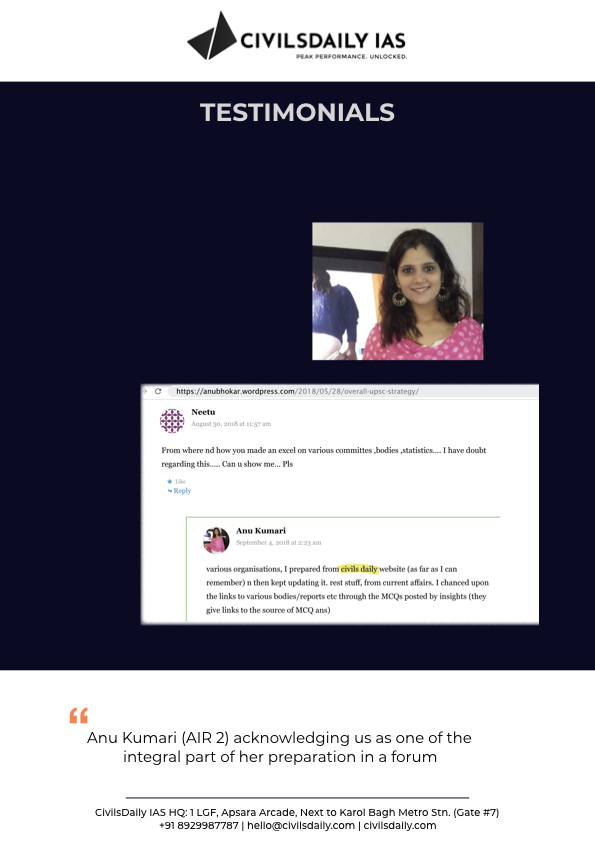
    Trusted by Rank 1 & 2:

    MODE OF PAYMENT

    PAY VIA CARD/UPI

    65000+GST = 76,700/-

    ASK FOR A PAYMENT LINK FROM OUR TEAM/ PING US ON WHATSAPP

    DIRECT BANK DEPOSIT

    A/C NAME: APEIROGON TECHNOLOGIES PVT. LTD

    A/C NO: 50200016012695

    IFSC CODE: HDFC0000922

    GSTIN: 07AAOCA0521B1ZA

    WALK-IN & PAY

    VISIT OUR OFFICE AN SWIPE CARD/ DEPOSIT CASH & GET A RECEIPT

    GET IN TOUCH

    LOCATION: 1 LGF, Apsara Arcade, Next to Karol Bagh Metro Stn. (Gate #7), Delhi 110060

    CONTACT: hello@civilsdaily.com OR +91 8929987787


  • Free Live Webinar Today @ 7PM, Registrations Closing Soon|| Free Live Webinar on 100 Days Action Plan for Prelims-2022|| By Civilsdaily Mentor Santosh Sir Who Cleared Prelims 6/6 Times with Above 145 Marks|| Don’t Let Prelims Take You By Surprise|| Limited Slots Available, Register Now

    Free Live Webinar Today @ 7PM, Registrations Closing Soon|| Free Live Webinar on 100 Days Action Plan for Prelims-2022|| By Civilsdaily Mentor Santosh Sir Who Cleared Prelims 6/6 Times with Above 145 Marks|| Don’t Let Prelims Take You By Surprise|| Limited Slots Available, Register Now

    For the past 1 year, you might be learning in a way where you know there are gaps but you are unable to bridge them. It is possible that you have revised the syllabus 5-10 times, it is also possible that you have solved 1000s of MCQs and it is quite possible that you have given 2-3 attempts. Yet you are scoring in the 90s and failed to qualify for Prelims by a whisker.

    It’s now all about fast tracking your learning and making the best use of these 100 days to change your prelims result altogether.

    Did you know that a score of 85 can be increased to 110 with just 10 correct questions? Only 10 correct questions can help you get 26.66 marks!

    Now that you are convinced that it’s not all that hard to score above 120+ in Prelims, Santosh sir will tell you how can you see this improvement in the next 100 days.

    What will you Learn in this Free Live Webinar by Santosh Sir

    1. What is the 5-point strategy to keep in mind for Prelims 2022? It’s never to late to implement them even if you have missed these for long.

    2. What are the Prelims Specific Focus topics for 2022? Know the static + current affairs topics under each subject with maximum weightage.

    3. What is the 3-step process for 5 revisions till prelims? In case you have only done few revisions till now, know how to squeeze two more revisons for all subjects.

    4. How to maintain consistency for the next 100 days? Have 4 study slots in a day.

    5. Surprise questions from current affairs. Based on Previous Year Papers, what were the surprise questions in the preceding years and what can be expected this year?

    6. Last minute notes for last minute revision. How to make quick-shorthand notes which you can revise a day before exam?

    7. What are the difficult topics in every subject which can negatively affect your Prelims score? Know the sources to refer to improve your conceptual clarity.

    The last 15 minutes of the session will be in Q&A format and all participants are welcome to clear their doubts with Santosh Sir.

    Webinar Details

    Prelims might only be the first stage of UPSC, but it’s undoubtedly the toughest one. Sometimes, staying focused and knowing in-and-out of the exam is the only way to remain optimistic and confident.

    Date: 28 February, 2022

    Time: 7 PM

More posts
